

Most conversations about epoxy resin focus on the resin itself. What actually decides whether a project succeeds is the hardener.
Many buyers evaluating an epoxy resin manufacturer spend most of their effort comparing resin viscosity, mix ratios, and pricing, then treat the hardener as an afterthought — a costly assumption. The hardener governs cure speed, heat output, clarity, and long-term color stability. Get the resin right and the hardener wrong, and the same problems keep showing up: cracked deep pours, cloudy tabletops, coatings that yellow before their first year is out. This article walks through the three hardener categories that matter most to B2B buyers — slow cure, fast cure, and low yellowing — and where each one actually belongs.
Hardener Chemistry Decides the Outcome
Nearly all epoxy hardeners are amine-based — aliphatic amines, cycloaliphatic amines, or amine adducts. The amine reacts with the epoxide groups in the resin to build a cross-linked polymer network. The backbone structure of that amine determines three things: how fast the reaction proceeds, how much heat it releases at peak (exotherm), and how the cured polymer behaves under UV exposure over time.
This is exactly where hardener selection tends to go wrong, and where working with an experienced epoxy resin manufacturer actually earns its keep — because the wrong amine chemistry rarely shows up right away. A deep pour can look fine at 24 hours and still develop stress cracks by 72 hours, because the hardener released heat too fast, too early. A tabletop can look glass-clear on day one and turn amber within six months, because the hardener was never engineered for UV resistance. Buyers sourcing for resale or private label need tested performance data upfront — not a customer complaint after the fact.
Slow Cure Hardeners: Built for Mass and Depth
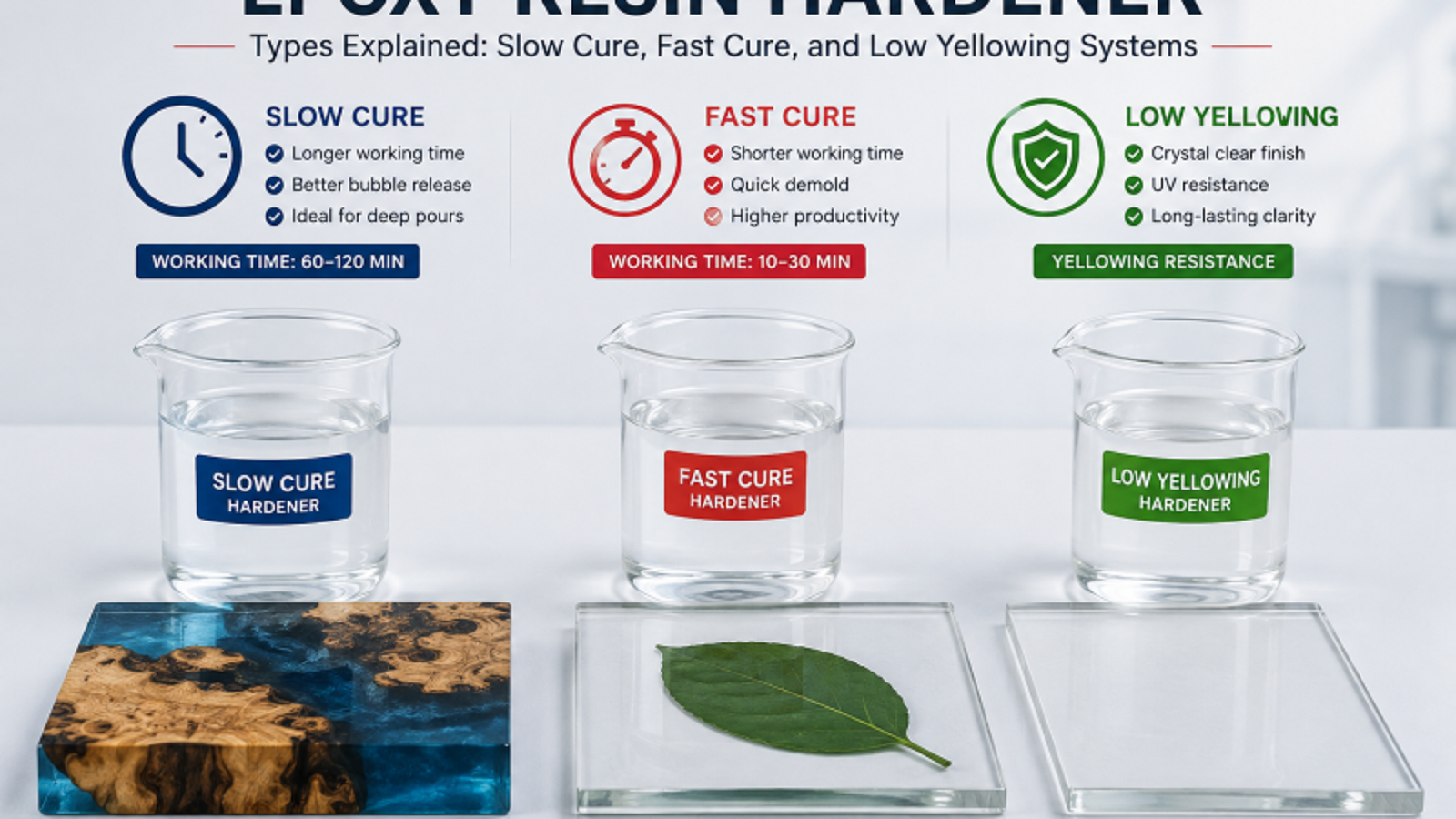
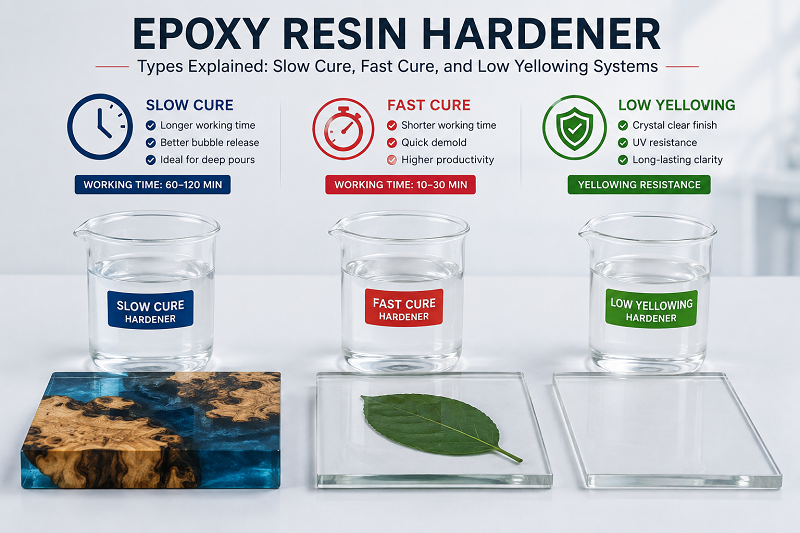
Slow cure hardeners extend working time and hold down peak exotherm, which is why they’re the standard choice for deep pour epoxy — river tables, thick castings, and any single-layer pour beyond roughly 1 inch (2.5 cm).
The logic is simple: slow cure hardeners rely on bulkier amine molecules or modified amine adducts that react more gradually with the epoxide. That keeps peak exotherm temperatures lower through a thick pour, which matters because runaway heat is the leading cause of cracking, yellowing, and bubbling in deep castings.
Typical figures for slow cure systems:
- Pot time: 45–90 minutes at room temperature, varying with batch volume
- Working time: Extended to 2–4 hours in some formulations, allowing large pours without premature gelling
- Full cure: 3–7 days, sometimes longer past 2 inches of depth
- Peak exotherm: Held low enough to avoid thermal cracking in single pours up to 2 inches
Buyers producing river tables, thick art castings, or large custom furniture should ask suppliers for the tested maximum pour depth per layer — this figure varies meaningfully between manufacturers and directly determines how many pour stages a project needs. A dependable epoxy resin manufacturer provides exotherm curves and maximum single-pour thickness data, not a generic “good for deep pour” claim.
Fast Cure Hardeners: Built for Turnaround
Fast cure hardeners sit at the other end of the spectrum. They use more reactive amine structures — typically lower-molecular-weight aliphatic amines — that speed up cross-linking. The trade-off is a shorter working window and higher exotherm per unit volume, which keeps fast cure systems limited to thin applications: coatings, small repairs, jewelry, and tabletop finishes under about 1/8 inch (3 mm).
Typical figures for fast cure systems:
- Pot time: 5–20 minutes
- Tack-free time: 2–4 hours
- Full cure: 24–48 hours, well ahead of the multi-day cycle for slow cure systems
- Thickness limit: Thin layers only — a thick pour run with fast cure hardener will overheat, cloud, or crack
Fast cure hardeners carry a direct commercial value wherever turnaround drives cost. Flooring contractors, repair shops, and small-batch coating operations all lean on fast cure for the same reason: faster demold and recoat times mean more jobs completed per week. For buyers evaluating OEM production schedules, cure speed is a real line item — a supplier that offers both fast and slow cure options can flex output around order volume instead of being locked into a single cure profile.
Low Yellowing Hardeners: Built for Clarity and Weather Resistance
This is the category that actually separates a solid epoxy resin manufacturer from one worth a long-term contract. Standard aromatic amine hardeners are inexpensive and cure predictably, but they yellow under UV exposure — sometimes within a matter of months. For tabletop epoxy, art resin, and anything sold on the strength of its clarity, that’s disqualifying.
Low yellowing hardeners get around this by using aliphatic or cycloaliphatic amines in place of aromatic ones. Aliphatic amine structures don’t contain the benzene ring that drives UV-triggered discoloration in aromatic systems, so the cured polymer holds its clarity considerably longer. Many formulations also add HALS (hindered amine light stabilizers) or UV absorbers into the hardener or resin package to push that resistance further out.
What buyers should specifically ask for:
- Yellowing index data (ASTM D1925 or a comparable standard) tied to a defined number of UV exposure hours — an unverified “won’t yellow” claim isn’t worth much on its own
- Aliphatic-to-aromatic amine ratio — a single spec that predicts long-term clarity far better than marketing language
- UV stabilizer package — whether HALS or UV absorbers are included, and at what concentration
Table top epoxy and UV resin product lines depend almost entirely on this hardener category. A tabletop that yellows ruins the customer’s finished piece and the seller’s reputation at the same time — which is why buyers sourcing for resale should treat yellowing-resistance documentation as a mandatory part of supplier qualification, not an optional extra.
Comparing the Three Systems
| Property | Slow Cure | Fast Cure | Low Yellowing |
|---|---|---|---|
| Pot time | 45–90 min | 5–20 min | Varies by base amine (often mid-range) |
| Full cure | 3–7 days | 24–48 hrs | 24 hrs–7 days |
| Best use | Deep pour, river tables | Coatings, repairs | Tabletop, art resin, outdoor |
| Exotherm | Low, controlled | Higher per volume | Depends on amine type |
| UV stability | Moderate | Moderate | High |
Worth noting: these three categories aren’t strictly separate in practice. Many production-grade hardeners are formulated to combine properties — a moderate-cure aliphatic amine hardener, for example, can deliver both workable pot time and strong yellowing resistance for tabletop use. This is exactly where OEM and private label buyers benefit from a direct formulation conversation instead of picking off a standard catalog.
Matching Hardener to Application
For buyers building out a product line, the decision usually comes down to three questions:
- How deep is the pour? Anything over an inch needs slow cure chemistry to manage exotherm. Thin coatings and repairs can run fast cure without cracking risk.
- Will the finished product see UV exposure? Indoor furniture that only catches occasional window light still benefits from low yellowing hardener. Outdoor coatings and countertops should treat it as a baseline requirement, not an upgrade.
- What’s the production turnaround target? Fast cure hardeners shorten the demold-to-ship window, which matters most for contract manufacturing under tight delivery deadlines.
An experienced epoxy resin manufacturer should be able to answer all three questions with test data rather than general reassurance, and should be able to adjust hardener ratios for climate — humidity and ambient temperature both shift working time and cure quality, sometimes significantly.
Working with a Manufacturer on Custom Hardener Formulations
Buyers running private label or OEM programs actually hold an advantage here: hardener systems can be tuned to the target market’s climate and application rather than sold as one formula for every customer. A supplier producing both deep pour epoxy and table top epoxy lines needs separate hardener formulations for each — slow cure with strong impact resistance for one, low yellowing with fast-enough turnaround for the other.
Jinhua Resin formulates hardener systems across all three categories in-house, which lets OEM and private label partners request adjusted pot times, exotherm profiles, or UV stability targets without switching suppliers between product lines. For buyers evaluating a long-term epoxy resin manufacturer relationship, that formulation flexibility — backed by real test data rather than marketing claims — is usually what settles the decision.
The Bottom Line
Slow cure, fast cure, and low yellowing hardeners aren’t interchangeable, and choosing by price alone tends to surface as a quality problem months down the line. Match the hardener to pour depth, UV exposure, and turnaround needs first — then evaluate suppliers on the data they’re willing to share, not the claims they’re willing to make.