


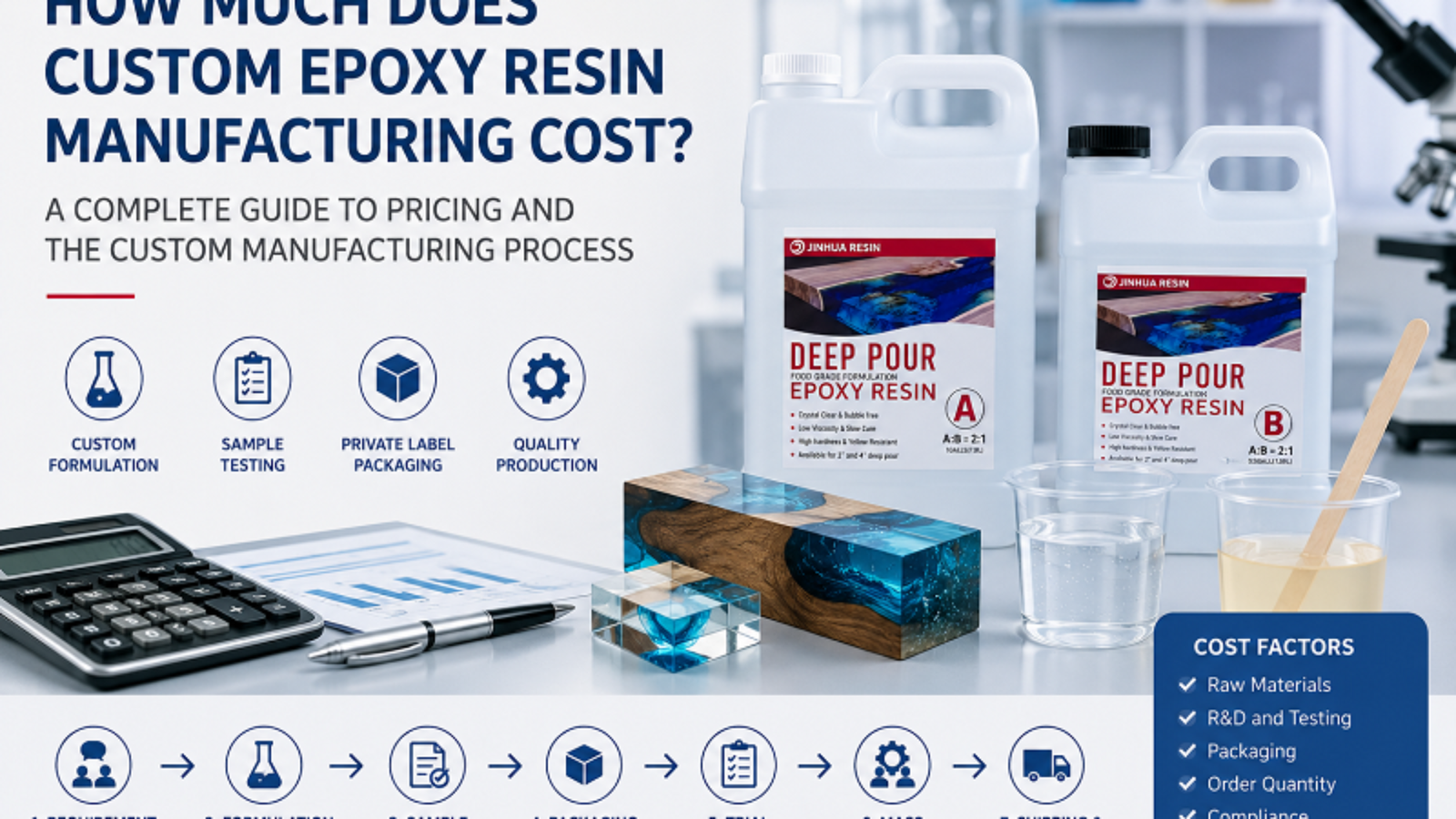
Buyers usually open with the same question when they contact an epoxy resin factory: how much will this cost?
There’s rarely a clean answer.
Two containers of resin can look identical on a shelf and come from completely different cost structures. One might be an existing clear epoxy formula with a new label slapped on. The other might need a lower-viscosity resin, a longer working window, better UV resistance, a different mix ratio, custom bottles, printed boxes, compliance testing, and three or four rounds of sampling before anyone signs off.
Both get called “custom epoxy resin.” They’re not the same project, and they shouldn’t carry the same price expectation.
A manufacturer worth working with will ask about the product, the application, the target market, the packaging, the order size, and the performance targets before quoting anything meaningful. This article walks through where the cost actually comes from — from first inquiry through full production.
1. Start by Defining What “Custom” Means
Customization covers a wide range in this industry.
On the simple end, a buyer takes an existing factory formula and puts it into their own branded packaging. That’s usually the fastest, cheapest path.
On the far end, a buyer shows up with a performance spec and asks the manufacturer to build a formula around it from scratch.
Most projects land somewhere in between — an existing formula with private labeling, a different bottle size, a modified mix ratio, adjusted viscosity, faster or slower curing, better bubble release, less yellowing over time, a different hardness or flex profile, custom colors, retail kits, printed cartons, or market-specific paperwork.
Before comparing quotes from different suppliers, make sure they’re quoting the same scope. A low number for “an existing formula, repackaged” isn’t comparable to a number that includes new formulation work, testing rounds, custom tooling, and compliance support.
2. What Actually Drives the Cost
There’s no fixed price list for custom epoxy resin production. Several layers stack on top of each other.
Formula and raw materials
Raw materials typically make up a large share of the product cost, and a general-purpose clear epoxy doesn’t pull from the same material list as a specialized deep-pour formula.
Performance requests shift the formulation. Better UV stability, lower viscosity, higher clarity, a longer working time, faster demolding, more heat resistance, better chemical resistance, more flexibility — each one nudges the raw material selection and the development cost.
Chasing several targets at once gets harder, not easier. A faster cure and a longer working time pull in opposite directions. The lab has to balance the formula around how the product will actually be used, not just pile on additives until a spec sheet looks good.
Development and testing
If an existing formula already covers what the buyer needs, development stays light.
A genuinely new formula is a different project. The lab may run through several versions, test each one, gather feedback, and adjust again — sometimes more than once.
Testing typically covers viscosity, gel time, working time, cure speed, hardness, transparency, bubble release, exothermic behavior, surface finish, yellowing resistance, adhesion, and chemical resistance.
A sample that doesn’t pass isn’t a failure — it usually tells the lab exactly what to change next. That back-and-forth is where a lot of the real cost sits.
Packaging
This one gets underestimated constantly.
Filling resin into a standard factory pail and building a retail-ready branded kit are two very different cost categories. Packaging can include bottles, pails, drums, caps, pumps, measuring cups, labels, printed cartons, inserts, instructions, protective wrapping, and export cartons.
A custom bottle shape or a specially printed box often comes with its own tooling cost or minimum order from the packaging supplier — which matters a lot more on a small run than a large one.
Order volume
Bigger runs spread setup, filling, labeling, packaging, and procurement costs across more units. Smaller custom orders carry a heavier per-unit cost because the factory still has to prep the line, source materials, run inspections, and clean equipment for a much smaller batch.
Don’t just chase the lowest MOQ — think about the quantity that actually makes sense for both production efficiency and testing the market.
Compliance and documentation
Different destination markets ask for different paperwork — TDS, SDS/MSDS, COA, and depending on the market, REACH, RoHS, Prop 65, or other testing.
Some of this can be pulled from existing product data. Some needs outside lab testing, which adds cost and time. Bring up compliance requirements early — ideally before packaging is locked in, not after.
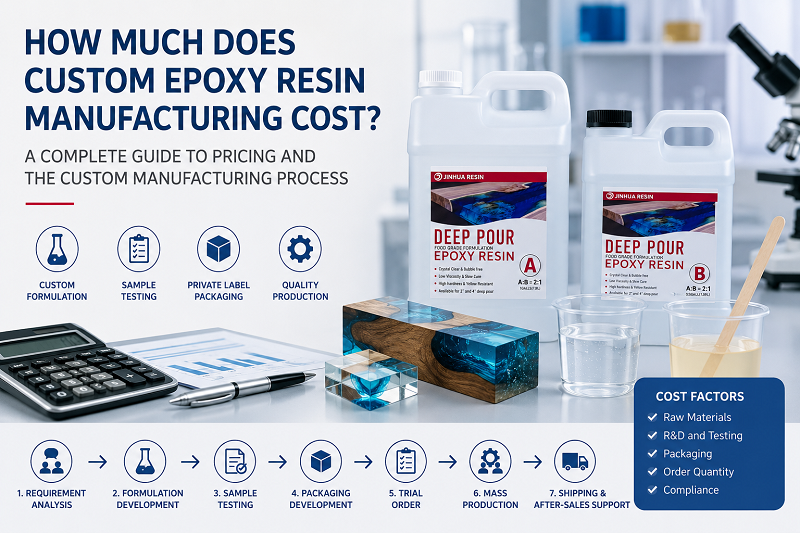
3. Step One: Requirement Analysis
A real custom project starts with questions, not a quote.
The manufacturer needs to understand what the resin is actually supposed to do: the application, the target customer, the target country, desired viscosity, working time, cure time, mix ratio, transparency, pour depth, hardness, UV exposure, packaging size, and expected order volume.
Take a river table brand as an example. “Clear epoxy resin” alone tells the manufacturer almost nothing. They need the casting depth, the workshop temperature, typical project size, and how much working time and cure behavior the customer expects.
A floor coating distributor cares about a completely different set of things — adhesion, abrasion resistance, chemical exposure, recoat timing, jobsite conditions. Getting this right upfront cuts down on wasted sampling rounds later.
4. Step Two: Existing Formula or New Formula
Not every project needs to start from zero.
Existing formula + private label. The buyer picks an established product and customizes the branding and packaging. Fastest and cheapest.
Modified existing formula. An existing system becomes the starting point, with one or two characteristics adjusted — lower viscosity, different cure speed, modified hardness, better UV resistance. This shortens development time while still producing something tailored to the buyer’s market.
Fully custom formula. Built from specific performance requirements. This makes sense when the buyer has a genuinely differentiated product idea, or when nothing on the shelf meets the application. It takes more time, more testing, and more sample rounds.
5. Step Three: Lab Formulation and Sample Development
Once the spec is locked, formulation starts. The technical team picks raw materials and adjusts the resin-hardener system toward the target performance.
The first lab sample almost never becomes the final product without changes.
For a deep-pour system, the team is watching viscosity, bubble release, peak exothermic temperature, working time, cure time, post-cure clarity, and how it performs at real casting depth. For a table top system, self-leveling, surface hardness, gloss, and bubble release matter more. For a floor coating, adhesion and mechanical or chemical resistance take priority.
The sample needs to be judged against the real application — not how it looks sitting in a bottle.
6. Step Four: Customer Sample Testing
Factory testing only covers half the picture. The buyer needs to test the sample under conditions that resemble how it’ll actually be used.
This matters even more for overseas buyers, since climate, working methods, substrates, pigments, molds, and application habits often differ from the manufacturer’s own lab.
Buyers commonly come back wanting longer working time, a thinner viscosity, better bubble release, faster cure, or a harder surface finish.
Vague feedback doesn’t help anyone. “The sample isn’t good” tells the lab nothing. “Viscosity is fine, but we need about 20 more minutes of working time at our normal shop temperature” gives the team something they can act on. Good custom development runs on specifics like that.
7. Step Five: Formula Adjustment and Final Sign-Off
After feedback comes in, the manufacturer adjusts the formula and, if needed, prepares another sample. Some products get approved after one round. Others take three or four — that’s normal for a genuinely custom product.
What matters is locking a clear final spec before mass production starts: mix ratio, viscosity range, working time, cure conditions, appearance, hardness, and packaging configuration. That approved version becomes the reference point for every production run and quality check that follows.
8. Step Six: Packaging and Private Label Development
Packaging work can move forward while the formula gets finalized. The buyer decides between small bottles, A+B kits, pails, drums, or bulk industrial packaging, and — for retail products — works out brand labels, product naming, mixing instructions, safety info, carton artwork, barcodes, and batch coding.
One common mistake: locking in nice-looking packaging before the technical spec is confirmed. If the mix ratio, working time, or application instructions change later, printed packaging may need a reprint or a full scrap. Formula confirmation and packaging development need to move together, not packaging racing ahead.
9. Step Seven: Trial Order Before Full Production
Jumping straight from a lab sample to a large commercial order is a risk that’s easy to avoid. A trial order bridges the gap — it lets both sides check production consistency, filling accuracy, label placement, packaging durability, shipping performance, and how customers actually respond.
For a new private label brand, a trial run can also reveal whether the package size and positioning actually work in the market. Fixing problems here is far cheaper than fixing them after thousands of finished units are already boxed.
10. Step Eight: Mass Production and Quality Control
Once the formula, packaging, and trial run are all approved, the project moves into regular production. This is where manufacturing discipline shows up.
A typical control flow: raw material inspection → batch prep → mixing → in-process checks → filling → packaging → final inspection.
The goal is simple — the product shipped six months from now should behave exactly like the sample the customer approved. For long-term OEM buyers, consistent batches matter more than one perfect-looking sample. A manufacturer worth keeping should maintain production records and defined quality criteria for repeat orders.
11. Step Nine: Shipping and Ongoing Support
Manufacturing isn’t over when the cartons leave the dock. Long-term customers eventually need updated technical documents, new packaging sizes, formula tweaks, additional product variants, troubleshooting help, or production planning for bigger volumes.
Markets shift too. A brand might start with a standard clear casting resin and later add deep pour epoxy, table top epoxy, UV resin, or floor coating. Working with a manufacturer that can grow with those additions saves you from rebuilding your supply chain every time you launch something new.
So What Does It Actually Cost?
The honest answer: it depends entirely on how much customization is involved.
A private label project built on an established formula stays relatively simple. A project that needs a new formula, specialized materials, repeated sampling, custom packaging, outside compliance testing, and a low initial volume will cost more — and should.
Instead of asking only “what’s your price per kilogram,” ask “what’s included in that price.” A useful quote spells out the formula, the spec, the packaging, the quantity, the testing, the documentation, and the lead time. The cheapest quote on paper can turn expensive fast if it leads to reformulation, repackaging, returns, or a redo.
Total project cost matters more than the number on the first quote.
Final Thoughts
Custom epoxy resin manufacturing isn’t one production step — it’s a chain of decisions. The final cost gets shaped long before mass production starts, during spec development, formula selection, sampling, testing, packaging, and compliance planning.
Buyers who nail down these requirements early tend to move faster and hit fewer surprises down the line.
The better question to ask a potential manufacturing partner isn’t “how cheap can you make this.” It’s “how will you take this from an idea to repeatable mass production.” The answer tells you more about the manufacturer than any price list ever will.