


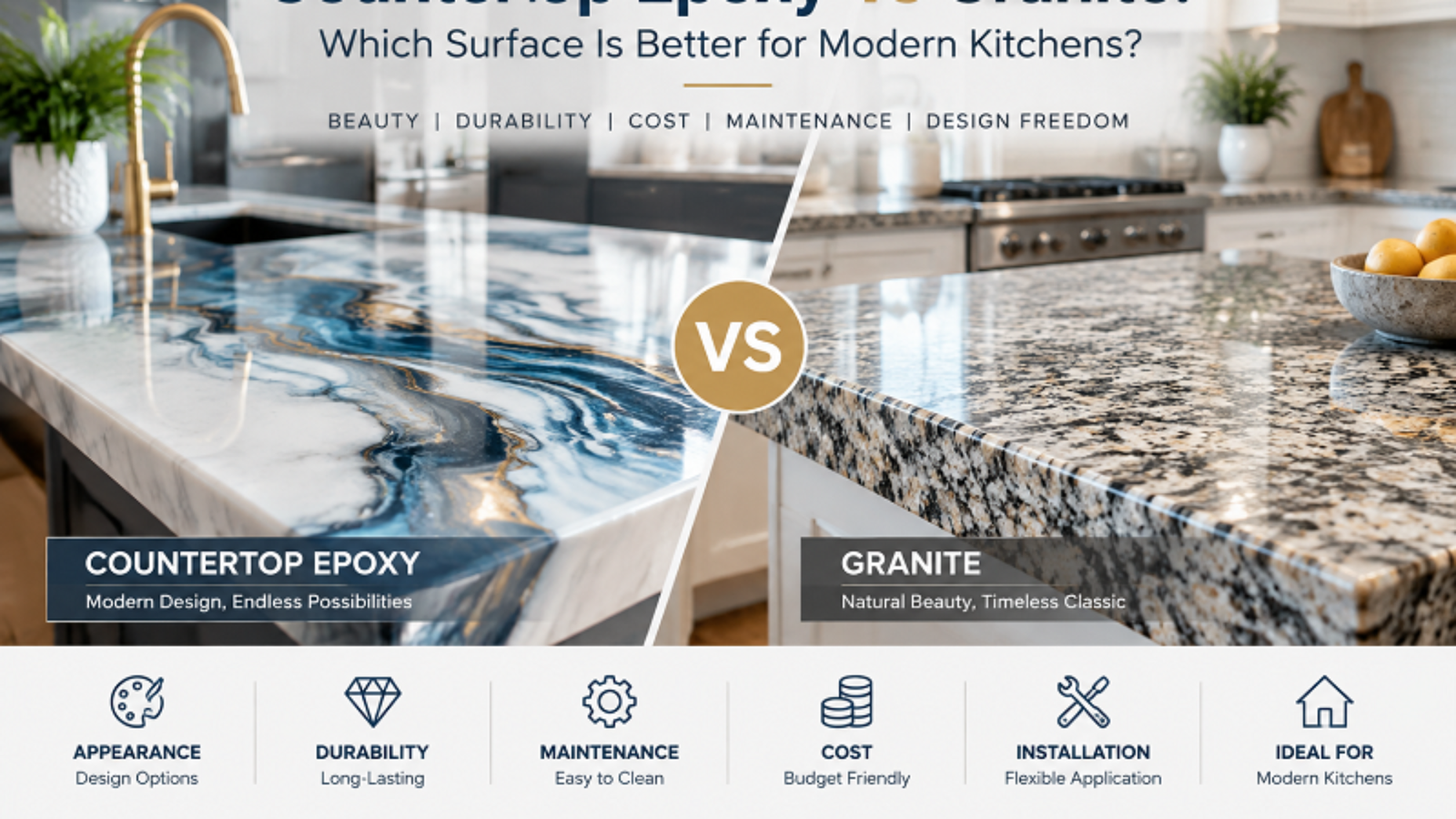
Granite has been the default “upscale kitchen” answer for thirty years, and for good reason — it’s hard, it’s natural, and it photographs well. But it’s not the only serious option anymore. Countertop epoxy resin has moved from a DIY novelty into a real commercial-grade surface, and a growing number of kitchen remodels are choosing it over stone. Here’s what actually changes when you pick one over the other — not the marketing version, the practical one.
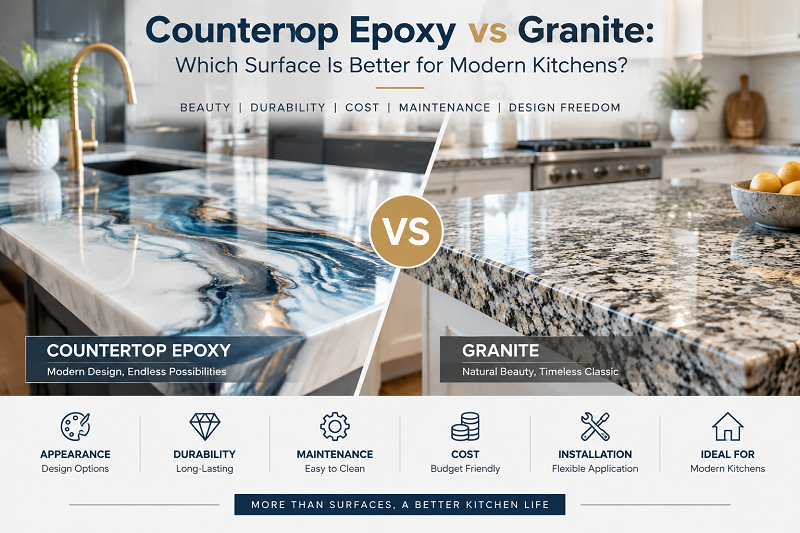
What “Countertop Epoxy” Actually Means
Countertop epoxy resin is a two-part system — resin and hardener — engineered specifically for horizontal surfaces. That matters more than it sounds: a formula built for countertops self-levels, resists UV yellowing, and cures to a hard, glass-like finish, unlike general-purpose casting or art resins that were never meant to take daily kitchen abuse. Once mixed and poured, it cures into a seamless, non-porous layer that can sit directly on top of laminate, wood, MDF, or concrete.
It shows up on kitchen islands, bathroom vanities, bar tops, and restaurant counters, and it’s become a go-to for anyone renovating on a budget who still wants a stone-look finish without a stone-sized invoice.
Looks: Nature’s Catalog vs. an Open One
A granite slab is what the quarry gives you. Every piece is genuinely one-of-a-kind, and that uniqueness is part of the appeal — but you’re choosing from existing inventory, not designing from scratch. Availability shifts by region, and the exact vein pattern you liked in a showroom sample may not be the slab that ships.
Epoxy flips that. Pigment, mica powder, and pour technique can replicate white marble veining, black granite speckle, metallic swirls, or a flat concrete look — or skip imitation altogether and go with a color no stone has ever produced. For a brand that wants a specific look across multiple locations, or a homeowner chasing one very particular shade of blue, that control is the whole draw.
Durability: Where Each One Actually Fails
Granite is genuinely tough — it sits around 6 to 7 on the Mohs hardness scale, which puts it above steel for scratch resistance, and a sealed slab shrugs off a hot pan without flinching. Its weak point is porosity. Left unsealed, or sealed and forgotten, it will drink up wine, oil, and coffee and stain. That upkeep is the trade-off for the natural material.
A properly cured countertop epoxy layer lands around 80-85 on the Shore D hardness scale and is completely non-porous, so staining from liquids isn’t really a failure mode the way it is for stone. Its weak point is heat and impact from the wrong angle — a dropped cast-iron pan can chip it, and setting a pot straight off the burner on a standard formula can leave a mark, unless the resin is specifically rated for high heat. Match the formula to how the surface will actually be used and this stops being a real concern.
Maintenance: The Difference Shows Up Over Years, Not Days
Both surfaces wipe clean with soap, water, and a soft cloth on a normal day — that part is a wash. The difference is what happens over time. Granite needs resealing on a schedule, typically every 12 to 24 months, or the porosity creeps back in. Epoxy doesn’t have that maintenance item on the calendar at all; the sealed, non-porous surface it cures into is the finished state, not a temporary one. Skip the resealing on granite for a few years and you’ll notice; skip it on epoxy because there’s nothing to skip.
Cost: Where the Number Actually Comes From
Granite pricing is driven by the slab — stone grade, thickness, how far it has to travel, and how much cutting the layout requires. Mid-range granite typically runs somewhere in the $50-$100 per square foot installed range, and premium colors or oversized islands push well past that.
Epoxy’s cost advantage comes from what it doesn’t require: no quarrying, no slab transport, and in a lot of renovation jobs, no tear-out. Coating over an existing laminate or wood countertop instead of replacing it is what keeps epoxy in the $35-$75 per square foot range for most residential jobs. The savings come from skipping steps, not from a cheaper material.
Installation: Slab Fabrication vs. On-Site Coating
Granite installation is a fabrication job. A template gets taken, the slab gets cut off-site with specialized equipment, and a crew sets and seals it in place — solid work, but it’s scheduled around a fabricator’s shop, not a weekend.
Epoxy is closer to a finishing trade than a stone trade. The rough sequence is straightforward: clean and prep the existing surface, prime it if the substrate calls for it, mix resin and hardener to spec, add pigment or decorative layers, pour and self-level, then let it cure fully before use — usually 24 to 72 hours depending on the formula and ambient temperature. That flexibility is why epoxy shows up so often in renovations where tearing out the old countertop isn’t on the table.
Side by Side
| Factor | Epoxy Countertop | Granite |
| Design range | Open — any color, pattern, or effect a pigment can produce | Fixed by the quarry — you choose from what exists |
| Surface hardness | ~80-85 Shore D once fully cured | ~6-7 on the Mohs scale |
| Porosity | Non-porous, no sealing needed | Porous, needs sealing every 1-2 years |
| Heat tolerance | Handles warm dishes; direct hot pans need a formula rated for it | Handles a hot pan straight off the stove |
| Typical install cost | $35-$75 per sq ft, coating over an existing base | $50-$200+ per sq ft, slab plus fabrication |
| Install method | Coated on-site over laminate, wood, or concrete | Slab cut, templated, and set by a fabricator |
So Which One Should You Actually Pick
Go with granite if a hot pan straight off the stove without a trivet is a real, frequent scenario in your kitchen, or if the look you want is specifically “unrepeatable natural stone” rather than anything a pigment could match.
Go with epoxy countertop resin if you’re renovating over an existing surface rather than gutting it, want a color or finish that stone doesn’t naturally produce, or are outfitting multiple units — a rental portfolio, a restaurant chain, a hotel — where matching the exact same finish across locations matters more than any single slab’s uniqueness.
Commercial buyers and private-label brands increasingly land on epoxy for a simpler reason: it scales. A stone supplier can’t guarantee two identical slabs; a formulated countertop epoxy resin, batch to batch, can be built to.
Sourcing the Resin Actually Matters
Not every epoxy sold as “clear resin” is built for a countertop. A formula meant for jewelry or river tables can yellow under UV, self-level poorly on a large surface, or trap bubbles that show up as defects once cured. A resin engineered specifically as a countertop epoxy manufacturer product should hold up to UV without ambering, self-level cleanly across a full slab, and cure to a consistent hardness batch after batch — which is the difference between a finish that photographs well on day one and one that still looks that way three years in.
Granite isn’t going anywhere, and it shouldn’t — it’s proven and it looks the part. But for kitchens, renovations, and commercial spaces where design flexibility, renovation speed, or consistent output across multiple units matters more than natural stone’s pedigree, countertop epoxy has become the more practical bet, not just the cheaper one.