


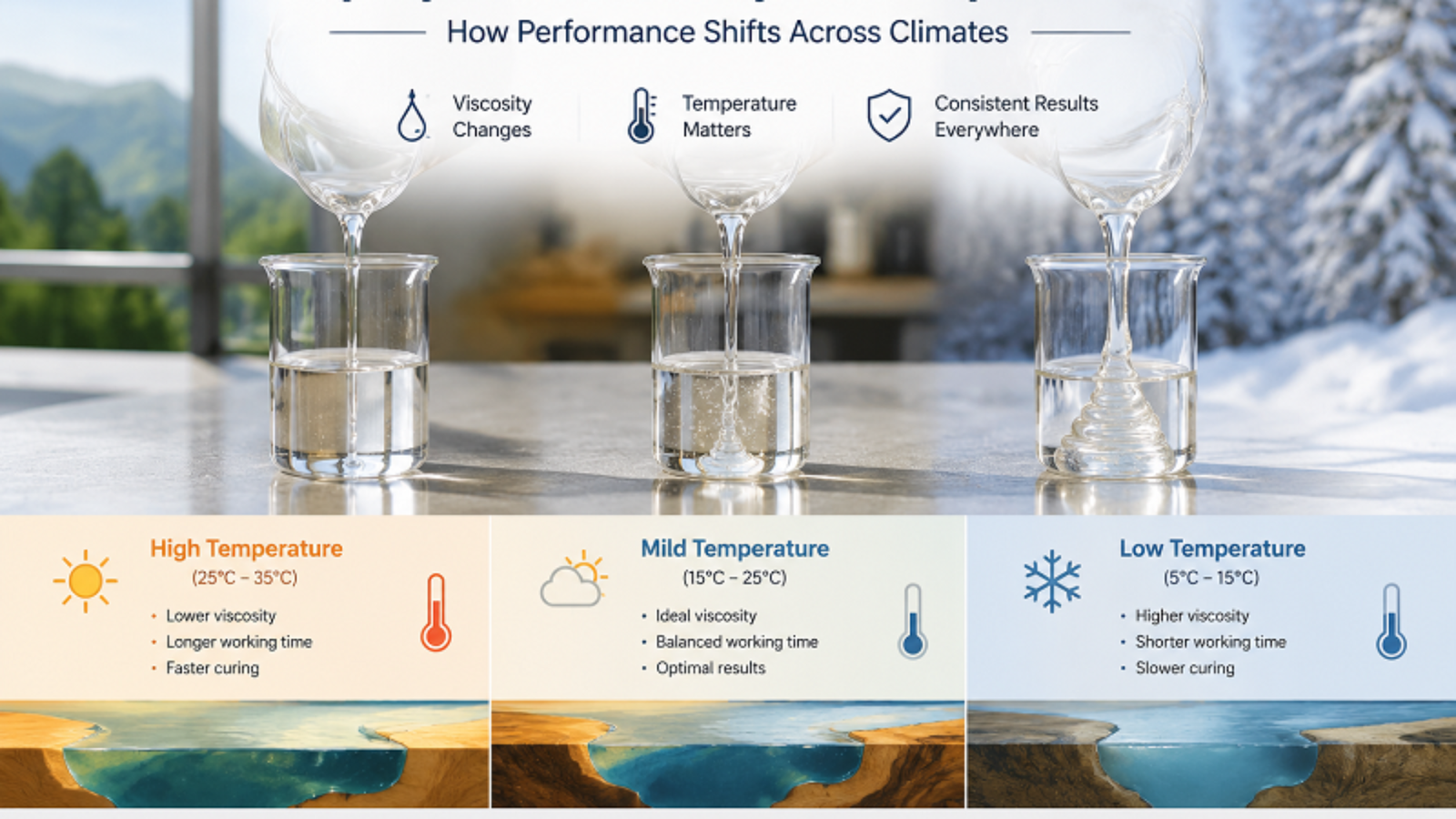
A resin that pours like water in a Guangzhou factory in July can behave like honey in a Minnesota garage in January. Same product, same batch number, completely different working experience — because Epoxy Resin Viscosity isn’t a fixed number. It’s a moving target that shifts with temperature, and that shift changes almost everything downstream: pour behavior, bubble release, working time, even how the cured piece looks.
Buyers rarely think about this until something goes wrong — a pour that won’t self-level, bubbles that won’t clear, a cure that takes twice as long as the data sheet said. Most of the time, the resin isn’t defective. The room it was mixed and poured in just wasn’t accounted for.
Viscosity, in Practical Terms
Epoxy Resin Viscosity measures resistance to flow, reported in centipoise (cP) at a stated temperature — almost always 25°C (77°F) on a standard TDS. Water sits around 1 cP. Honey sits around 2,000–3,000 cP. Most table top and deep pour epoxy resins fall somewhere in the 400–1,000 cP range at 25°C before mixing, though this varies by formulation.
That single number on the data sheet is a snapshot, not a constant. Epoxy resin, like most liquids, thins out (lower viscosity) as it warms and thickens (higher viscosity) as it cools — and the relationship isn’t linear. A 10°C swing near room temperature might shift viscosity by a modest amount; the same 10°C swing at the cold end of a resin’s working range can nearly double it.
Why This Matters More for Epoxy Than for Most Liquids
Two things make an epoxy resin manufacturer product more temperature-sensitive in practice than, say, cooking oil.
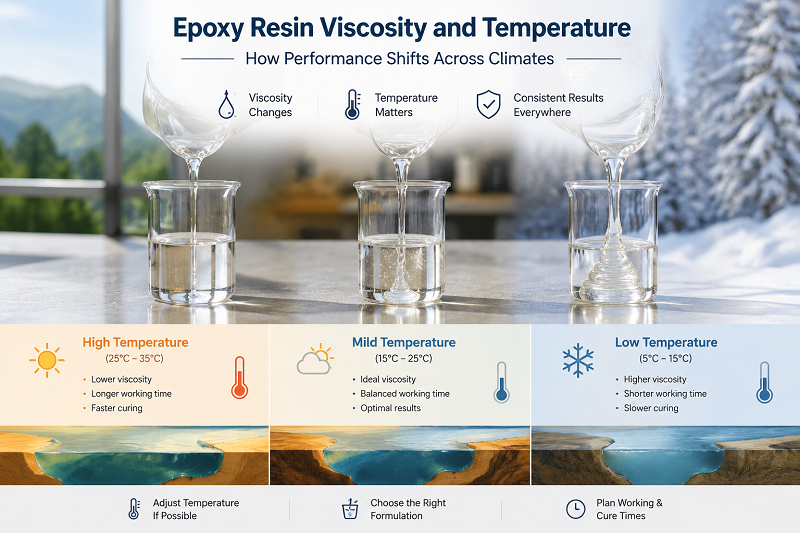
First, epoxy is a two-part chemical reaction, not a static liquid. Temperature affects viscosity and reaction speed at the same time. A warmer room means lower viscosity — easier flow — but also faster cure and shorter pot life. A colder room means higher viscosity — harder to pour and self-level — but also slower cure and longer pot life. Buyers often adjust for one effect and get caught off guard by the other.
Second, most epoxy applications — table top, deep pour, coatings — depend on the resin flowing well enough to self-level and release trapped air before it starts to gel. Viscosity that’s too high at pour time doesn’t just make the job harder. It directly causes the two defects buyers complain about most: trapped bubbles, and an uneven, textured surface instead of a smooth, glass-like one.
What Happens in a Hot Climate or Warm Workshop
Buyers in warmer regions of the US, or running production in an unair-conditioned workshop through summer, deal with the opposite problem more often than the cold-weather one.
Faster cure, shorter working time. Pot life figures on a TDS are almost always given at 25°C. In a workshop running at 30–35°C, working time can shrink meaningfully — sometimes by a third or more, depending on formulation and batch size, since larger mixed volumes generate their own exothermic heat on top of ambient temperature. A resin rated for 45 minutes of pot life at 25°C may give you closer to 25–30 minutes once ambient heat and mass-related heat stack up.
Higher risk of exotherm-related problems. Larger pours in hot conditions run a greater risk of overheating during cure — amber discoloration, cracking, or in extreme cases, visible smoking or boiling mid-cure. This concerns deep pour work more than thin table top coats, since deeper pours hold heat rather than dissipating it.
Lower viscosity can mean surface bubbles rising too fast. Counterintuitively, very low viscosity in hot conditions can push bubbles to rise and pop at the surface faster than they can properly release, sometimes leaving micro-craters if the surface skins over before they’ve fully settled.
Practical adjustments buyers in hot climates typically make: mixing smaller batches to manage exotherm, working faster once mixed, pouring during cooler parts of the day, and in some cases, asking their manufacturer whether a slower hardener suits their climate better than the standard option.
What Happens in a Cold Climate or Unheated Workshop
Cold-climate buyers — parts of Canada, the northern US, UK winters — run into the opposite set of problems, and they’re often the ones who contact a supplier assuming something is wrong with the resin itself.
Higher viscosity, harder to pour and self-level. Below roughly 18–20°C, most formulations noticeably thicken. Below 15°C, some systems get difficult to pour cleanly at all — closer to honey than water. That’s not a flaw. It’s the direct, expected effect of temperature on Epoxy Resin Viscosity.
Bubbles get trapped instead of releasing. This is the most common cold-weather complaint. Thicker resin holds air more stubbornly, and a torch or heat gun pass that clears bubbles easily at 25°C often isn’t enough at 15°C, because the resin re-thickens faster than the bubble can rise and escape.
Slower cure, longer full-cure time. Cold conditions slow the chemical reaction between resin and hardener. A piece that reaches full cure in 3 days at 25°C might take a week or more at 15–18°C, and in genuinely cold conditions — below roughly 10°C — some formulations may not cure properly at all, staying tacky or soft indefinitely.
Hardener crystallization. Some hardener components can crystallize or turn cloudy in cold storage or cold shipping conditions, particularly during winter transit through unheated warehouses or containers. This usually resolves with gentle warming and thorough mixing before use — but a buyer unaware of this can mistake it for spoiled product and reject a shipment unnecessarily.
Practical adjustments buyers in cold climates typically make: bringing both resin and hardener components to room temperature (typically 21–25°C) before mixing — not just the room, the containers themselves, since a cold container of resin doesn’t warm up quickly just because the room around it is heated — working in a heated space through the full pour-and-cure window, and building in extra time for cure before handling or shipping finished pieces.
Storage and Shipping: Where Climate Problems Often Start Before the Pour
A meaningful share of viscosity complaints don’t actually start at the buyer’s workbench. They start in transit or storage, before the resin is ever mixed.
International shipping routes to the US, Canada, Australia, and the UK can expose product to a wide temperature range across a single journey — a hot loading dock in southern China, a cold ocean crossing, a hot or cold final-mile truck depending on season and region. Resin held at extreme temperatures for extended periods during shipping can arrive with altered viscosity, cloudy hardener, or in rare cases, degraded performance, before the buyer has even opened the container.
Buyers sourcing at volume, especially around winter or summer shipping windows, should ask their epoxy resin manufacturer directly about recommended storage temperature range (commonly stated on the SDS, typically somewhere between 10–30°C for most formulations) and whether temperature-controlled shipping is available or necessary for their specific route and season.
Practical Guidance by Climate
Hot climates / summer workshops: Mix smaller batches, work quickly once mixed, avoid pouring large or deep pieces during the hottest part of the day, and confirm with your manufacturer whether a longer-pot-life formulation suits your conditions better than the standard one.
Cold climates / winter workshops: Bring resin and hardener to room temperature before mixing — plan for it in advance, since containers take longer to warm than the room does — work in a heated space through the full cure window, and don’t judge a resin as defective on thickness alone without checking the ambient temperature first.
Year-round, any climate: Read the TDS temperature conditions before assuming pot life and cure time apply directly to your workshop. If your actual working temperature differs meaningfully from the stated 25°C, ask your manufacturer for adjusted figures rather than guessing.
The Bottom Line
Epoxy Resin Viscosity isn’t a fixed spec. It’s a temperature-dependent property, and the number on a data sheet only tells you what to expect at the stated test temperature. Buyers who understand how their own climate and workshop conditions shift that number get more consistent, predictable results. Buyers who don’t tend to blame the resin for problems the room actually caused.
Before your next order, it’s worth asking your epoxy resin manufacturer one direct question: what does this formulation’s pot life and cure time actually look like at the temperature I’m working in — not just at 25°C.