


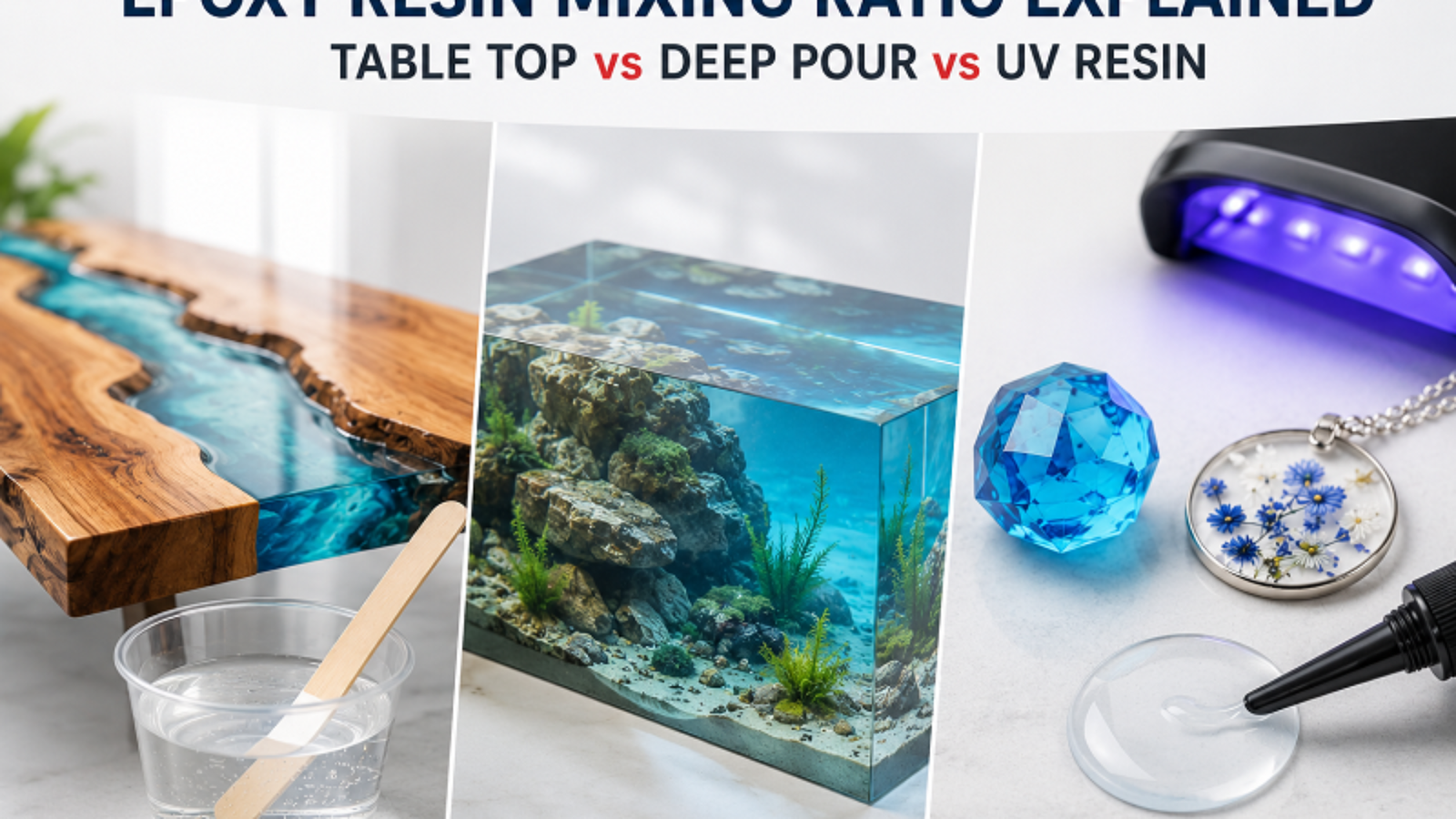
Get the ratio wrong and no amount of finishing skill saves the pour. Table top epoxy, deep pour epoxy, and UV resin are each built around a specific resin-to-hardener balance, and you can’t swap one for another. Buyers who assume “epoxy is epoxy” end up with tacky surfaces, cloudy pours, or resin that just won’t cure. Here’s what the actual epoxy resin mixing ratio looks like for each type, why the numbers aren’t the same, and what changes once you go from a small test cup to a full drum.
Why Mixing Ratio Isn’t a Suggestion
Epoxy cures through a chemical reaction, not by drying out. Resin (part A) and hardener (part B) react in fixed proportions set by their molecular structure — stoichiometry, not guesswork. Skimp on hardener and unreacted resin molecules stay soft and sticky, sometimes for good. Add too much and the leftover hardener has nothing to bond with, so you get a brittle, cloudy, occasionally rubbery surface instead.
An epoxy resin manufacturer publishes a separate mixing ratio for each formulation for exactly this reason — there isn’t one universal number. Table top, deep pour, and UV systems use different resin chemistries, cure at different speeds, and generate heat differently, so a ratio that’s correct for one will wreck the results on another.
Table Top Epoxy Mixing Ratio
Most table top epoxy runs 1:1 by volume — equal parts resin and hardener. A handful of fast-cure or bar-top formulas use 2:1 instead. Nothing arbitrary about the 1:1 design: this resin is meant to self-level in thin layers, usually 1/8″ to 1/4″ per coat, so the chemistry is built for low viscosity and a quicker gel time. There’s a practical side to the simple ratio too — DIYers and small shops make up a big share of this market, and a 1:1 mix is just harder to mess up.
One thing buyers often miss: 1:1 by volume isn’t the same as 1:1 by weight. Resin and hardener have different densities, so weighing out “equal amounts” can throw off the cure even when the label says 1:1. Mix to whatever method the manufacturer states — volume or weight — not whichever happens to be easier in your shop.
Deep Pour Epoxy Mixing Ratio
Deep pour epoxy is almost always 2:1 by volume, and some low-exotherm formulas go up to 3:1. It comes down to heat. Curing is exothermic — the reaction itself releases heat — and in a thin table top layer that heat escapes fast. Pour something 1″–4″ deep, though, and heat gets trapped in the center of the mass. Try running a 1:1 ratio at that thickness and internal temperatures can climb high enough to crack the resin, yellow it, or even trigger a runaway cure that basically boils.
Deep pour formulas dilute the reactive load — more hardener relative to catalyst, slower-reacting chemistry — which stretches the cure to 24–72 hours instead of the 6–8 hours you’d see on a table top pour. Slower reaction, heat spread over a longer window, clearer result with no cracking. It’s also why you can’t just “pour it thicker” with a table top formula — the ratio and chemistry are matched to a specific depth, and going past that depth is asking for trouble.
UV Resin: No Mixing Ratio at All
UV resin skips the resin-hardener reaction altogether. It cures through photoinitiators reacting to UV light rather than a two-part chemical process, so there’s no ratio to measure and nothing to get wrong on that front. What you control instead: layer thickness (usually capped around 2–3mm per pass) and exposure time. For OEM buyers casting thin pieces — jewelry, name tags, small decorative parts — that removes a whole failure point from the line, though now your results depend on the UV lamp’s output staying consistent.
Mixing Ratio Comparison
| Resin Type | Typical Ratio | Measured By | Typical Cure Window | Best For |
| Table Top Epoxy | 1:1 (some 2:1) | Volume | 6–8 hrs to touch, 24 hrs to handle | Countertops, bar tops, thin coatings |
| Deep Pour Epoxy | 2:1 (up to 3:1) | Volume | 24–72 hrs | River tables, molds, thick castings |
| UV Resin | No mixing — single component | N/A | Seconds to minutes under UV | Jewelry, small parts, thin castings |
What Happens When the Ratio Is Off
Too little hardener and the resin just stays soft and tacky — sometimes it never fully hardens at all, and that’s not always obvious until days after the pour. Go the other way, add too much hardener, and you get excess heat during cure, visible cloudiness, a surface that’s brittle instead of tough, and in deep pours, cracking as the mass expands and contracts unevenly.
Even eyeballing it can cause problems most people wouldn’t expect. A 5–10% deviation from the stated ratio is often enough to shift cure time, clarity, and hardness — fail an entire batch, in other words — and at deep-pour volumes that error compounds fast across gallons. None of it is reversible once curing starts, either. There’s no “add more hardener later” fix. An off-ratio batch gets sanded down and recoated, or it gets tossed.
Measuring Accurately for Bulk and OEM Orders
Graduated mixing cups are fine for hobbyist-scale pours. At production or OEM volume the margin for error shrinks, because a small percentage mistake stops being a nuisance and becomes a full-drum failure. A few things we tell private label and bulk buyers to watch for:
- Weigh it — don’t eyeball, even on volume-rated resins. Once you know a batch’s specific gravity, a calibrated scale beats reading a cup line for speed and accuracy both.
- Metered pumps for repeat runs. A calibrated dispensing pump holds ratio accuracy to roughly 1%, which starts to matter once you’re running the same formula across dozens of batches and need OEM output to look consistent every time.
- Account for climate, not just chemistry. The ratio itself doesn’t shift with temperature, but working time does — a hot, humid production floor shortens pot life, so batch size and mixing speed need to adjust.
- Ask your supplier for batch-specific documentation. Formulas get refined over time. A supplier worth using will confirm the current ratio — and flag any recent change — before a large order ships.
FAQ
Can I mix table top epoxy and deep pour epoxy together?
You shouldn’t. The two are tuned for different chemistries and reaction speeds, and combining them tends to give unpredictable results that aren’t usable.
What if I already poured the wrong ratio?
Once curing has started there’s no reliable fix. A small error might still cure, just softer than intended — a larger one usually means sanding it off and starting over.
Does ambient temperature change the mixing ratio?
It doesn’t. Temperature changes cure speed and working time, not the ratio. Mix to the stated numbers regardless of how warm or cold the shop is.
Why does UV resin skip mixing entirely?
Because it cures through light-triggered polymerization rather than a two-part chemical reaction — there’s simply nothing to combine.
Every resin we make — table top, deep pour, UV — ships with a fixed, tested ratio and batch documentation. That matters most to OEM and private label buyers running production at scale. If you’re sourcing in bulk and want ratio consistency checked across batches before committing, our team can walk you through the spec sheet first.