


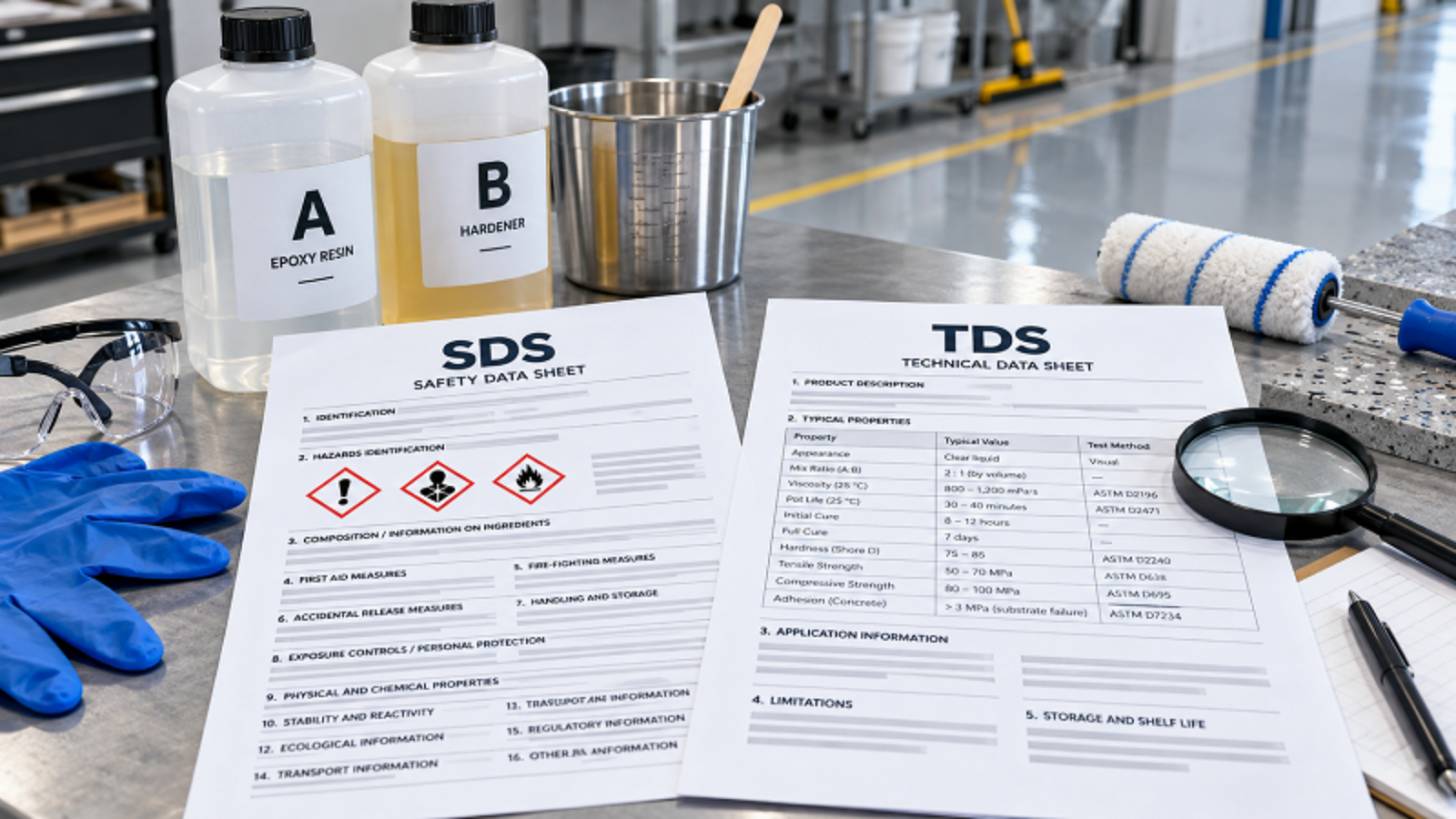
Ask a buyer what’s in their supplier’s SDS and most describe the TDS instead — the two get mixed up constantly, even though they answer completely different questions. A Safety Data Sheet tells you whether the resin is dangerous to handle, ship, and store. A Technical Data Sheet tells you whether it’ll actually perform the way you need it to. Mixing them up isn’t just a vocabulary slip; it means buyers sometimes clear customs on the wrong document, or approve a resin for production without ever checking whether it cures the way their process requires. Here’s what’s actually inside each one, and which questions each is built to answer.
What an SDS Actually Covers
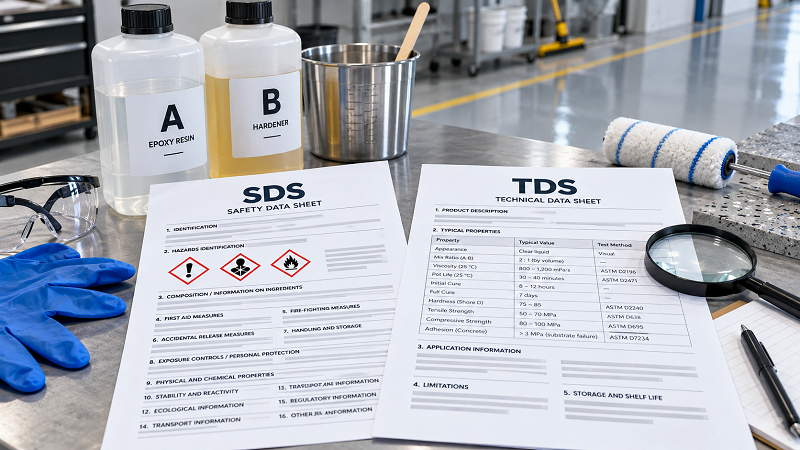
A Safety Data Sheet follows a standardized 16-section format under the Globally Harmonized System (GHS), so once you know the structure, any SDS from any epoxy resin manufacturer reads roughly the same way. A few sections matter more than the rest for buyers.
Section 2, hazard identification, is where the signal words live (Warning or Danger), along with hazard statements and pictograms. This is where you’ll see whether a resin counts as a skin sensitizer, an irritant, or something worse.
Section 3 covers composition: the chemical ingredients and their CAS numbers. Some manufacturers give exact percentages; others use concentration ranges instead to protect a proprietary formula.
Section 7, handling and storage, lists ventilation requirements, an acceptable storage temperature range, and materials the resin shouldn’t be stored near.
Section 8 is exposure controls and PPE — gloves, eye protection, respiratory gear if needed, and exposure limits for anyone mixing or applying the resin day to day.
Physical and chemical properties show up in Section 9: flash point, viscosity, specific gravity, pH, solubility. Some of these numbers overlap with what you’d find on a TDS, but here they’re framed around hazard rather than performance.
Then there’s Section 14, transport information, which says whether the resin counts as a dangerous good for shipping and under which UN number if so. This one section can move freight cost quite a bit and determine which carriers will even take the shipment.
Section 15 is regulatory information — REACH, TSCA, Prop 65, and similar frameworks, whichever apply. Importing into the U.S., EU, or Australia, this is usually the first thing a customs broker asks to see.
What a TDS Actually Covers
A Technical Data Sheet has no standardized format — every epoxy resin manufacturer lays it out a little differently — but it exists to answer one question: how does this resin actually perform? A few things you’ll almost always find on one.
Mixing ratio and method come first, usually by volume or weight, with the exact number spelled out (1:1, 2:1, whatever applies).
Pot life is how long you’ve got to work with the mixed resin before it starts to gel. It’s normally given at a specific ambient temperature, since heat shortens it noticeably.
Cure schedule breaks down into touch-dry time, tack-free time, and full cure time — often listed separately, because a resin can feel safe to touch well before it’s actually reached full hardness.
Viscosity, given in cP for the mixed resin, tells you how self-leveling it’ll be and how prone it is to trapping bubbles.
Physical properties after cure round things out: Shore D hardness, tensile strength, heat deflection temperature, and yellowing resistance, sometimes rated against ASTM D4212 or a comparable standard.
Shelf life and storage conditions tell you how long an unopened container stays usable and what temperature range keeps it stable in the meantime.
And recommended application thickness matters a lot for deep pour products specifically — go past the rated depth and you’re into the cracking and overheating territory we’ve covered elsewhere.
None of it is standardized across suppliers, which is exactly why comparing two manufacturers’ TDS sheets takes more than a quick glance. The same property might get tested under different conditions, or reported in different units entirely.
SDS vs TDS at a Glance
| SDS (Safety Data Sheet) | TDS (Technical Data Sheet) | |
| Answers | Is it safe to handle, ship, store? | Will it perform the way I need? |
| Format | Standardized 16-section GHS layout | Varies by manufacturer |
| Used by | Compliance, customs, EHS teams | Production, R&D, QC teams |
| Key content | Hazards, PPE, transport class, regulatory status | Mixing ratio, cure time, hardness, viscosity |
| Required for | Import/export, workplace safety compliance | Process planning, formulation matching |
Why Buyers Need Both, Not Just One
Compliance teams usually reach for the SDS first, since that’s the document customs brokers and OSHA inspectors ask for. It settles whether a shipment needs special handling and whether workers need specific PPE on the floor. But an SDS won’t tell you a thing about whether the resin cures clear, holds up under UV, or sets inside your production window — that’s the TDS’s job entirely. Skip it, and this is exactly how OEM buyers end up with a resin that sails through customs but doesn’t match the working properties their process was built around.
It goes the other way too. Buyers who lock in on cure time and hardness numbers from the TDS and never open the SDS sometimes get blindsided by shipping restrictions or PPE requirements they hadn’t budgeted for — occasionally after the order’s already gone through.
Common Mistakes When Reading These Sheets
Confusing “hazardous for shipping” with “hazardous to use” trips people up more than almost anything else. A resin flagged as a dangerous good under transport regulations (Section 14 of the SDS) can still be perfectly fine to handle with basic gloves in a well-ventilated shop. That classification is about the concentrated, undiluted product moving in bulk — not about the risk level during normal, everyday use.
Skipping the revision date is another one. SDS and TDS documents both get updated as formulations or regulations shift, and an old SDS might list a hazard classification that’s no longer accurate, or leave out one that’s been added since. Ask for the current revision before placing a large order — not whatever version turned up in a search last year.
What to Check Before You Order
On the SDS side, confirm the transport classification lines up with what your freight forwarder can actually ship, then check Section 15 against whatever regulations your destination market enforces — REACH for the EU, Prop 65 for California, TSCA for general U.S. import.
On the TDS side, weigh the pot life against your real working conditions. A 45-minute pot life means something different in a 90°F warehouse than it did in whatever lab conditions it was tested under. Confirm the cure schedule actually fits your production timeline before you commit to volume.
FAQ
Is an SDS required by law?
In most markets, yes. Suppliers are legally required to provide one for hazardous chemical products, and it typically has to accompany shipments or stay available to any worker handling the material.
Does a TDS have any legal requirement behind it?
Not really — it’s a manufacturer’s technical claim about performance rather than a regulatory document, so there’s no mandated format and nothing forcing consistency. Which is exactly why it’s worth comparing carefully across suppliers instead of assuming they’re all measuring the same thing.
Can the same resin have different SDS sheets in different countries?
Sometimes, yes. Regulatory classification can shift by jurisdiction even for an identical formulation, so a manufacturer selling into the U.S., EU, and Australia might issue a separate SDS for each market.
How often should I request updated sheets from a supplier?
Before every large or repeat order is the safest habit — formulations and regulatory status can both change without much warning reaching the buyer’s side.
We provide current SDS and TDS documentation for every resin line — table top, deep pour, and UV — and can walk through both with your compliance or production team before you commit to a bulk or OEM order.