


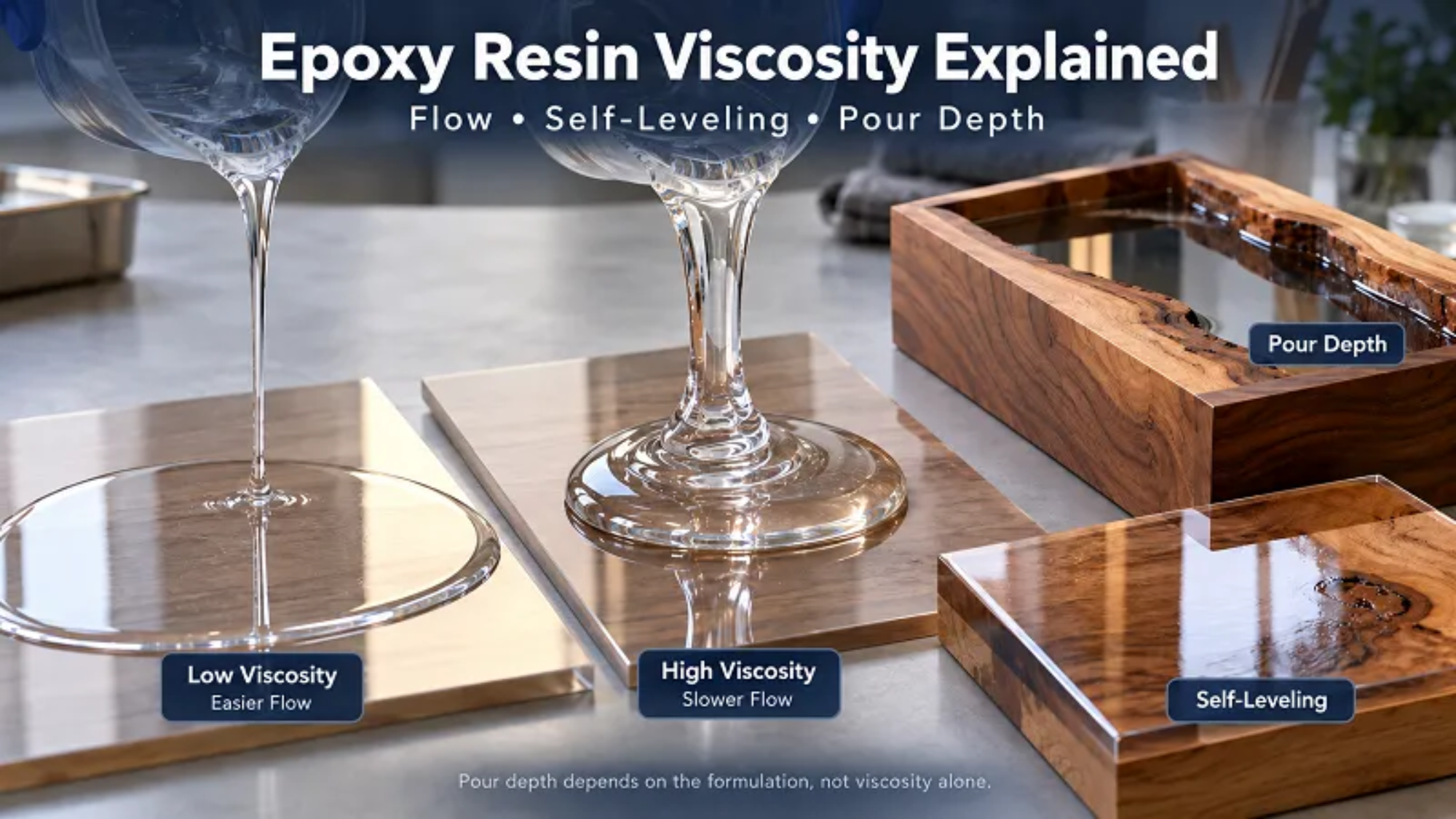
Price, clarity, cure time. That’s what most buyers compare when they line up two epoxies. Viscosity gets skipped, and it shouldn’t, because it controls things you actually see on the job: whether a flood coat flattens out or leaves ridges, whether bubbles reach the surface of a deep pour, whether the resin sits on the edge of a table or ends up on the floor.
Get it wrong and it comes back as a return. Someone grabs a thin casting resin to coat a bar top, or a thick coating resin to fill a river table, and the review says the epoxy is bad. The epoxy was fine. It was the wrong epoxy.
Below: what epoxy resin viscosity is, how it’s measured, what pushes it up and down, and how to match it to a job. If you buy from an epoxy resin manufacturer for resale or private label, the last two sections are for you.
What epoxy resin viscosity actually means
Viscosity is how hard a liquid resists flowing. Water is about 1 cP (centipoise). Olive oil is near 80. Honey runs anywhere from 2,000 to 10,000 depending on the kind and how warm it is. Most pourable epoxy lands somewhere between thin syrup and runny honey.
A few things trip people up on data sheets. cP and mPa·s are the same unit, so 1,000 cP is 1,000 mPa·s, no conversion needed. Temperature matters more than the number itself: a viscosity figure only means something next to the temperature it was tested at, usually 77°F (25°C). A resin listed at 560 cP at 86°F (30°C) isn’t thinner than one listed at 800 cP at 77°F. They could be nearly the same product.
And there isn’t just one viscosity. Part A, Part B and the mixed resin each have their own, with A usually the thicker side. The mixed figure is what you pour, and it keeps climbing while you work.
Typical viscosity by product type
These ranges are typical for the industry and meant for orientation only. For a specific product, trust the TDS from your epoxy resin manufacturer over any chart, this one included.
| Product type | Typical mixed viscosity (at 77°F / 25°C) | Typical thickness per pour | Why it is built that way |
| Seal coat / penetrating epoxy | Under about 500 cP | Very thin coat | Soaks into wood grain and seals pores before the main pour. |
| Deep pour / casting epoxy | Roughly 300–1,000 cP | Up to about 2 in (5 cm) per layer | Thin enough for bubbles to rise out of a thick pour before it gels. |
| Table top / flood coat epoxy | Roughly 1,000–3,000 cP | About 1/8–1/4 in (3–6 mm) | Holds on the edges and levels without running away. |
What changes epoxy resin viscosity
Temperature is the big one. Warm epoxy flows, cold epoxy doesn’t. As a rough guide, viscosity can drop by about half for every 18°F (10°C) you warm it, though every formula has its own curve. A resin reading 1,200 cP at 77°F might be nearer 800–900 cP at 86°F (30°C). You pay for that with working time, since warm resin reacts faster and gels sooner. Most people keep both containers somewhere in the 77–86°F range; check your TDS. Storage counts too. Resin that spent the night in a cold warehouse pours much thicker than the data sheet says, so give containers a day to come up to room temperature, especially in winter when shipments tend to arrive cold.
Time works against you from the second you mix. Viscosity creeps up slowly at first, then speeds up as the resin heads for gel. A pour that levels like glass at minute 10 can show ridges at minute 40. The resin hasn’t gone bad. It’s just too thick to move.
Fillers and colorants thicken the mix. Mica, pigment paste, glow powder and silica all do it, and a heavy load can leave resin stiff and slow to degas. Our guide to table top epoxy pigments has safe loading limits.
Formulation is the part buyers can’t see. Reactive diluents thin the resin and then bond into the polymer, which is fine in moderation and costs you hardness and chemical resistance if overdone. Some cheap products use non-reactive solvents instead, and those can bring shrinkage, haze and a soft cure. Ask your epoxy resin manufacturer what’s in the bottle.
Viscosity and self-leveling
Flow drives self-leveling, and viscosity drives flow, up to a point. Thinner resin spreads and levels faster. Go too thin and it runs off the edges, leaves corners bare and soaks into porous wood before it cures. Thicker resin stays put and builds a more forgiving coat, but it levels slowly, holds bubbles and can show tool marks if it gels before it settles.
Table top epoxy lives in the middle on purpose. It flows out across a surface, yet it’s thick enough to hold a 1/8-inch coat on an edge until it gels. Three things are in your hands on a flood coat: room and resin temperature (roughly 72–80°F / 22–27°C), pour thickness, and how long you wait between mixing and spreading. Sort those out and a mid-range resin does most of the work.
Viscosity and bubbles
Bubbles climb at a speed set by viscosity. Thin resin lets them go quickly. In a 1/8-inch table top coat they only have a few millimeters to travel, so one pass with a heat gun or torch clears them. In a 2-inch pour the trip is much longer, and resin that’s too thick or too cold cures with bubbles stuck halfway up.
If bubbles are the complaint, look at temperature before anything else. Cold resin traps more air than a bad batch ever does. Technique counts, too. Stir slowly, scrape the sides and bottom of the cup, and don’t whip it, because thick resin won’t give back the air you beat in.
Viscosity and pour depth: a common mix-up
This one gets confused a lot. Low viscosity doesn’t buy you extra pour depth. Depth is capped by exotherm, the heat the reaction gives off. In a thick pour that heat has nowhere to go, and an overheated pour can yellow, crack or shrink. Deep pour epoxy gets its depth rating from a slower hardener that lets heat out gradually. It’s also made thin so bubbles escape before gel. Two separate design choices that happen to show up together.
So don’t pour table top epoxy deep just because it flows nicely. Read the maximum pour depth on the TDS, not the cP number. A reputable epoxy resin manufacturer rates depth from exotherm testing, not from how thin the resin looks in the pail.
Seal coats, wood and edges
Wood holds a lot of air. Pour thick resin over raw wood and that air comes up through the resin during cure, leaving craters and pinholes. A thin, low-viscosity seal coat soaks into the grain first and gives the air a way out before the real pour. For live-edge slabs and river tables, a seal coat followed by a deep pour formula is the usual route. Open edges on a bar top need tape or a dam before you flood.
Troubleshooting: when viscosity is the culprit
| Symptom | Likely viscosity cause | Fix |
| Resin runs off the edges, thin at corners | Too thin for a flood coat, or resin too warm | Switch to a table top (thicker) formula, tape or dam the edges, and let overheated resin cool toward room temperature. |
| Ridges, brush marks or orange-peel texture | Resin too thick or too cold; spread too late | Warm the resin to about 77–80°F and get it spread earlier in the working time. |
| Bubbles trapped in a deep pour | Resin too thick or too cold | Warm both components, use a deep pour formula and pour in thinner layers. |
| Dull or dry spots over wood | Thin resin soaked into a porous surface | Seal the wood first, then do the main pour. |
| Streaks or clumps after adding powders | Filler load pushed viscosity past what mixing can handle | Pre-wet the powder in a little resin and cut the loading. |
How to read viscosity on a TDS
If you’re buying for resale, check four things on the data sheet. Is the figure for the mixed resin, or just Part A and Part B? What temperature was it tested at? (77°F / 25°C is the common standard.) How was it measured? Viscometer type, spindle and speed all change the reading, and two labs can disagree on the same resin. And what pot life and maximum pour depth are printed next to it?
Even with all that matched, two resins at the same cP can behave differently, because reactivity and flow behavior vary by formula. Ask the epoxy resin manufacturer for a sample and pour it at your own temperature before you commit to volume.
Specifying viscosity for OEM and private label
Viscosity is one of the first numbers to settle on a private label project. Tell the factory the application (flood coat, deep pour, seal coat), the pour thickness you want, and the temperatures your customers really work in. Arizona and Minnesota need different resins. A formula that levels beautifully at 85°F can be too stiff at 60°F.
Jinhua Resin is an epoxy resin manufacturer making table top epoxy, deep pour epoxy and UV resin under OEM and private label programs. Send us your application and a target viscosity range, and we’ll talk through a formula to match.
FAQ
What is a good viscosity for epoxy resin?
It depends on the job. Deep pour and casting epoxies usually run roughly 300–1,000 cP, while table top and flood coat epoxies sit around 1,000–3,000 cP at 77°F (25°C). Match the product to the application and check its TDS.
Is lower viscosity epoxy better?
Not always. Thin resin releases bubbles faster and soaks into wood, but it can run off the edges. Thicker resin holds a heavier coat and levels more slowly.
How do I make epoxy thinner?
Warm the containers gently, to about 77–86°F (25–30°C), before mixing. Don’t thin it with alcohol, acetone or any other solvent. They weaken the cure and can leave haze.
Does viscosity affect cure time?
Not directly. Hardener reactivity and temperature set the cure time. Warm resin is both thinner and faster to cure, which is why people mix the two up.
What does cP mean?
cP stands for centipoise, a unit of viscosity. It is identical to mPa·s (millipascal-second).