


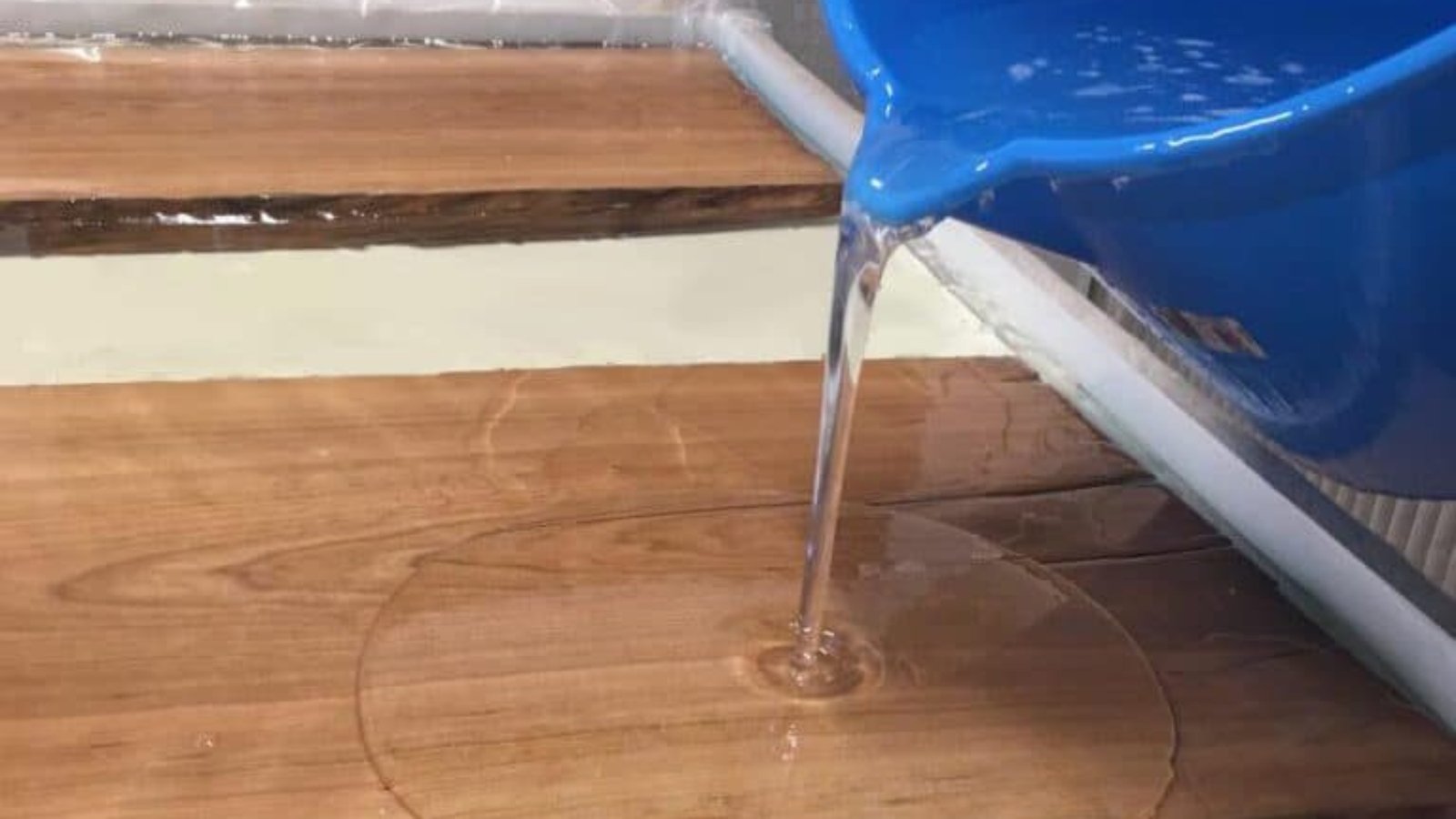
Deep pour epoxy resin is a two-component (resin + hardener) epoxy resin system. Its core characteristic is the ability to achieve relatively thick layers in a single casting (general casting thickness ranges from 1 inch to 8 inches, with some industrial-grade products reaching 12 inches). Simultaneously, by controlling the formulation, it achieves a long gel time and low exothermic temperature rise, avoiding cracking and shrinkage problems caused by heat accumulation during curing.
Its core advantages stem from precise formulation design: on the one hand, its low viscosity gives it excellent self-leveling and air release capabilities, resulting in a bubble-free, crystal-clear molding effect. Some products also contain UV inhibitors to improve resistance to yellowing. On the other hand, its 100% solids content and low VOC (volatile organic compound) properties enhance safety in use. After curing, it possesses high hardness, wear resistance, chemical corrosion resistance, and waterproof and moisture-proof properties, and is not prone to deformation or aging over long-term use.
The key difference between deep-cast epoxy and ordinary epoxy resin lies in the upper limit of casting thickness and curing characteristics: the single casting thickness of ordinary epoxy is usually 2-5mm (a single casting thickness exceeding 5mm will cause violent exothermic curing leading to runaway, central scorching, surface cracking, and performance degradation, which is why “deep-cast epoxy” and “ordinary epoxy” must be strictly distinguished), requiring multiple layers, while deep-cast epoxy can significantly reduce the number of construction layers; the surface drying time is also longer (usually 6-14 hours), which can meet the needs of complex shape design or object embedding, and the curing cycle is relatively long (complete curing requires 7-14 days), but the structural stability after molding is stronger.
With a wide range of applications, covering both artistic creation and industrial fields, it can be used to create river tables, resin jewelry, encapsulated ornaments, large decorative sculptures, etc. Specific specifications must be followed during use. Typically, it needs to be precisely mixed at a volume ratio of 2:1 (resin:hardener, some products can reach 3:1). After thorough mixing, it should be poured. An ambient temperature of 18-27℃ and humidity below 70% are more conducive to molding. Hot air can be used to help remove air bubbles generated during mixing.
The core of correctly using deep-cast epoxy resin is to control four key aspects: environmental control, precise mixing ratio, standardized operation, and proper curing. Combined with its characteristics of “long working time, low heat release, and thick-layer casting,” following the standardized operation of the entire process—”preparation—mixing—casting—air bubble removal—curing”—can effectively avoid problems such as air bubbles, cracking, shrinkage, and yellowing, ensuring the molding effect. The following are detailed steps and precautions:

1、Preliminary preparations: Dual control of environment and materials
(1)Environmental condition control (core critical factor)
Temperature control: Temperature control is a crucial aspect of deep-cast epoxy resin processes. The ambient temperature needs to be stable between 18-27℃, with the optimal temperature being 22-25℃. Too low a temperature will lead to increased resin viscosity, mixing difficulties, slow curing, or even incomplete curing; too high a temperature will shorten the working time, exacerbate the exothermic reaction, and increase the risk of cracking. Avoid operation in direct sunlight, excessively ventilated environments, or environments with large temperature differences. In winter, avoid using “frozen materials” directly; allow them to stand indoors for 24 hours before use.
Humidity Control: Humidity control is even more important than temperature control. The optimal ambient humidity range is 40%-60% RH, with a maximum limit of 70% RH. High humidity can cause the resin surface to turn cloudy, remain tacky after curing, and even compromise adhesive strength. Dehumidifiers should be used to regulate humidity during rainy seasons or plum rain periods.
Ventilation requirements: Choose a well-ventilated space. Although the VOC content of deep-cast epoxy resin is low, a slight odor may still be generated during mixing. Ventilation can prevent odor accumulation and reduce dust falling into the uncured resin.
(2)Material and tool preparation
Core Materials: Confirm the type and shelf life of the deep-cast epoxy resin (resin + hardener), prioritizing products suitable for the current application scenario (e.g., choose a high-transparency, anti-yellowing version for artistic creations, and a high-strength, corrosion-resistant version for industrial applications). Check for sedimentation or clumping. If slight sedimentation occurs, slowly stir the resin 30 minutes before mixing (to avoid air bubbles).
Tool Preparation: ① Mixing Container: Use a clean, dry, and oil-free plastic or glass container. The container capacity should be 1.5-2 times the estimated casting volume (allowing for mixing space to prevent overflow), and the inner wall should be smooth (for even mixing); ② Stirring Tool: Use a wooden, plastic, or silicone stirring rod. Avoid using metal rods (which may introduce impurities or affect curing); ③ Auxiliary Tools: Measuring cup (with graduations for precise proportioning), heat gun/butane torch (for removing air bubbles), gloves (corrosion resistant), goggles, mask (for protection), and release agent (if demolding is required, such as for making a river table, apply to the inner wall of the mold beforehand).
Substrate preparation: If pouring onto a substrate such as wood or concrete, ensure the substrate is dry (moisture content below 10%), clean, free of oil and dust. Wood needs to be sanded smooth beforehand, and concrete needs to have loose particles removed and be dry. If necessary, apply a layer of epoxy resin primer to enhance adhesion and prevent air or moisture from the substrate from seeping into the resin and causing bubbles.
2、Core operations: precise mixing and standardized pouring
(1)Precise Mixing Ratio (Critical Step, No Deviation Allowed)
For deep-cast epoxy resin, a volume ratio of “resin:hardener = 2:1” is typically used (refer to the product instructions for specific details; some products may use a 3:1 ratio). Precise measurement using a graduated measuring cup is essential; estimation based on feel is strictly prohibited.
Measurement Points: Pour in the resin first, then the hardener, avoiding reversing the order. The measuring cup should be placed horizontally, with your line of sight aligned with the graduations to minimize errors.
Impact of Deviation: Inaccurate mixing ratios will directly lead to incomplete resin curing, resulting in problems such as a sticky, soft surface and insufficient hardness. Even adding more material later cannot salvage the situation.
(2)Mix thoroughly (to avoid air bubbles and uneven curing).
Stirring Method: Slowly stir along the inner wall of the container with a stirring rod in the same direction (clockwise or counterclockwise) at a moderate speed to avoid introducing a large amount of air during rapid stirring. Ensure the bottom and corners of the container are completely covered during stirring. Mix for 3-5 minutes until the resin and hardener are fully combined, and the solution is transparent, uniform, and free of streaks, particles, and turbidity.
Secondary Stirring (You can choose to stir only once, but secondary stirring is recommended for better air bubble release): Pour the mixed resin solution into another clean container and stir a second time (1-2 minutes). This further ensures uniform mixing and helps release some of the tiny air bubbles generated during stirring.
(3)Standardized pouring (controlling flow rate and thickness)
Pouring Timing: After mixing, let stand for 1-2 minutes (allowing tiny air bubbles to rise naturally) before pouring. Avoid prolonged standing time, which can increase resin viscosity and affect flow and spread.
Pouring Method: Slowly pour the resin along the edge of the mold or substrate, allowing it to self-level naturally. Do not pour directly into the center (to avoid impact and air bubbles). For larger areas or complex molds, pour slowly in sections to ensure even coverage without any gaps.
Thickness Control: Strictly adhere to the maximum single-pour thickness specified in the product (typically 1-8 inches). Excessive thickness will prevent heat dissipation during curing, leading to resin cracking and shrinkage. For thicker finished products, pour in batches, waiting for each layer to fully gel (usually 6-14 hours) before pouring the next layer. The total thickness of adjacent layers must still meet product requirements.

3、Bubble removal and surface finishing
(1)bubble removal
Preliminary Defoaming: After pouring, let stand for 3-5 minutes to allow air bubbles generated during mixing and pouring to rise naturally to the surface.
Secondary Defoaming: Use a hot air gun or butane torch (set to low flame) to evenly move along the resin surface (10-15 cm away from the surface to avoid localized high temperatures that could burn the resin). Use heat to break up the air bubbles. For areas difficult to reach with hot air, such as mold edges and corners, gently tap the outer wall of the mold to help the bubbles rise. During operation, be careful not to leave the hot air gun/torch in the same position for too long to prevent localized overheating, discoloration, or premature curing of the resin.
Special Cases: If there are many air bubbles in the resin, vacuum defoaming of the mixture can be performed before pouring (requires specialized vacuum equipment). Defoaming time is 1-2 minutes, until the bubbles completely disappear.
(2)Surface finishing
Besides air bubbles, surface smoothness and detail processing directly affect the final product’s quality. Surface preparation must be completed before resin gelling. The specific steps are as follows: After air bubble removal, check the resin surface for smoothness. If there are drips or bumps, gently guide the resin to self-level. If decorative elements (such as wood, stone, or dried flowers) need to be embedded, gently place them in before resin gelling (during the working time), adjusting them to the appropriate position, avoiding forceful pressing to prevent air bubbles. If new air bubbles form after placement, de-bubbling treatment must be performed again.
4、Post-Curing Maintenance and Treatment
(1)Curing Stage Protection
Gel stage (6-14 hours): During this stage, the resin gradually loses its fluidity. Do not touch or move the mold or finished product to avoid scratches or dents on the surface. Keep the environment clean to prevent dust and debris from falling into the uncured resin.
Initial curing (24-48 hours): The resin surface hardens and can be lightly touched, but it is not yet fully cured. Do not bear weight, sand, or demold (specific times are subject to the product instructions). If the ambient temperature is low, the initial curing time needs to be extended.
Complete curing (7-14 days): The resin is completely cured internally, possessing final hardness, strength, and corrosion resistance. Demolding, sanding, polishing, and other subsequent processing can be performed at this time. Before complete curing, maintain a stable environment and avoid drastic temperature changes and vibrations.
(2)Subsequent processing
After complete curing, if there are minor imperfections on the surface of the finished product (such as small bubbles or rough edges), sandpaper can be used to smooth it out, and then polishing can be performed to restore the high transparency and gloss of the surface. If used in industrial settings, no further processing is required, and it can be put into use directly.
5、Safety and Common Problem Avoidance
(1) Safety Precautions
Personal Protective Equipment: Wear gloves, goggles, and a mask throughout the operation to avoid direct contact of the resin with skin and eyes. If the resin comes into contact with skin, wash immediately with soap and water. If it splashes into eyes, rinse thoroughly with plenty of water and seek medical attention immediately.
Contraindications: Smoking and open flames are strictly prohibited near the resin (some resin components are flammable). Keep out of reach of children and pets. Do not pour uncured resin down the drain; seal it and dispose of it as hazardous waste.
(2)Common problems and avoidance methods
Surface stickiness and incomplete curing: This is mostly caused by mixing ratio deviations or excessively low ambient temperature. The solution is precise mixing ratios and controlling the ambient temperature between 18-27℃. If problems have already occurred, slight stickiness can be removed by sanding after complete curing; severe stickiness requires removal and re-pouring.
Cracking and shrinkage of finished products are mostly caused by excessive thickness of a single pour, heat accumulation, or large temperature differences in the environment. The way to avoid this is to strictly control the thickness of a single pour and keep the curing environment temperature stable.
White haze on the surface: This is mostly caused by excessive ambient humidity or excessively high moisture content in the substrate. The solution is to control the ambient humidity below 70%, pre-dry the substrate, and apply a sealing primer if necessary.