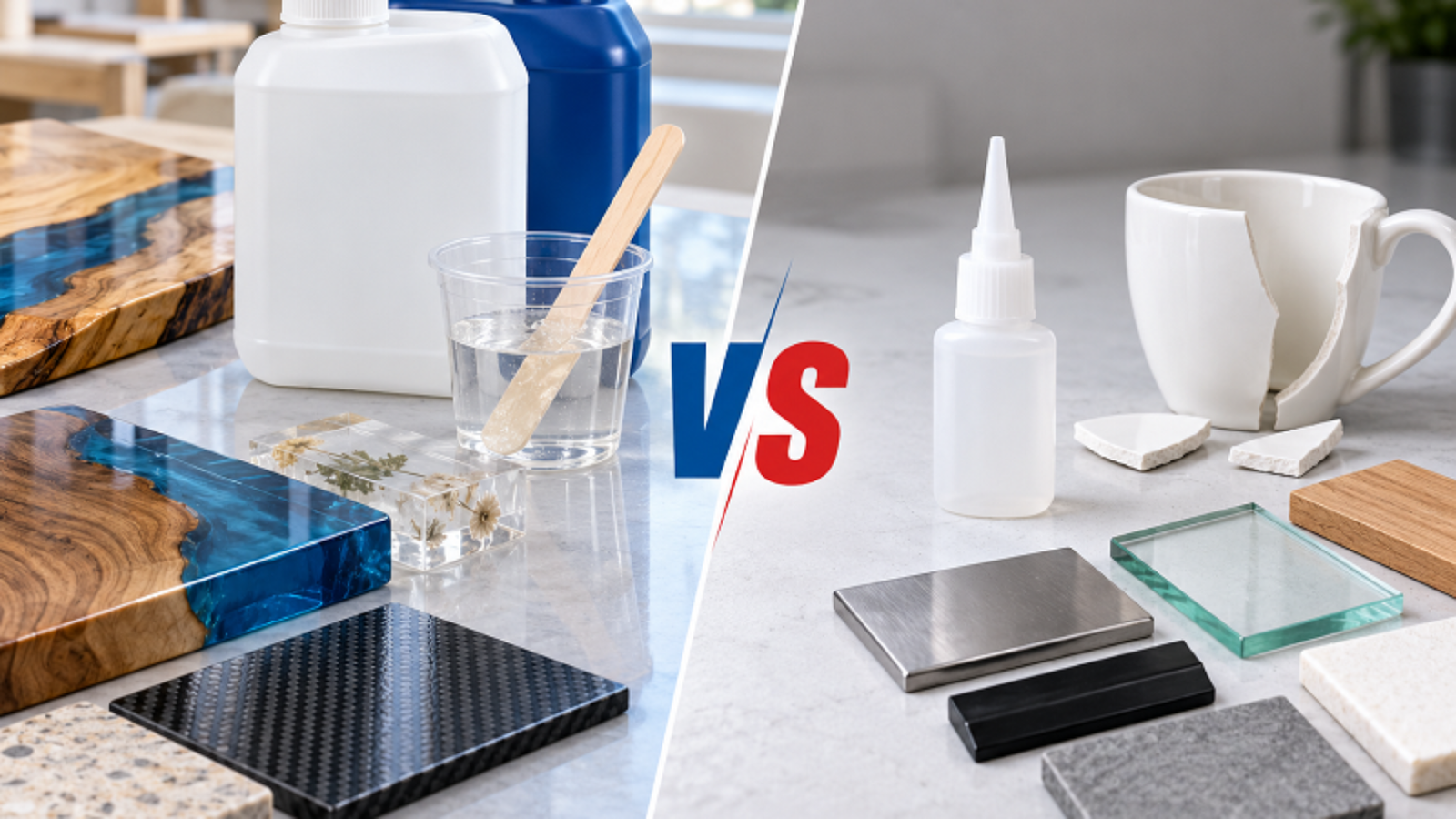

Anyone sourcing resin for coatings, composites, furniture, or fiberglass work runs into the same fork in the road: epoxy or polyester?
Both are thermosetting resins. Both show up in boats, floors, tanks, tables, and tooling. But they’re not interchangeable, and picking the wrong one costs more than a bad batch — it costs warranty claims, rework, and a buyer who doesn’t reorder.
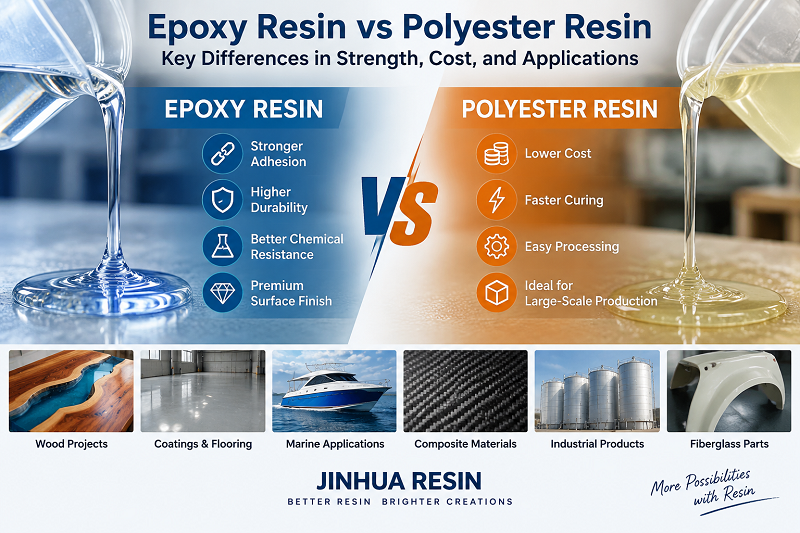
There’s no universal winner in the epoxy resin vs polyester resin decision. Epoxy wins on strength, adhesion, and chemical resistance. Polyester wins on price and speed. The right call depends entirely on what you’re building and who’s paying for it.
Two Different Chemistries, Two Different Jobs
Epoxy resin cures through a reaction between resin and hardener, mixed at a specific ratio. Get the ratio wrong and the cure fails — no shortcuts. That precision is also what gives epoxy its cross-linked structure and the mechanical performance that comes with it: strong bonding to wood, metal, concrete, and fiberglass, low shrinkage, and a cure profile you can actually control.
Polyester resin cures differently — a catalyst (usually MEKP) kicks off the reaction rather than a stoichiometric hardener. That’s part of why it’s cheaper to produce and faster to process. It’s the standard resin behind fiberglass boats, automotive panels, storage tanks, and most large-volume composite molding, where MEKP-cured shops have run for decades without needing epoxy’s precision.
Epoxy Resin vs Polyester Resin: Side-by-Side
| Feature | Epoxy Resin | Polyester Resin |
| Adhesion | Excellent | Moderate |
| Mechanical strength | Higher | Good |
| Chemical resistance | Excellent | Moderate to good |
| Water resistance | Excellent | Good |
| Cure shrinkage | Low | Higher |
| Odor | Low to moderate | Stronger |
| Cure speed | Adjustable | Usually faster |
| Cost | Higher | Lower |
| Surface finish | Excellent | Good |
| Crack resistance | Better | More brittle |
| Dimensional stability | Better | Lower |
| Processing | Needs accurate mixing | Easier at volume |
Strength: Epoxy Doesn’t Really Compete Here — It Just Wins
Epoxy’s tensile strength, bonding strength, impact resistance, and fatigue resistance all outperform polyester in direct comparisons. That’s why it shows up in applications where a failure years down the line isn’t an option.
Polyester holds up fine when reinforced with fiberglass — plenty of boats and panels have proven that over decades. But on its own, it shrinks more during cure and bonds less aggressively to the substrate, which shows up as brittleness sooner. For big composite runs where the budget rules, that trade-off is usually acceptable. For anything load-bearing or long-term, it’s a real limitation.
Why Epoxy Sticks Better
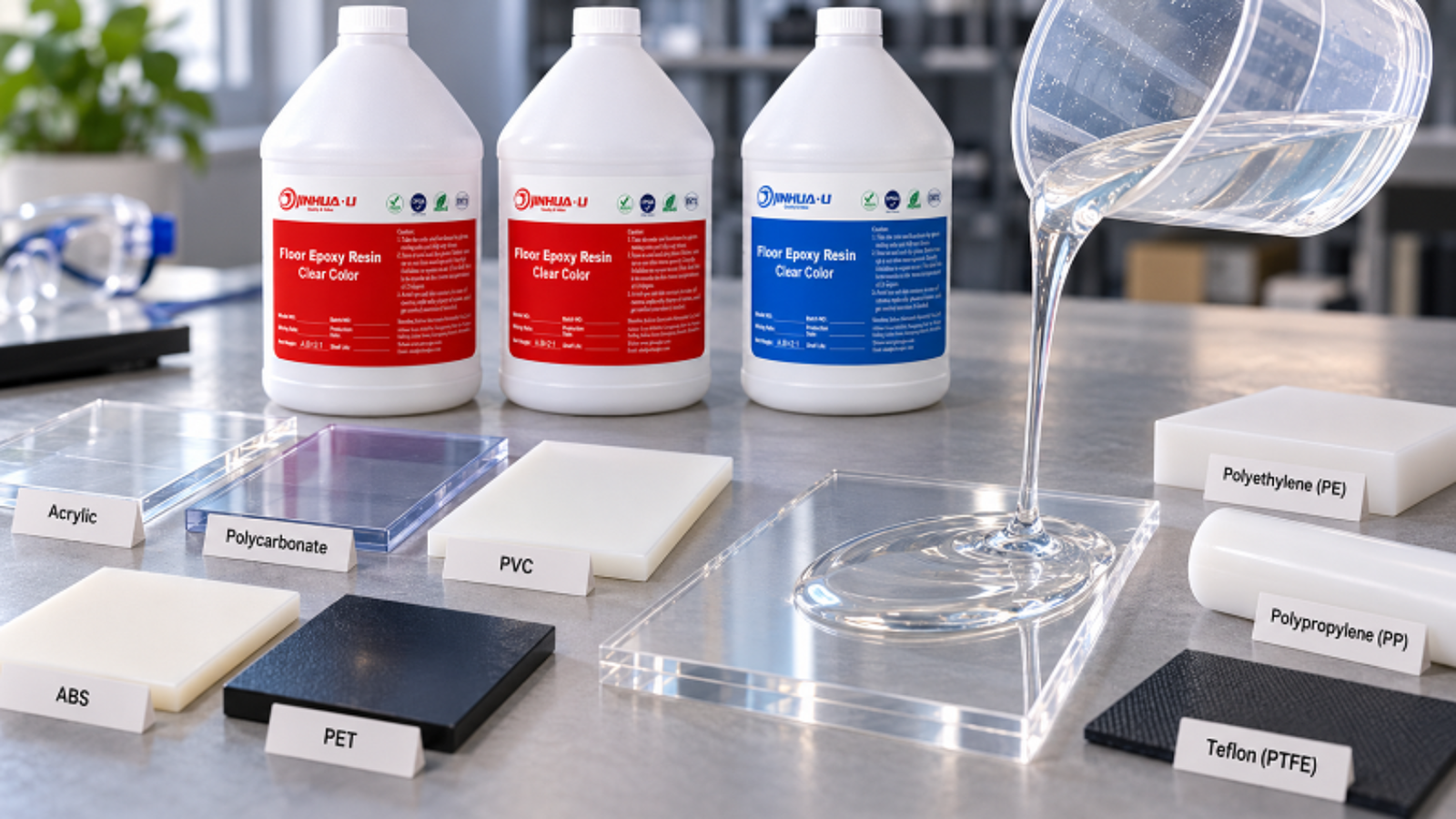
Adhesion is where the two resins diverge most. Epoxy’s chemistry lets it bond directly to wood, metal, concrete, carbon fiber, fiberglass, and most prepped plastics — which is exactly why it dominates repair work, protective coatings, and composite lay-ups where the resin itself has to hold.
Polyester leans on mechanical bonding instead of chemical bonding. Wrapped around fiberglass, it performs well. Asked to bond directly to a substrate the way epoxy does, it usually falls short. If the resin needs to be the adhesive, not just the matrix, epoxy is the safer bet.
Cure Time: Fast Isn’t Always Better
Polyester cures quickly, which is exactly what high-volume shops want — faster turnaround, more units per shift. The trade-off is a shorter working window, harder positioning, and more shrinkage stress baked into the part.
Epoxy’s cure speed is a spectrum, not a fixed number. Fast-cure, standard-cure, and slow-cure deep pour formulations all exist, and the slower end of that range buys you lower internal stress, more working time, and a better final surface. For anything where precision matters more than throughput, that adjustability is the whole point.
Is Polyester Actually Cheaper?
On sticker price, the epoxy resin vs polyester resin gap is real — polyester wins on lower raw material cost, cheaper processing, and faster cycles. For a boat builder running thousands of hulls a year, that math is hard to argue with.
But “cheaper” and “lower total cost” aren’t the same thing. Epoxy’s durability, reduced maintenance, and longer service life often close the gap over the life of the product — especially when the substrate underneath is expensive enough that a coating failure means redoing the whole job. Price the resin against the project’s lifespan, not just the invoice.
Fiberglass: Both Work, Different Tiers
Polyester fiberglass covers the volume end of the market — boats, automotive parts, panels, industrial molding — where cost and speed decide the spec.
Epoxy fiberglass shows up where failure isn’t an option: aerospace parts, carbon fiber structures, marine repair, high-performance composites. Stronger fiber bonding, lower shrinkage, better fatigue resistance. For anything engineered to a performance spec rather than a price point, epoxy is usually the default.
Wood: Not Really a Contest
Wood moves — it absorbs moisture, expands, contracts, and it’s porous by nature. Polyester’s adhesion and flexibility aren’t built for that. Epoxy is: it penetrates the grain, seals fibers, fills cracks, and bonds tightly enough to handle wood’s constant movement.
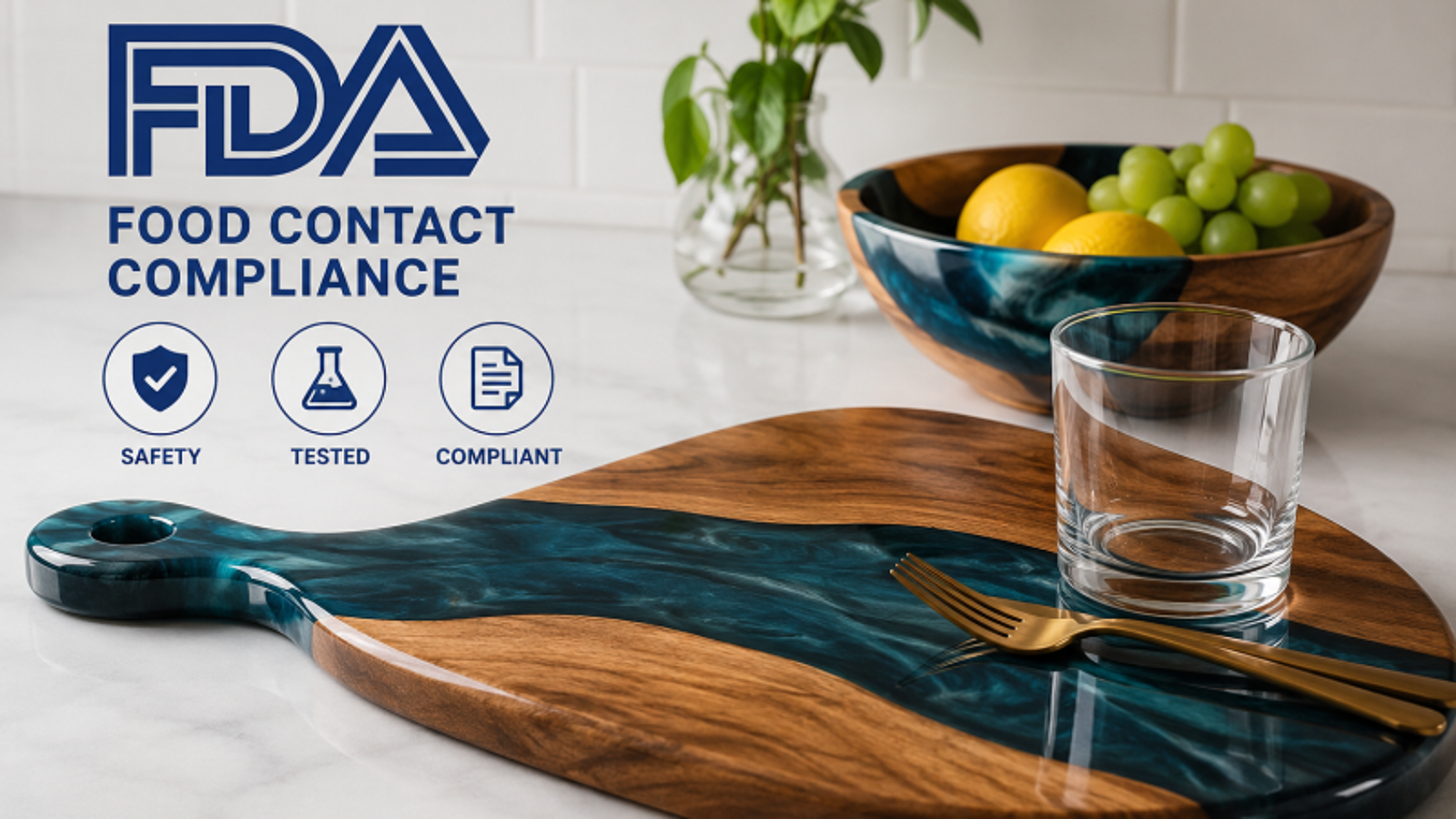
That’s the entire reason river tables, live-edge furniture, wood stabilization, and countertop pours are an epoxy category almost exclusively. Polyester barely shows up here for a reason.
Coatings: Epoxy’s Home Turf
Industrial floors, garage floors, concrete protection, chemical-resistant surfaces — epoxy dominates coatings because adhesion, hardness, and chemical resistance are exactly what those jobs demand.
One caveat worth flagging: standard epoxy can yellow under prolonged UV exposure without a stabilizer or a protective topcoat. For outdoor coatings, that’s a spec question to raise before quoting the job, not after it’s installed.
Chemical Resistance
Epoxy holds up against water, oils, solvents, and most industrial chemicals better than polyester does. For chemical storage, manufacturing floors, and protective coatings in industrial settings, that resistance is usually the deciding factor — not price.
Shrinkage and Dimensional Accuracy
All thermosets shrink somewhat during cure, but epoxy shrinks less than polyester. Less shrinkage means less internal stress, tighter dimensional accuracy, and a lower risk of cracking after the part comes out of the mold. For precision components and decorative castings, that difference shows up directly in the finish.
Epoxy Resin vs Polyester Resin: Which One Should You Actually Use?
Go with epoxy when: the job needs strong adhesion, long-term durability, chemical resistance, low shrinkage, or a premium finish — river tables, furniture coatings, industrial flooring, carbon fiber composites, marine repair, structural bonding.
Go with polyester when: the priority is cost and volume — fiberglass boats, automotive parts, composite panels, storage tanks, general molding.
Can epoxy replace polyester? Often, yes — when performance matters more than unit cost. But a shop pushing out thousands of large fiberglass parts a year still has good reason to stick with polyester; the economics don’t always favor switching. It comes down to volume, required strength, budget, and how the part will actually be used.
FAQ
In the epoxy resin vs polyester resin comparison, is epoxy actually stronger? On mechanical performance, adhesion, and durability, yes. Polyester still earns its place in fiberglass work where cost efficiency drives the decision.
Which is cheaper — epoxy or polyester resin? Polyester, generally, due to lower material cost and faster processing.
Can epoxy resin replace polyester resin? In many cases, yes — particularly where strength, adhesion, or durability matter more than unit price.
Which resin is better for fiberglass? Both work. Polyester covers cost-driven, high-volume production; epoxy covers performance-driven composites.
Which resin is better for wood? Epoxy, by a wide margin — its adhesion, penetration, and crack-filling ability suit wood’s movement far better than polyester’s.
Does polyester yellow more than epoxy? Both can shift color over time depending on formulation and UV exposure. Yellowing resistance comes down to the specific product’s UV stabilization, not the resin family alone.
Jinhua Resin supplies epoxy systems for deep casting, tabletop coatings, DIY projects, industrial applications, and OEM/private-label programs. Matching the right formulation — viscosity, cure speed, hardness, clarity — to the application is what keeps performance consistent across different markets.