

Epoxy Resin Manufacturer (5)

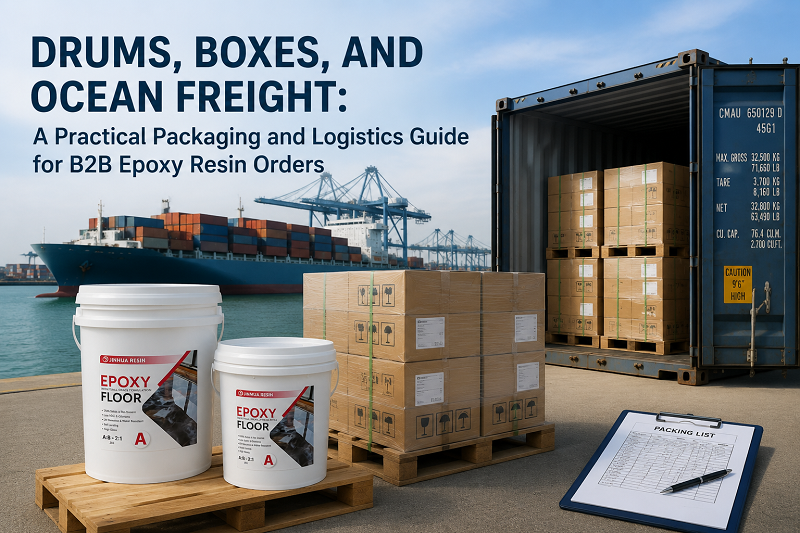
Drums, Boxes, and Ocean Freight: A Practical Packaging and Logistics Guide for B2B Epoxy Resin Orders

The Question Nobody Asks Until It’s Too Late

Most conversations about sourcing epoxy resin from China focus on formulation, price, and certifications. Packaging and logistics come up late — usually after someone has received a shipment with damaged drums, unexpected hazmat surcharges, or a container that technically complied with regulations but caused delays at the port.

Packaging isn’t just a box. For a liquid chemical product like epoxy resin, it determines your landed cost, your customs classification, your freight options, and how the product behaves by the time it reaches your warehouse. Getting this part right at the sourcing stage — before the first purchase order — saves real money and prevents real headaches.

This guide covers the standard packaging configurations for epoxy resin, how each one affects ocean freight logistics, and what to confirm with your Chinese epoxy resin manufacturer before you sign anything.
Epoxy Resin Manufacturer (5)

Packaging Formats: What’s Actually Available

Small-Volume Retail and E-Commerce Units

At the smallest scale, epoxy resin ships in dual-component kits — typically 0.5L, 1L, 2L, or 4L sets combining resin and hardener in matching bottles or cans. These are the units that end up on e-commerce platforms and in craft supply stores.

For B2B importers, these small units aren’t the primary purchase format — but they matter for private label brands that sell into consumer or small-business channels. Lead times, minimum order quantities, and labeling requirements for retail kits are different from bulk formats, and they need to be negotiated separately with the epoxy resin manufacturer even when you’re buying the same underlying chemistry.

Retail kits also carry different freight handling requirements. Consumer-packaged chemical products typically ship as Limited Quantity (LQ) under IMDG regulations, which reduces documentation burden but also limits how they can be consolidated.

Pails: 5-Gallon and 20-Liter

The 5-gallon pail (roughly 18–19L) and the 20-liter pail are the workhorses of the mid-volume epoxy market. They’re the standard unit for woodworking shops, fabricators, small contractors, and any B2B buyer who processes product at the unit level rather than pumping from a drum.

Pails palletize cleanly — typically 4 per layer, 4–5 layers per pallet, giving you 16–20 pails per pallet depending on the product density and pail height. HDPE pails with sealed lids are standard; some manufacturers use metal pails for hardener components where chemical compatibility requires it.

For importers building a distribution model, pails are often the sweet spot. They’re manageable for downstream customers who don’t have drum-handling equipment, they ship on standard pallets, and they can be labeled for retail or trade distribution with less regulatory friction than drums.

Drums: 55-Gallon / 200-Liter

The 200-liter steel or HDPE drum is the standard bulk format for epoxy resin orders above a certain volume threshold. It’s what most experienced importers default to once they’re past the sample-and-trial stage.

A standard 20-foot container holds approximately 80 drums at 200L each — roughly 16,000 liters of product, or around 18–19 metric tons depending on resin density. A 40-foot container roughly doubles that. These are the volume benchmarks that most Chinese epoxy resin manufacturers quote against.

Steel drums are common for resin components. HDPE drums are more typical for amine-based hardeners, where steel can cause compatibility issues over storage time. Confirm material compatibility with your supplier — it’s a basic question, but it’s one that sometimes doesn’t come up until there’s a problem.

Drum orders require proper UN-certified packaging. For epoxy resins classified as Class 9 or non-regulated under IMDG depending on formulation, the UN certification requirement on the drum itself is a compliance item that needs to be confirmed before shipment — not after.

IBC Totes: 1,000-Liter

Intermediate Bulk Containers — IBCs — are 1,000-liter cage-mounted tanks used for very high-volume orders or for buyers with pumping and dispensing infrastructure. They’re less common in the table top epoxy and casting resin segment, more common in industrial coatings and construction adhesives where throughput volume justifies the equipment investment.

IBCs offer the best per-liter freight economics at scale, but they require receiving facilities with forklift access and liquid handling capability. If your downstream customers or warehouse don’t have this, IBCs create handling problems that eat up the cost savings.


Hazardous Material Classification: Where Things Get Complicated

Epoxy resin products occupy a complicated position in international hazmat regulations. Some formulations are classified as dangerous goods under IMDG; others ship as non-regulated materials. The difference has direct implications for freight costs, documentation, and which carriers will accept the shipment.

IMDG Classification Basics

The International Maritime Dangerous Goods code governs how chemical products are classified and handled on ocean freight. For epoxy resin:

  • Liquid epoxy resin (bisphenol A/epichlorohydrin, MW ≤ 700) typically classifies as Class 9, UN 3082 — Environmentally Hazardous Substance, Liquid. This is the mildest hazmat classification and carries relatively modest documentation requirements.
  • Amine hardeners — particularly low-molecular-weight aliphatic amines — often classify as Class 8 Corrosives, UN 2735 or similar, depending on the specific chemistry. Class 8 carries more documentation weight and higher freight surcharges.
  • Some high-viscosity or solid epoxy formulations may qualify as non-regulated, which significantly simplifies shipping.

The practical implication: a complete two-part epoxy system may have its resin component shipping as Class 9 and its hardener shipping as Class 8 — two different UN numbers, two different sets of documentation, potentially two different handling requirements at the port. Importers who don’t map this out in advance end up surprised by MSDS declarations, carrier surcharges, and port handling fees that weren’t in the original freight quote.

Your Chinese epoxy resin manufacturer should be able to provide the IMDG classification for each component, along with the corresponding Safety Data Sheet structured to international standards. If they can’t — or if their SDS doesn’t clearly state the IMDG classification — that’s information worth resolving before booking freight.

Dangerous Goods Documentation

For any shipment that includes IMDG-classified components, the following documents need to be confirmed before the vessel departs:

  • Dangerous Goods Declaration (DGD) — prepared by the shipper, certifying that the goods are properly classified, packaged, and marked
  • Safety Data Sheet (SDS) — 16-section GHS-compliant document for each component
  • UN-certified packaging certification — confirming the drums or pails meet UN performance standards for the specific goods
  • Emergency Response information — contact details and procedures, typically embedded in the SDS or DGD

Experienced freight forwarders handle the DGD preparation as a matter of course. But the underlying information — classification, packaging certification, SDS — has to come from the manufacturer. A supplier who has exported to regulated markets before will have these documents ready. One who hasn’t will need time to produce them, and “I’ll send it next week” doesn’t work when the vessel booking window is open.


Ocean Freight: How Packaging Format Affects Your Costs

FCL vs. LCL

Full Container Load (FCL) — you book the whole container. Your cargo doesn’t share space with anyone else’s. For drum orders at volume, FCL is almost always the better economic choice once you’re past a certain tonnage threshold. It’s also simpler from a hazmat handling perspective — you control what’s in the container.

Less than Container Load (LCL) — your cargo consolidates with other shippers’ cargo in a shared container. LCL makes sense for smaller orders or early-stage buying before you’ve validated volume. For hazmat cargo, LCL has stricter co-loading restrictions — not every freight forwarder will consolidate Class 8 hardeners with non-hazmat goods, and some ports have explicit rules about what can share space with dangerous goods. Confirm hazmat LCL acceptance with your forwarder before planning around it.

Weight vs. Volume: Which Governs Your Freight Rate

Ocean freight is charged on either gross weight or volume (CBM), whichever produces the higher revenue for the carrier — known as weight-or-measure, or W/M.

Epoxy resin is dense. A 200L drum of standard table top epoxy resin component weighs roughly 220–240kg. At that density, weight typically governs over volume, which means you’re paying per ton rather than per CBM. This is actually favorable compared to lighter products — you’re filling your container by weight before you fill it by volume, which improves cargo utilization.

Where this math shifts is with packaging-heavy configurations. Pails with significant headspace, over-boxed retail kits, or IBCs with low fill ratios start to eat into your per-liter freight efficiency. Ask your epoxy resin manufacturer for the gross weight and net weight per packaging unit — both numbers matter for freight calculation.

Port Selection and Transit Time

From South China manufacturing hubs (Guangdong, Dongguan, Foshan), the main departure ports for epoxy resin are Nansha, Yantian, and Shekou. For the U.S. West Coast, transit runs approximately 14–18 days. East Coast via Panama adds 25–30 days. Australia (Melbourne, Sydney) runs 12–16 days from Nansha. Canada West Coast (Vancouver) is comparable to U.S. West Coast; East Coast (Halifax, Montreal) adds time via Panama or Suez routing.

These are the numbers to use for lead time planning. Add buffer for Chinese factory holidays — Golden Week in early October, Spring Festival in January/February — when production and shipping schedules compress significantly.

Freight Surcharges Worth Knowing

Beyond the base ocean freight rate, the following surcharges apply with enough frequency to warrant line-item budgeting:

  • Hazmat surcharge (HMC): applied by carriers on IMDG-classified cargo. Ranges from USD 50–200 per container depending on carrier and route, sometimes per-package.
  • Port congestion surcharge (PCS): applied when destination ports are running backlogs. Variable and unpredictable.
  • Bunker Adjustment Factor (BAF): fuel surcharge applied by most carriers, fluctuates with oil prices.
  • Documentation fee: for DGD preparation, typically charged by the freight forwarder.
  • Destination delivery charge (DDC): port handling on the receiving end.

The gap between a quoted ocean freight rate and actual landed freight cost is routinely 30–50% for first-time importers who haven’t accounted for these items. Build them into your cost model from the beginning.


What to Confirm With Your Supplier Before the First Order

A competent Chinese epoxy resin manufacturer should be able to answer the following without hesitation. If any of these questions produce vague answers or require multiple follow-ups, that tells you something about their export readiness.

Packaging:

  • What packaging formats are available at my order volume? (Pails, drums, IBCs — and minimum order per format)
  • Are drums UN-certified? What is the UN certification number and performance standard?
  • What is the gross weight, net weight, and dimensions per packaging unit?
  • Can you provide custom labeling or bilingual labeling for my destination market?

Hazmat and documentation:

  • What is the IMDG classification for each component? (UN number, class, packing group)
  • Can you provide a 16-section GHS-compliant SDS for each component?
  • Can you prepare or support the Dangerous Goods Declaration?

Logistics:

  • Which departure port do you use, and what is the typical transit time to my destination?
  • What are your standard payment terms and production lead times?
  • How do you handle Chinese factory holidays in your production schedule?

Jinhua Resin (jinhuaresin.com) is a Guangdong-based epoxy resin manufacturer with active FCL export programs to North America, Australia, and the UK. Product range covers table top epoxy, deep pour casting resin, and UV resin, available in pail, drum, and IBC formats. UN-certified packaging, full IMDG documentation, and OEM labeling are standard for export orders.


A Working Checklist: Before the Container Loads

  1. Confirm packaging format, UN certification, and per-unit weight/CBM with your supplier.
  2. Get the IMDG classification for each component — resin and hardener separately.
  3. Request GHS-compliant SDS documents for all components before booking freight.
  4. Brief your freight forwarder on hazmat classification before they quote.
  5. Build landed cost including base freight, HMC, BAF, DDC, and import duties.
  6. Confirm production lead time against your target vessel booking date.
  7. Plan around Chinese factory holiday schedules if your order window overlaps.

The Cost Is in the Details

Ocean freight for epoxy resin isn’t complicated — but it has enough moving parts that underprepared importers consistently pay more than they should or receive shipments that cause problems at customs. The fix is straightforward: ask the right questions at the sourcing stage, qualify suppliers on their export documentation capability, and work with a freight forwarder who has handled IMDG cargo before.

The packaging format you choose, the hazmat classification of your product, and the documentation your supplier can produce aren’t afterthoughts. They’re the variables that determine whether your landed cost matches your business model — or doesn’t.


Sourcing table top epoxy or casting resin for international distribution? Jinhua Resin provides FCL export programs with full IMDG documentation, UN-certified packaging, and OEM labeling for importers in the U.S., Australia, Canada, and the UK: jinhuaresin.com
Epoxy Resin (2)

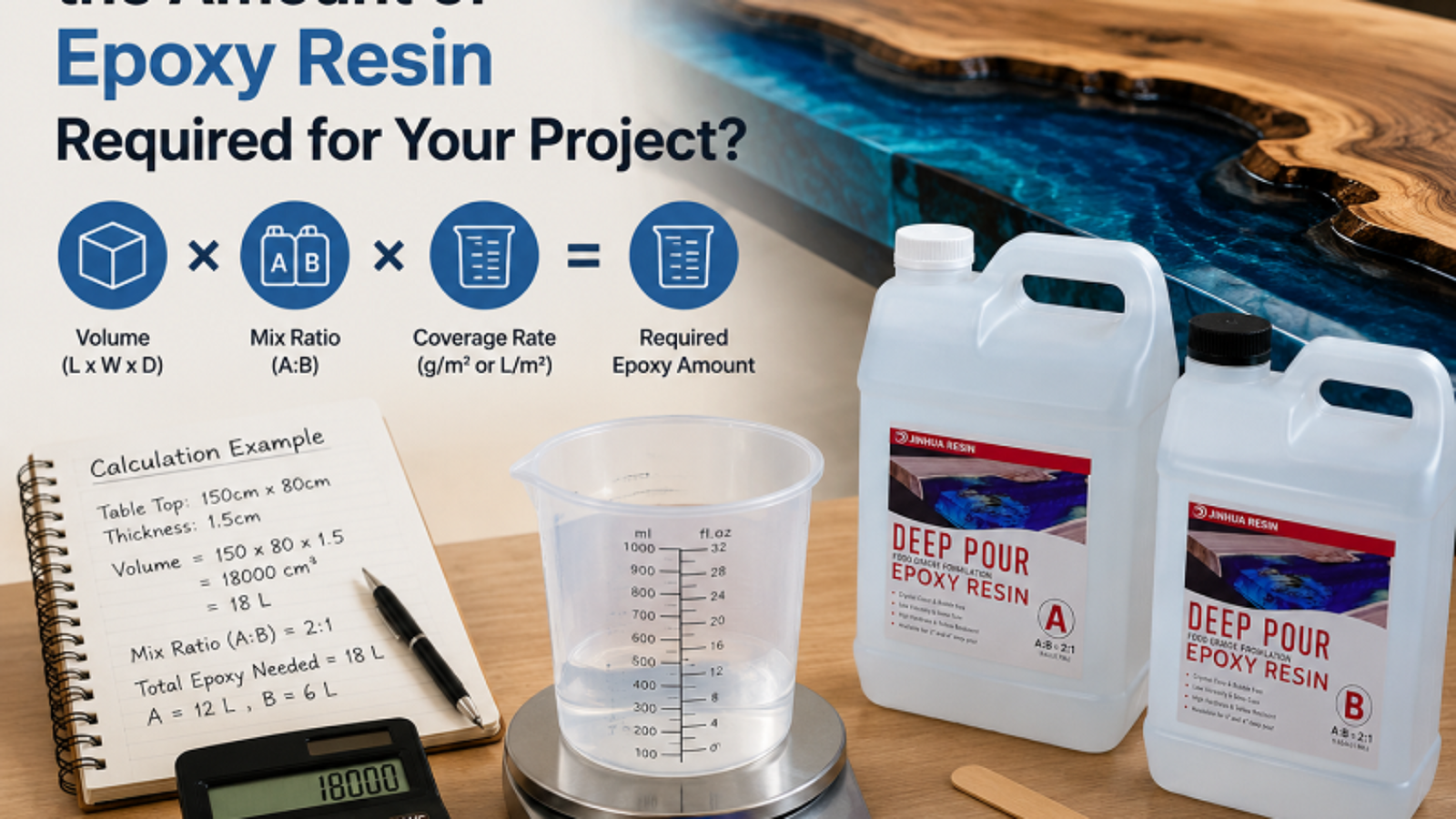
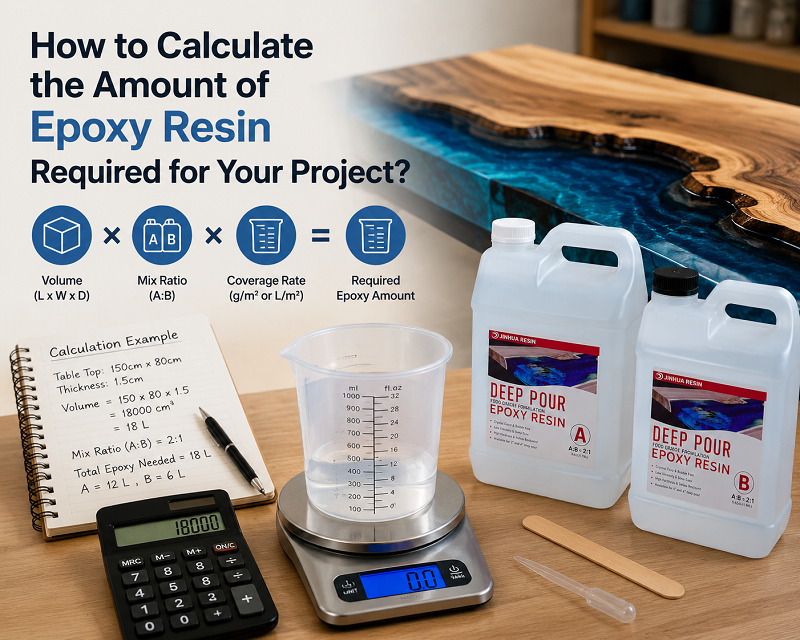
How to Calculate the Amount of Epoxy Resin Required for Your Project? (With Simple Calculation Formulas Attached)

One of the most common pitfalls for both beginners and experienced crafters embarking on a new project is misjudging the volume of materials needed. Mix too little epoxy resin, and you are forced to rush a second batch mid-pour, risking distinct lines, structural weaknesses, and uneven curing. Mix too much, and you end up wasting premium-grade chemical liquid that hardens uselessly in your mixing container.

Accurately calculating the exact volume of epoxy resin required before you crack open your bottles ensures a flawless finish, seamless layering, and budget-friendly project management.

Whether you are preparing to seal a wooden kitchen countertop, coat a canvas, or pour a massive deep-pour river table, this comprehensive guide breaks down the precise mathematical formulas and physical variables you need to know.

Epoxy Resin (2)

The Core Variables: Understanding Three-Dimensional Volume

To find out how much epoxy resin liquid will fill a specific space, we must treat the project area as a three-dimensional geometric shape. Regardless of the shape, you will always need to measure three essential metrics:

  1. Length
  2. Width
  3. Depth (or Thickness)

Crucial Tip for Accuracy: Always use the same unit of measurement for every dimension before performing your calculations. If you measure your table length in meters but its depth in millimeters, your final calculation will be completely distorted. For precision, converting everything into centimeters ($cm$) or inches ($in$) from the very start is highly recommended.

Standard Calculation Formulas for Different Project Shapes

Not every epoxy resin project is a perfect rectangle. Below are the standard geometric formulas tailored specifically for casting and coating projects.

1. Cuboid and Rectangular Projects (Tables, Trays, Countertops)

For classic rectangular projects like river tables, chopping boards, or surface coatings, you are dealing with a standard rectangular prism volume.

Volume = Length \times Width \times Depth

  • Metric System Formula (cm):Volume~(cm^3) = Length~(cm) \times Width~(cm) \times Depth~(cm)
  • Imperial System Formula (in):$$Volume~(in^3) = Length~(in) \times Width~(in) \times Depth~(in)

2. Circular and Round Projects (Coasters, Round Tables, Clock Faces)

When pouring epoxy resin into circular silicone molds or onto round table surfaces, the formula shifts to account for the radius (r) of the circle and the mathematical constant Pi ($\pi \approx 3.1416$).

Volume = \pi \times r^2 \times Depth

  • Metric System Formula (cm):Volume~(cm^3) = 3.1416 \times [Radius~(cm)]^2 \times Depth~(cm)(Note: Radius is exactly half of the total diameter of your circle).

Converting Volume into Weight (The Density Factor)

Calculating the physical space or volume ($cm^3$ or $in^3$) is only the first part of the puzzle. Liquid epoxy resin kits are heavily manufactured and sold by weight (grams or kilograms) or fluid volume (ounces or liters).

Because epoxy resin compounds possess a higher density than plain water, 1 milliliter of mixed polymer does not weigh exactly 1 gram. On average, the specific gravity (density) of standard clear casting polymer sits around 1.1~g/cm^3$ to $1.15~g/cm^3.

To convert your calculated volume into the precise weight you need to measure out on your digital scale, use these simple conversion factors:

The Metric Conversion Pathway

If you measured your dimensions in centimeters, your volume is expressed in cubic centimeters ($cm^3$), which directly translates to milliliters ($ml$).

  • Weight~in~Grams~(g) = Volume~(cm^3) \times 1.1
  • Weight~in~Kilograms~(kg) = Grams \div 1000

The Imperial Conversion Pathway

If your measurements were recorded in inches, your volume is calculated in cubic inches ($in^3$).

  • Fluid~Ounces~(fl~oz) = Volume~(in^3) \times 0.554
  • Weight~in~Ounces~(oz) = Volume~(in^3) \times 0.61

Step-by-Step Practical Calculation Examples

Let’s look at two realistic scenarios to see how these math formulas work in a real-world workshop setting.

Example A: A Medium-Sized Rectangular River Table

Imagine you are crafting a wooden river table where the central void requiring an epoxy resin pour measures 120 cm long, 20 cm wide, and has a thickness of 4 cm.

  1. Calculate the Cubic Volume:120~cm \times 20~cm \times 4~cm = 9,600~cm^3~(ml)
  2. Convert Volume into Total Target Weight:9,600 \times 1.1 = 10,560~grams
  3. Final Requirement: You will need approximately 10.56 kg of total mixed material (Part A + Part B combined) to execute this specific pour successfully.

Example B: A Round Ocean-Theme Coaster

Suppose you are pouring a series of circular coasters using a silicone mold with a diameter of 10 cm and a desired pour depth of 0.8 cm.

  1. Determine the Radius:Radius = 10~cm \div 2 = 5~cm
  2. Calculate Circular Volume:3.1416 \times (5 \times 5) \times 0.8 = 3.1416 \times 25 \times 0.8 = 62.83~cm^3~(ml)
  3. Convert to Weight:62.83 \times 1.1 = 69.11~grams
  4. Final Requirement: Each coaster will consume roughly 69 grams of mixed fluid.

Crucial Field Adjustments: Account for the Wasted Space

While pure mathematics yields perfect answers on paper, practical material handling involves several real-world variables that can throw off your calculations if ignored.

1. The 10% Waste Buffer (Safety Margin)

No matter how carefully you pour, material loss is inevitable. A small amount of mixed epoxy resin will always remain stuck to the sides and bottom of your mixing buckets. Furthermore, if you are working on a coating project, material will drip over the edges during the leveling process.

The Professional Rule of Thumb: Always multiply your final calculated weight or volume by 1.1 (adding a 10% safety margin). It is infinitely better to have a tiny cup of leftover material than to look at a half-filled mold with a clock ticking on your chemical pot life.

2. Factoring in Irregular Objects (Wood, Stones, Embeds)

If your casting project involves submerging large solid objects—such as live-edge wood slabs in a river table or stones in a deep art piece—those objects displace liquid.

  • For tight, highly irregular spaces, break the area down into smaller imaginary rectangles, calculate each zone individually, and add them together.
  • If wood edges are wildly uneven, measure the maximum width and minimum width of the gap, find the average width, and plug that average value into your primary equation.

Summary Cheat Sheet for Workshop Reference

Keep this quick reference guide pinned inside your workspace to eliminate guesswork next time you prepare to mix your liquids:

Project ShapeBase Mathematical FormulaConversion to Total Metric Weight
Rectangle / SquareLength \times Width \times DepthVolume~(cm^3) \times 1.1 = Grams~(g)
Circle / Cylinder3.1416 \times Radius^2 \times DepthVolume~(cm^3) \times 1.1 = Grams~(g)

By taking five minutes to measure your dimensions accurately and running them through these basic conversion formulas, you protect your projects from curing defects, minimize expensive material waste, and achieve professional, highly predictable results with your epoxy resin systems every single time.

Epoxy Resin Manufacturer (4)

The U.S. Isn’t the Only Option: What Epoxy Resin Importers Need to Know About Australia and Canada

The Default Setting Nobody Questions

Walk into any sourcing conversation at a resin trade show, and someone mentions the U.S. market within the first two minutes. It makes sense — big volume, English-language commerce, well-documented regulations. For Chinese epoxy resin exporters, America became the obvious first call so long ago that most stopped asking whether it should still be.

Here’s the thing: Australia and Canada are both underserved, both growing, and both structurally set up for exactly the kind of product that experienced Chinese manufacturers produce. Neither country has meaningful domestic capacity for formulated resin at the product level. Buyers in both markets want table top epoxy and casting resin that ships reliably, documents cleanly, and lands at a price that leaves room for margin.

The gap isn’t awareness. It’s execution — specifically, knowing the regulatory terrain well enough to build a supplier relationship that holds up when a customs officer or a workplace inspector asks questions. This article covers that terrain.

Epoxy Resin Manufacturer (4)

Two Markets That Don’t Get Enough Credit

The global epoxy resin market sat at roughly USD 14.3 billion in 2025 and is on track to reach somewhere north of USD 23 billion by 2034. Asia Pacific manufacturers — China first among them — supply the bulk of global volume. But the interesting story for B2B importers isn’t the aggregate; it’s where the gaps are.

Australia’s resin market is projected to grow at 6% annually through 2031. That number is being driven partly by government infrastructure spend and renewable energy buildout, but also by a creative and furniture sector that consistently punches above its weight. River tables, resin art panels, custom bartops — Australia’s small-business artisan market is disproportionately active for its population size, and it buys on quality documentation as much as on price.

Canada runs parallel. Epoxy resin imports grew at a 4.19% CAGR between 2020 and 2024, backed by construction, automotive, and aerospace demand. The table top epoxy segment in Canada mirrors U.S. trends — shared culture, cross-border e-commerce, similar application patterns — which makes it a natural extension for any brand already operating in the U.S. market.

Neither country manufactures much of its own formulated resin. That’s the opening.


Australia: The Regulatory Landscape

AICIS — The Registration You Cannot Skip

Australia replaced its old NICNAS chemical framework in July 2020. What came out the other side is the Australian Industrial Chemicals Introduction Scheme — AICIS — governed by the Industrial Chemicals Act 2019.

The rule is simple: register your business before you import. Not before you sell. Before you import. The AICIS registration year runs September 1 through August 31, and registration applies to the business entity, not to individual products or SKUs. Miss the window and you’re out of compliance before the first container clears customs.

Once registered, every chemical introduction gets categorized into one of six risk tiers. For most standard resin formulations — the bisphenol A-based DGEBA systems and amine hardeners that make up the bulk of commercial table top epoxy — the relevant ingredients are already listed on Australia’s Inventory of Industrial Chemicals (AIIC). Listed chemicals get a smoother path. Novel chemistries or specialty additives not on the inventory trigger a more involved assessment process.

What this means for sourcing: your Chinese epoxy resin manufacturer needs to give you a full ingredient list — CAS numbers included — for every component in the formulation. Not a summary. Not a product name with “proprietary blend” underneath it. If they can’t do that, AICIS categorization becomes a guessing game, and guessing games don’t go well at the declaration stage.

SDS and Labeling

Australia runs GHS through Safe Work Australia. Every hazardous chemical sold or imported commercially needs a GHS-compliant label and a 16-section SDS in English that reflects the actual formulation. Generic export SDS documents written for Chinese domestic compliance won’t pass.

The ask when qualifying a new supplier: request the SDS that’s been specifically prepared for export to English-speaking regulated markets. Experienced exporters have these. New-to-export factories typically don’t — and that gap surfaces at the worst possible time.

The Tariff Situation

HS code 3907.30 applies to epoxy resins entering Australia. The standard customs duty is 5%. No anti-dumping duties currently apply to Chinese product — a meaningful contrast with the EU, where provisional ADD rates of up to 40.8% on Chinese epoxy resin were announced in early 2025. Australia’s current tariff environment is manageable and predictable, which makes landed cost modeling straightforward.

Where the Demand Actually Is

Construction and infrastructure remain the volume leaders. But for importers focused on the table top epoxy and casting resin segment specifically, the real action is in Australia’s artisan economy — furniture makers, resin artists, custom countertop fabricators — who buy through e-commerce channels and care deeply about product clarity, cure reliability, and documentation they can show customers. Differentiated product with a real TDS and a real SDS commands premiums here. Commodity resin doesn’t.


Canada: The Regulatory Landscape

CEPA — A Different System

Canada’s chemical management framework sits under the Canadian Environmental Protection Act — CEPA. Unlike AICIS, CEPA doesn’t require importers to register a business before bringing in industrial chemicals. The compliance structure is substance-first rather than business-first.

The key reference document is the Canadian Domestic Substances List (DSL) — the national inventory of assessed chemicals approved for use in Canada. Standard epoxy resin chemistries are already on the DSL. DGEBA resins, common amine and anhydride hardeners, the workhorses of commercial resin formulation — all assessed, all listed. For an importer bringing in a product built from DSL-listed components, no federal pre-market notification is required.

The flag goes up when a formulation includes something not on the DSL. In that case, a New Substance Notification must be filed with Environment and Climate Change Canada before the substance can be commercially imported or manufactured. Pre-entry DSL screening — done with the supplier’s full ingredient disclosure — catches this before it becomes a customs problem.

WHMIS: The Bilingual Requirement Nobody Budgets For

WHMIS 2015 is Canada’s workplace hazard communication system, fully aligned with GHS. Any epoxy resin product moving through commercial or industrial channels in Canada needs a WHMIS-compliant SDS and label. For national distribution — and especially for supply into Quebec — that SDS must be available in both English and French.

This is not a suggestion. French-language documentation is a legal requirement under WHMIS and under Quebec’s Charter of the French Language. Importers who discover this after their first Quebec customer asks for the French SDS are in an awkward position. Budget for it upfront. When qualifying a Chinese epoxy resin manufacturer for Canadian supply, ask directly: can they provide bilingual SDS documentation, or at minimum documentation suitable for Canadian compliance translation?

Toxic Substance Prohibitions — Updated December 2025

Canada revised its Prohibition of Certain Toxic Substances Regulations in December 2025. The new regulations entered into force June 30, 2026. The update prohibits importing, manufacturing, and selling specific hazardous substances and products containing them — targeting persistent, bioaccumulative compounds aligned with Canada’s Stockholm Convention commitments.

For standard commercial epoxy resin formulations, this isn’t typically a problem. The substances targeted are legacy compounds — flame retardants, chlorinated chemicals — not the core resin or hardener chemistry. But specialty additives, pigments, and reactive diluents can introduce unexpected ingredients. Screen the full formulation against the current Schedule 1 prohibited substances list before the first shipment. It takes an afternoon and prevents a much larger headache later.

Tariffs

Canada applies a 6.5% Most-Favoured-Nation duty on epoxy resin imports from non-CUSMA countries under HS 3907.30 — China included. No anti-dumping duties currently apply to Chinese resin in Canada. Factor the 6.5% into landed cost from day one; it’s stable and predictable, which makes financial modeling easier than in markets where ADD investigations create uncertainty.

Where the Demand Is

Canada’s volume is in construction coatings, industrial flooring, and adhesives. The creative resin and woodworking segment is growing — river tables, bartops, live-edge furniture — and tracks closely with the U.S. market in terms of product preferences and application trends. For brands already operating in the U.S., Canada is often a natural second market: similar distribution models, overlapping marketing content, and buyers who are already familiar with product categories they’ve seen on the U.S. side of the border.


What Separates a Usable Supplier from a Compliant One

Most Chinese epoxy resin manufacturers can ship product. Fewer can ship product into Australia or Canada without triggering compliance problems on arrival. Here’s what separates the two.

Ingredient transparency at the CAS level. AICIS categorization and DSL screening both require knowing exactly what’s in the formulation — not at the product level, but at the component level. A supplier who treats their formulation as a trade secret isn’t suitable for regulated-market supply. Full stop.

Market-specific SDS documentation. The SDS for Australian supply needs to be GHS-compliant to Safe Work Australia standards, in English, structured correctly. The SDS for Canadian supply needs the same, plus French. Generic export SDSs written for Chinese domestic distribution fail on both counts.

Formula stability across production runs. Compliance documentation — SDS files, AICIS declarations, DSL screenings — is tied to a specific formulation. If the factory changes suppliers for a raw material and the resin chemistry shifts, the documentation is stale. Ask about raw material sourcing stability and change notification protocols before signing a supply agreement.

OEM capability that goes beyond printing a label. Running a private label brand in Australia or Canada means more than sticking a logo on a Chinese factory’s standard container. It means custom packaging formats suited to local retail or trade channels, bilingual labeling where required, and documentation that carries your brand rather than the factory’s. An epoxy resin manufacturer with genuine OEM infrastructure — not just a willingness to swap labels — is a different animal from one that isn’t.

A certification portfolio that’s current. ISO 9001 is the baseline. Ask for the certificate and verify the expiry date — not the framed version on the factory wall, the actual current document. For specific downstream applications, additional certifications may matter.

Jinhua Resin (jinhuaresin.com) is a Guangdong-based epoxy resin manufacturer with active export programs into North American and Asia-Pacific markets. Product lines cover table top epoxy, deep pour casting resin, and UV resin, with OEM and private label capability for brands entering Australia and Canada. Full formulation disclosure and market-specific SDS documentation are available on request.


Before the First Container Ships: A Working Checklist

Australia:

  1. Run every formulation ingredient through the AICIS inventory search tool — confirm AIIC listing status before ordering.
  2. Register the business with AICIS before the first shipment. Registration year closes August 31.
  3. Categorize each introduction and set a reminder for the annual declaration deadline.
  4. Get the SDS from the supplier in Australian-market format. Review it — don’t just file it.
  5. Build landed cost with 5% customs duty and freight; confirm no ADD applies to the specific HS subheading.

Canada:

  1. Screen every ingredient in the formulation against the DSL. Flag anything not listed.
  2. File New Substance Notification for any flagged ingredient before the shipment date.
  3. Get the SDS in both English and French before the first sale into Quebec.
  4. Run the formulation against the December 2025 CEPA prohibited substances schedule.
  5. Build landed cost with 6.5% MFN duty. Confirm supplier OEM capability in writing if private labeling.

The Opportunity Is There

Australia and Canada don’t appear on most Chinese exporters’ priority lists because they’re smaller than the U.S., and because the regulatory learning curve looks steeper than it actually is. Once you’ve run the compliance process once — AICIS registration, DSL screening, bilingual SDS — the ongoing burden is modest. What the process does require is a supplier willing to be fully transparent about what’s in their product.

That transparency question is the real filter. Importers who find a Chinese epoxy resin manufacturer that can document cleanly, formulate consistently, and support OEM at a professional level will find less competition in both markets than they’d face in the U.S. — and buyers who are willing to pay for product they can trust.


Planning to bring table top epoxy or casting resin into Australia or Canada? Jinhua Resin offers formulation documentation, bilingual SDS support, and OEM production for importers building brands in both markets: jinhuaresin.com

Diy Epoxy Resin (2)

Summer DIY Epoxy Resin Guide: How to Beat High Heat and Humidity

Working with DIY epoxy resin opens up a world of creative possibility — that glass-clear finish, the way it suspends color and texture like a moment frozen in amber. But start a project on a sweltering July afternoon, and things can go sideways fast. The liquid heats up almost the moment it hits the mixing cup. A milky haze creeps across what should be a mirror-clear surface. Or you come back the next morning expecting a hard, glossy piece, only to find it still tacky to the touch.

The culprit, more often than not, is the season itself. Summer heat and humidity don’t just make you uncomfortable — they actively interfere with the chemistry your resin depends on.

DIY epoxy resin cures through an exothermic reaction: the resin and hardener combine, generate heat, and gradually solidify. That process is finely tuned. Push the ambient temperature even a few degrees higher than intended, and the reaction accelerates in ways that are hard to control — trapping bubbles, causing uneven curing, or triggering excessive heat buildup that cracks or yellows the finished piece. Humidity adds another layer of trouble, introducing moisture that clouds the surface or prevents a clean bond.

This guide cuts through the guesswork. Whether you’re new to resin or running into summer-specific problems for the first time, you’ll find clear explanations of what’s actually happening — and practical fixes that work.

Diy Epoxy Resin (2)

1. The Heat Factor: Why Your Resin is Curing Too Fast

When it comes to polymer chemistry, temperature dictates speed. Typically, the sweet spot for pouring DIY epoxy resin sits between 21°C and 25°C (70°F – 77°F). Once your workspace climbs past 30°C (86°F), the chemical kinetics shift into overdrive.

Shorter Working Windows

The “pot life”—the golden window you have to mix, tint, pour, and pop bubbles—shrinks drastically in the summer. A standard 45-minute working time can easily drop to 15 minutes or less. If you aren’t careful, the liquid will begin to gel right in your mixing cup before you even finish adding pigments.

The Danger of Flash Curing

This is the ultimate summer nightmare for makers. When resin and hardener are mixed in large quantities, they generate natural internal heat. If the ambient air is already hot, that heat cannot escape. The mixture spirals into a runaway thermal reaction known as flash curing. The resin becomes intensely hot, smokes, cracks, turns yellow, and can even melt plastic mixing cups.

2. The Humidity Trap: Banishing Sticky Surfaces and Blush

While high heat accelerates the process, heavy summer humidity (anything above 70% relative humidity) sabotages the chemical structure itself. Epoxy hardeners are highly hygroscopic, meaning they actively draw moisture directly out of the air.

Amine Blush (The Cloudy Film)

When moisture reacts with un固化 (uncured) hardener on the surface of your project, it creates a chemical byproduct known as amine blush. This manifests as a dull, greasy, or waxy white film over your cured piece. Instead of a high-gloss finish, your artwork ends up looking foggy and dirty.

Sticky or Flexible Cures

Moisture disrupts the precise ratio needed for the polymer chains to cross-link properly. Areas contaminated by airborne water vapor will fail to polymerize completely. As a result, your piece may remain tacky to the touch, easily pick up fingerprints, or bend like rubber days after pouring.

3. Pro-Tips to Control Temperature and Moisture

You don’t have to put your hobby on pause until autumn. By implementing these workspace hacks used by professional resin studios, you can master DIY epoxy resin even in July.

Cooling Strategies

  • Mix in Smaller Batches: Deep containers trap heat. Keep your pours small and spread out, or use wide, shallow silicone bowls to mix your components. This allows the heat to dissipate into the air rather than building up internally.
  • The Pre-Pour Ice Bath: Before mixing your A and B parts together, submerge the sealed, individual bottles in a cold-water bath for 5 to 10 minutes. Lowering the initial temperature of the raw liquids buys you valuable extra working time.
  • Time-Shifting Your Workspace: If your studio lacks air conditioning, run your projects during the coolest parts of the day—either in the early morning or late at night.
  • Switch to a Slow Hardener: Swap out your standard casting formula for a “Deep Pour” or slow-curing resin. These formulas are engineered to release heat at a much slower rate, making them inherently more forgiving in hot weather.

Moisture-Defying Tactics

  • Check the Room Humidity: Keep a digital hygrometer near your workspace. If the relative humidity climbs past 65%–70%, it’s best to hold off on final clear topcoats.
  • Run a Dehumidifier: Setting up a dedicated dehumidifier in a closed room is the single most effective way to guarantee a mirror-like, glossy finish on your DIY epoxy resin projects.
  • The Protective Box Shield: Immediately after torching your fresh pour, invert a clean cardboard box or plastic container over the mold. This keeps dust out and traps a micro-climate of drier air directly above the curing surface.

4. Troubleshooting Summer Failures: Can You Save It?

If you’ve already ended up with a sticky or foggy mess, don’t throw it in the trash just yet. Try these restoration steps:

  • For Sticky, Cloudy Surfaces: Wipe down the tacky layer vigorously with a microfiber cloth soaked in high-grade isopropyl alcohol to strip away the amine blush. If the underlying resin is hard but dull, sand the surface with progressive grits (400 to 1500) and pour a fresh, thin topcoat under controlled, dry conditions.
  • For Gummy, Soft Projects: If the piece remains rubbery after 48 hours due to severe moisture contamination, it cannot be salvaged internally. You will need to scrape away the unpolymerized gooey sections, clean the substrate, and pour a fresh batch.

By keeping an eye on your room’s climate and adjusting your mixing habits, you can easily conquer the challenges of summer and create flawless resin art all year round.

Uv Resin

Making Jewelry with Epoxy Resin: Summer UV Resin Styles That Are Trending Right Now

Summer is when UV resin jewelry-making really comes into its own. The bright light, the beachy color palettes, the long afternoons that are perfect for a craft project on the porch — all of it lines up with what UV resin does best: fast, satisfying projects that go from liquid to finished piece in minutes under a UV lamp, rather than waiting a full day for a slow cure.

If you’ve got a UV lamp, some pigments, and an afternoon to spare, here are the styles that are showing up everywhere in summer 2025 — and how to get started with each one.

Uv Resin

1. Ocean Wave Pendants

The ocean wave look has been a UV resin staple for years, and it’s not going anywhere — but the 2025 take on it leans toward softer, more realistic color gradients rather than the bright, saturated blues that were popular a few seasons ago.

To get this effect: start with a clear UV resin base in your pendant mold or bezel. Add small amounts of white pigment in swirling motions to create foam-like texture, then layer in soft blue and seafoam green tones, blending at the edges rather than creating hard color lines. Cure each layer briefly under your UV lamp before adding the next — this lets you build depth without the colors muddying together.

A trick that’s gaining popularity: adding a tiny pinch of fine glitter or mica powder along the “foam” lines mimics the way sunlight catches sea spray. Keep it subtle — a little goes a long way with UV resin, since the light-curing process can make glitter clump if you add too much at once.


2. Pressed Flower Jewelry

Pressed flowers in resin aren’t new, but they’re having a real moment this summer, particularly with smaller, more delicate florals — baby’s breath, small daisies, pansies, and ferns — rather than large statement blooms.

The process is simple but benefits from patience. Press your flowers flat for at least a week before using them (a heavy book works fine if you don’t have a flower press). Place the pressed flower into your mold, pour a thin layer of clear UV resin to seat it in place, cure briefly, then pour the remaining resin to fully encapsulate the flower. Curing in thin layers prevents the flower from shifting or floating as the resin moves.

For pendants and earrings, small botanicals work better than large ones — they fit naturally within smaller mold sizes and don’t require deep pours, which keeps cure times short and consistent with UV resin’s quick-turnaround appeal.


3. Geode-Inspired Pieces

Geode jewelry — pieces that mimic the look of a cut crystal geode, with layered colors radiating from a “crystal” center — has moved from a niche technique to one of the most searched-for UV resin styles this year.

The look is built in layers: a base layer of deep, saturated color (purples, blues, and teals are especially popular for summer pieces) around the edges, transitioning to lighter tones toward the center, with small pieces of glass chips, crushed glass, or resin “crystals” clustered in the middle to mimic a crystal formation. Each color layer is cured separately under the UV lamp before the next is added, which is part of why UV resin — rather than slow-curing epoxy — is the preferred material for this technique. A multi-layer geode piece that might take all day with slow-cure epoxy can be completed in under an hour with UV resin.


4. Terrazzo-Style Earrings and Studs

The terrazzo look — small flecks of color suspended in a neutral or white base, mimicking the speckled stone flooring style — has carried over from home decor trends into jewelry, and it’s a particularly good fit for UV resin because of how quickly small, flat pieces like earrings and studs cure.

To create this effect: mix small amounts of colored resin (or use resin tinted with different pigments) and let them partially cure to a soft, rubbery state — not fully hard. Chop or break these partially-cured pieces into small, irregular flecks. Mix these flecks into a base layer of white or clear resin, pour into your mold, and cure under the UV lamp. The result is the classic terrazzo speckle pattern, and because both the flecks and the final pour use UV resin, the whole process — from mixing the fleck colors to the finished piece — can be done in a single afternoon.


5. Color-Shift and Iridescent Pieces

Pieces that shift in color depending on the angle and lighting — using color-shift mica powders or iridescent pigments — are one of the more eye-catching trends for summer 2025, and they photograph particularly well, which is part of why they’re popular for anyone making pieces to sell or share on social media.

These pigments work best in UV resin with a clear or very lightly tinted base, since the color-shift effect depends on light passing through and reflecting off the pigment particles — a heavily pigmented or opaque base will mute the effect. Mix the color-shift pigment into clear resin at a relatively low concentration (more isn’t always better here — over-pigmenting can make the shift effect look muddy rather than vibrant), pour into your mold, and cure. For pendants and statement pieces, a slightly thicker pour shows off the color-shift effect more dramatically than a very thin layer.


Tips for Working with UV Resin in Summer

A few practical notes for anyone getting started, especially if you’re working in a warm environment:

Heat affects pot life less than with two-part epoxy — UV resin doesn’t cure until exposed to UV light, so warm summer temperatures don’t speed up curing the way they would with a mixed two-part epoxy. That said, very warm resin can be slightly more fluid, which can help with self-leveling in flat pieces like pendants, but may also make fine details (like positioning small flecks or glitter) trickier to control.

Cure time depends on your lamp and layer thickness — thin layers (a few millimeters) typically cure in 60–120 seconds under a standard UV lamp, while thicker pours need longer exposure and may benefit from curing in stages rather than all at once.

Work in a well-ventilated space — even though UV resin cures quickly, ventilation during mixing and before curing is still good practice, same as with any resin product.

UV-resistant resin matters for color longevity — for pieces that will be worn outdoors or displayed near windows, a UV resin formulated with good anti-yellowing performance keeps colors looking fresh longer, especially for the lighter pastel tones popular in ocean and geode styles.


Final Thoughts

What makes UV resin particularly well-suited to summer jewelry-making is the pace — these are projects you can start, layer, and finish in an afternoon, which fits the rhythm of summer crafting much better than projects that need a full day (or several) to cure. Whether you’re drawn to ocean waves, pressed botanicals, geode layers, terrazzo speckles, or color-shift pieces, the techniques above all lean on the same core advantage: quick, controllable curing that lets you build up detail without long waiting periods between steps.

If you’re just getting started, a small UV lamp, a few silicone molds, and a clear UV resin with good clarity and color stability will cover most of the styles above — and from there, it’s mostly a matter of experimenting with pigments and layering techniques to find your own style.


Jinhua Resin | Professional Epoxy Resin Manufacturer | UV Resin & Art Resin | OEM & Bulk Supply Available

Epoxy Resin Manufacturer (3)

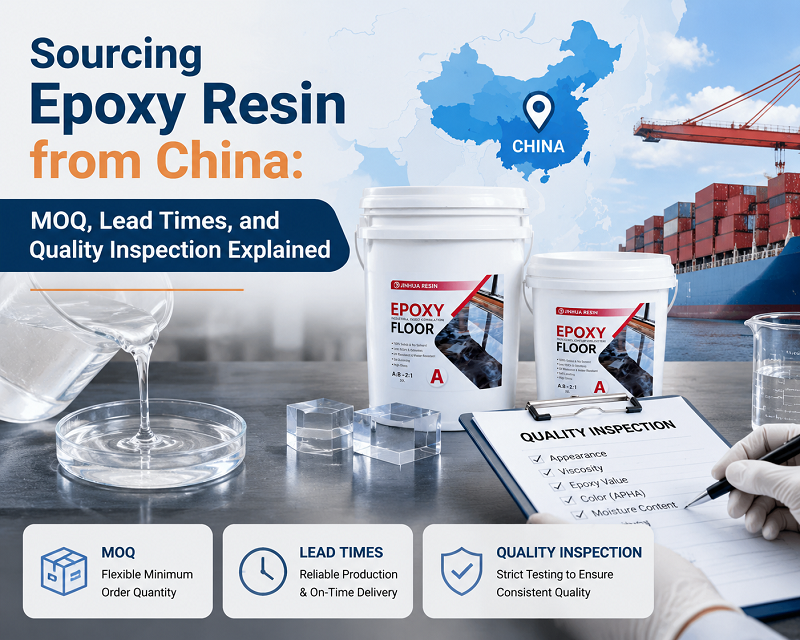
Sourcing Epoxy Resin manufacturer from China: MOQ, Lead Times, and Quality Inspection Explained

For many furniture manufacturers, distributors, and brand owners in North America, Europe, and Australia, China is already part of the resin supply chain — whether directly or several steps removed through a distributor marking up an imported product. The case for sourcing directly is straightforward: better pricing, more control over formulation and packaging, and a direct relationship with the people who actually make the product.

The case against it, in most buyers’ minds, comes down to three uncertainties: how much do I have to order, how long will it take, and how do I know what I’m getting is actually what I ordered. These aren’t unreasonable concerns — they’re the right questions. This guide answers them directly, based on how the process actually works with an established epoxy resin manufacturer in China.

Epoxy Resin Manufacturer (3)

Minimum Order Quantities: What’s Realistic, and Why They Exist

MOQ is often the first thing buyers ask about, and often the thing they’re most anxious about — particularly buyers used to ordering from domestic distributors in smaller quantities at retail-adjacent pricing.

Why MOQs Exist at the Manufacturer Level

A manufacturer’s MOQ isn’t an arbitrary gatekeeping number — it reflects the economics of running a production batch. Mixing equipment, raw material batch sizes, and quality control testing all have fixed costs that need to be spread across a production run. A batch that’s too small doesn’t just cost more per unit — in some cases it isn’t economically viable to run at all, because the fixed costs exceed any reasonable margin.

For standard table top epoxy and deep pour epoxy products, MOQs from established manufacturers typically start in the range of 200–500 kg for standard formulations and standard packaging. For custom formulations or custom packaging (private label, for example), MOQs are often higher — sometimes 1,000 kg or more — because the setup costs for a custom run are higher and need to be amortized across more volume.

How MOQ Relates to Container Shipping

For buyers shipping internationally, there’s a practical relationship between MOQ and container economics that’s worth understanding. A 20-foot container holds roughly 20–24 tons depending on packaging, and a 40-foot container roughly double that. Many manufacturers will quote more competitive per-unit pricing as your order approaches a full or partial container load, because the shipping cost per unit drops significantly — and because filling containers efficiently matters to the manufacturer’s own logistics planning.

For smaller buyers, LCL (less-than-container-load) shipping is the standard solution — your order shares container space with other shippers’ goods, at a higher per-unit shipping cost but without requiring you to fill an entire container. Most manufacturers experienced in export can arrange LCL shipping or work with freight forwarders who specialize in it.

Negotiating MOQ for New Relationships

For buyers testing a new supplier relationship, it’s common — and reasonable — to request a smaller initial order above standard MOQ in exchange for a commitment to larger reorders if the product performs as expected. Manufacturers serious about building long-term relationships will often accommodate this, particularly for buyers who can demonstrate a credible path to recurring volume. What’s less realistic is expecting sample-size quantities (a few kilograms) at production pricing — sample requests and bulk order MOQs operate under different economics, and conflating the two creates friction early in a supplier relationship.


Lead Times: What Actually Takes the Time

“How long until I receive my order” is really three separate questions: production lead time, documentation and inspection time, and shipping transit time. Buyers who plan around only one of these — usually shipping transit time, because it’s the most visible — tend to be surprised by the total.

Production Lead Time

For standard products in stock or readily producible from standing inventory of raw materials, production lead time can be as short as 1–2 weeks. For products requiring a dedicated production run — larger orders, custom colors, or formulations not currently in active production — lead time typically runs 2–4 weeks, depending on the manufacturer’s current production schedule and where your order falls in the queue.

This is one area where the supplier evaluation indicators from a stability assessment matter directly: a manufacturer who can tell you specifically where your order falls in their production schedule — rather than a generic “2-3 weeks” — is one whose planning process you can actually rely on.

Documentation and Pre-Shipment Inspection

Before goods leave the factory, documentation needs to be prepared: commercial invoice, packing list, certificate of origin (relevant for trade agreement tariff treatment), and for resin products, often a Certificate of Analysis (CoA) and Safety Data Sheet (SDS) specific to the batch being shipped. If you’ve requested compliance documentation — REACH, Prop 65, or others — this is also when batch-specific versions of those documents get finalized.

Many buyers also arrange a pre-shipment inspection (PSI) — either through their own representative, a freight forwarder’s inspection service, or a third-party inspection company (SGS, Bureau Veritas, and others offer this service in China). PSI typically adds 3–7 days to the timeline but provides verification that the goods match the order specification before they’re loaded — catching issues while they’re still correctable, rather than after a container has crossed the ocean.

Shipping Transit Time

For ocean freight — the standard method for bulk epoxy resin shipments given the weight and volume involved — transit times from major Chinese ports to North American and European destinations typically run as follows: to U.S. West Coast ports, roughly 2–3 weeks; to U.S. East Coast or European ports, roughly 4–6 weeks, depending on routing (via Panama Canal or Suez Canal) and whether the shipment is direct or transships through an intermediate port.

Air freight is faster (days rather than weeks) but rarely economical for bulk resin given its weight — it’s typically reserved for urgent sample shipments or very small orders.

Total Realistic Timeline

Combining these: for a standard product with available raw materials, a realistic total timeline from order confirmation to goods arriving at a North American or European port is roughly 5–9 weeks. For custom formulations or first orders requiring a dedicated production run, 8–12 weeks is more realistic. Buyers planning inventory around these timelines — rather than around shipping transit time alone — avoid the most common source of stockout surprises in import-based supply chains.


Quality Inspection: What to Check, and When

Quality issues in imported resin tend to surface in one of two ways: either the product doesn’t meet specification when tested on arrival, or it meets specification on paper but performs differently in application than expected. Both are addressable with the right inspection approach at the right stages.

Pre-Production Sample Verification

Before placing a bulk order, the sample you receive and approve should be tested under conditions matching your intended application — not just visually inspected. For deep pour epoxy, this means a test pour at a representative depth, checking exotherm behavior and cure time. For table top epoxy, this means a test application checking self-leveling, gloss, and cure characteristics.

Critically, retain a portion of the approved sample. This becomes your reference point for comparing against the bulk shipment when it arrives — color, clarity, and cure behavior should match the approved sample, not just meet generic spec sheet numbers.

Pre-Shipment Inspection (PSI)

As discussed above, PSI verifies that the goods being loaded match the order — correct product, correct quantity, correct packaging, and ideally a quick comparison against the approved sample for visual properties like color and clarity. PSI doesn’t typically include full performance testing (that would require curing a sample, which takes days), but it catches packaging errors, quantity discrepancies, and gross visual mismatches before the goods ship.

On-Arrival Testing

Once goods arrive, testing against the approved sample and the product specification confirms the shipment meets requirements before it enters your production process. For resin products, this typically includes: viscosity check, color/clarity comparison against the retained sample, and — ideally — a small test pour or application matching your actual use case, cured and evaluated before the bulk material is committed to production.

Documentation Cross-Check

Alongside physical testing, cross-reference the CoA provided with the shipment against your own test results. Discrepancies between the supplier’s stated batch parameters and your independent testing are worth investigating — occasional minor variance is normal, but systematic discrepancy suggests either a testing methodology difference worth resolving, or a documentation practice worth questioning.


Building These Into a Repeatable Process

For a first order, all of this can feel like significant overhead relative to the order size. The value becomes clearer on the second and third orders, when the process is repeatable: the same sample verification protocol, the same PSI arrangement (often the same inspection company, familiar with your specification), and the same on-arrival testing checklist.

An epoxy resin manufacturer experienced in export — particularly to North America and Europe — will be familiar with this process and won’t be thrown by PSI requests, CoA requirements, or questions about MOQ flexibility for a trial order. Manufacturers who are less experienced with export buyers sometimes treat these requests as unusual or burdensome, which itself is informative about how smoothly the broader relationship is likely to run.

At Jinhua Resin, we work with overseas buyers across North America, Europe, and Australia on standard MOQ and custom orders for table top epoxy, deep pour epoxy, and UV resin product lines, with established PSI and documentation processes for export shipments. Contact us to discuss MOQ, lead times, and inspection arrangements for your specific order.

Epoxy Resin

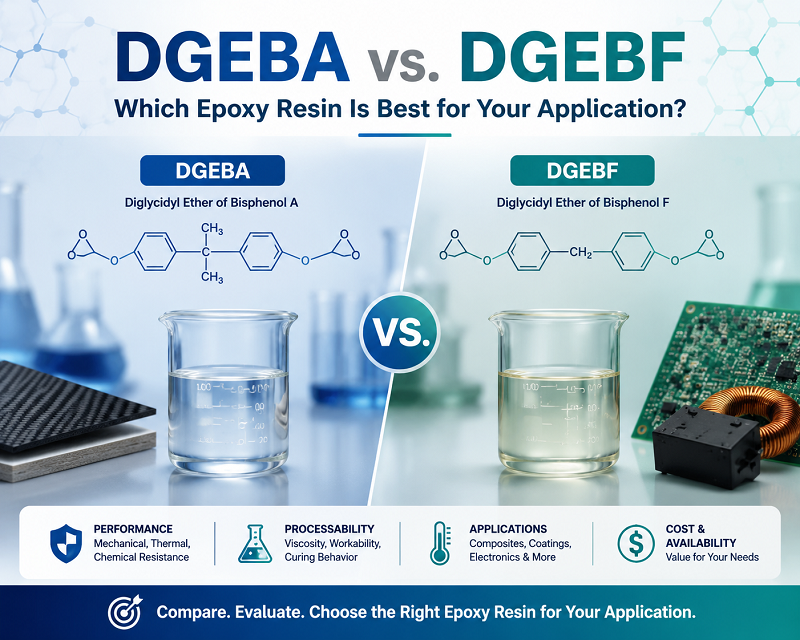
DGEBA vs. DGEBF: Which Epoxy Resin Is Best for Your Application?

When formulating industrial coatings, composites, or heavy-duty adhesives, your choice of polymer base dictates the lifespan of the entire project. In the high-performance thermosetting market, two options come up constantly: DGEBA and DGEBF.

At first glance, their technical data sheets look almost identical. However, treating them as interchangeable is a mistake that often leads to brittle coatings, premature product failure, or inflated production costs. To avoid these issues, smart procurement managers work closely with an established epoxy resin manufacturer to match the exact chemical grade to their specific operational environment.

This guide moves past the basic data sheets to compare the core chemistry, viscosity, chemical resistance, and actual field performance of Bisphenol-A and Bisphenol-F epoxy resins.

Epoxy Resin

1. The Core Chemistry: Breaking Down BPA vs. BPF

To predict how these resins perform under stress, we have to look at their molecular structures. This structural framework is exactly what an epoxy resin manufacturer alters to tune a product’s final properties.

What is DGEBA?

DGEBA (Diglycidyl Ether of Bisphenol-A) is the traditional industry standard. Produced by reacting Bisphenol-A (BPA) with epichlorohydrin, its molecule contains a rigid central carbon link alongside two bulky benzene rings. This stiff molecular backbone gives the cured material its excellent physical strength, thermal stability, and reliable electrical insulation.

What is DGEBF?

DGEBF (Diglycidyl Ether of Bisphenol-F) swaps out the Bisphenol-A for Bisphenol-F (BPF). By removing the central methyl groups found in BPA, it reduces internal crowding within the molecular chain. The resulting DGEBF molecule is leaner and more flexible before curing. This structural shift lowers the liquid viscosity and alters the final cross-link density, which is why it is highly sought after from any specialized industrial epoxy resin supplier.

2. Viscosity and Processing Behaviors on the Line

Viscosity directly affects your production efficiency, determining everything from pump wear to how fast the resin wets out fiber reinforcements.

PropertyDGEBA (Bisphenol-A)DGEBF (Bisphenol-F)
Typical Viscosity (at 25°C)11,000 – 15,000 mPa·s2,000 – 4,000 mPa·s
Risk of CrystallizationHighLow to Moderate
Need for DiluentsOften requires reactive diluentsFrequently used solvent-free
Fiber Wet-Out SpeedModerate to SlowRapid and thorough

The Practical Value of Low-Viscosity DGEBF

At room temperature, pure DGEBA feels like thick molasses. Moving or mixing it without applying heat or adding solvents is a constant headache for plant operators.

DGEBF changes that. Its viscosity is roughly one-quarter of standard DGEBA. This thin consistency gives B2B formulators a few major practical perks:

  • Higher Filler Loading: You can pack more functional fillers—like silica, alumina, or flame retardants—into the mix before it becomes too thick to pump.
  • Fewer Solvents Needed: It allows an epoxy resin manufacturer to build cleaner, zero-VOC formulations without relying on volatile organic solvents or reactive diluents that can compromise structural integrity.
  • Faster Wet-Out: In resin infusion setups (like RTM or VARTM) for carbon fiber, DGEBF flows easily through tight fabric layers, stopping dry spots before they happen.

Handling the Crystallization Headache

Cold warehouses kill DGEBA efficiency. The resin tends to crystallize into a milky, semi-solid paste that requires hours under heating blankets to liquefy. DGEBF uses an isomeric mixture profile that resists this crystallization process, giving it a much more forgiving shelf life in cold storage—a benefit any reliable epoxy resin factory will verify.

3. Cured Performance: Chemical Limits and Structural Toughness

When you blend the resin with an amine or acid anhydride hardener, DGEBF’s compact molecular shape yields a tighter cured matrix than DGEBA can manage.

Chemical and Solvent Resistance

Because DGEBF molecules are smaller, they pack tightly during polymerization. This creates a dense atomic grid that acts as a shield against chemical attacks. If you source your materials from a qualified epoxy resin manufacturer, they will typically recommend DGEBF systems for handling:

  • Aggressive organic solvents like acetone, toluene, and MEK.
  • Concentrated mineral acids (sulfuric, hydrochloric).
  • Corrosive industrial wastewater and crude oil sludges.

DGEBA handles basic environments well, but it swells, softens, and degrades much faster than DGEBF when soaked in harsh chemical baths over long periods.

Mechanical Strength and Heat Deflection

  • Strength vs. Stiffness: Both bases are tough. However, the rigid BPA backbone means DGEBA often retains slightly higher stiffness and modulus in low-stress environments.
  • Impact and Toughness: DGEBF yields a slightly more compliant, less brittle network, making it better at absorbing cyclic vibrations without cracking.
  • Glass Transition Temperature ($T_g$): Cured under identical lab conditions, DGEBA usually reaches a slightly higher $T_g$ due to its rigid aromatic center. If your project demands maximum resistance to dry heat, a custom DGEBA blend from your epoxy resin manufacturer is usually the right choice.

4. Downstream Industrial Applications: Matching Grades to Projects

These distinct performance profiles have split the industrial market into clear application camps, shaping how an epoxy resin factory runs its production schedules.

Where DGEBA Works Best

  • Civil Engineering & Everyday Adhesives: Standard concrete repair, commercial garage floor sealants, and consumer glues use DGEBA because it keeps raw material costs down.
  • Industrial Powder Coatings: Solid-grade DGEBA is the go-to base for electrostatic powder coatings used on appliances, car parts, and pipeline rebar.
  • Basic Electrical Encapsulation: For potting electronics that stay dry and operate at steady temperatures, DGEBA gives you great insulation without the premium price tag.

Where DGEBF is Mandatory

  • Marine Coatings and Tank Linings: Sump pumps, chemical storage tanks, fuel lines, and ocean-going ships use DGEBF to survive continuous exposure to salt spray and corrosive chemicals.
  • Heavy-Duty Flooring: Food processing plants (which endure harsh hot-water and acid cleanings) and battery rooms require rugged, self-leveling DGEBF floors from a specialized epoxy resin manufacturer.
  • Aerospace and Wind Composites: Filament-wound hydrogen tanks and high-load structural components rely on DGEBF to achieve low-void fiber wet-out and long-term fatigue resistance.

5. Hybrid Formulation: Getting a Custom Blend

You don’t always have to pick just one. To hit specific performance and cost targets, an experienced epoxy resin manufacturer will frequently build DGEBA/DGEBF hybrid systems.

Adding a measured percentage of Bisphenol-F into a Bisphenol-A base gives you a highly optimized material:

  1. It drops the overall viscosity without using cheap diluents that ruin physical properties.
  2. It stops the liquid resin from turning to crystals in cold weather.
  3. It keeps material costs reasonable while giving a distinct boost to chemical resistance and structural flex.

Summary: Choosing the Right Supplier and Grade

The choice between DGEBA and DGEBF comes down to analyzing your operating environment against your budget limits.

  • Stick with DGEBA if: Your project involves standard indoor conditions, general structural bonding, basic electrical potting, or applications where keeping raw material costs low is your primary goal.
  • Upgrade to DGEBF if: You need a low-viscosity liquid for deep resin infusion, high filler loading capacity, defense against strong acids and solvents, or long-term durability in punishing marine environments.

Understanding these underlying structural differences helps you protect your production line from unexpected field failures. For the best results, consult a vetted B2B epoxy resin manufacturer who can provide complete technical data sheets (TDS) and customize a blend tailored specifically to your machinery and industry compliance rules.

Epoxy Resin Manufacturer (2)

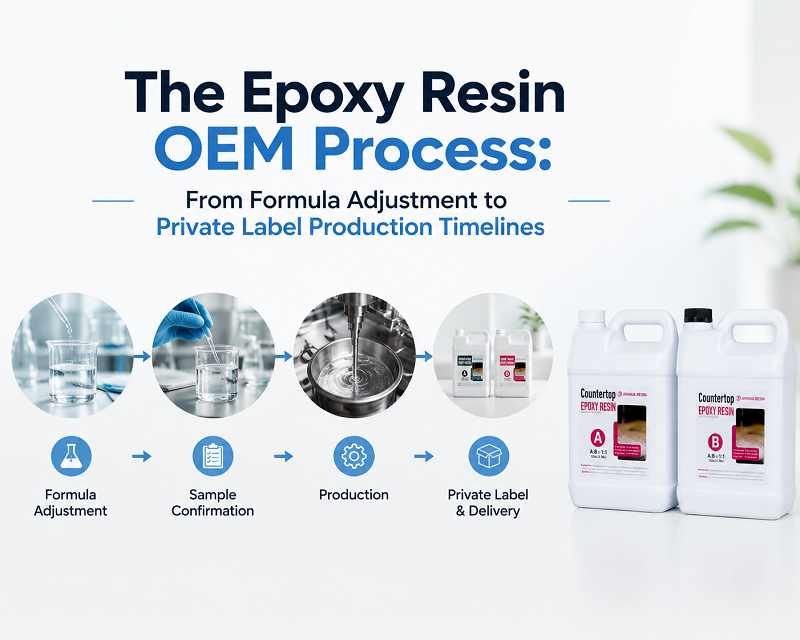
The Epoxy Resin OEM Process: From Formula Adjustment to Private Label Production Timelines

At some point, every brand selling epoxy products under its own name reaches the same fork in the road: keep reselling someone else’s formula under your logo, or work with a manufacturer to build something that’s actually yours. The second path — OEM and private label production — is how most established epoxy brands got their start, and it’s increasingly accessible to smaller buyers than it used to be.

But “OEM” gets used loosely, and the gap between what buyers expect and what the process actually involves causes more failed partnerships than any technical issue. This guide walks through what actually happens when you work with an epoxy resin manufacturer on a private label or custom formulation project — from the first formula conversation through to repeat production — so you know what to ask for, what to expect, and how long it realistically takes.

Epoxy Resin Manufacturer (2)

What “OEM” Actually Means for Epoxy Resin

Before getting into process, it’s worth clarifying terms, because they get conflated constantly.

Private label means taking an existing, proven formulation from a manufacturer and packaging it under your own brand name. The product inside the bottle is the same one the manufacturer already produces — you’re buying their formulation, their quality control, and their production capacity, with your label on the outside.

OEM (Original Equipment Manufacturer) production, in the epoxy context, more often refers to custom formulation work — adjusting an existing base formula to meet specific performance requirements, packaging specifications, or market positioning that the manufacturer’s standard product doesn’t address.

ODM (Original Design Manufacturer) sits further along the spectrum — the manufacturer develops a formulation largely from scratch based on your performance brief, rather than modifying an existing product.

Most buyers entering this process actually want something between private label and OEM: a manufacturer’s proven base formula, with adjustments to viscosity, cure time, color, or packaging that differentiate it for their market. Understanding which of these you’re actually asking for shapes the timeline, cost, and minimum order quantities you’ll be working with — and being clear about it from the first conversation avoids a lot of back-and-forth later.


Step 1: Defining What You Actually Need

The OEM process starts before any formulation work — it starts with a clear brief. This step gets rushed more often than any other, and rushing it is the single biggest cause of delays later in the process.

A useful brief for an epoxy resin manufacturer covers:

Product category and application: Table top epoxy, deep pour epoxy, art resin, UV resin — each category has different base chemistries, and “epoxy resin” alone isn’t specific enough for a manufacturer to scope the work.

Performance requirements: Pot life, cure time, viscosity range, UV resistance level, hardness, and any application-specific requirements (self-leveling for table tops, low exotherm for deep pours, fast cure for production-line UV resin).

Target market and compliance needs: If the product is headed to North America or Europe, REACH, Prop 65, RoHS, and TSCA requirements need to be on the table from day one — not discovered during the compliance review of a finished formulation.

Packaging specifications: Container size, kit ratios (1:1 vs 2:1 vs other), labeling requirements, and any branding elements that need to be incorporated into packaging design or supplied separately.

Volume expectations: Initial order volume and projected ongoing volume. This affects everything from which production line your order runs on to what MOQ thresholds apply.

Manufacturers who are serious about OEM work will ask for this information upfront — and a manufacturer who skips straight to pricing without asking these questions is either offering you an unmodified standard product, or hasn’t thought through what custom work actually requires.


Step 2: Formula Matching and Adjustment

Once the brief is clear, the manufacturer’s technical team maps it against their existing formulation library. This is where private label and OEM diverge in process.

For private label: If an existing formula meets your performance requirements as-is, the process moves quickly to sample approval and packaging discussions. No formulation work is needed — you’re adopting a proven product.

For OEM adjustments: The technical team identifies the closest existing formula and determines what needs to change. Common adjustments include:

  • Viscosity modification (adding or reducing reactive diluents)
  • Cure time adjustment (changing hardener ratios or hardener type)
  • Color base adjustment (modifying APHA color values for clarity-critical applications)
  • UV stabilizer package changes (adjusting HALS/UVA loading for different climate exposure)
  • Pot life extension or reduction (for different application methods or climates)

Each adjustment has downstream effects on other properties — extending pot life often affects cure time; reducing viscosity can affect UV stability if it changes stabilizer concentration proportionally. A competent technical team models these tradeoffs before producing a test batch, rather than discovering them after.

For ODM work: Formulation starts closer to first principles, based on the performance brief rather than an existing product. This takes longer and typically involves multiple rounds of lab-scale formulation before reaching a sample worth testing at production scale.


Step 3: Sample Production and Testing

This is where the formulation moves from theoretical to physical. Lab-scale samples — typically 1–5 kg — are produced according to the adjusted formula and sent for evaluation.

What buyers should test at this stage:

Application testing: Mix and apply the sample under conditions matching your actual end-use — same temperature range, same substrate, same application method your customers will use. A sample that performs well in a controlled lab environment but hasn’t been tested under your real-world conditions is an incomplete evaluation.

Cure verification: Confirm pot life, tack-free time, and full cure time match the brief. These numbers matter for downstream production planning on your end.

Visual and optical properties: For table top epoxy or deep pour epoxy applications, clarity, color, and gloss need to be evaluated against your target specification — ideally compared side-by-side with a reference sample.

Compliance verification: If REACH, Prop 65, or other compliance requirements were part of the brief, this is the stage to request preliminary compliance data on the adjusted formulation — not after production scale-up.

Sample iteration typically takes one to three rounds. A single round is realistic for private label or minor adjustments. Two to three rounds is typical for OEM formulation work involving multiple property changes. ODM projects can require more, depending on how far the target specification sits from existing formulations.

Realistic timeline for this stage: 2–6 weeks, depending on the number of iteration rounds and whether compliance testing is run in parallel or sequentially.


Step 4: Scale-Up and Pilot Production Batch

Lab-scale samples don’t always behave identically at production scale. Mixing equipment, batch size, and production environment all introduce variables that a 1–5 kg lab sample doesn’t expose.

A pilot production batch — typically 100–500 kg depending on the manufacturer’s production line minimums — validates that the formulation performs consistently when produced at the scale your orders will actually require. This step matters most for:

Deep pour epoxy formulations, where exotherm behavior at lab scale (small sample mass, fast heat dissipation) doesn’t predict behavior at production pour depths.

Color-critical formulations, where pigment dispersion uniformity needs to be verified across a larger batch volume.

Viscosity-sensitive formulations, where production mixing equipment may introduce more or less shear than lab mixing, affecting final viscosity.

The pilot batch is also typically what gets used for full compliance testing — REACH, Prop 65, RoHS documentation should be generated from material that represents your actual production formulation, not the original lab sample.

Realistic timeline for this stage: 2–4 weeks, including production scheduling, the pilot run itself, and testing of pilot batch material.


Step 5: Packaging Development and Branding Integration

Packaging runs in parallel with formulation work where possible, but final packaging decisions typically wait until the formula is confirmed — container materials need to be chemically compatible with the final formulation, particularly for products with higher reactive diluent content or unusual viscosity profiles.

Container compatibility: Not all plastic containers are suitable for all epoxy formulations. Some reactive diluents can interact with certain plastics over extended storage. The manufacturer should confirm container compatibility based on your final formulation — this is a step that gets skipped by manufacturers without genuine OEM experience, and the consequences (container degradation during the product’s shelf life) surface months after shipment.

Kit configuration: Part A / Part B ratio determines container sizing — a 2:1 ratio requires different container volumes than 1:1. This needs to be finalized before container tooling or procurement.

Labeling: For private label and OEM products, label artwork needs to incorporate required regulatory information (hazard symbols, SDS reference, batch coding) alongside your branding. Manufacturers experienced in export markets will flag regulatory labeling requirements specific to your target market — EU CLP labeling requirements differ from US OSHA requirements, for example.

Realistic timeline for this stage: 3–6 weeks, often running concurrent with Steps 3–4. Custom container tooling (if required) can extend this significantly — generic containers with custom labels are faster than fully custom container molds.


Step 6: First Production Run and Quality Verification

The first full production run at commercial volume is the point where everything gets verified together: formulation, packaging, labeling, and compliance documentation as a complete product.

Buyers should expect:

Certificate of Analysis (CoA) for the production batch, documenting key quality parameters against the agreed specification.

Retained samples from the production batch — both for your own reference and for any compliance documentation that references specific batch numbers.

Batch documentation that establishes the baseline for future reorders — this is what your manufacturer will reference when producing subsequent batches to maintain consistency.

This is also the stage where any final adjustments get made before the formulation is “locked” for ongoing production. Minor tweaks at this stage are normal; major formulation changes at this stage suggest the brief or sample testing stages weren’t thorough enough.

Realistic timeline for this stage: 3–5 weeks for production, depending on order volume and the manufacturer’s production schedule.


Step 7: Establishing the Reorder Process

Once the formulation is locked and the first production run is complete, ongoing reorders should be significantly faster than the initial development process — this is one of the main commercial benefits of going through OEM development in the first place.

A well-structured reorder process includes:

Standing formulation reference: Your manufacturer maintains the locked formulation as a reference for all future batches, eliminating the need to re-specify requirements with each order.

Reorder lead times: For an epoxy resin manufacturer with established production capacity, reorder lead times for an already-developed OEM product are typically 3–6 weeks from order confirmation to shipment — substantially faster than the 3–6 month total timeline for initial development.

Batch-to-batch consistency tracking: Request that CoA documentation continues for reorder batches, allowing you to track consistency over time and catch any drift before it affects your end customers.

Volume flexibility: Discuss MOQ for reorders versus initial development runs — these are often different, with reorder MOQs sometimes lower once the formulation and production setup are established.


Realistic Total Timeline

Putting the stages together, a realistic timeline for a private label or moderate OEM adjustment project:

  • Brief and formula matching: 1–2 weeks
  • Sample development and testing: 2–6 weeks
  • Pilot production and compliance testing: 2–4 weeks
  • Packaging development: 3–6 weeks (often parallel)
  • First production run: 3–5 weeks

Total: Roughly 3–4 months from initial brief to first shipment for private label or moderate OEM adjustments. More extensive ODM projects — formulations developed substantially from scratch — typically run 4–6 months given additional formulation iteration rounds.

These timelines assume the buyer provides a clear brief at the outset and responds to sample evaluation requests promptly. The most common cause of timeline extension isn’t manufacturing — it’s buyers taking weeks to evaluate samples or finalize packaging decisions partway through the process.


What Separates a Capable OEM Partner from a Reseller

A manufacturer offering genuine OEM capability — versus simply relabeling a standard product — typically demonstrates this through:

Technical questions early in the conversation: Asking about your application conditions, target market, and performance priorities before discussing pricing signals a manufacturer thinking about formulation, not just packaging.

Transparency about formulation tradeoffs: A manufacturer who explains how adjusting one property affects others is showing genuine formulation expertise, not just running your request through a generic process.

Compliance integration from the start: An epoxy resin manufacturer with real export experience raises REACH, Prop 65, and other compliance requirements during the briefing stage — not as an afterthought once a formulation is finalized.

Realistic timelines: Manufacturers promising private-label turnaround in days, or OEM formulation work in under a month, are either overpromising or not doing the work the timeline implies.


Final Thoughts

OEM and private label epoxy production is one of the most accessible ways for a brand to differentiate its product line without building manufacturing capability from scratch — but the process has real steps, real timelines, and real technical work behind it. Buyers who go in with a clear brief, realistic timeline expectations, and an understanding of what each stage actually involves get better outcomes — and better long-term manufacturer relationships — than those treating OEM as a quick relabeling exercise.

At Jinhua Resin, we support both private label and custom OEM formulation work across our table top epoxy, deep pour epoxy, and UV resin product lines, with export compliance documentation for North American and European markets built into the development process. Contact us to discuss your brief and realistic timelines for your specific requirements.


Jinhua Resin | Professional Epoxy Resin Manufacturer | OEM & Private Label Development | Table Top Epoxy & Deep Pour Epoxy | Export-Ready

Epoxy Resin Manufacturer

River Table Export Compliance: The Certifications Your Epoxy Resin Needs for North America and Europe

The order is almost there. Your river table production is solid, the pricing is competitive, and a buyer in North America or Europe is ready to move forward. Then comes the question that stops deals in their tracks: “What certifications does your resin carry?”

Fumble this answer and the conversation ends — not because your product fell short, but because your documentation did. Western market buyers have compliance teams. Those teams have checklists. And the chemical content of the deep pour epoxy in your river tables sits near the top of those lists.

This isn’t bureaucratic friction for its own sake. The regulations are real, the penalties for non-compliance land on the importer, and the epoxy resin manufacturer you’re sourcing from either has the paperwork or doesn’t. Knowing which documents to ask for — and what makes them worth the paper they’re printed on — is what separates export-ready procurement from a compliance liability waiting to surface.

Epoxy Resin Manufacturer

The Landscape Has Shifted

A decade ago, a verbal assurance and a basic safety data sheet moved product across borders without much friction. That window closed, and it’s not reopening.

The tightening happened from multiple directions simultaneously. Legislation in both the EU and California expanded. Major retail platforms — Amazon, Wayfair, and most large furniture chains — added documented chemical compliance to their supplier onboarding requirements. EU distributors now face market withdrawal and customs detention if they can’t demonstrate conformity on demand.

For river table manufacturers, wood isn’t the problem. Deep pour epoxy is. As a two-component synthetic resin system, its chemical composition, cure chemistry, and residual unreacted compounds all fall squarely within what compliance auditors review. The epoxy resin manufacturer supplying your production line is, from a regulatory standpoint, your first line of defense — and your first point of failure if they’re not export-ready.


REACH: The European Baseline

REACH — Registration, Evaluation, Authorisation and Restriction of Chemicals — is administered by the European Chemicals Agency and governs chemical substance use across the European Economic Area. For furniture manufacturers, it’s the non-negotiable starting point for any EU export conversation.

The mechanism that matters most for epoxy resin is the SVHC (Substances of Very High Concern) candidate list. Bisphenol A, a building block in many standard epoxy formulations, is on it. Amine hardener components common to deep pour epoxy systems are also under scrutiny. EU law requires that finished articles placed on the market contain no SVHC above 0.1% by weight — and importers bear the compliance burden, not the manufacturer.

What this means practically: your epoxy resin manufacturer needs to provide a REACH SVHC compliance declaration backed by third-party laboratory chemical analysis, issued within the last twelve months. A self-declaration without lab data behind it isn’t compliance — it’s a statement of intent that won’t hold up under an importer audit.


RoHS: Not Just for Electronics Anymore

RoHS — Restriction of Hazardous Substances — originated as an EU directive targeting electronics, but its reach has expanded. Buyers operating across multiple product categories, or running unified supplier compliance programs, increasingly include RoHS documentation in standard onboarding packages regardless of product type.

The directive restricts ten substances: lead, mercury, cadmium, hexavalent chromium, and several phthalates among them. River tables aren’t electronic equipment, but if your target retail channel or distributor applies RoHS across its supply base, the requirement applies to your resin just the same.

RoHS compliance for deep pour epoxy is demonstrated through XRF screening or ICP analysis of the cured material. Ask your epoxy resin manufacturer for a current report from a recognized lab — SGS, Bureau Veritas, Intertek, or equivalent. If they can’t produce one, that’s a gap worth resolving before your first shipment.


California Proposition 65: The North American Compliance Reality

Proposition 65 is California’s Safe Drinking Water and Toxic Enforcement Act — a list of over 900 chemicals designated as known carcinogens or reproductive toxins, paired with a warning obligation for businesses that knowingly expose consumers to them above defined thresholds.

Several components present in deep pour epoxy systems touch this list. Bisphenol A is on it. Certain reactive diluents and amine hardener compounds appear as well. Titanium dioxide, used in white or opaque pigment formulations, is listed for inhalation exposure during manufacturing. Improperly cured resin — where hardener hasn’t fully reacted — can leave residual compounds that trigger Prop 65 obligations in the finished piece.

The practical stakes are high. Major U.S. distributors and furniture retailers require Prop 65 documentation before onboarding suppliers. Non-compliance in California exposes importers to civil litigation enforced by private plaintiffs — a mechanism that functions aggressively and doesn’t require government initiation to proceed.

What you need from your epoxy resin manufacturer isn’t a generic compliance letter. It’s a product-specific Prop 65 assessment: which listed substances are present, at what concentrations, whether exposure levels fall below safe harbor thresholds, and whether a warning label is required. General assurances don’t protect you when a plaintiff’s attorney starts asking questions.


TSCA: The Federal U.S. Framework

The Toxic Substances Control Act is the EPA’s primary authority over chemical substances in U.S. commerce. Under TSCA Section 6, the agency can restrict or ban chemicals presenting unreasonable risk — and all chemical components in products sold or imported into the U.S. must be listed on the TSCA Chemical Substance Inventory.

TSCA becomes most relevant when resin is imported as a chemical substance rather than as a component of a finished article — which applies to furniture manufacturers or distributors importing bulk deep pour epoxy into the U.S. for further processing. In that context, a TSCA compliance letter from your epoxy resin manufacturer confirming that all formulation components appear on the TSCA inventory is a standard document. Any manufacturer with genuine export capability should have it ready without being asked twice.


CARB: VOC Limits for California Sales

The California Air Resources Board sets VOC emission limits for coatings and finishes. Deep pour epoxy used as a casting medium or flood coat is generally low-VOC compared to solvent-based alternatives — but “generally” isn’t documentation, and assumptions about VOC content have a way of becoming problems at the retail compliance stage.

A CARB compliance statement from your supplier, showing measured VOC content in grams per liter, is what you need if your product moves through California channels or through national retail chains that apply California standards uniformly. Don’t assume the product qualifies — request the measurement.


EN 71-3: Worth Flagging for Certain EU Channels

EN 71-3 sets migration limits for chemical elements from surface coatings and materials — it’s technically a toy safety standard, but some European furniture buyers selling into children’s or nursery applications extend its requirements to their supply base. River tables aren’t toys, and this standard isn’t universally required, but if any of your export lines touch children’s furniture channels, check whether the buyer’s compliance program references it.


Verifying the Documents, Not Just Collecting Them

Compliance paperwork is only useful if the testing behind it is real. Several habits protect you from gaps that surface after a container leaves the port:

Third-party lab backing is non-negotiable. REACH SVHC declarations, RoHS reports, and Prop 65 assessments need to come from ISO 17025-accredited laboratories — not from the manufacturer’s own quality team. Self-declarations without independent testing don’t satisfy serious buyers and won’t hold up under scrutiny.

Check the date on every report. Compliance documentation should be current — within twelve to twenty-four months, ideally tied to the production batch you’re actually purchasing. A three-year-old REACH report for a formulation that may have been updated is not reliable documentation.

Match the report to the specific product. The test report should reference the exact product name, formulation code, or batch range corresponding to what you’re buying. Generic letters covering “epoxy resin products” offer thin protection when a compliance question gets specific.

Cross-reference the SDS independently. A current Safety Data Sheet isn’t a compliance certificate, but it lists what’s in the formulation. Running those components against the REACH SVHC candidate list and the Prop 65 chemical list gives you an independent check on your epoxy resin manufacturer‘s compliance claims — before you’re relying on those claims in a live shipment.

Make compliance a qualification criterion, not an afterthought. Before placing a first export order, require the full documentation package as a condition of the relationship — not a follow-up request after the commercial terms are agreed. An epoxy resin manufacturer with genuine export experience has this material ready and presents it proactively. One that needs weeks to pull it together hasn’t been operating in export markets at any serious volume.


What to Carry Into Supplier Conversations

The compliance question isn’t a formality to clear at the end of a supplier negotiation. It belongs at the front — because the answer determines whether the supplier can actually support your export business, or just your domestic one.

A genuinely export-capable epoxy resin manufacturer comes to that conversation with current REACH SVHC declarations, RoHS test reports, a product-specific Prop 65 assessment, a TSCA compliance letter, and CARB VOC data. That documentation set doesn’t get assembled in a hurry. It reflects an ongoing commitment to the standards that Western trade channels require.

The cost of a non-compliant shipment — customs detention, retailer delisting, market withdrawal, or Prop 65 litigation — is not a rounding error. It’s an existential disruption to a product line. Qualifying your resin supplier on compliance before the first order is the straightforward way to avoid it.

At Jinhua Resin, compliance documentation for both North American and European markets is prepared as standard and available with every product inquiry. Contact us to request the full documentation package for your target market.


Jinhua Resin | Professional Epoxy Resin Manufacturer | Deep Pour Epoxy & Table Top Epoxy | Export-Ready | OEM & Bulk Supply Available

River Table Export Compliance

Epoxy Resin Certifications for River Table Export: REACH, Prop 65, RoHS & More | Jinhua Resin

The order is almost there. Your river table production is solid, the pricing is competitive, and a buyer in North America or Europe is ready to move forward. Then comes the question that stops deals in their tracks: “What certifications does your resin carry?”

Fumble this answer and the conversation ends — not because your product fell short, but because your documentation did. Western market buyers have compliance teams. Those teams have checklists. And the chemical content of the deep pour epoxy in your river tables sits near the top of those lists.

This isn’t bureaucratic friction for its own sake. The regulations are real, the penalties for non-compliance land on the importer, and the epoxy resin manufacturer you’re sourcing from either has the paperwork or doesn’t. Knowing which documents to ask for — and what makes them worth the paper they’re printed on — is what separates export-ready procurement from a compliance liability waiting to surface.

River Table Export Compliance

The Landscape Has Shifted

A decade ago, a verbal assurance and a basic safety data sheet moved product across borders without much friction. That window closed, and it’s not reopening.

The tightening happened from multiple directions simultaneously. Legislation in both the EU and California expanded. Major retail platforms — Amazon, Wayfair, and most large furniture chains — added documented chemical compliance to their supplier onboarding requirements. EU distributors now face market withdrawal and customs detention if they can’t demonstrate conformity on demand.

For river table manufacturers, wood isn’t the problem. Deep pour epoxy is. As a two-component synthetic resin system, its chemical composition, cure chemistry, and residual unreacted compounds all fall squarely within what compliance auditors review. The epoxy resin manufacturer supplying your production line is, from a regulatory standpoint, your first line of defense — and your first point of failure if they’re not export-ready.


REACH: The European Baseline

REACH — Registration, Evaluation, Authorisation and Restriction of Chemicals — is administered by the European Chemicals Agency and governs chemical substance use across the European Economic Area. For furniture manufacturers, it’s the non-negotiable starting point for any EU export conversation.

The mechanism that matters most for epoxy resin is the SVHC (Substances of Very High Concern) candidate list. Bisphenol A, a building block in many standard epoxy formulations, is on it. Amine hardener components common to deep pour epoxy systems are also under scrutiny. EU law requires that finished articles placed on the market contain no SVHC above 0.1% by weight — and importers bear the compliance burden, not the manufacturer.

What this means practically: your epoxy resin manufacturer needs to provide a REACH SVHC compliance declaration backed by third-party laboratory chemical analysis, issued within the last twelve months. A self-declaration without lab data behind it isn’t compliance — it’s a statement of intent that won’t hold up under an importer audit.


RoHS: Not Just for Electronics Anymore

RoHS — Restriction of Hazardous Substances — originated as an EU directive targeting electronics, but its reach has expanded. Buyers operating across multiple product categories, or running unified supplier compliance programs, increasingly include RoHS documentation in standard onboarding packages regardless of product type.

The directive restricts ten substances: lead, mercury, cadmium, hexavalent chromium, and several phthalates among them. River tables aren’t electronic equipment, but if your target retail channel or distributor applies RoHS across its supply base, the requirement applies to your resin just the same.

RoHS compliance for deep pour epoxy is demonstrated through XRF screening or ICP analysis of the cured material. Ask your epoxy resin manufacturer for a current report from a recognized lab — SGS, Bureau Veritas, Intertek, or equivalent. If they can’t produce one, that’s a gap worth resolving before your first shipment.


California Proposition 65: The North American Compliance Reality

Proposition 65 is California’s Safe Drinking Water and Toxic Enforcement Act — a list of over 900 chemicals designated as known carcinogens or reproductive toxins, paired with a warning obligation for businesses that knowingly expose consumers to them above defined thresholds.

Several components present in deep pour epoxy systems touch this list. Bisphenol A is on it. Certain reactive diluents and amine hardener compounds appear as well. Titanium dioxide, used in white or opaque pigment formulations, is listed for inhalation exposure during manufacturing. Improperly cured resin — where hardener hasn’t fully reacted — can leave residual compounds that trigger Prop 65 obligations in the finished piece.

The practical stakes are high. Major U.S. distributors and furniture retailers require Prop 65 documentation before onboarding suppliers. Non-compliance in California exposes importers to civil litigation enforced by private plaintiffs — a mechanism that functions aggressively and doesn’t require government initiation to proceed.

What you need from your epoxy resin manufacturer isn’t a generic compliance letter. It’s a product-specific Prop 65 assessment: which listed substances are present, at what concentrations, whether exposure levels fall below safe harbor thresholds, and whether a warning label is required. General assurances don’t protect you when a plaintiff’s attorney starts asking questions.


TSCA: The Federal U.S. Framework

The Toxic Substances Control Act is the EPA’s primary authority over chemical substances in U.S. commerce. Under TSCA Section 6, the agency can restrict or ban chemicals presenting unreasonable risk — and all chemical components in products sold or imported into the U.S. must be listed on the TSCA Chemical Substance Inventory.

TSCA becomes most relevant when resin is imported as a chemical substance rather than as a component of a finished article — which applies to furniture manufacturers or distributors importing bulk deep pour epoxy into the U.S. for further processing. In that context, a TSCA compliance letter from your epoxy resin manufacturer confirming that all formulation components appear on the TSCA inventory is a standard document. Any manufacturer with genuine export capability should have it ready without being asked twice.


CARB: VOC Limits for California Sales

The California Air Resources Board sets VOC emission limits for coatings and finishes. Deep pour epoxy used as a casting medium or flood coat is generally low-VOC compared to solvent-based alternatives — but “generally” isn’t documentation, and assumptions about VOC content have a way of becoming problems at the retail compliance stage.

A CARB compliance statement from your supplier, showing measured VOC content in grams per liter, is what you need if your product moves through California channels or through national retail chains that apply California standards uniformly. Don’t assume the product qualifies — request the measurement.


EN 71-3: Worth Flagging for Certain EU Channels

EN 71-3 sets migration limits for chemical elements from surface coatings and materials — it’s technically a toy safety standard, but some European furniture buyers selling into children’s or nursery applications extend its requirements to their supply base. River tables aren’t toys, and this standard isn’t universally required, but if any of your export lines touch children’s furniture channels, check whether the buyer’s compliance program references it.


Verifying the Documents, Not Just Collecting Them

Compliance paperwork is only useful if the testing behind it is real. Several habits protect you from gaps that surface after a container leaves the port:

Third-party lab backing is non-negotiable. REACH SVHC declarations, RoHS reports, and Prop 65 assessments need to come from ISO 17025-accredited laboratories — not from the manufacturer’s own quality team. Self-declarations without independent testing don’t satisfy serious buyers and won’t hold up under scrutiny.

Check the date on every report. Compliance documentation should be current — within twelve to twenty-four months, ideally tied to the production batch you’re actually purchasing. A three-year-old REACH report for a formulation that may have been updated is not reliable documentation.

Match the report to the specific product. The test report should reference the exact product name, formulation code, or batch range corresponding to what you’re buying. Generic letters covering “epoxy resin products” offer thin protection when a compliance question gets specific.

Cross-reference the SDS independently. A current Safety Data Sheet isn’t a compliance certificate, but it lists what’s in the formulation. Running those components against the REACH SVHC candidate list and the Prop 65 chemical list gives you an independent check on your epoxy resin manufacturer‘s compliance claims — before you’re relying on those claims in a live shipment.

Make compliance a qualification criterion, not an afterthought. Before placing a first export order, require the full documentation package as a condition of the relationship — not a follow-up request after the commercial terms are agreed. An epoxy resin manufacturer with genuine export experience has this material ready and presents it proactively. One that needs weeks to pull it together hasn’t been operating in export markets at any serious volume.


What to Carry Into Supplier Conversations

The compliance question isn’t a formality to clear at the end of a supplier negotiation. It belongs at the front — because the answer determines whether the supplier can actually support your export business, or just your domestic one.

A genuinely export-capable epoxy resin manufacturer comes to that conversation with current REACH SVHC declarations, RoHS test reports, a product-specific Prop 65 assessment, a TSCA compliance letter, and CARB VOC data. That documentation set doesn’t get assembled in a hurry. It reflects an ongoing commitment to the standards that Western trade channels require.

The cost of a non-compliant shipment — customs detention, retailer delisting, market withdrawal, or Prop 65 litigation — is not a rounding error. It’s an existential disruption to a product line. Qualifying your resin supplier on compliance before the first order is the straightforward way to avoid it.

At Jinhua Resin, compliance documentation for both North American and European markets is prepared as standard and available with every product inquiry. Contact us to request the full documentation package for your target market.


Jinhua Resin | Professional Epoxy Resin Manufacturer | Deep Pour Epoxy & Table Top Epoxy | Export-Ready | OEM & Bulk Supply Available