


The Question Nobody Asks Until It’s Too Late
Most conversations about sourcing epoxy resin from China focus on formulation, price, and certifications. Packaging and logistics come up late — usually after someone has received a shipment with damaged drums, unexpected hazmat surcharges, or a container that technically complied with regulations but caused delays at the port.
Packaging isn’t just a box. For a liquid chemical product like epoxy resin, it determines your landed cost, your customs classification, your freight options, and how the product behaves by the time it reaches your warehouse. Getting this part right at the sourcing stage — before the first purchase order — saves real money and prevents real headaches.
This guide covers the standard packaging configurations for epoxy resin, how each one affects ocean freight logistics, and what to confirm with your Chinese epoxy resin manufacturer before you sign anything.
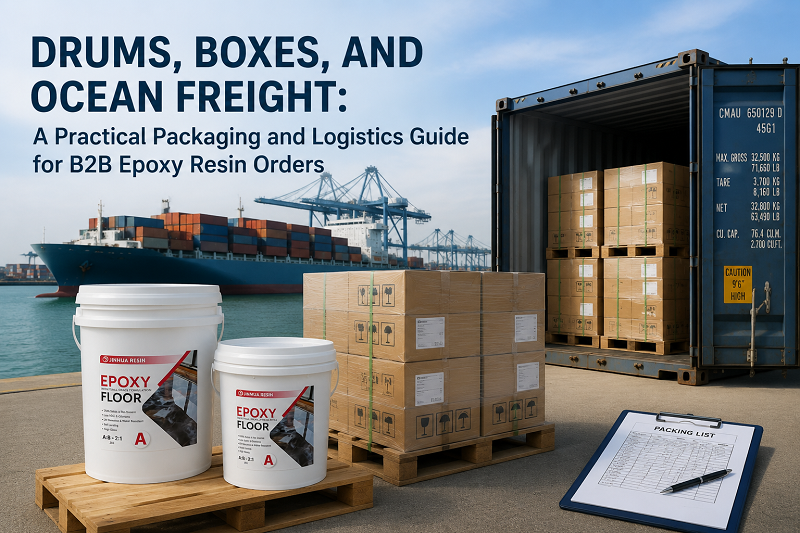
Packaging Formats: What’s Actually Available
Small-Volume Retail and E-Commerce Units
At the smallest scale, epoxy resin ships in dual-component kits — typically 0.5L, 1L, 2L, or 4L sets combining resin and hardener in matching bottles or cans. These are the units that end up on e-commerce platforms and in craft supply stores.
For B2B importers, these small units aren’t the primary purchase format — but they matter for private label brands that sell into consumer or small-business channels. Lead times, minimum order quantities, and labeling requirements for retail kits are different from bulk formats, and they need to be negotiated separately with the epoxy resin manufacturer even when you’re buying the same underlying chemistry.
Retail kits also carry different freight handling requirements. Consumer-packaged chemical products typically ship as Limited Quantity (LQ) under IMDG regulations, which reduces documentation burden but also limits how they can be consolidated.
Pails: 5-Gallon and 20-Liter
The 5-gallon pail (roughly 18–19L) and the 20-liter pail are the workhorses of the mid-volume epoxy market. They’re the standard unit for woodworking shops, fabricators, small contractors, and any B2B buyer who processes product at the unit level rather than pumping from a drum.
Pails palletize cleanly — typically 4 per layer, 4–5 layers per pallet, giving you 16–20 pails per pallet depending on the product density and pail height. HDPE pails with sealed lids are standard; some manufacturers use metal pails for hardener components where chemical compatibility requires it.
For importers building a distribution model, pails are often the sweet spot. They’re manageable for downstream customers who don’t have drum-handling equipment, they ship on standard pallets, and they can be labeled for retail or trade distribution with less regulatory friction than drums.
Drums: 55-Gallon / 200-Liter
The 200-liter steel or HDPE drum is the standard bulk format for epoxy resin orders above a certain volume threshold. It’s what most experienced importers default to once they’re past the sample-and-trial stage.
A standard 20-foot container holds approximately 80 drums at 200L each — roughly 16,000 liters of product, or around 18–19 metric tons depending on resin density. A 40-foot container roughly doubles that. These are the volume benchmarks that most Chinese epoxy resin manufacturers quote against.
Steel drums are common for resin components. HDPE drums are more typical for amine-based hardeners, where steel can cause compatibility issues over storage time. Confirm material compatibility with your supplier — it’s a basic question, but it’s one that sometimes doesn’t come up until there’s a problem.
Drum orders require proper UN-certified packaging. For epoxy resins classified as Class 9 or non-regulated under IMDG depending on formulation, the UN certification requirement on the drum itself is a compliance item that needs to be confirmed before shipment — not after.
IBC Totes: 1,000-Liter
Intermediate Bulk Containers — IBCs — are 1,000-liter cage-mounted tanks used for very high-volume orders or for buyers with pumping and dispensing infrastructure. They’re less common in the table top epoxy and casting resin segment, more common in industrial coatings and construction adhesives where throughput volume justifies the equipment investment.
IBCs offer the best per-liter freight economics at scale, but they require receiving facilities with forklift access and liquid handling capability. If your downstream customers or warehouse don’t have this, IBCs create handling problems that eat up the cost savings.
Hazardous Material Classification: Where Things Get Complicated
Epoxy resin products occupy a complicated position in international hazmat regulations. Some formulations are classified as dangerous goods under IMDG; others ship as non-regulated materials. The difference has direct implications for freight costs, documentation, and which carriers will accept the shipment.
IMDG Classification Basics
The International Maritime Dangerous Goods code governs how chemical products are classified and handled on ocean freight. For epoxy resin:
- Liquid epoxy resin (bisphenol A/epichlorohydrin, MW ≤ 700) typically classifies as Class 9, UN 3082 — Environmentally Hazardous Substance, Liquid. This is the mildest hazmat classification and carries relatively modest documentation requirements.
- Amine hardeners — particularly low-molecular-weight aliphatic amines — often classify as Class 8 Corrosives, UN 2735 or similar, depending on the specific chemistry. Class 8 carries more documentation weight and higher freight surcharges.
- Some high-viscosity or solid epoxy formulations may qualify as non-regulated, which significantly simplifies shipping.
The practical implication: a complete two-part epoxy system may have its resin component shipping as Class 9 and its hardener shipping as Class 8 — two different UN numbers, two different sets of documentation, potentially two different handling requirements at the port. Importers who don’t map this out in advance end up surprised by MSDS declarations, carrier surcharges, and port handling fees that weren’t in the original freight quote.
Your Chinese epoxy resin manufacturer should be able to provide the IMDG classification for each component, along with the corresponding Safety Data Sheet structured to international standards. If they can’t — or if their SDS doesn’t clearly state the IMDG classification — that’s information worth resolving before booking freight.
Dangerous Goods Documentation
For any shipment that includes IMDG-classified components, the following documents need to be confirmed before the vessel departs:
- Dangerous Goods Declaration (DGD) — prepared by the shipper, certifying that the goods are properly classified, packaged, and marked
- Safety Data Sheet (SDS) — 16-section GHS-compliant document for each component
- UN-certified packaging certification — confirming the drums or pails meet UN performance standards for the specific goods
- Emergency Response information — contact details and procedures, typically embedded in the SDS or DGD
Experienced freight forwarders handle the DGD preparation as a matter of course. But the underlying information — classification, packaging certification, SDS — has to come from the manufacturer. A supplier who has exported to regulated markets before will have these documents ready. One who hasn’t will need time to produce them, and “I’ll send it next week” doesn’t work when the vessel booking window is open.
Ocean Freight: How Packaging Format Affects Your Costs
FCL vs. LCL
Full Container Load (FCL) — you book the whole container. Your cargo doesn’t share space with anyone else’s. For drum orders at volume, FCL is almost always the better economic choice once you’re past a certain tonnage threshold. It’s also simpler from a hazmat handling perspective — you control what’s in the container.
Less than Container Load (LCL) — your cargo consolidates with other shippers’ cargo in a shared container. LCL makes sense for smaller orders or early-stage buying before you’ve validated volume. For hazmat cargo, LCL has stricter co-loading restrictions — not every freight forwarder will consolidate Class 8 hardeners with non-hazmat goods, and some ports have explicit rules about what can share space with dangerous goods. Confirm hazmat LCL acceptance with your forwarder before planning around it.
Weight vs. Volume: Which Governs Your Freight Rate
Ocean freight is charged on either gross weight or volume (CBM), whichever produces the higher revenue for the carrier — known as weight-or-measure, or W/M.
Epoxy resin is dense. A 200L drum of standard table top epoxy resin component weighs roughly 220–240kg. At that density, weight typically governs over volume, which means you’re paying per ton rather than per CBM. This is actually favorable compared to lighter products — you’re filling your container by weight before you fill it by volume, which improves cargo utilization.
Where this math shifts is with packaging-heavy configurations. Pails with significant headspace, over-boxed retail kits, or IBCs with low fill ratios start to eat into your per-liter freight efficiency. Ask your epoxy resin manufacturer for the gross weight and net weight per packaging unit — both numbers matter for freight calculation.
Port Selection and Transit Time
From South China manufacturing hubs (Guangdong, Dongguan, Foshan), the main departure ports for epoxy resin are Nansha, Yantian, and Shekou. For the U.S. West Coast, transit runs approximately 14–18 days. East Coast via Panama adds 25–30 days. Australia (Melbourne, Sydney) runs 12–16 days from Nansha. Canada West Coast (Vancouver) is comparable to U.S. West Coast; East Coast (Halifax, Montreal) adds time via Panama or Suez routing.
These are the numbers to use for lead time planning. Add buffer for Chinese factory holidays — Golden Week in early October, Spring Festival in January/February — when production and shipping schedules compress significantly.
Freight Surcharges Worth Knowing
Beyond the base ocean freight rate, the following surcharges apply with enough frequency to warrant line-item budgeting:
- Hazmat surcharge (HMC): applied by carriers on IMDG-classified cargo. Ranges from USD 50–200 per container depending on carrier and route, sometimes per-package.
- Port congestion surcharge (PCS): applied when destination ports are running backlogs. Variable and unpredictable.
- Bunker Adjustment Factor (BAF): fuel surcharge applied by most carriers, fluctuates with oil prices.
- Documentation fee: for DGD preparation, typically charged by the freight forwarder.
- Destination delivery charge (DDC): port handling on the receiving end.
The gap between a quoted ocean freight rate and actual landed freight cost is routinely 30–50% for first-time importers who haven’t accounted for these items. Build them into your cost model from the beginning.
What to Confirm With Your Supplier Before the First Order
A competent Chinese epoxy resin manufacturer should be able to answer the following without hesitation. If any of these questions produce vague answers or require multiple follow-ups, that tells you something about their export readiness.
Packaging:
- What packaging formats are available at my order volume? (Pails, drums, IBCs — and minimum order per format)
- Are drums UN-certified? What is the UN certification number and performance standard?
- What is the gross weight, net weight, and dimensions per packaging unit?
- Can you provide custom labeling or bilingual labeling for my destination market?
Hazmat and documentation:
- What is the IMDG classification for each component? (UN number, class, packing group)
- Can you provide a 16-section GHS-compliant SDS for each component?
- Can you prepare or support the Dangerous Goods Declaration?
Logistics:
- Which departure port do you use, and what is the typical transit time to my destination?
- What are your standard payment terms and production lead times?
- How do you handle Chinese factory holidays in your production schedule?
Jinhua Resin (jinhuaresin.com) is a Guangdong-based epoxy resin manufacturer with active FCL export programs to North America, Australia, and the UK. Product range covers table top epoxy, deep pour casting resin, and UV resin, available in pail, drum, and IBC formats. UN-certified packaging, full IMDG documentation, and OEM labeling are standard for export orders.
A Working Checklist: Before the Container Loads
- Confirm packaging format, UN certification, and per-unit weight/CBM with your supplier.
- Get the IMDG classification for each component — resin and hardener separately.
- Request GHS-compliant SDS documents for all components before booking freight.
- Brief your freight forwarder on hazmat classification before they quote.
- Build landed cost including base freight, HMC, BAF, DDC, and import duties.
- Confirm production lead time against your target vessel booking date.
- Plan around Chinese factory holiday schedules if your order window overlaps.
The Cost Is in the Details
Ocean freight for epoxy resin isn’t complicated — but it has enough moving parts that underprepared importers consistently pay more than they should or receive shipments that cause problems at customs. The fix is straightforward: ask the right questions at the sourcing stage, qualify suppliers on their export documentation capability, and work with a freight forwarder who has handled IMDG cargo before.
The packaging format you choose, the hazmat classification of your product, and the documentation your supplier can produce aren’t afterthoughts. They’re the variables that determine whether your landed cost matches your business model — or doesn’t.
Sourcing table top epoxy or casting resin for international distribution? Jinhua Resin provides FCL export programs with full IMDG documentation, UN-certified packaging, and OEM labeling for importers in the U.S., Australia, Canada, and the UK: jinhuaresin.com