


The Warning Label You Cannot Ignore
If you’ve spent any time browsing epoxy resin products on U.S. e-commerce platforms, you’ve seen it: a small yellow triangle, a bolded “WARNING,” and a sentence about chemicals known to the State of California to cause cancer or reproductive harm. That’s a Proposition 65 warning. And for anyone importing or selling epoxy resin in the U.S. — especially into California — understanding what triggers it, what it requires, and what happens if you get it wrong is not optional.
California’s Safe Drinking Water and Toxic Enforcement Act of 1986, universally known as Prop 65, is one of the most consequential chemical disclosure laws in the world. It doesn’t ban substances. It doesn’t restrict formulations. What it does is require businesses to warn consumers and workers before exposing them to chemicals on the state’s published list — a list that currently exceeds 900 substances and gets updated regularly.
For epoxy resin importers and brand owners, Prop 65 is a compliance layer on top of federal requirements like TSCA and OSHA HazCom. It operates differently, it’s enforced differently, and ignoring it carries financial exposure that most first-time importers seriously underestimate.
This article explains the mechanics of Prop 65 as they apply to epoxy resin products, identifies the specific chemicals of concern in common resin formulations, and outlines what to demand from a Chinese epoxy resin manufacturer before you bring product to market in California.
How Prop 65 Actually Works
The mechanism is simple. California maintains a list of chemicals known to cause cancer, birth defects, or other reproductive harm. If a business exposes any individual to a listed chemical above a defined safe harbor threshold, that business must provide a clear and reasonable warning before the exposure occurs.
“Business” in this context means any company with ten or more employees operating in California — which, for practical purposes, includes any brand selling on major U.S. e-commerce platforms with California customers.
The warning obligation sits with whoever is selling the product to the end user. For importers and private label brand owners, that means you — not the Chinese factory you sourced from. The epoxy resin manufacturer in Guangdong has no Prop 65 obligation. Your LLC selling table top epoxy on Amazon does.
Enforcement is almost entirely private. California’s Attorney General can bring Prop 65 actions, but the vast majority of enforcement comes from private plaintiffs — law firms and advocacy organizations that screen products, purchase samples, test for listed chemicals, and file 60-day notices of violation when they find non-compliant products. The 60-day notice gives the alleged violator a window to settle or prepare a defense before a lawsuit is filed.
Settlement amounts for Prop 65 violations typically range from $5,000 to $30,000 per violation, plus plaintiff attorney fees — which can exceed the settlement itself. For a product line with multiple SKUs, multiple violations, and a plaintiff’s firm billing at California rates, the exposure adds up fast.
Which Chemicals in Epoxy Resin Trigger Prop 65
Not every epoxy resin formulation contains Prop 65-listed chemicals above the threshold that requires a warning. But several common components do, and importers need to know which ones.
Bisphenol A (BPA)
BPA is listed under Prop 65 as a reproductive toxicant. It’s also a primary building block of the most widely used epoxy resin chemistry — bisphenol A diglycidyl ether (DGEBA), the base resin in standard table top epoxy and most commercial casting resin products.
The safe harbor level for BPA as a reproductive toxicant is 3 micrograms per day. Whether a cured epoxy product leaches BPA above that threshold depends on the formulation, cure conditions, and intended use. For uncured liquid resin, the analysis is different — liquid formulations in direct skin contact during application represent a different exposure pathway than a cured tabletop.
The reality for most table top epoxy importers: BPA is present, and the safe harbor math requires careful formulation data to work through. Many brands opt to provide the Prop 65 warning rather than conduct the exposure assessment required to claim no warning is needed.
Epichlorohydrin
Epichlorohydrin is listed as both a carcinogen and a reproductive toxicant under Prop 65. It’s a precursor chemical in DGEBA synthesis and appears as a residual component in many standard epoxy resin formulations. Concentration levels vary by manufacturer and by the specific production process used.
The acceptable daily intake (NSRL for cancer) for epichlorohydrin is 0.9 micrograms per day. Residual epichlorohydrin content in the resin itself is the key data point — this should be available from the epoxy resin manufacturer as part of the product’s technical documentation.
Titanium Dioxide (in pigmented or white-tinted formulations)
Titanium dioxide was added to the Prop 65 list as a carcinogen via inhalation. It applies specifically to airborne exposure — the listing is for titanium dioxide in products that can be inhaled as dust or spray, not for solid cured materials.
For epoxy resin products, TiO₂ is relevant in two scenarios: pigmented resin formulations that are poured or mixed in a way that generates aerosol, and spray-applied coatings. If your product line includes pigmented table top epoxy or spray formulations with TiO₂ content, the inhalation pathway needs to be assessed.
Other Additives to Screen
Depending on the specific formulation, the following may also warrant screening: certain reactive diluents (some glycidyl ethers are listed), specific colorants and pigments, and UV stabilizers. The exact additive package varies by manufacturer. A full Prop 65 screen requires knowing every component in the formulation — which brings us back to the supplier transparency question.
The Three Ways to Handle Prop 65
When a listed chemical is present above the no-observable-effect level, a business has three options.
Option 1: Provide the warning. The simplest path. Affix a Prop 65 compliant warning to the product, include it in any online listing, and add it to the SDS and any accompanying documentation. The warning must meet specific content requirements — it can’t be vague or buried. Current regulations require the warning to identify at least one chemical by name and indicate whether it causes cancer, birth defects, or both.
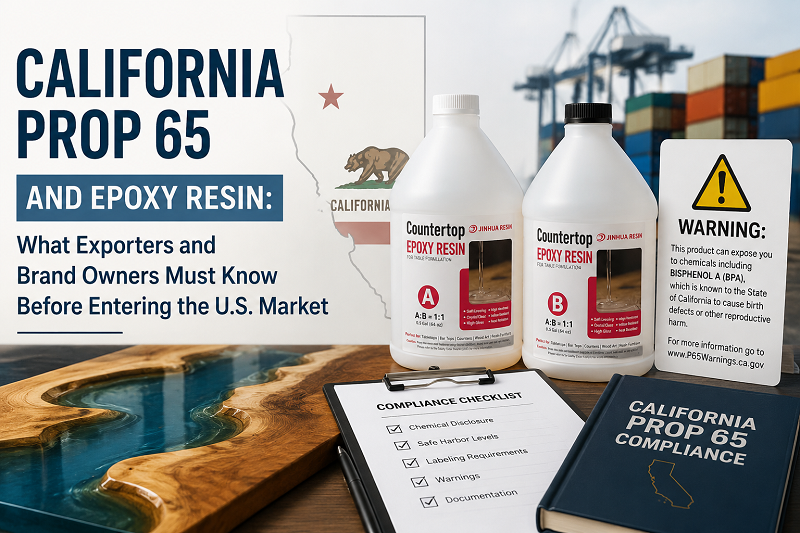
The standard warning for a product containing BPA and epichlorohydrin would read something like: “WARNING: This product can expose you to chemicals including Bisphenol A and Epichlorohydrin, which are known to the State of California to cause birth defects or other reproductive harm and cancer. For more information go to www.P65Warnings.ca.gov.”
This is the approach most epoxy resin brands in the U.S. market take. It’s not an admission of danger — it’s a legal safe harbor.
Option 2: Conduct an exposure assessment and demonstrate levels are below safe harbor thresholds. If your formulation data and intended use analysis show that exposure to listed chemicals stays below safe harbor levels, you may be able to sell without a warning. This requires a documented exposure assessment — not a guess, a documented analysis that can withstand scrutiny if a plaintiff files a notice.
This path is viable for specific formulations with low residual epichlorohydrin content and limited BPA exposure pathways. It requires detailed analytical data from the manufacturer and, typically, independent laboratory verification.
Option 3: Reformulate. Some manufacturers have moved toward BPA-free resin systems — typically using alternative glycidyl ether bases. BPA-free table top epoxy exists and is marketed as such. Whether the alternative chemistry also triggers Prop 65 concerns under other listed substances requires its own analysis — “BPA-free” is not automatically “Prop 65 clear.”
Federal Context: TSCA and OSHA HazCom
Prop 65 doesn’t exist in isolation. It sits alongside two federal frameworks that also apply to epoxy resin importers.
TSCA — Toxic Substances Control Act
The U.S. EPA administers TSCA, which governs the manufacture, import, and use of chemical substances in the United States. For epoxy resin importers, the key TSCA obligation is the Chemical Data Reporting (CDR) rule, which requires manufacturers and importers of listed substances above certain volume thresholds to report to EPA every four years. Epoxy resin components including DGEBA and common hardeners are subject to CDR if import volumes exceed the threshold.
TSCA Section 5 also requires Pre-Manufacture Notice (PMN) for new chemical substances not already on the TSCA Chemical Substance Inventory. For importers bringing in standard commercial resin formulations based on listed substances, PMN is not typically required. Novel chemistries or new reactive components may trigger it.
OSHA HazCom — Hazard Communication Standard
OSHA’s HazCom standard requires that chemical hazards be communicated to workers through GHS-compliant labels and Safety Data Sheets. For importers who resell epoxy resin into industrial or commercial channels — contractors, fabricators, woodworking shops — the downstream customers need GHS-compliant SDS documentation for their own workplace compliance.
The SDS from your Chinese epoxy resin manufacturer needs to be reformatted for U.S. compliance if it isn’t already. Chinese domestic SDS documents follow a different format standard and may not reflect U.S. GHS requirements. This is a documentation gap that surfaces during distributor onboarding or when a downstream commercial customer asks for the SDS.
What to Demand From Your Epoxy Resin Manufacturer
Prop 65 compliance starts with the supplier. An epoxy resin manufacturer that can’t or won’t provide detailed formulation data isn’t suitable for U.S. market supply — full stop. Here’s what to ask for before you commit to a supply relationship.
Full ingredient disclosure at the CAS number level. You need to know every component in the formulation, including reactive diluents, stabilizers, and additives. Not a product summary. Not a trade-name ingredient list. CAS numbers for everything.
Residual epichlorohydrin content. Specifically the parts-per-million concentration of residual epichlorohydrin in the liquid resin. This is a standard quality control measurement that any serious epoxy resin manufacturer tracks. If they don’t know the number, that’s a problem.
BPA content confirmation. Confirm whether the resin is BPA-based and, if so, what the BPA content is in the as-supplied liquid. For BPA-free alternative formulations, confirm the base chemistry and its Prop 65 status.
U.S.-market SDS documentation. Request an SDS specifically prepared for U.S. regulatory requirements — GHS-compliant, 16-section format, with Prop 65 listed chemicals identified in Section 15 (Regulatory Information). A Chinese domestic SDS won’t cover this.
Certificate of Analysis with batch data. For each production batch, a CoA confirming key chemical parameters including residual monomer content. This is the document you need if you’re pursuing an exposure assessment to support a no-warning position.
Jinhua Resin (jinhuaresin.com) is a Guangdong-based epoxy resin manufacturer with documented export experience serving U.S. market brands. Full ingredient disclosure, residual epichlorohydrin data, and U.S.-format SDS documentation are available for table top epoxy and casting resin product lines. OEM and private label production for U.S. compliance requirements is supported.
Before Your First California Sale: A Working Checklist
- Get full CAS-level ingredient disclosure from your supplier for every component.
- Identify which listed chemicals are present — BPA, epichlorohydrin, TiO₂, relevant diluents.
- Decide: provide warning, conduct exposure assessment, or reformulate.
- If providing warning: draft compliant warning language naming specific chemicals, post on product listing and physical label.
- Ensure your SDS is U.S. GHS-compliant with Prop 65 chemicals noted in Section 15.
- Confirm TSCA CDR obligations at your import volume.
- Get a Certificate of Analysis with residual monomer data for each batch.
The Compliance Gap Is a Business Opportunity
Here’s the part most compliance guides skip: Prop 65 enforcement targets the unprepared. The brands that get hit with 60-day notices are overwhelmingly those that either didn’t know the requirement existed or assumed the factory handled it. The brands that do the compliance work upfront — warning language on the listing, proper SDS, documented supplier data — are not the ones writing settlement checks.
For importers sourcing table top epoxy or casting resin from China, Prop 65 compliance is entirely achievable. It requires a supplier willing to be transparent about formulation data, a few hours of documentation review, and the willingness to put a warning label on a product when the chemistry calls for it. The warning doesn’t kill sales. A 60-day notice does.
Sourcing epoxy resin for the U.S. market and need formulation documentation for Prop 65 compliance? Jinhua Resin provides full ingredient disclosure, U.S.-format SDS, and Certificate of Analysis for all export product lines: jinhuaresin.com