
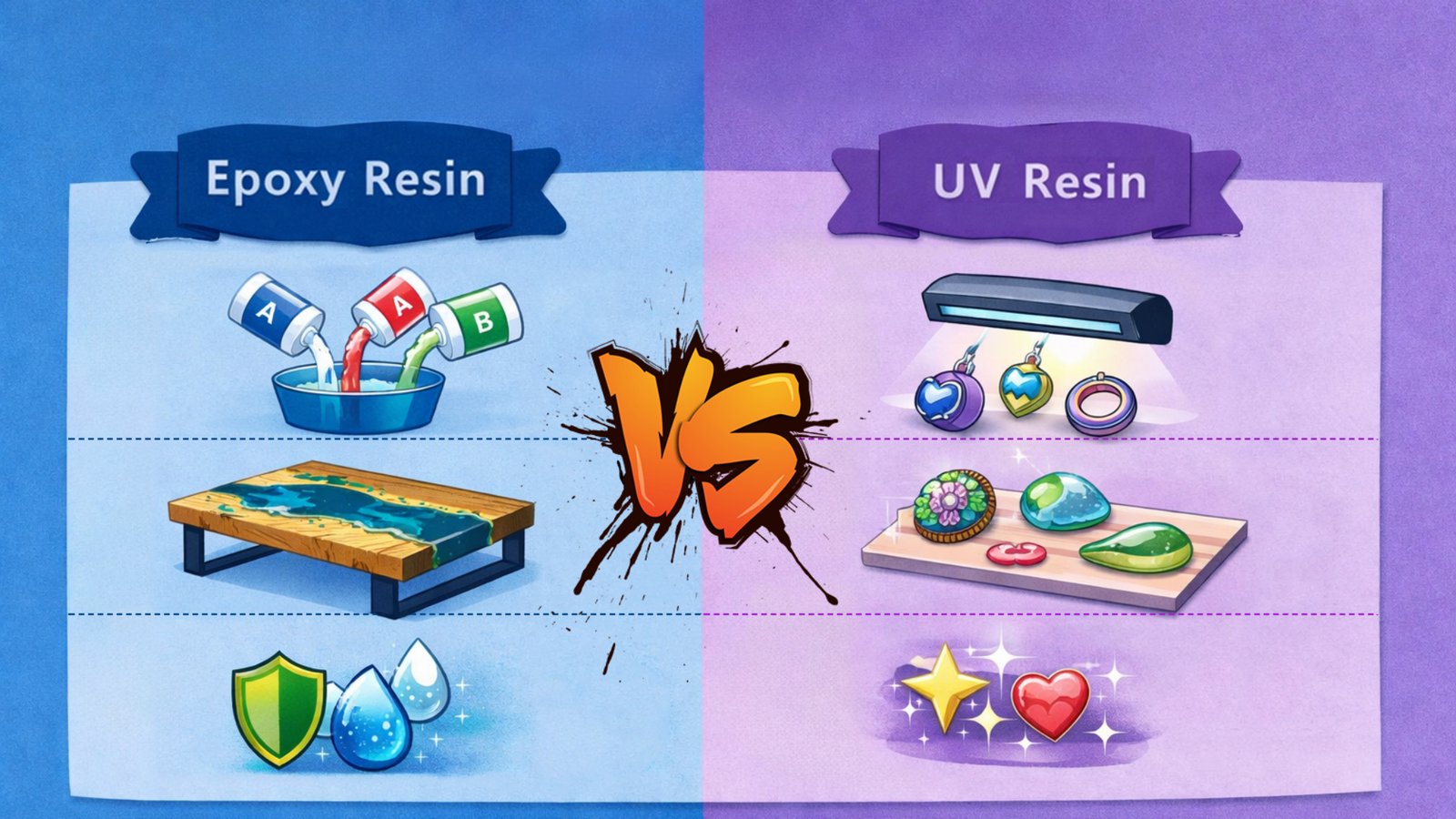
In the application of resin materials, epoxy resin and UV resin are two very common types. They are widely used in various fields such as crafts making, jewelry processing, coating protection, and industrial manufacturing. Although both are resin materials that can cure to form a hard and transparent surface, they differ significantly in curing method, performance characteristics, and applicable scenarios. Understanding their differences helps select the more suitable material for practical applications.
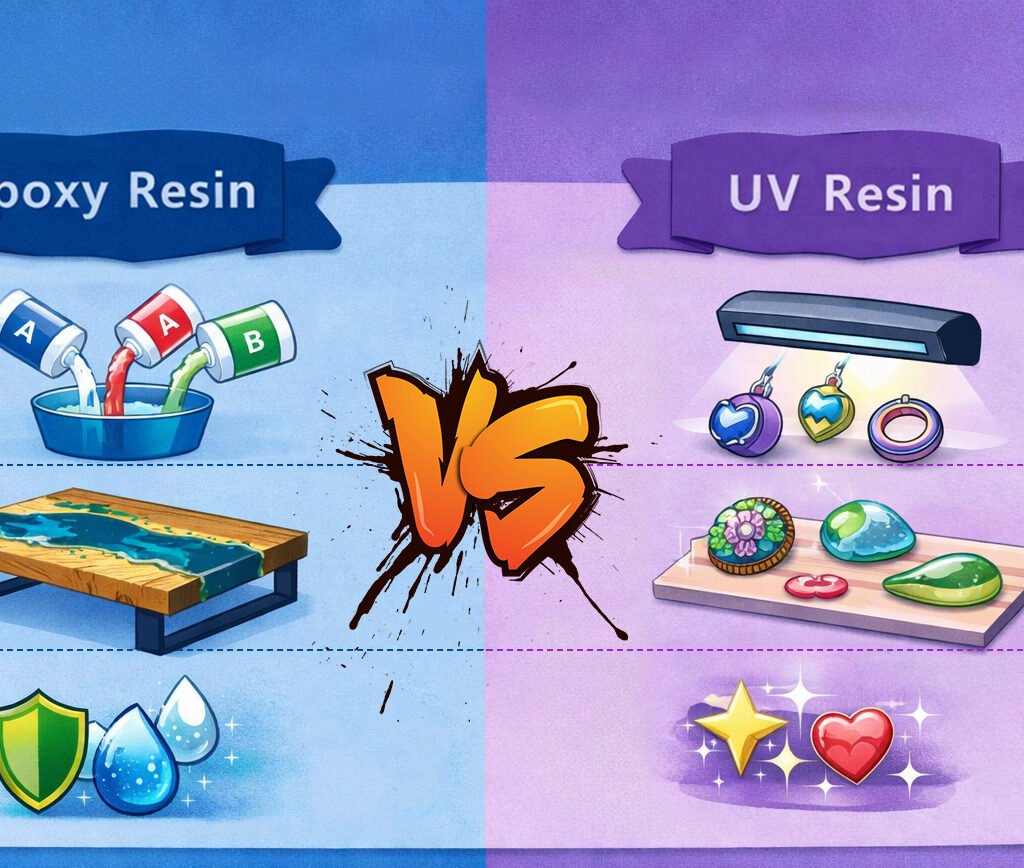
First, the most obvious difference lies in their curing mechanisms.Epoxy resin usually uses a two-component system consisting of Part A resin and Part B hardener. They must be mixed in a fixed ratio before use. A chemical reaction occurs after mixing, leading to gradual cross-linking and curing. This process often takes several hours or longer to fully harden.UV resin is a single-component material that requires no additional hardener. It cures rapidly under UV light or sunlight, belonging to the photo-curing system. Normally, UV resin fully cures within a few minutes under UV irradiation, greatly improving work efficiency.
Second, there is a clear difference in applicable thickness.Epoxy resin allows thick casting. Especially dedicated deep-pour epoxy resin can be cast to a thickness of several centimeters or more in one go, making it ideal for river tables, thick decorative parts, and large crafts.Due to the limited penetration of UV light, UV resin is only suitable for thin-layer coating or small products, with a single layer usually within a few millimeters. Over-thick casting will prevent UV light from fully penetrating, resulting in incomplete internal curing.
Third, the hardness and overall performance are also different.Epoxy resin generally has high strength, good wear resistance, and excellent adhesion, so it is often used in industrial fields such as floor coatings, structural adhesives, and composite materials. It also offers good water resistance and chemical corrosion resistance.In contrast, although UV resin has a high surface gloss after curing, its overall strength and durability are usually lower than epoxy resin. Therefore, it is mostly used for surface coatings of jewelry, models, or small decorative parts.
Fourth, they differ in ease of operation.Epoxy resin requires accurate ratio control of Part A and Part B, as well as thorough mixing. Otherwise, problems such as incomplete curing or sticky surfaces may occur. In addition, bubbles are easily generated during curing, so degassing is sometimes necessary.UV resin is relatively simple to use: no mixing or ratio matching is needed. It can be used directly and cured under UV light, which is why many hobbyists prefer it.
Furthermore, the two resins also differ in transparency and surface finish.High-quality epoxy resin achieves extremely clear transparency after full curing, suitable for large transparent decorative parts or artworks.UV resin typically produces a very glossy surface. With fast curing, it quickly forms a mirror-like finish, making it perfect for jewelry sealing or surface protection.
Overall, epoxy resin and UV resin each have their own advantages and suitable applications.Epoxy resin is usually a better choice for thick casting, large decorative parts, or industrial applications.UV resin is more convenient and efficient for fast curing, small jewelry, or thin-layer coating.Choosing the right resin based on specific needs will achieve the most satisfactory results.