


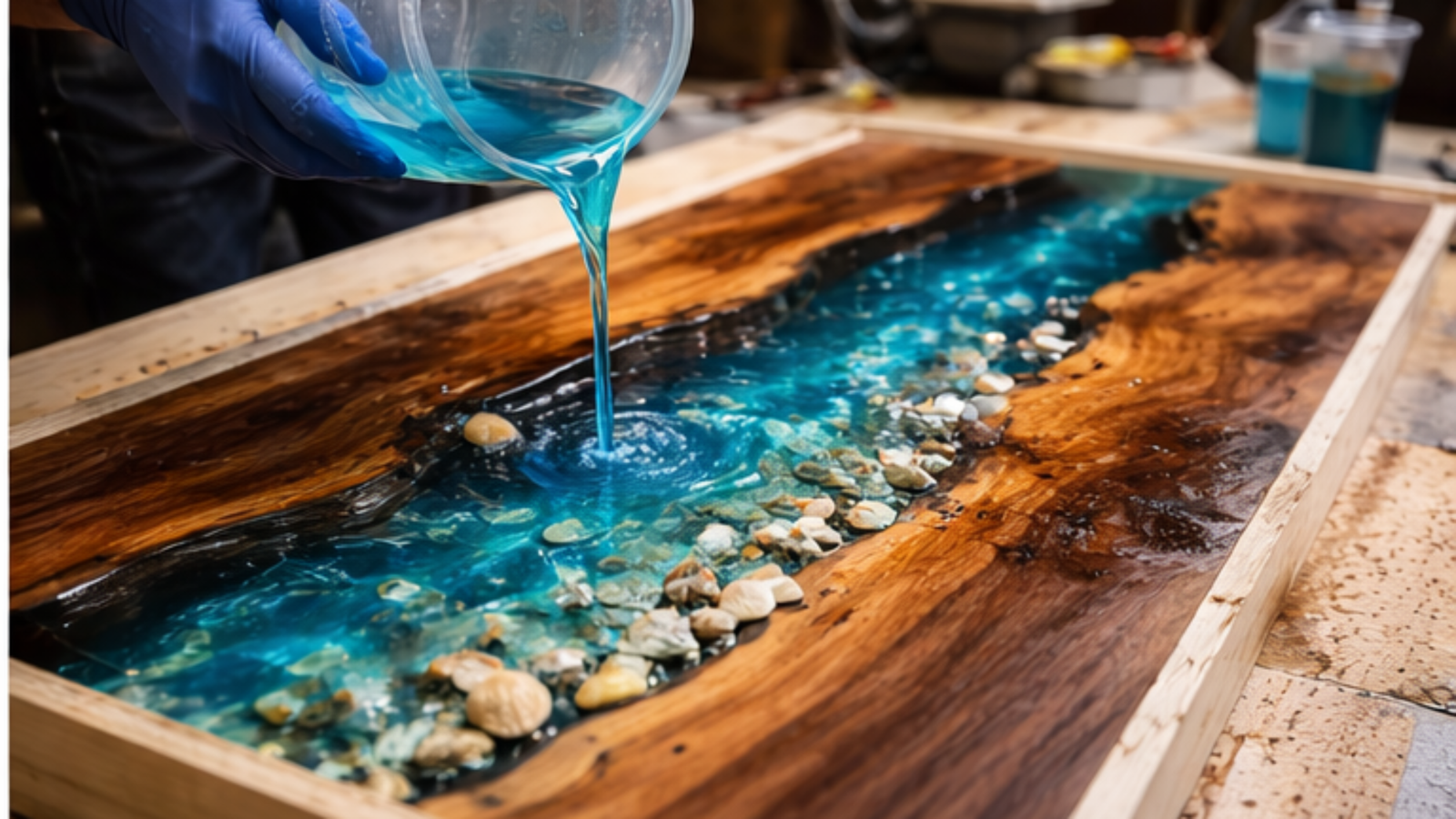
Epoxy resin is widely used in the production of wooden table tops, bar counters, artistic countertops, and river tables due to its high transparency, excellent hardness, and good chemical resistance. When using epoxy resin to make countertops, one of the most common concerns is: How long does epoxy resin for countertops take to dry?
In fact, the drying time of epoxy resin is not fixed; it is affected by various factors such as product formulation (fast-curing, slow-curing), pouring thickness, and ambient temperature.
1. Basic Curing Time of Countertop Epoxy Resin
The curing process of countertop epoxy resin can be divided into three stages: tack-free time, initial curing time, and full curing time.
- Tack-free time: For most tabletop epoxy resins, the surface gradually dries in about 6–12 hours after pouring. At this point, the surface is no longer sticky, but the interior remains semi-cured. The resin is still soft and cannot be sanded or loaded.
- Initial curing time: Usually around 24 hours, the epoxy resin is mostly cured. The countertop can be lightly touched or moved gently, but heavy objects or rough handling are still not recommended.
- Full curing time: It generally takes 48–72 hours for the resin to reach high hardness and stability. Some high-performance countertop resins even require 5–7 days to achieve optimal mechanical properties.Therefore, it is best to wait at least 3 full days before sanding, polishing, or officially using the countertop.
2. Main Factors Affecting Epoxy Resin Drying Time
Although suppliers usually provide a reference curing time, the actual drying speed is influenced by many factors.
(1) Ambient Temperature
Temperature is one of the most important factors affecting epoxy curing speed.
- The ideal curing temperature range is 20°C–25°C.
- Below 15°C, curing slows significantly and may result in incomplete curing.
- Higher temperatures accelerate curing but may increase bubbles or surface ripples.
(2) Pouring Thickness
Countertop epoxy is usually designed for medium-to-shallow pours, with a single layer of 2–5 mm.
Excessively thick layers generate more internal heat, altering curing speed and possibly causing cracking. Thick countertops therefore require layered pouring, with each layer fully cured before the next.
(3) Ambient Humidity
- When humidity exceeds 70%, moisture in the air causes fogging, pinholes, and slower curing.
- Very low humidity does not delay drying but increases the risk of cracking.It is recommended to work on sunny days with good ventilation. On rainy days, use a dehumidifier to maintain humidity at 50%–60%.
3. How to Speed Up Countertop Epoxy Drying
You can use simple methods to accelerate curing:
Maintain a suitable indoor temperature of around 22°C–25°C to greatly improve efficiency. Use heaters if needed, but do not use high-temperature devices for close-range baking, as uneven heating causes bubbles and deformation.
Mix resin and hardener strictly by ratio and stir thoroughly. Incomplete mixing leads to partial under-curing and longer overall drying time.
Avoid pouring too thickly. For a thick countertop, pour in multiple layers, keeping each within the recommended thickness.
Keep the environment stable after application: avoid dust, vibration, and extreme temperature changes to ensure even curing.
4. How to Tell If Epoxy Resin Is Fully Dry
Surface dryness does not equal full curing. Use these methods to check:
- Touch test: Surface is hard and non-sticky.
- Nail test: No indentation when gently pressed with a fingernail.
- Odor test: Resin odor is greatly reduced.
- Time test: Waiting more than 72 hours is the safest practice.
5. Summary
In general:
- Countertop epoxy resin is tack-free in 6–12 hours
- Initially cured in 24 hours
- Nearly fully cured in 48–72 hours
Exact time varies with temperature, humidity, and pouring thickness.
For best results, apply epoxy in suitable conditions and wait for full curing before finishing or use. Only fully cured resin guarantees durability and appearance, creating a long-lasting epoxy countertop.