


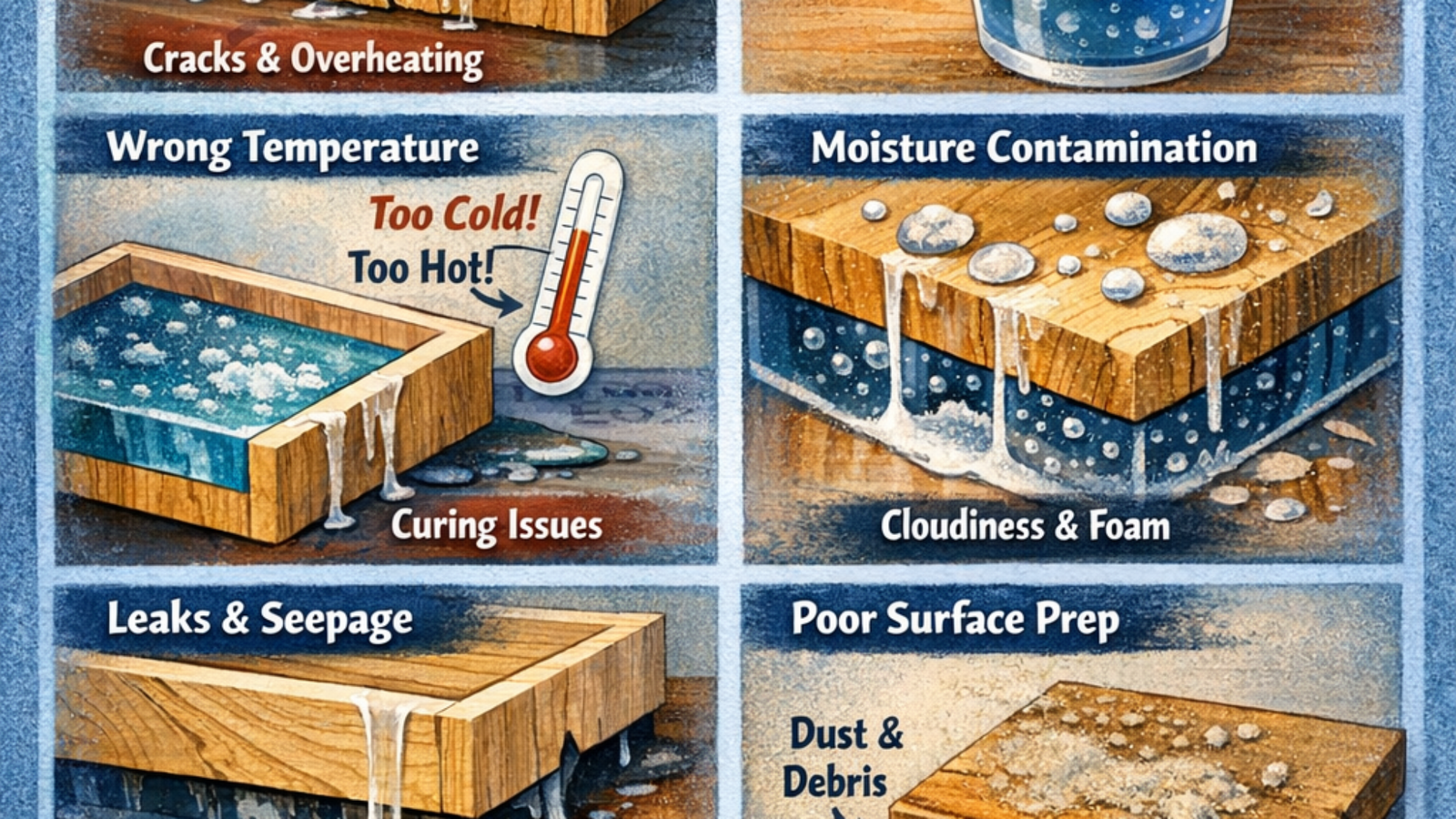
Deep pour epoxy is a core material for creating resin river tables, artistic tabletops, wood fillers, and large decorative pieces. Many people start with great confidence, but often encounter problems such as bubbles, cracking, overheating, and even curing failure. It’s not as simple as “pouring more resin”—the heat release during curing, internal stress, and bubble control are far more complex than with thin-layer applications. Today, Jinghua will guide you through common mistakes made during the application of deep-pour epoxy, helping us avoid many unnecessary losses.
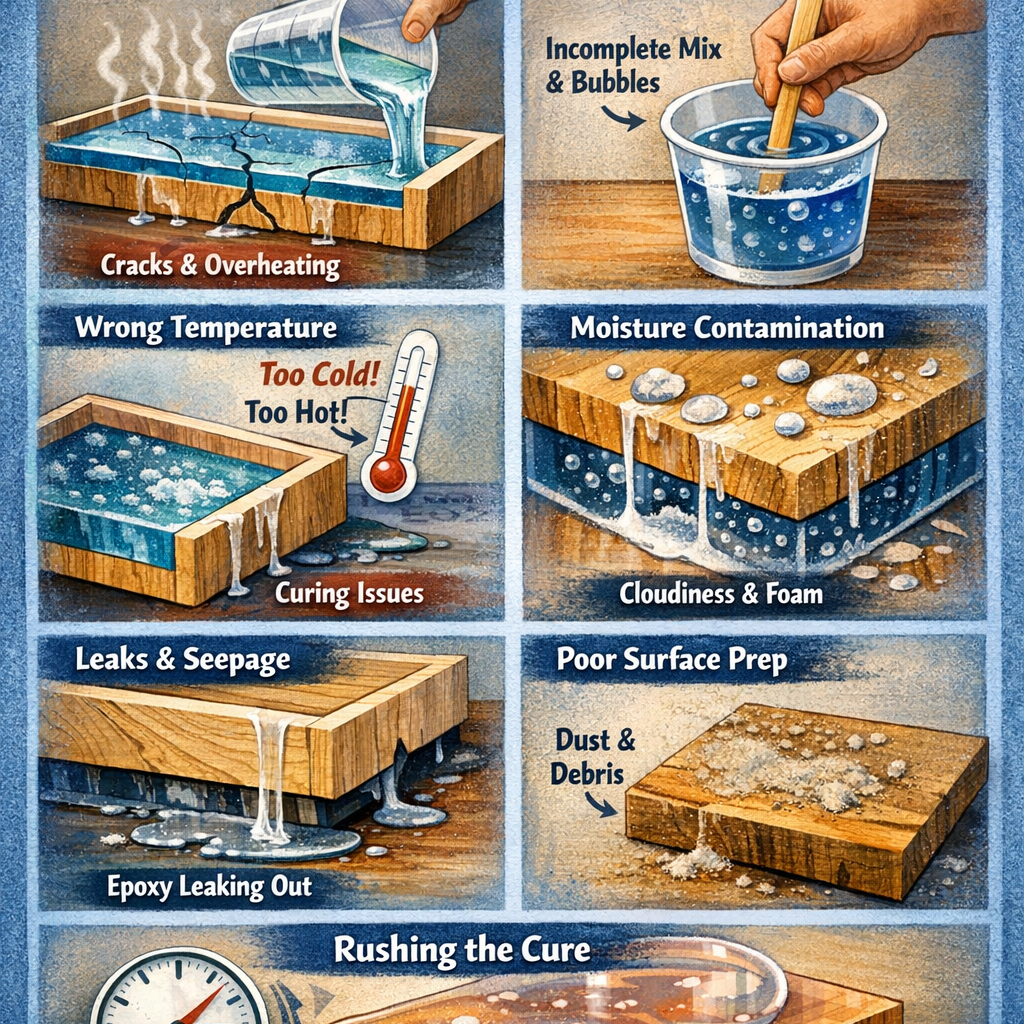
First, we must understand that deep-pour epoxy is different from ordinary epoxy. Deep-pour products can typically be poured several centimeters or even thicker in one go, but at the same time, its curing time and heat release reaction are relatively longer and more intense. Many people try to save time by pouring a thickness exceeding the maximum single-pour thickness, completely ignoring the heat release limit. Heat accumulates extremely quickly inside a thick layer, with the center temperature far exceeding the edges, resulting in inconsistent curing speeds and generating enormous internal stress. Minor issues include uneven surface texture and inconsistent hardness; severe issues include cracking and warping. The correct approach is to strictly follow the product instructions, pouring no more than the maximum thickness allowed in a single application (refer to the product’s detailed specifications for specific thickness), such as 2-3cm per layer, with a 24-48 hour interval between each layer, allowing each layer to fully cure and dissipate heat before pouring the next. Layering not only controls temperature but also reduces air bubbles and improves overall strength.
The second common mistake is uneven mixing or incorrect proportions. Thick-layer epoxy resin pours are generally two-component materials: epoxy resin and hardener. Even a slight difference in the ratio of the main component to the hardener will cause curing problems. Some people pour the material by feel or roughly measure it using a regular cup, resulting in too much or too little hardener. Too little hardener will make the resin perpetually sticky and lack hardness; too much hardener will make the adhesive layer brittle and prone to cracking later. Care must be taken when mixing; many people only stir for 1-2 minutes, failing to scrape the resin off the sides and bottom of the container, resulting in uneven mixing. Thick-layer casting involves a large mixing volume, and areas that are not thoroughly mixed will remain uncured for a long time, forming soft spots and sticky surfaces. The correct method is to accurately weigh the mixture using an electronic scale, mix it according to the manufacturer’s ratio, stir for 3-5 minutes, and repeatedly scrape the sides and bottom of the container until the liquid is completely uniform and without any streaks.
The third and most easily overlooked problem is: inadequate substrate preparation and lack of a sealing primer. Thick-layer casting is often combined with wood and stone, such as river tables. Wood is a porous material, and directly pouring resin will continuously release air, forming numerous air bubbles inside the resin. More problematic, dust, oil, and moisture on the substrate surface will severely reduce adhesion, making the resin prone to blistering and delamination later. Before construction, the substrate must be thoroughly sanded, degreased, dust-free, and completely dried. A thin sealing coating must be applied to the wood first to seal the pores and prevent air release and bubble formation. At the same time, the moisture content of the substrate must be maintained; construction should never be carried out if it exceeds 8%, as moisture will cause the resin to turn white and foggy, significantly reducing adhesion.
The fourth common mistake is ignoring ambient temperature and humidity. The construction environment has a significant impact on epoxy resin. If the temperature is too low, the resin’s fluidity will decrease, making it difficult for air bubbles to escape and prolonging the curing time. If the temperature is too high, it may cause the reaction to be too rapid. Excessive humidity may affect the surface finish, leading to whitening or fogging. Normal construction temperature is generally maintained at around 20℃–25℃; humidity should be below 65%.
The fifth common problem is improper air bubble handling. Air bubbles are one of the most common problems in thick-layer casting. Air is introduced during resin mixing and pouring. If not addressed promptly, it will affect the transparency and appearance after curing. The correct approach is to stir slowly at a low speed to reduce air entrainment; after pouring, quickly sweep the surface with a heat gun or flame gun to allow air bubbles to rise and burst. Be careful not to get too close to avoid baking the resin yellow; air bubbles are difficult to rise in thick layers, and layered pouring helps air bubbles escape layer by layer. If possible, placing the resin in a vacuum chamber for degassing shortly after pouring will yield even better results.
The sixth common problem is neglecting the curing time; this is a mistake made by most beginners. Thick layers of epoxy resin require a long time to fully cure. Even if the surface appears dry and hard, the internal reaction may still be ongoing. Many beginners, seeing the surface harden, rush to sand, move, or apply heavy pressure, causing resin deformation, scratches, and even internal cracking. Thick layers should be cured for at least 7 days before light sanding, and full curing to reach maximum hardness typically takes 15-30 days. During curing, avoid exposure to direct sunlight, high temperatures, and heavy pressure. Sanding and polishing should be done gradually. Afterward, avoid scratching with sharp objects and direct contact with high temperatures. Proper maintenance is essential to maintain the translucent texture and prevent yellowing and aging.
The seventh common problem is using unsuitable pigments; when making large crafts, pigments, colorants, and color pastes are often added to adjust the color and achieve better results. However, adding too much or using unsuitable materials can affect resin curing. For example, some water-based pigments may affect the resin reaction, leading to abnormal local curing. Therefore, when adding colorants, it is best to choose pigments specifically designed for epoxy resins and control the addition ratio.
Thick-layer epoxy resin casting may seem simple, but to achieve the desired effect, we need to pay attention to the details of each step to create a piece that matches our expectations. If you are a beginner, we recommend starting with small-scale projects to gradually familiarize yourself with the material’s properties before moving on to larger crafts.
Finally, if you want to purchase the highest quality, most cost-effective thick-layer epoxy resin casting, please feel free to contact us at jinghua.