


If you are working on epoxy resin projects or have come into contact with epoxy resin products, you must have heard of deep pour epoxy resin and standard epoxy resin. Most people cannot tell the two products apart by appearance alone. Although they look similar, their formulations and applications are completely different, and they are not interchangeable. Today, Jinhua Resin will break down the core properties, application scenarios, costs, and common misconceptions of these two products to help you with your epoxy resin projects.
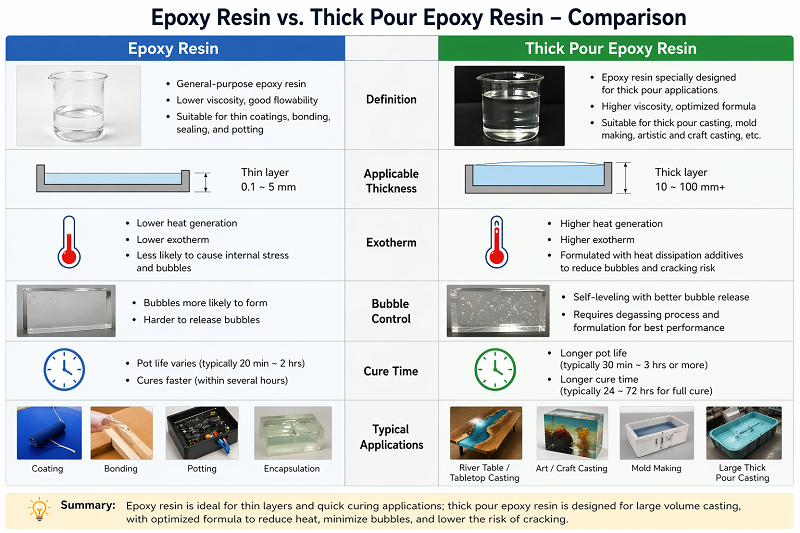
What is Standard Epoxy Resin?
Standard epoxy resin, also known as coating epoxy, is applied as a thin layer on surfaces to create a protective, high-gloss finish. Common types include tabletop epoxy, art epoxy, and floor coating epoxy. It typically has a relatively fast curing time (floor coatings cure slower).
Common mixing ratios are 2:1 and 1:1. It is designed to create smooth, durable top coats for wood, concrete, bar tops, coasters, and small art pieces.
What is Deep Pour Epoxy Resin?
Deep pour epoxy resin is a specialty resin formulated specifically for thick pours and filling large voids. It usually uses a slow exothermic curing system, with a common mixing ratio of 2:1 (some are 3:1). It effectively controls heat release and allows for thick single-layer pours. Typical single-pour thickness on the market is 2–8 cm, and some industrial-grade epoxies can exceed 10 cm.
Deep pour epoxy resin has low viscosity and slow curing, resulting in a long working time (60–120+ minutes). Initial curing takes 24–72 hours, and full cure usually requires 7–14 days. The thicker the single pour, the longer the curing time. The slow chemical reaction releases heat steadily, ensuring clarity and stability even in large-volume pours.
Common applications: River tables, embedded objects (flowers, stones, coins), deep molds, and resin art requiring a thick, transparent effect.
Core Differences Between Standard Epoxy Resin and Deep Pour Epoxy Resin
The most critical difference is pour thickness:
- Standard epoxy resin: 1–6 mm per pour
- Deep pour epoxy resin: 2–8 cm per pour
Next is curing time:
- Standard epoxy (tabletop, art): cures within 6–24 hours (floor coatings take longer)
- Deep pour epoxy: 24–72 hours initial cure, full cure takes 7+ days
In terms of hardness and durability:
- Standard epoxy: better performance, high Shore D hardness (75–85), scratch and wear resistant, ideal for high-use surfaces like tabletops and floors
- Deep pour epoxy: slightly lower hardness (Shore D 60–75), moderate wear resistance. River tables are usually top-coated with standard epoxy for a high-gloss, wear-resistant finish.
All epoxy curing is inherently an exothermic reaction:
- Deep pour epoxy: low viscosity, low exotherm, slow cure
- Standard epoxy: higher viscosity, more intense exothermic reaction, faster cureThis is why deep pour epoxy is better for large-volume projects.
Cost Comparison
Deep pour epoxy resin is generally more expensive per liter than standard epoxy resin, due to specialized slow-curing hardeners and temperature-control additives, as well as more complex manufacturing.
- Standard epoxy: affordable and readily available
- Deep pour epoxy: higher upfront cost, but single thick pour reduces labor from multi-layer applications
For example, a river table with a 1 cm resin layer can be completed in one pour with deep pour epoxy, which is more time-efficient than 4+ thin pours with standard epoxy, often making the total cost more reasonable.
Application Scenarios
Standard Epoxy Resin
- Thin, high-gloss top coats for tabletops, bar tops, kitchen countertops
- Small resin paintings, coasters, jewelry, photo frame sealing, wood sealing
- Concrete floor coatings, countertop refinishing
- Any project needing a hard, wear-resistant, thin protective layer
Deep Pour Epoxy Resin
- River tables (filling wide gaps between solid wood slabs)
- Deep mold casting, large resin sculptures, thick-slab resin art
- Embedding and preserving plants, fossils, coins, souvenirs
- Filling deep holes and cracks in wood and concrete
- Thick solid resin blocks, decorative panels
Can They Be Used Together?
Many large projects use both resins together. For example, in a typical river table:
- Wood is first sealed with standard epoxy resin to prevent bubbles during pouring
- The main pour uses deep pour epoxy
- After curing, a top coat of standard epoxy resin is applied for protection
Summary
In short: use deep pour for thick projects, standard for thin projects. There is no absolute “best” option—only the most suitable for your project. Choosing the right product is more important than choosing the most expensive one. If you have questions or need sourcing for your project, feel free to consult Jinhua Resin.