


Why Viscosity Is the First Thing You Should Check
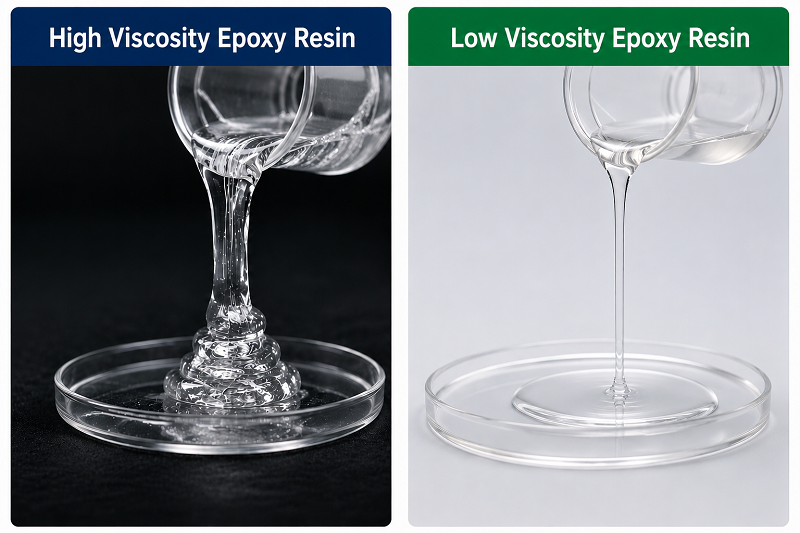
Walk into any epoxy aisle — online or in a hardware store — and you’ll quickly notice that not all resins pour the same way. Some run like warm water. Others sit in the container like cold honey. That difference comes down to one property: viscosity.
Viscosity measures how much a liquid resists flowing. In the epoxy world, it’s expressed in centipoise (cP) or millipascal-seconds (mPa·s), and the number matters far more than most beginners expect. Pick the wrong viscosity for your project and you’ll end up with resin running off vertical surfaces, trapped air bubbles you can’t get rid of, or a pour that generates enough heat to crack your mold.
Here’s the short version before we go deeper:
- Low viscosity epoxy resin — thin, pourable, typically under 1,000 cP. Flows like cooking oil. Great for penetrating porous surfaces, self-leveling coatings, and thick casting pours.
- High viscosity epoxy resin — thick, paste-like, often above 10,000 cP and sometimes reaching several hundred thousand cP. Clings to vertical surfaces. Built for bonding, filling, and structural repair.
Neither is better. They’re designed for entirely different jobs.
Low Viscosity Epoxy Resin — What It Does Well
Core Properties at a Glance
| Property | Typical Value |
|---|---|
| Viscosity range | 100–3,000 cP |
| Flow behavior | High — self-leveling |
| Penetration depth | Excellent |
| Bubble release | Easy — bubbles rise and pop naturally |
| Working time | Usually longer, which helps with large pours |
| Mixing accuracy | Easier to achieve consistent ratios |
Where Low Viscosity Actually Shines
Deep penetration into porous surfaces. Because the resin is thin, it wicks into the microscopic channels of wood, concrete, and fiber reinforcements rather than sitting on top. This is what makes low viscosity formulas the default choice for structural lamination and crack repair.
Self-leveling on flat surfaces. Pour it out and it finds its own level without much coaxing. That’s why floor coatings use it — you’d spend hours chasing a thick paste across a warehouse floor.
Bubble-free results. Air introduced during mixing rises to the surface quickly in a thin resin. In a thick one, those bubbles get stuck. This alone is reason enough to choose low viscosity for any transparent art piece where clarity matters.
Long working windows. The same chemistry that slows the cure rate also gives you more time to work. Handy when you’re managing a big pour across a 12-foot dining table.
Products Best Suited for Low Viscosity Epoxy
Epoxy Floor Coating The self-leveling nature of thin resin is exactly what you need when covering a garage, factory floor, or commercial space. Applied correctly, it wets out the concrete surface and cures to a hard, chemical-resistant finish without roller marks or high spots.
Art Resin / Casting Resin Transparent art pieces — resin paintings, geode coasters, decorative objects — depend on a bubble-free, high-clarity result. Low viscosity delivers both. It also accepts alcohol inks, mica powders, and pigment pastes without muddying the color.
River Table & Decorative Wood Pours The colored or clear “river” running through a live-edge slab needs to fill the gap evenly and release all its air before gelling. Low viscosity handles that job. For slabs deeper than about a quarter inch, you’d switch to a deep pour formula (more on that shortly).
Carbon Fiber & Fiberglass Lamination Composite fabricators rely on thin resin to fully saturate the fiber weave. If the resin is too thick, dry spots form inside the laminate — weak points that can fail under load. Boat builders, automotive shops, and aerospace suppliers all specify low viscosity infusion or laminating resins for this reason.
Concrete Crack Injection Ultra-low viscosity products in the 50–200 cP range are literally injected under pressure into hairline cracks in bridges, tunnels, and foundations. The resin flows through the crack network and bonds the concrete back together from the inside out.
Electronics Potting & Impregnation Thin resin seeps between transformer windings, around PCB components, and into connector housings where a thicker material simply wouldn’t go. After curing, it provides electrical insulation and moisture protection in a single step.
Jewelry & Small Craft Pieces Encasing dried flowers, glitter, or small objects in a clear resin requires something thin enough to fill every void without trapping air. Small silicone molds pair particularly well with low viscosity casting resins.
Wood Stabilization Rotted or punky wood that would otherwise crumble can be salvaged by soaking it in thin resin. The resin displaces the moisture and locks the wood fibers together. After curing, the stabilized piece machines and finishes cleanly.
High Viscosity Epoxy Resin — What It Does Well
Core Properties at a Glance
| Property | Typical Value |
|---|---|
| Viscosity range | 10,000 cP and above (including paste/thixotropic grades) |
| Flow behavior | Low — holds its shape |
| Vertical surface performance | Excellent — won’t sag or run |
| Gap-filling capacity | Strong — stays put in large voids |
| Load bearing | High when fully cured |
| Bubble control | Requires more deliberate mixing technique |
Where High Viscosity Pulls Ahead
Non-sag on vertical and overhead surfaces. This is the defining advantage. A thick, thixotropic epoxy stays exactly where you put it — on a hull side, a pipe, a ceiling joint — until it cures. Thin resin would puddle at the bottom of the joint.
Bridging wide gaps. Low viscosity resin would drain straight through a loose-fitting joint or a large void. Paste-grade epoxy fills the gap and supports the load while curing.
Structural bonding strength. Thixotropic epoxy adhesives are engineered specifically for high shear and peel loads. They’re what holds aircraft components, marine hulls, and structural assemblies together in demanding environments.
Thick single-pass coatings. A high viscosity coating applied with a trowel or notched squeegee can lay down several millimeters of material in one pass — useful for protective linings on tanks, containment areas, and industrial floors.
Products Best Suited for High Viscosity Epoxy
Structural Adhesive / Epoxy Putty The hardware store version of this is often sold as “steel epoxy” or two-part putty. You knead the two components together and apply the resulting paste to metal, ceramic, stone, or wood. It sets hard enough to machine, drill, and paint. Used everywhere from plumbing repairs to antique furniture restoration.
Protective Topcoats & Anti-Corrosion Coatings Heavy-duty marine and industrial coatings are formulated at high viscosity so a single brush or roller pass builds meaningful film thickness. Ship hulls, offshore platforms, and pipeline exteriors rely on this for long-term corrosion protection.
Marine Fiberglass Repair Gel coat damage, delamination, and osmotic blistering on a boat hull all get filled with high viscosity paste. It doesn’t run out of the repair before it gels, and it bonds well to existing fiberglass laminates.
Tile & Stone Setting (Epoxy Grout / Mortar) Epoxy tile adhesives and grouts outperform cement-based alternatives in wet, chemically aggressive environments. Swimming pools, commercial kitchens, and laboratory floors often specify epoxy mortar because it won’t crack, stain, or support mold growth.
Chemical Anchoring (Injection Epoxy) Injection-grade high viscosity epoxy fills a drilled hole and bonds a rebar or threaded rod to concrete with holding loads that exceed the strength of the concrete itself. Used extensively in curtain wall installation, bridge retrofits, and heavy equipment foundations.
Wind Turbine Blade Repair Leading-edge erosion on turbine blades is repaired with thixotropic paste that can be shaped and smoothed on a curved, near-vertical surface without sagging. Downtime is costly, so the material also needs a reasonably fast cure.
Epoxy Mortar for Concrete Repair Industrial floors take a beating. High viscosity epoxy mortar mixed with aggregate fills spalled areas, pothole-like damage, and joint failures. Once cured, the repair is often harder and more abrasion-resistant than the original concrete.
Sealing & Caulking Paste-grade epoxy sealants handle joints, pipe penetrations, and expansion cracks in concrete where long-term chemical resistance matters more than flexibility.
Three Products Worth Knowing in Detail
The following product categories show up constantly in search results and buyer questions. Each occupies a distinct niche — here’s what actually matters about them.
Table Epoxy Resin
What it is: A medium-to-low viscosity two-part epoxy formulated specifically for wood tabletops, bar counters, and decorative furniture surfaces. It’s the resin category that probably drove most of the DIY epoxy boom over the last decade.
Table epoxy is engineered around a specific set of requirements: crystal clarity, self-leveling behavior, a long enough working time to remove bubbles with a heat gun, and a surface that cures hard enough to resist scratches, alcohol spills, and daily use.
Typical Specifications
| Parameter | Typical Range |
|---|---|
| Viscosity | 800–3,000 cP |
| Mix ratio | 2:1 or 1:1 by volume |
| Pot life | 30–45 minutes |
| Demold time | 24–48 hours |
| Full cure | 72 hours to 7 days |
| Pour depth per layer | 3–6 mm (surface coat) |
| Clarity | Crystal clear, anti-yellowing formula |
Where People Use It
River tables. Two live-edge slabs separated by a gap filled with colored or clear resin — this is probably the project that introduced table epoxy to a mainstream DIY audience. The resin becomes the “river” running between the wood, and the finished piece looks like nothing else you can buy at a furniture store.
Bar tops. Bars coat their wood counters with table epoxy to get a surface that handles spilled drinks, wet glasses, and years of hard use without absorbing stains. The glossy finish also makes cleanup easy.
Embedding objects in tabletops. Pressed flowers, bottle caps, maps, seashells, coins — anything flat (or nearly flat) can be encased under a clear epoxy pour. Schools and restaurants sometimes commission tables with local maps or historical photos built into the surface.
Furniture refinishing. A worn dining table with scratches, water rings, and old finish can be resurfaced entirely with table epoxy. Fill the cracks first, let that layer cure, then flood the surface with a self-leveling coat.
Kitchen and restaurant counters. Food-safe formulas (look for products that specifically state food safety after full cure) work on kitchen islands and countertops. They resist heat from hot pans better than most finishes, though extreme temperatures — over about 150°F — can cause some softening.
Buying Advice
Go with a UV-stabilized, non-yellowing formula if the piece will see any sunlight. Cheaper resins yellow noticeably within a year near a window. Also check VOC content — water-clear results can come from low-VOC formulas too, and indoor air quality matters.
For large tables, pour in layers no thicker than 4mm and wait for each layer to reach the gel stage before adding the next. Stacking too much liquid epoxy at once means the exothermic heat from the deeper layers has nowhere to go, which can cause bubbles, cracking, or worse.
Deep Pour Epoxy Resin
What it is: An ultra-low viscosity casting resin built for single pours significantly thicker than what table epoxy can handle — typically 25mm to 100mm in one shot, depending on the product.
The problem with standard epoxy in thick pours is purely thermal. Epoxy cures through an exothermic chemical reaction. In a thin coat, the heat dissipates into the air. In a thick block, it has nowhere to go, and temperatures inside the pour can spike high enough to crack the resin, create massive bubbles, or in extreme cases, start a fire. Deep pour formulas solve this by using a slower-reacting hardener that spreads the exotherm over a much longer window.
Typical Specifications
| Parameter | Typical Range |
|---|---|
| Viscosity | 100–500 cP |
| Single pour depth | 25–100 mm |
| Pot life | 60–120 minutes |
| Demold time | 48–72 hours |
| Full cure | 7–14 days |
| Clarity | Optically clear, glass-like |
| Color stability | Long-term anti-yellowing |
Deep Pour vs. Table Epoxy — Side by Side
| Feature | Table Epoxy | Deep Pour Epoxy |
|---|---|---|
| Max pour depth per layer | 3–6 mm | 25–100 mm |
| Viscosity | Medium-low | Ultra-low |
| Cure speed | Faster | Slow (low exotherm) |
| Bubble release | Good | Excellent |
| Suitable for thick castings | No (needs multiple layers) | ✅ Yes |
| Suitable as surface topcoat | ✅ Yes | No (too thin) |
What People Build With It
River table fill. Deep pour lets you fill the entire gap between two slabs in a single session rather than building up 3mm layers over multiple days. For a river that’s 50mm deep, this cuts days off the project timeline.
3D ocean and landscape scenes. Artists use deep pour to create transparent blocks containing underwater scenes — suspended fish, coral, air bubbles — that look genuinely three-dimensional because the resin itself becomes part of the depth illusion.
Large transparent castings. Furniture legs, decorative columns, award trophies, and architectural elements can be cast as solid clear blocks. Deep pour is the only practical way to achieve this without sectioning the piece into thin layers.
Preservation casting. Sports memorabilia, insects, military medals, even a pair of baby shoes — people cast these in clear deep pour blocks as permanent keepsakes. The result is essentially a solid glass-like object surrounding the preserved item.
Illuminated resin art. LED strips embedded inside a deep pour block create glowing sculptures. The transparency of the cured resin carries light surprisingly well, especially with tinted pours.
A Few Things Worth Knowing Before You Pour
Keep the ambient temperature between 20–25°C throughout the cure. Below that range, the resin may cure cloudy or incompletely. Above it, even a slow-cure formula can overheat in thick sections. Warming your resin to around 30°C before mixing reduces viscosity further and helps any remaining air escape quickly after the pour.
UV Resin
What it is: A single-component resin that cures not through a chemical reaction with a hardener, but through exposure to ultraviolet light. No mixing, no pot life — it stays liquid indefinitely in a dark bottle and solidifies within seconds to a few minutes under a UV or LED lamp.
UV resin contains photoinitiators — molecules that absorb UV light (typically at 365–405nm) and kick off the polymerization reaction almost instantaneously. The convenience this creates is real: you can work with small amounts precisely, cure only what you need, and move on immediately.
UV Resin vs. Two-Part Epoxy — How They Actually Differ
| Feature | UV Resin | Epoxy Resin |
|---|---|---|
| Components | Single part, no mixing | Two parts (resin + hardener) |
| Cure trigger | UV/LED light | Chemical reaction |
| Cure time | Seconds to 5 minutes | Hours to days |
| Working time | Unlimited (keep away from light) | Limited by pot life |
| Max pour depth | ~1–3 mm per layer | Several centimeters to 100mm+ |
| Clarity | Very high | Very high |
| Yellowing resistance | Variable (poor in budget grades, good in professional grades) | Good with UV-stabilized formulas |
| Cost per volume | Higher | Lower |
| Practical for large volumes | No | Yes |
Viscosity in UV Resin — It Also Matters
UV resin isn’t one-size-fits-all on the thickness front either.
Thin (low viscosity) UV resin flows easily into small molds, fills fine details, and levels itself out. Best for jewelry pieces, flat embedments, and small casting work where clarity is the priority.
Thick (gel) UV resin holds shape when applied to curved or vertical surfaces. Useful for building up dome effects on flat pieces, creating water droplet decorations, and applying topcoat layers to irregular objects without the resin running off the edge before it cures.
Where UV Resin Gets Used
Jewelry and accessories. This is probably the biggest use category for consumer UV resin. Fill a small silicone mold with flowers, glitter, or charms, hit it with a 36W UV lamp for two minutes, and pop out a finished pendant. The turnaround is minutes rather than hours, which makes it ideal for craft markets, custom orders, and teaching environments.
Nail art and gel nails. The gel polish at nail salons is, chemically speaking, a close relative of UV resin. It cures under a UV or LED lamp in the same way. The nail industry was arguably the first to commercialize UV cure chemistry at the consumer level.
Scale model and miniature repair. A broken sword on a 28mm figurine, a snapped antenna on a plastic model kit — UV resin fills and bonds these micro-repairs with a precision that’s hard to achieve with two-part epoxy. Mix ratios and pot life become irrelevant when you’re working with drops.
Electronics and photonics. In industrial manufacturing, UV cure adhesives hold fiber optic connectors in alignment, secure lens assemblies, and bond components that can’t tolerate the heat of conventional curing. The cure happens in under a second with the right light source, which keeps production lines moving fast.
Optical bonding. Specialty UV resins formulated for optics cure to a glass-like clarity with a controlled refractive index — meaning light passes through without distortion. These are used in camera lenses, eyeglass lens bonding, and display assemblies.
Art and photography protection. Poured over a flat canvas or photograph, UV resin creates a high-gloss protective layer that’s clearer and more durable than conventional varnish. Because it cures in minutes, there’s no waiting around for dust to settle on a wet surface.
SLA and DLP 3D printing. The photopolymer resins used in resin 3D printers are essentially UV resins with tuned viscosity and photosensitivity. After printing, parts go into a UV wash-and-cure station to complete the polymerization and reach full hardness.
Before You Buy UV Resin
Get a lamp with at least 36W output. A 9W lamp will technically cure the surface but often leaves the interior soft — a problem called “undercure” that only shows up later when the piece flexes or scratches unexpectedly.
Store open bottles in a dark, cool place. Even indirect sunlight through a window can gradually thicken the resin and shorten its shelf life. UV resin in a dark amber or black bottle is packaged that way for good reason.
Cure in thin layers. UV light doesn’t penetrate more than a few millimeters into most resins. For anything deeper than 3mm, cure in stages and check for tackiness between each layer.
Uncured UV resin is a skin sensitizer. Short-term exposure probably won’t cause problems, but repeated contact can develop into a persistent allergy. Nitrile gloves and eye protection are worth the habit, especially if you’re working with it regularly.
High Viscosity vs. Low Viscosity — The Full Comparison
| Category | Low Viscosity | High Viscosity |
|---|---|---|
| Viscosity range | 100–3,000 cP | 10,000+ cP |
| Flow behavior | High — self-leveling | Low — paste/thixotropic |
| Surface penetration | Excellent | Poor |
| Vertical surface use | Not recommended | Ideal |
| Bubble management | Easy — bubbles rise naturally | Requires more care |
| Thick casting | Yes (deep pour formulas) | No — heat buildup risks |
| Primary applications | Casting, lamination, crack injection, floor coating | Bonding, patching, repair, sealing |
| Representative products | Art resin, floor epoxy, deep pour, crack injection | Structural adhesive, chemical anchor, epoxy mortar |
How to Pick the Right Epoxy for Your Project
A few targeted questions usually get you to the right answer faster than reading specification sheets:
Is the surface vertical or overhead? Yes → high viscosity. It won’t sag before it gels. No → either works, depending on the other criteria.
Do you need the resin to soak into a porous material? Yes → low viscosity. Penetration is its whole point. No → high viscosity is usually more practical.
Is the pour deeper than 6mm in a single session? Yes → deep pour epoxy specifically. Standard low viscosity resin will overheat.
Is transparency and visual clarity the main goal? Yes → low viscosity art or casting resin, UV-stabilized formula.
Do you need structural strength — high loads, shear forces, impact resistance? Yes → high viscosity structural adhesive or epoxy mortar.
Do you need a quick turnaround on small, precise work? Yes → UV resin. Nothing else cures in under five minutes.
Frequently Asked Questions
Does higher viscosity mean higher strength? Not directly. Viscosity and cured mechanical properties are largely independent of each other — they’re controlled by different aspects of the chemical formulation. High viscosity structural adhesives tend to be stronger in shear because they’re designed for bonding, but a low viscosity laminating resin can produce composite panels with extraordinary tensile strength when paired with fiber reinforcement.
Can you use low viscosity resin on a wall? Standard low viscosity resin will run. If you specifically need a thin resin on a vertical surface — say, for consolidating crumbling stone on a wall — look for thixotropic grades that are formulated thin but still have enough gel structure to resist flow. Otherwise, switch to a high viscosity product.
What’s the easiest way to reduce epoxy viscosity on-site? Warm the unmixed components to 30–45°C before mixing. Viscosity drops significantly with temperature, and the extra working time loss is usually minor. Avoid solvent thinners — they interfere with the cure chemistry and weaken the final product.
Are thick high-viscosity resins more brittle after curing? That depends on the formulation, not the viscosity. Flexible epoxy systems can be either thick or thin. If you need impact resistance or some degree of flexibility in a cured part, look for formulas that specifically mention flexibility or elongation in their technical data sheet rather than inferring it from viscosity.
Can UV resin replace epoxy resin for table pours? Not practically. UV light can only penetrate a few millimeters into resin, so a 4mm river table pour would require many separate cure cycles with precise light positioning — slow, inefficient, and still likely to leave undercured spots in the corners. Two-part epoxy remains the right choice for any significant pour volume.
Final Thoughts
The viscosity of an epoxy resin isn’t a quality indicator — it’s a design decision made by the manufacturer to suit a specific set of tasks. Thin resins flow, penetrate, and self-level. Thick resins grip, fill, and hold. Matching the product to the job is how you get results that look and perform like they’re supposed to.
For decorative and furniture work: table epoxy for surfaces, deep pour for thick fills, UV resin when speed and precision matter more than volume.
For structural and industrial work: high viscosity adhesives, mortars, and injection systems where strength, gap-filling, and vertical adhesion are what count.
When you’re not sure, the manufacturer’s technical data sheet is more reliable than any product description on the front label. Viscosity, pot life, mix ratio, and recommended pour depth are all there — and those four numbers will tell you everything you need to know before you open the can.