



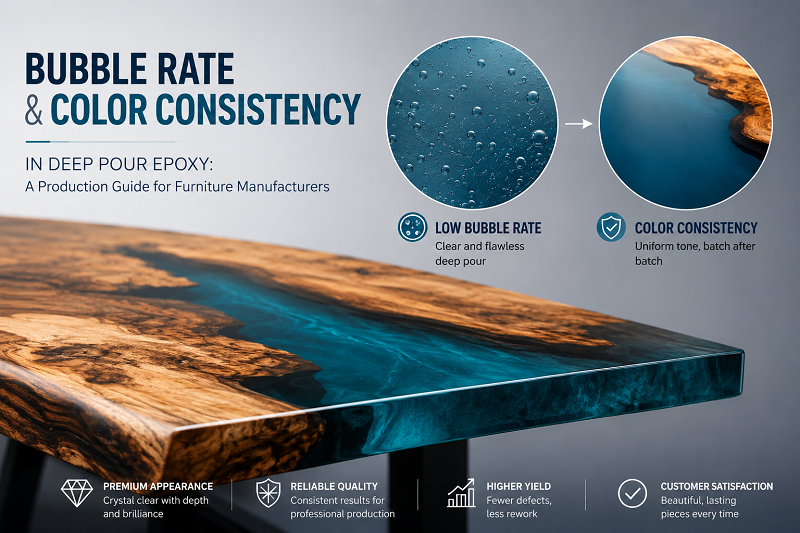
The reject shelf in a river table factory tends to tell the same story twice. First version: a finished slab with bubbles caught mid-pour, visible through the resin like insects in amber. Second version: a piece that poured clean but came out two shades lighter than the last batch, making the order unfulfillable to spec.
Neither problem announces itself loudly. Both bleed margin quietly — through rework, through scrapped blanks, through client calls that start with “this doesn’t match what we ordered.” For shops running deep pour epoxy as a production material rather than a one-off studio exercise, the difference between a profitable river table line and a chaotic one often comes down to whether these two variables are being actively managed or just tolerated.
Here’s how to manage them.
Where Bubbles Actually Come From
Three mechanisms produce bubbles in cured epoxy. Understanding which one is active in a given defect tells you exactly where in the process to intervene.
Air Pulled In During Mixing
This is the most frequent culprit and the easiest to address. The act of combining Part A and Part B introduces air — more so when mixing is fast, when the container is undersized for the batch volume, or when the paddle geometry creates turbulence rather than laminar flow.
Shops that scale up from hand-mixing to drill-powered mixing often make the problem worse before they make it better. A high-speed drill mixer is fast, but the vortex it generates draws air into the batch continuously. The fix is counterintuitive: go slower. A paddle running under 300 RPM — jiffy-style, not propeller — with deliberate scraping of the container walls and base, run for four to five minutes, followed by a three-to-five minute rest before the pour. That rest window is where the larger bubbles surface and break. Don’t skip it.
For batches in the five-to-twenty liter range, a vacuum degassing chamber changes the output quality meaningfully. Three to five minutes under vacuum after mixing pulls entrained air out before the deep pour epoxy reaches the mold. The equipment pays for itself in reject reduction faster than most shops expect.
Gas Coming Out of the Wood
Walnut, oak, elm — the porous hardwoods that define most river table work — hold air and moisture in their grain structure. Warm resin hitting a cold or unsealed slab draws that gas out. If it migrates upward while the resin is still fluid, it escapes. If the resin has started to gel first, the bubble stays.
Two controls, used together, close this off. The first is a seal coat — a thin layer of deep pour epoxy or dedicated wood sealer, applied twelve to twenty-four hours before the structural pour. It closes the surface pores and lets any remaining outgassing happen in a layer that gets sanded away rather than trapped in the final piece. The second is temperature: bringing slabs up to shop ambient temperature before pouring eliminates the thermal gradient that accelerates outgassing. Cold stock pulled straight from outdoor storage and immediately poured is a reliable way to generate substrate bubbles.
Moisture Reacting with the Hardener
Amine hardeners — standard in most deep pour epoxy systems — react with atmospheric moisture to release CO₂. The resulting bubbles are small, uniformly distributed through the pour, and resistant to torch treatment. When a shop sees this pattern, it’s almost never a mixing issue. It’s a storage or environment issue.
The controls are basic: hardener in sealed containers, away from humidity. Workshop RH held below 60% during active pours. Any component that’s been stored open or through temperature swings should be treated as suspect. And at the procurement level — deep pour epoxy has a shelf life of roughly twelve months under correct storage conditions. Bulk buying beyond what you’ll turn in that window isn’t actually a savings.
Standardizing the Torch Step
Some surface bubbles will appear after every pour regardless of process quality. This is normal. The question at production scale isn’t how to eliminate them — it’s how to handle them consistently when you have three operators running four pours simultaneously.
A propane torch at fifteen to twenty centimeters above the surface, moved in slow, overlapping passes, temporarily thins the surface viscosity enough to let bubbles pop. The hard limit is dwell time: more than two seconds in one spot and you’re scorching the resin, introducing yellowing, or leaving heat texture in the surface.
At production scale, the torch step needs a physical standard — a marked working height at a dedicated station — not just verbal training. Once you’ve standardized the motion, use rejected pieces to classify whether bubble defects are surface-type (torch-correctable) or internal (mixing or substrate origin). The two categories need different interventions, and conflating them wastes diagnostic time.
Color Consistency: The Variable That Doesn’t Announce Itself
Bubble defects are visible immediately after demolding. Color drift often isn’t caught until pieces from two different production runs are placed side by side — sometimes at the client’s site.
Pigment Measurement Is the First Thing to Lock Down
Batch-to-batch color variation almost always originates in how pigment is added, not in the pigment formula itself. Eyeballing colorant additions across a production run introduces drift that compounds over time. The fix is a calibrated scale and a documented ratio — grams of pigment per kilogram of mixed resin, recorded for every pour.
Beyond measurement, the type of colorant affects how manageable this is. Alcohol inks and dye concentrates are sensitive to small quantity changes — a few drops off and the hue shifts visibly. Pigment pastes and epoxy-compatible dispersions are denser and more forgiving at scale; the color-per-gram output is more consistent. For any production run requiring color matching across multiple batches, pastes are the professional choice.
Sequence also matters. Adding pigment to Part A and mixing it in before combining with Part B produces more even dispersion than adding it after the two components are blended. One procedure, applied consistently across the whole team.
Base Resin Color Is a Supplier Problem You Can Measure
Clear deep pour epoxy isn’t perfectly colorless — it runs from water-clear to a faint straw tone depending on the raw material inputs that went into that particular production batch. On heavily pigmented pours, this doesn’t matter. On natural-color or lightly tinted work, a shift in base resin color between supplier batches shows up in the finished piece.
This is partly a production problem and partly a sourcing problem. A supplier with tight raw material controls holds their base resin color consistent across batches. One with variable inputs doesn’t. When qualifying suppliers for volume production, ask for APHA color values across multiple production runs — not just a single sample. APHA below 30 is a workable threshold for high-clarity applications. A supplier who can’t provide multi-batch APHA data is telling you something about their process controls.
Temperature Windows Affect Cure Color
The same deep pour epoxy poured at 18°C and at 28°C will cure to slightly different optical results. Higher temperatures accelerate the exothermic reaction, raise internal mass temperature, and increase the chance of thermal-driven color shift in the cured piece.
Production color consistency doesn’t require climate control — it requires consistent temperature windows. Know the range your shop operates in seasonally, test your deep pour epoxy at both ends, and adjust pigment ratios to compensate if the base color shifts. Document those adjustments so seasonal transitions aren’t relearned from scratch each year.
A Minimal QC Framework That Actually Gets Used
Documentation systems fail in production shops when they’re too complex to maintain under pressure. These four records cover the variables that matter, without requiring a quality manager to run:
Pour log — batch number of the deep pour epoxy used, ambient temperature, RH, pigment type and weight, operator name. When a defect appears, the log tells you which batch and which conditions to investigate.
Color reference panels — one cured panel per approved color, kept from the first accepted production run. Every subsequent batch gets physically compared before shipping. Color drift caught at QC doesn’t become a client conversation.
Supplier batch records — batch number and APHA value from the supplier with every delivery, cross-referenced against your internal color output. If base resin variation is causing color drift in your pieces, the pattern shows up in this data before it surfaces as a complaint.
Defect log by type — surface bubble, mid-pour bubble, color drift, haze, other. Thirty days of entries reveals where the process pressure is. A run of mid-pour bubbles points to mixing or humidity. Persistent color drift points to base resin or pigment measurement. Surface bubbles in isolation point to torch protocol.
What to Look for in a Supplier
Process controls only go so far when the deep pour epoxy itself is inconsistent. Three product characteristics have direct bearing on how well the defects above can be controlled:
Viscosity at working temperature — lower initial viscosity means the mixed resin self-degasses more readily after mixing and releases bubbles more easily before gel. Ask for viscosity data at your actual production temperature range, not just the 25°C standard. A product that behaves very differently at 20°C versus 30°C will introduce seasonal variability that your process controls can’t fully compensate for.
Exotherm curve by pour depth — deep pour epoxy is formulated to cure slowly, but the actual heat profile varies by product and by the depth of the pour mass. At 50mm depth, a product with a poorly managed exotherm will generate enough internal heat to yellow the center of the pour regardless of ambient conditions. Ask for exotherm data at your working depths.
Multi-batch APHA records — as described above, this is the supplier-side variable with the most direct impact on your color output. A manufacturer who holds tight raw material controls can produce this data without difficulty. One who can’t produce it probably hasn’t been tracking it.
The Bottom Line
Bubble rate and color drift in deep pour epoxy production are not luck-dependent outcomes. They’re downstream effects of specific, traceable variables — in the mix, in the substrate, in the environment, and in the raw material. The shops that build reliable river table production lines are the ones that treat each of those variables as something to be measured and recorded, not improvised around.
Start with the process basics. Build the documentation layer. Then hold your deep pour epoxy supplier to the same standard of consistency you’re holding your own production to.
If you’re evaluating suppliers for scaled-up production and want to see batch consistency data alongside product specs, reach out to Jinhua Resin — we supply deep pour epoxy to furniture manufacturers across North America, Europe, and Southeast Asia and are happy to discuss technical requirements for your output volume.
Jinhua Resin | Professional Epoxy Resin Manufacturer | Deep Pour Epoxy & Table Top Epoxy | OEM & Bulk Supply Available