


For many furniture manufacturers, distributors, and brand owners in North America, Europe, and Australia, China is already part of the resin supply chain — whether directly or several steps removed through a distributor marking up an imported product. The case for sourcing directly is straightforward: better pricing, more control over formulation and packaging, and a direct relationship with the people who actually make the product.
The case against it, in most buyers’ minds, comes down to three uncertainties: how much do I have to order, how long will it take, and how do I know what I’m getting is actually what I ordered. These aren’t unreasonable concerns — they’re the right questions. This guide answers them directly, based on how the process actually works with an established epoxy resin manufacturer in China.
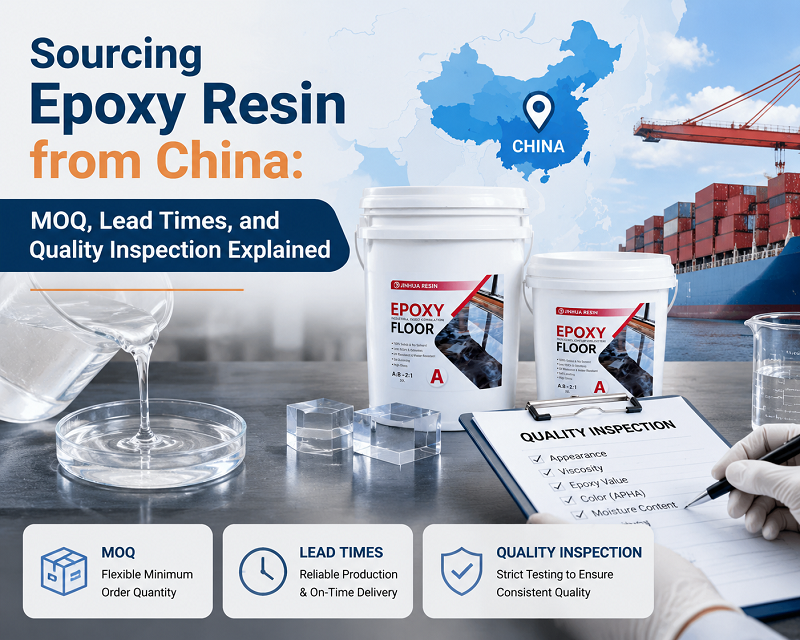
Minimum Order Quantities: What’s Realistic, and Why They Exist
MOQ is often the first thing buyers ask about, and often the thing they’re most anxious about — particularly buyers used to ordering from domestic distributors in smaller quantities at retail-adjacent pricing.
Why MOQs Exist at the Manufacturer Level
A manufacturer’s MOQ isn’t an arbitrary gatekeeping number — it reflects the economics of running a production batch. Mixing equipment, raw material batch sizes, and quality control testing all have fixed costs that need to be spread across a production run. A batch that’s too small doesn’t just cost more per unit — in some cases it isn’t economically viable to run at all, because the fixed costs exceed any reasonable margin.
For standard table top epoxy and deep pour epoxy products, MOQs from established manufacturers typically start in the range of 200–500 kg for standard formulations and standard packaging. For custom formulations or custom packaging (private label, for example), MOQs are often higher — sometimes 1,000 kg or more — because the setup costs for a custom run are higher and need to be amortized across more volume.
How MOQ Relates to Container Shipping
For buyers shipping internationally, there’s a practical relationship between MOQ and container economics that’s worth understanding. A 20-foot container holds roughly 20–24 tons depending on packaging, and a 40-foot container roughly double that. Many manufacturers will quote more competitive per-unit pricing as your order approaches a full or partial container load, because the shipping cost per unit drops significantly — and because filling containers efficiently matters to the manufacturer’s own logistics planning.
For smaller buyers, LCL (less-than-container-load) shipping is the standard solution — your order shares container space with other shippers’ goods, at a higher per-unit shipping cost but without requiring you to fill an entire container. Most manufacturers experienced in export can arrange LCL shipping or work with freight forwarders who specialize in it.
Negotiating MOQ for New Relationships
For buyers testing a new supplier relationship, it’s common — and reasonable — to request a smaller initial order above standard MOQ in exchange for a commitment to larger reorders if the product performs as expected. Manufacturers serious about building long-term relationships will often accommodate this, particularly for buyers who can demonstrate a credible path to recurring volume. What’s less realistic is expecting sample-size quantities (a few kilograms) at production pricing — sample requests and bulk order MOQs operate under different economics, and conflating the two creates friction early in a supplier relationship.
Lead Times: What Actually Takes the Time
“How long until I receive my order” is really three separate questions: production lead time, documentation and inspection time, and shipping transit time. Buyers who plan around only one of these — usually shipping transit time, because it’s the most visible — tend to be surprised by the total.
Production Lead Time
For standard products in stock or readily producible from standing inventory of raw materials, production lead time can be as short as 1–2 weeks. For products requiring a dedicated production run — larger orders, custom colors, or formulations not currently in active production — lead time typically runs 2–4 weeks, depending on the manufacturer’s current production schedule and where your order falls in the queue.
This is one area where the supplier evaluation indicators from a stability assessment matter directly: a manufacturer who can tell you specifically where your order falls in their production schedule — rather than a generic “2-3 weeks” — is one whose planning process you can actually rely on.
Documentation and Pre-Shipment Inspection
Before goods leave the factory, documentation needs to be prepared: commercial invoice, packing list, certificate of origin (relevant for trade agreement tariff treatment), and for resin products, often a Certificate of Analysis (CoA) and Safety Data Sheet (SDS) specific to the batch being shipped. If you’ve requested compliance documentation — REACH, Prop 65, or others — this is also when batch-specific versions of those documents get finalized.
Many buyers also arrange a pre-shipment inspection (PSI) — either through their own representative, a freight forwarder’s inspection service, or a third-party inspection company (SGS, Bureau Veritas, and others offer this service in China). PSI typically adds 3–7 days to the timeline but provides verification that the goods match the order specification before they’re loaded — catching issues while they’re still correctable, rather than after a container has crossed the ocean.
Shipping Transit Time
For ocean freight — the standard method for bulk epoxy resin shipments given the weight and volume involved — transit times from major Chinese ports to North American and European destinations typically run as follows: to U.S. West Coast ports, roughly 2–3 weeks; to U.S. East Coast or European ports, roughly 4–6 weeks, depending on routing (via Panama Canal or Suez Canal) and whether the shipment is direct or transships through an intermediate port.
Air freight is faster (days rather than weeks) but rarely economical for bulk resin given its weight — it’s typically reserved for urgent sample shipments or very small orders.
Total Realistic Timeline
Combining these: for a standard product with available raw materials, a realistic total timeline from order confirmation to goods arriving at a North American or European port is roughly 5–9 weeks. For custom formulations or first orders requiring a dedicated production run, 8–12 weeks is more realistic. Buyers planning inventory around these timelines — rather than around shipping transit time alone — avoid the most common source of stockout surprises in import-based supply chains.
Quality Inspection: What to Check, and When
Quality issues in imported resin tend to surface in one of two ways: either the product doesn’t meet specification when tested on arrival, or it meets specification on paper but performs differently in application than expected. Both are addressable with the right inspection approach at the right stages.
Pre-Production Sample Verification
Before placing a bulk order, the sample you receive and approve should be tested under conditions matching your intended application — not just visually inspected. For deep pour epoxy, this means a test pour at a representative depth, checking exotherm behavior and cure time. For table top epoxy, this means a test application checking self-leveling, gloss, and cure characteristics.
Critically, retain a portion of the approved sample. This becomes your reference point for comparing against the bulk shipment when it arrives — color, clarity, and cure behavior should match the approved sample, not just meet generic spec sheet numbers.
Pre-Shipment Inspection (PSI)
As discussed above, PSI verifies that the goods being loaded match the order — correct product, correct quantity, correct packaging, and ideally a quick comparison against the approved sample for visual properties like color and clarity. PSI doesn’t typically include full performance testing (that would require curing a sample, which takes days), but it catches packaging errors, quantity discrepancies, and gross visual mismatches before the goods ship.
On-Arrival Testing
Once goods arrive, testing against the approved sample and the product specification confirms the shipment meets requirements before it enters your production process. For resin products, this typically includes: viscosity check, color/clarity comparison against the retained sample, and — ideally — a small test pour or application matching your actual use case, cured and evaluated before the bulk material is committed to production.
Documentation Cross-Check
Alongside physical testing, cross-reference the CoA provided with the shipment against your own test results. Discrepancies between the supplier’s stated batch parameters and your independent testing are worth investigating — occasional minor variance is normal, but systematic discrepancy suggests either a testing methodology difference worth resolving, or a documentation practice worth questioning.
Building These Into a Repeatable Process
For a first order, all of this can feel like significant overhead relative to the order size. The value becomes clearer on the second and third orders, when the process is repeatable: the same sample verification protocol, the same PSI arrangement (often the same inspection company, familiar with your specification), and the same on-arrival testing checklist.
An epoxy resin manufacturer experienced in export — particularly to North America and Europe — will be familiar with this process and won’t be thrown by PSI requests, CoA requirements, or questions about MOQ flexibility for a trial order. Manufacturers who are less experienced with export buyers sometimes treat these requests as unusual or burdensome, which itself is informative about how smoothly the broader relationship is likely to run.
At Jinhua Resin, we work with overseas buyers across North America, Europe, and Australia on standard MOQ and custom orders for table top epoxy, deep pour epoxy, and UV resin product lines, with established PSI and documentation processes for export shipments. Contact us to discuss MOQ, lead times, and inspection arrangements for your specific order.