


The Default Setting Nobody Questions
Walk into any sourcing conversation at a resin trade show, and someone mentions the U.S. market within the first two minutes. It makes sense — big volume, English-language commerce, well-documented regulations. For Chinese epoxy resin exporters, America became the obvious first call so long ago that most stopped asking whether it should still be.
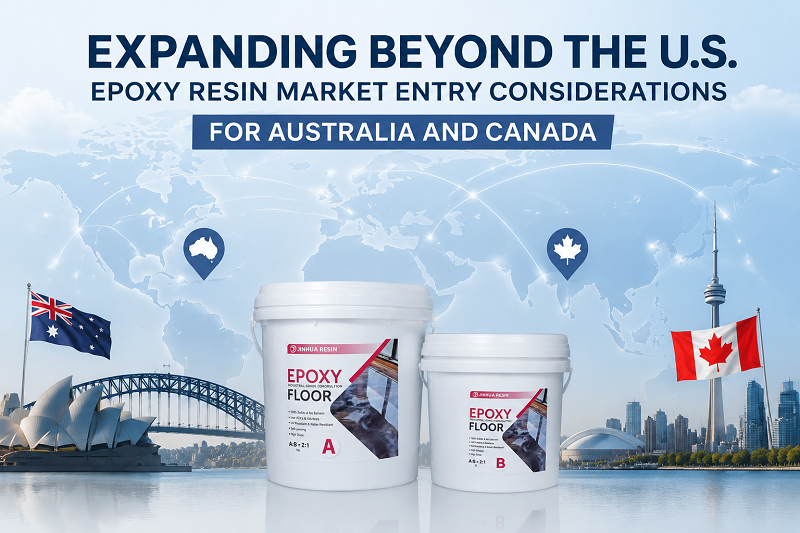
Here’s the thing: Australia and Canada are both underserved, both growing, and both structurally set up for exactly the kind of product that experienced Chinese manufacturers produce. Neither country has meaningful domestic capacity for formulated resin at the product level. Buyers in both markets want table top epoxy and casting resin that ships reliably, documents cleanly, and lands at a price that leaves room for margin.
The gap isn’t awareness. It’s execution — specifically, knowing the regulatory terrain well enough to build a supplier relationship that holds up when a customs officer or a workplace inspector asks questions. This article covers that terrain.
Two Markets That Don’t Get Enough Credit
The global epoxy resin market sat at roughly USD 14.3 billion in 2025 and is on track to reach somewhere north of USD 23 billion by 2034. Asia Pacific manufacturers — China first among them — supply the bulk of global volume. But the interesting story for B2B importers isn’t the aggregate; it’s where the gaps are.
Australia’s resin market is projected to grow at 6% annually through 2031. That number is being driven partly by government infrastructure spend and renewable energy buildout, but also by a creative and furniture sector that consistently punches above its weight. River tables, resin art panels, custom bartops — Australia’s small-business artisan market is disproportionately active for its population size, and it buys on quality documentation as much as on price.
Canada runs parallel. Epoxy resin imports grew at a 4.19% CAGR between 2020 and 2024, backed by construction, automotive, and aerospace demand. The table top epoxy segment in Canada mirrors U.S. trends — shared culture, cross-border e-commerce, similar application patterns — which makes it a natural extension for any brand already operating in the U.S. market.
Neither country manufactures much of its own formulated resin. That’s the opening.
Australia: The Regulatory Landscape
AICIS — The Registration You Cannot Skip
Australia replaced its old NICNAS chemical framework in July 2020. What came out the other side is the Australian Industrial Chemicals Introduction Scheme — AICIS — governed by the Industrial Chemicals Act 2019.
The rule is simple: register your business before you import. Not before you sell. Before you import. The AICIS registration year runs September 1 through August 31, and registration applies to the business entity, not to individual products or SKUs. Miss the window and you’re out of compliance before the first container clears customs.
Once registered, every chemical introduction gets categorized into one of six risk tiers. For most standard resin formulations — the bisphenol A-based DGEBA systems and amine hardeners that make up the bulk of commercial table top epoxy — the relevant ingredients are already listed on Australia’s Inventory of Industrial Chemicals (AIIC). Listed chemicals get a smoother path. Novel chemistries or specialty additives not on the inventory trigger a more involved assessment process.
What this means for sourcing: your Chinese epoxy resin manufacturer needs to give you a full ingredient list — CAS numbers included — for every component in the formulation. Not a summary. Not a product name with “proprietary blend” underneath it. If they can’t do that, AICIS categorization becomes a guessing game, and guessing games don’t go well at the declaration stage.
SDS and Labeling
Australia runs GHS through Safe Work Australia. Every hazardous chemical sold or imported commercially needs a GHS-compliant label and a 16-section SDS in English that reflects the actual formulation. Generic export SDS documents written for Chinese domestic compliance won’t pass.
The ask when qualifying a new supplier: request the SDS that’s been specifically prepared for export to English-speaking regulated markets. Experienced exporters have these. New-to-export factories typically don’t — and that gap surfaces at the worst possible time.
The Tariff Situation
HS code 3907.30 applies to epoxy resins entering Australia. The standard customs duty is 5%. No anti-dumping duties currently apply to Chinese product — a meaningful contrast with the EU, where provisional ADD rates of up to 40.8% on Chinese epoxy resin were announced in early 2025. Australia’s current tariff environment is manageable and predictable, which makes landed cost modeling straightforward.
Where the Demand Actually Is
Construction and infrastructure remain the volume leaders. But for importers focused on the table top epoxy and casting resin segment specifically, the real action is in Australia’s artisan economy — furniture makers, resin artists, custom countertop fabricators — who buy through e-commerce channels and care deeply about product clarity, cure reliability, and documentation they can show customers. Differentiated product with a real TDS and a real SDS commands premiums here. Commodity resin doesn’t.
Canada: The Regulatory Landscape
CEPA — A Different System
Canada’s chemical management framework sits under the Canadian Environmental Protection Act — CEPA. Unlike AICIS, CEPA doesn’t require importers to register a business before bringing in industrial chemicals. The compliance structure is substance-first rather than business-first.
The key reference document is the Canadian Domestic Substances List (DSL) — the national inventory of assessed chemicals approved for use in Canada. Standard epoxy resin chemistries are already on the DSL. DGEBA resins, common amine and anhydride hardeners, the workhorses of commercial resin formulation — all assessed, all listed. For an importer bringing in a product built from DSL-listed components, no federal pre-market notification is required.
The flag goes up when a formulation includes something not on the DSL. In that case, a New Substance Notification must be filed with Environment and Climate Change Canada before the substance can be commercially imported or manufactured. Pre-entry DSL screening — done with the supplier’s full ingredient disclosure — catches this before it becomes a customs problem.
WHMIS: The Bilingual Requirement Nobody Budgets For
WHMIS 2015 is Canada’s workplace hazard communication system, fully aligned with GHS. Any epoxy resin product moving through commercial or industrial channels in Canada needs a WHMIS-compliant SDS and label. For national distribution — and especially for supply into Quebec — that SDS must be available in both English and French.
This is not a suggestion. French-language documentation is a legal requirement under WHMIS and under Quebec’s Charter of the French Language. Importers who discover this after their first Quebec customer asks for the French SDS are in an awkward position. Budget for it upfront. When qualifying a Chinese epoxy resin manufacturer for Canadian supply, ask directly: can they provide bilingual SDS documentation, or at minimum documentation suitable for Canadian compliance translation?
Toxic Substance Prohibitions — Updated December 2025
Canada revised its Prohibition of Certain Toxic Substances Regulations in December 2025. The new regulations entered into force June 30, 2026. The update prohibits importing, manufacturing, and selling specific hazardous substances and products containing them — targeting persistent, bioaccumulative compounds aligned with Canada’s Stockholm Convention commitments.
For standard commercial epoxy resin formulations, this isn’t typically a problem. The substances targeted are legacy compounds — flame retardants, chlorinated chemicals — not the core resin or hardener chemistry. But specialty additives, pigments, and reactive diluents can introduce unexpected ingredients. Screen the full formulation against the current Schedule 1 prohibited substances list before the first shipment. It takes an afternoon and prevents a much larger headache later.
Tariffs
Canada applies a 6.5% Most-Favoured-Nation duty on epoxy resin imports from non-CUSMA countries under HS 3907.30 — China included. No anti-dumping duties currently apply to Chinese resin in Canada. Factor the 6.5% into landed cost from day one; it’s stable and predictable, which makes financial modeling easier than in markets where ADD investigations create uncertainty.
Where the Demand Is
Canada’s volume is in construction coatings, industrial flooring, and adhesives. The creative resin and woodworking segment is growing — river tables, bartops, live-edge furniture — and tracks closely with the U.S. market in terms of product preferences and application trends. For brands already operating in the U.S., Canada is often a natural second market: similar distribution models, overlapping marketing content, and buyers who are already familiar with product categories they’ve seen on the U.S. side of the border.
What Separates a Usable Supplier from a Compliant One
Most Chinese epoxy resin manufacturers can ship product. Fewer can ship product into Australia or Canada without triggering compliance problems on arrival. Here’s what separates the two.
Ingredient transparency at the CAS level. AICIS categorization and DSL screening both require knowing exactly what’s in the formulation — not at the product level, but at the component level. A supplier who treats their formulation as a trade secret isn’t suitable for regulated-market supply. Full stop.
Market-specific SDS documentation. The SDS for Australian supply needs to be GHS-compliant to Safe Work Australia standards, in English, structured correctly. The SDS for Canadian supply needs the same, plus French. Generic export SDSs written for Chinese domestic distribution fail on both counts.
Formula stability across production runs. Compliance documentation — SDS files, AICIS declarations, DSL screenings — is tied to a specific formulation. If the factory changes suppliers for a raw material and the resin chemistry shifts, the documentation is stale. Ask about raw material sourcing stability and change notification protocols before signing a supply agreement.
OEM capability that goes beyond printing a label. Running a private label brand in Australia or Canada means more than sticking a logo on a Chinese factory’s standard container. It means custom packaging formats suited to local retail or trade channels, bilingual labeling where required, and documentation that carries your brand rather than the factory’s. An epoxy resin manufacturer with genuine OEM infrastructure — not just a willingness to swap labels — is a different animal from one that isn’t.
A certification portfolio that’s current. ISO 9001 is the baseline. Ask for the certificate and verify the expiry date — not the framed version on the factory wall, the actual current document. For specific downstream applications, additional certifications may matter.
Jinhua Resin (jinhuaresin.com) is a Guangdong-based epoxy resin manufacturer with active export programs into North American and Asia-Pacific markets. Product lines cover table top epoxy, deep pour casting resin, and UV resin, with OEM and private label capability for brands entering Australia and Canada. Full formulation disclosure and market-specific SDS documentation are available on request.
Before the First Container Ships: A Working Checklist
Australia:
- Run every formulation ingredient through the AICIS inventory search tool — confirm AIIC listing status before ordering.
- Register the business with AICIS before the first shipment. Registration year closes August 31.
- Categorize each introduction and set a reminder for the annual declaration deadline.
- Get the SDS from the supplier in Australian-market format. Review it — don’t just file it.
- Build landed cost with 5% customs duty and freight; confirm no ADD applies to the specific HS subheading.
Canada:
- Screen every ingredient in the formulation against the DSL. Flag anything not listed.
- File New Substance Notification for any flagged ingredient before the shipment date.
- Get the SDS in both English and French before the first sale into Quebec.
- Run the formulation against the December 2025 CEPA prohibited substances schedule.
- Build landed cost with 6.5% MFN duty. Confirm supplier OEM capability in writing if private labeling.
The Opportunity Is There
Australia and Canada don’t appear on most Chinese exporters’ priority lists because they’re smaller than the U.S., and because the regulatory learning curve looks steeper than it actually is. Once you’ve run the compliance process once — AICIS registration, DSL screening, bilingual SDS — the ongoing burden is modest. What the process does require is a supplier willing to be fully transparent about what’s in their product.
That transparency question is the real filter. Importers who find a Chinese epoxy resin manufacturer that can document cleanly, formulate consistently, and support OEM at a professional level will find less competition in both markets than they’d face in the U.S. — and buyers who are willing to pay for product they can trust.
Planning to bring table top epoxy or casting resin into Australia or Canada? Jinhua Resin offers formulation documentation, bilingual SDS support, and OEM production for importers building brands in both markets: jinhuaresin.com