


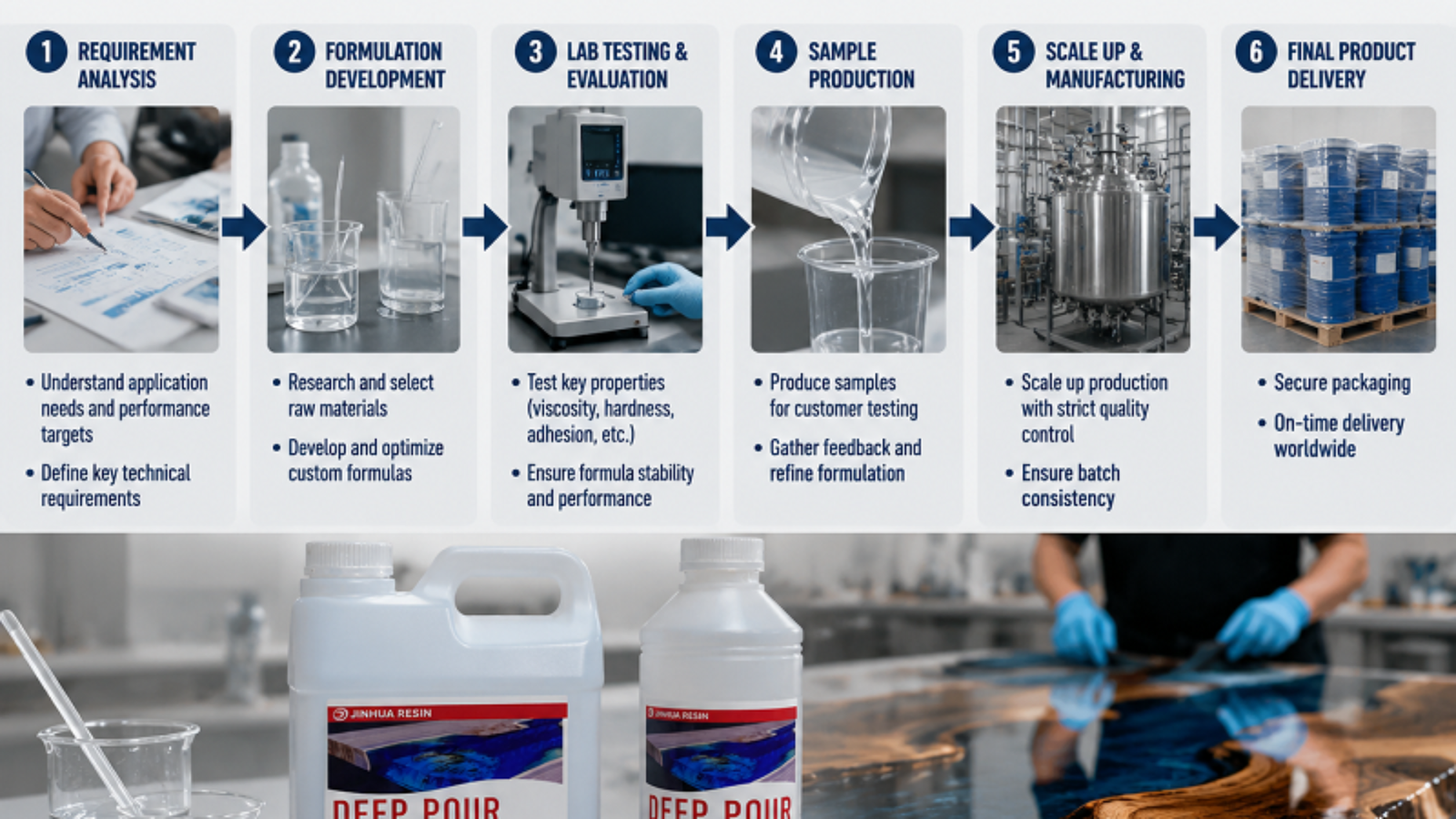
What “Custom Formulation” Actually Means in Practice
Custom OEM epoxy resin development is one of those phrases that means completely different things depending on who’s using it. To a buyer, it might mean adjusting the viscosity of an existing product, changing the mix ratio, or specifying a different cure speed. To a factory, “custom” might mean anything from relabeling a standard formula to building a new chemistry from scratch.
The gap between those definitions is where projects stall, timelines blow out, and buyers end up with a product that’s almost right but not quite right — and no clear path back to the specification they originally wanted.
This guide maps the actual process: what custom OEM epoxy resin development looks like from the first conversation to the first production run, what decisions happen at each stage, where the common failure points are, and how to structure the supplier relationship so that what arrives in the container matches what was agreed on paper.
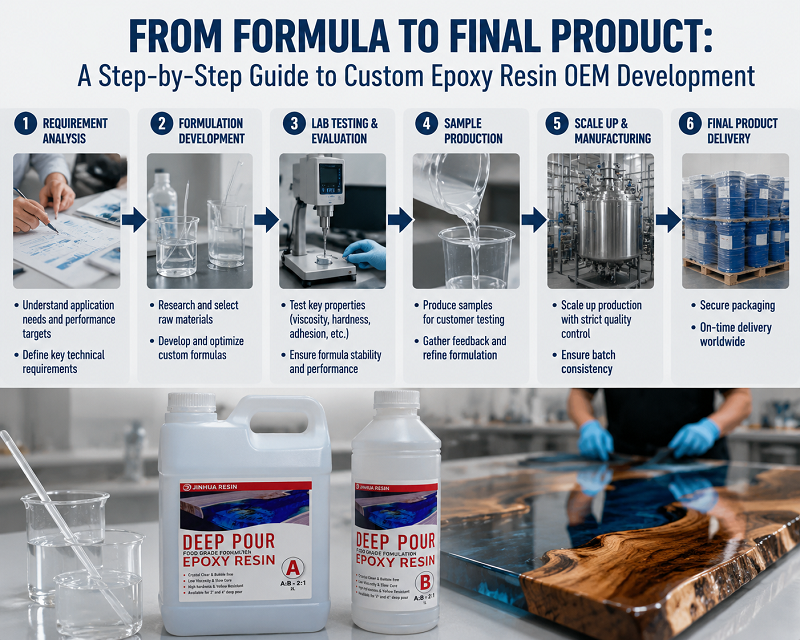
Stage 1: Defining the Specification Before Talking to Suppliers
The most expensive mistake in custom epoxy development is starting the supplier conversation before the product specification exists in writing. It seems obvious stated that way. In practice, most buyers start with a vague performance target — “I need a table top epoxy that cures clearer than what I’m currently using” or “I want a deep pour product with a longer working time” — and expect the factory to translate that into a specification.
Factories will translate it. The translation may not match what you had in mind.
A workable product specification for custom OEM development covers, at minimum:
Performance targets:
- Viscosity range (cPs at a defined temperature)
- Mix ratio (A:B by weight or volume)
- Pot life and working time (at defined temperature and mass)
- Cure schedule (tack-free time, handling strength time, full cure time)
- Maximum pour depth per layer (for casting products)
- Shore D hardness at full cure
- Optical clarity requirements (if applicable — yellowing index, haze)
Regulatory and market requirements:
- Target market(s) and applicable regulations (Prop 65 for U.S., REACH for EU, AICIS for Australia)
- Any restricted substances that must be absent from the formulation
- SDS format requirements for the destination market
Packaging and presentation:
- Container format and size
- Mix ratio labeling
- Bilingual requirements (if applicable)
Commercial parameters:
- Target volume and order frequency
- Required MOQ for the custom formula
- Acceptable price range
None of this needs to be fixed before the first supplier conversation — some of it will be shaped by what’s technically achievable. But having it written down, even as a draft, changes the quality of that conversation significantly. You’re negotiating against a document rather than a verbal description that each party remembers differently.
Stage 2: Supplier Qualification — Before the Formulation Work Starts
Custom formulation development requires a different supplier qualification process than standard product sourcing. The question isn’t just “can you make this product” — it’s “do you have the chemistry capability to develop it, and can I trust that the formula you develop will remain stable over time.”
The key questions at this stage:
In-house formulation capability or toll blending? Some factories that market themselves as epoxy resin manufacturers are actually compounders — they purchase base resins and hardeners and blend to a recipe, but don’t have the chemistry expertise to develop new formulations from the molecular level. There’s nothing inherently wrong with this model for standard products, but it limits what’s achievable in custom development. A true formulation-capable manufacturer has chemists, analytical equipment, and the ability to work from performance targets rather than pre-existing recipes.
Ask directly: do you have in-house formulation chemists? What analytical equipment do you use for QC? Can you provide a performance target specification and develop a formula to meet it, or do you need the customer to provide the formula?
IP and confidentiality. Custom formulations represent intellectual property. The question of who owns the formula — buyer, factory, or jointly — needs to be addressed before development starts, not after it’s complete. A factory that won’t sign a non-disclosure agreement or formula exclusivity agreement before development work begins is telling you something about how seriously they take IP protection.
Get the NDA signed before sharing detailed performance specifications or application context that could inform formula development.
Reference products and validation capability. Ask the factory for reference samples of their existing epoxy resin product line. Evaluate them against your performance targets. A factory whose standard products are already close to what you need is a much lower-risk development partner than one whose standard products are far from your target specification.
Also ask about their testing and validation capability: do they have a lab that can run the property tests your specification requires? Or will they be sending samples out for third-party testing, which adds time and cost to every iteration cycle?
Stage 3: The Development Iteration Cycle
Custom formulation development is iterative by nature. The factory proposes an initial formula, produces a lab-scale sample, ships it for evaluation, receives feedback, adjusts, and repeats. In practice, a straightforward custom development — adjusting an existing product’s viscosity and cure speed — might take 2–3 iterations over 6–8 weeks. A genuinely novel formulation targeting performance characteristics outside the factory’s existing portfolio can take 4–6 months and 8–10 iterations.
Buyers who haven’t done this before routinely underestimate the timeline. The iteration cycle is not slow because factories are inefficient — it’s slow because formulation chemistry is empirical. You can’t calculate your way to a specific optical clarity or a specific flexibility at cure; you have to test it, measure it, and adjust.
What good iteration looks like:
Each sample submission should come with a formulation iteration record — what was changed from the previous version, what property the change was intended to address, and what the factory’s predicted outcome was. This documentation disciplines the development process and builds a record that explains why the final formula looks the way it does. If your development partner can’t produce this documentation, the iteration is happening by trial and error rather than by principled adjustment.
Evaluation criteria for each iteration:
Define your evaluation protocol before the first sample arrives. What tests will you run? Who will run them — you, a third-party lab, or a combination? What measurement will constitute pass/fail for each property? What properties are hard requirements vs. nice-to-haves?
Without a defined evaluation protocol, feedback to the factory becomes impressionistic — “this one feels better but the color is still a bit off” — which is not enough information to drive a targeted next iteration.
Managing iteration shipping costs:
Each development iteration involves shipping a sample from China. Air freight for small sample quantities runs $40–120 per shipment depending on size and carrier. Over 8–10 iterations, that’s a meaningful cost. Some factories offer to send digital data (viscosity curves, cure speed graphs, hardness data) before shipping physical samples — request this for early iterations where the performance gap is still large. Reserve physical shipping for iterations where digital data suggests you’re close to target.
Stage 4: Formula Lock and Production Scale-Up
When a formulation iteration passes all evaluation criteria, the formula gets “locked” — formally documented with exact component identities, grades, and ratios, and designated as the production specification. Formula lock is a formal milestone, not just an informal agreement that “this one’s good.”
The formula lock document should specify:
- Each raw material component by CAS number and supplier grade
- Weight ratios of each component to four significant figures
- Processing parameters (mixing sequence, temperature, mixing time)
- QC test methods and acceptance criteria for each testable property
- Shelf life and storage conditions
This document is the product. Not the sample. Not the lab notebook. Not the chemist’s memory. If the factory can’t produce a formal formula lock document, the product definition lives only in the factory’s systems — which means any personnel change, raw material substitution, or process adjustment can alter the product without the buyer knowing.
The scale-up gap:
Lab-scale samples and production-scale batches don’t always produce identical results. Mixing dynamics at production scale differ from lab scale. Heat management in large reactors differs from small vessels. A formula that performed perfectly at 1kg sample scale may require adjustment at 200kg production scale.
This is not a failure — it’s a normal feature of chemical manufacturing. The question is whether it’s expected, planned for, and handled transparently, or whether it surfaces as a surprise when the first production batch doesn’t match the approved sample.
Request a pilot production run — typically 20–50kg — as an intermediate step between lab sample approval and full production. Evaluate the pilot batch against the locked formula specification before placing the first commercial order.
Stage 5: QC Framework and Change Control
Custom formulation development doesn’t end at first production. It ends at the establishment of a quality system that keeps the product consistent over the life of the supply relationship.
Per-batch Certificate of Analysis: Every production batch should be accompanied by a CoA confirming that tested properties are within the specification range. The CoA should reference the locked formula specification, list the test methods used, and include actual measured values — not just pass/fail. A CoA that says “viscosity: PASS” without the actual viscosity number is not a CoA; it’s a piece of paper.
Raw material change notification: Raw material supply chains shift. A resin manufacturer’s chemical supplier changes grades, discontinues a product, or substitutes an alternative. Any of these changes can alter the final product’s properties, even if the factory believes the substitution is equivalent. Your supply agreement should require written notification before any raw material change, with an obligation to re-validate the affected properties and get buyer approval before the change goes into production.
This clause is frequently absent from standard factory supply agreements. Negotiate it in before signing.
Audit rights: For high-volume or high-value custom formulations, the ability to audit the factory’s QC records and production logs provides assurance that the formula lock is being respected in practice. Remote audit (documentation review) is a reasonable first level; on-site audit may be warranted for critical applications.
Jinhua Resin (jinhuaresin.com) is a Guangdong-based epoxy resin manufacturer with in-house formulation capability for table top epoxy, deep pour casting resin, and UV resin. Custom OEM development programs include IP protection agreements, formal formula lock documentation, per-batch CoA, and raw material change notification protocols. Pilot production runs available before first commercial order.
Timeline Reference: What to Expect at Each Stage
| Stage | Typical Duration | Key Deliverable |
|---|---|---|
| Specification drafting | 1–2 weeks (buyer) | Written product specification |
| Supplier qualification | 2–3 weeks | Qualified development partner, signed NDA |
| Development iteration | 6–16 weeks | Approved sample, iteration record |
| Formula lock | 1 week | Formal formula lock document |
| Pilot production | 2–3 weeks | Pilot batch CoA |
| First commercial order | 4–6 weeks from order | Production batch + CoA |
| Total minimum | 16–24 weeks | Production-ready custom formula |
This is the timeline for a straightforward development. Novel chemistries, regulatory complexity, or multiple evaluation cycles extend it.
The Question That Separates Development Partners from Sample Suppliers
There’s a question that reliably distinguishes a factory capable of genuine custom formulation development from one that will send you samples of their standard products with a custom label:
“If I give you a performance specification rather than a formula, can you develop a formula to meet it? And if the first iteration doesn’t meet the spec, what’s your process for diagnosing why and determining what to change?”
The answer to the first part is binary — yes or no. The answer to the second part reveals whether the factory has a principled development process or a trial-and-error one. Factories with genuine formulation capability will describe a diagnostic approach: measuring specific properties, identifying which component drives which property, and making targeted adjustments. Factories without it will describe trying something different and seeing what happens.
Both can produce a good sample eventually. Only one will do it in a timeframe and with a consistency that works for a commercial supply relationship.
Planning a custom epoxy resin OEM development? Jinhua Resin offers structured development programs with IP protection, formal formula lock, and pilot production validation: jinhuaresin.com