


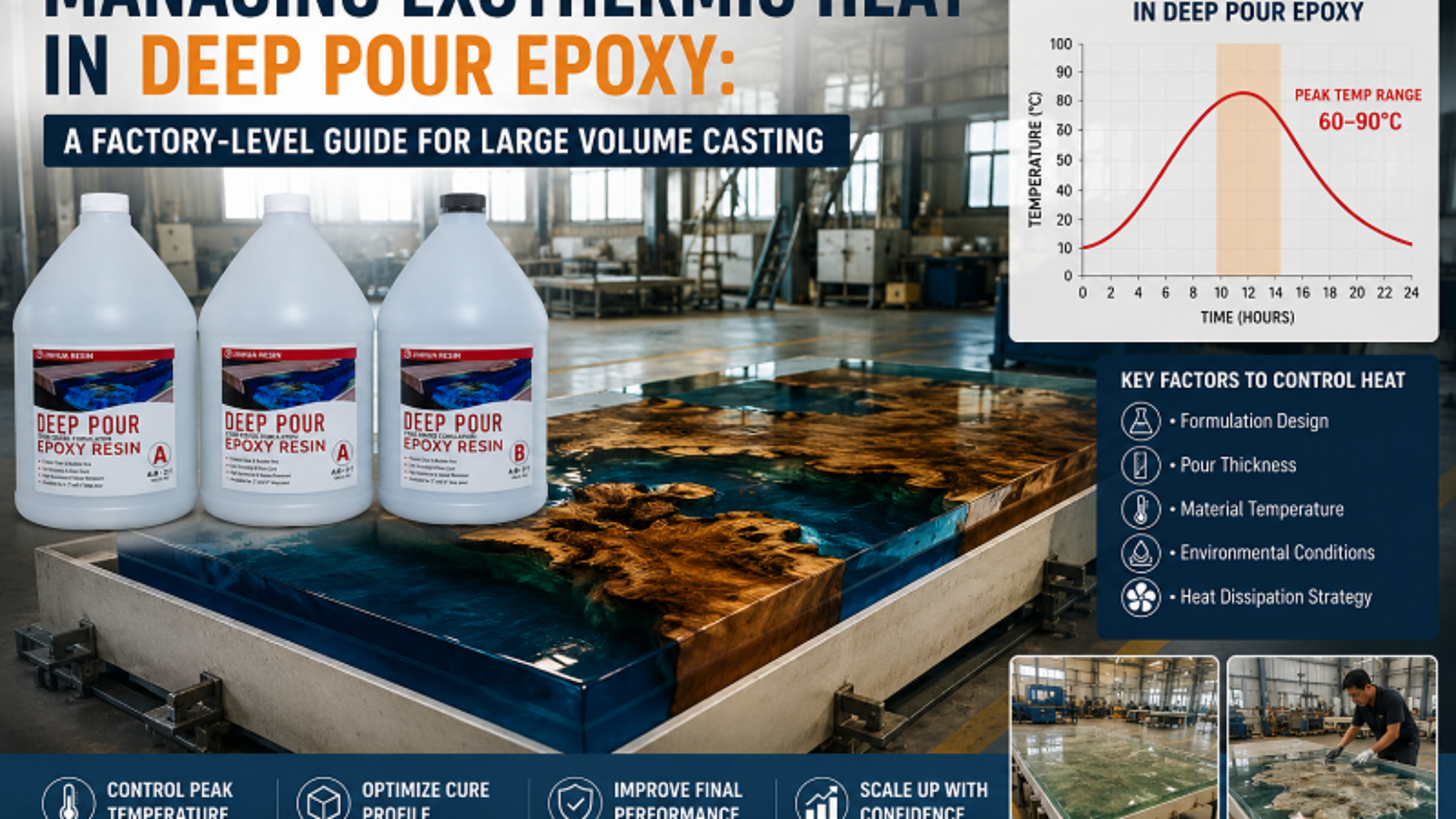
The Problem That Doesn’t Show Up in the Product Description
Deep pour epoxy fails in a specific way. Not gradually, not ambiguously — it cracks, discolors, smokes, or in severe cases generates enough heat to warp the mold, damage the substrate, or create a fire hazard. When it happens, the instinct is to blame the resin. The actual cause, in the large majority of cases, is thermal management — not product defect.
The exothermic reaction that cures epoxy resin is self-reinforcing: crosslinking generates heat, heat accelerates crosslinking, accelerated crosslinking generates more heat. In a thin flood coat, the surface area is large relative to the volume, heat dissipates quickly, and the cycle stays controlled. In a deep pour — a river table blank, a thick art casting, a potted electrical assembly — the mass-to-surface-area ratio inverts. Heat accumulates faster than it escapes. The reaction accelerates beyond the formulation’s design parameters. Something goes wrong.
Understanding this mechanism is not academic for B2B buyers sourcing deep pour epoxy. It determines which products are actually suitable for deep pour applications, how to specify pour depth limits for downstream customers, and what to look for in a Chinese epoxy resin manufacturer product documentation that signals genuine deep pour capability versus a standard table top product in a different container.
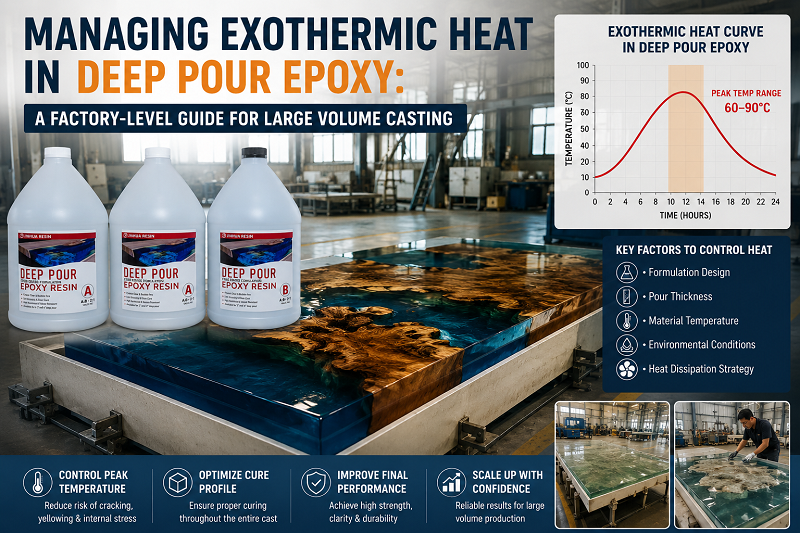
The Physics of Exothermic Cure: What’s Actually Happening
When Part A resin and Part B hardener are combined, the curing reaction begins immediately. The reaction is exothermic — it releases energy as heat. The rate of that heat release is a function of the reaction kinetics, which are themselves temperature-dependent: higher temperature means faster reaction, which means faster heat release, which means higher temperature.
This feedback loop is called thermal runaway. In small volumes, the heat generated is modest and the surface-to-volume ratio is high enough that ambient conditions absorb it without the temperature rising enough to significantly accelerate the reaction. In large volumes, the feedback loop can produce peak temperatures well above 100°C at the center of the pour — hot enough to cause thermal cracking as the exterior cools faster than the interior, yellowing from thermal degradation of the cured polymer, volatile release from hardener components, and in extreme cases, combustion of mold materials.
The three variables that govern whether thermal runaway occurs — and how severe it is — are:
Mass. More material means more total heat generated. A 5kg pour generates five times more heat than a 1kg pour of the same formulation, assuming equivalent geometry. The relationship between mass and peak temperature is nonlinear — doubling the mass more than doubles the peak temperature because the larger mass also has a less favorable surface-to-volume ratio.
Geometry. A wide, shallow pour dissipates heat laterally. A narrow, deep pour traps heat vertically. The same volume of resin in a 600mm × 600mm × 50mm mold will behave very differently from the same volume in a 200mm × 200mm × 450mm mold. This is why maximum pour depth — not maximum pour volume — is the critical specification for deep pour products.
Formulation. The hardener chemistry determines the base reaction rate and its temperature sensitivity. Slow-cure aliphatic hardeners with low exotherm profiles are the foundation of true deep pour formulations. Standard table top epoxy uses faster-reacting hardener systems optimized for surface cure and working time, not for thermal management at depth. Using table top epoxy in a deep pour application is not a formulation substitution — it’s a category error.
What Deep Pour Formulations Actually Do Differently
A genuine deep pour epoxy resin formulation differs from table top epoxy at the chemistry level, not just the label.
Hardener selection. Deep pour formulations use hardener systems with intrinsically lower reaction rates — cycloaliphatic amines, modified polyamides, or specific aliphatic amine blends selected for low exotherm. The tradeoff is longer cure time: where a table top epoxy might achieve handling strength in 8–12 hours, a true deep pour formulation at the same temperature may take 36–72 hours or longer. That’s not a product weakness — it’s the mechanism by which peak temperature is kept below the threshold for thermal damage.
Cure temperature profile. In a well-formulated deep pour system, the temperature rise during cure should be gradual and the peak temperature should stay below approximately 60–70°C even in pours of 5–10cm depth. A product that exceeds this threshold at standard pour depths is not a deep pour product regardless of what the label says. Temperature rise curves — plots of internal temperature versus time at different pour depths and ambient temperatures — are the product data that actually characterizes deep pour behavior. If a manufacturer can’t provide these curves, they don’t have deep pour data.
Viscosity. Deep pour formulations are typically lower viscosity than table top products, for two reasons: lower viscosity at mixing means air bubbles release more easily from a thick section where they can’t be torched after pouring, and lower viscosity reduces the mechanical energy input required during mixing, which reduces the risk of introducing air during the mixing process itself.
Optical performance. The longer cure cycles of deep pour products mean extended exposure to ambient conditions before the polymer network is fully locked. Formulations intended for clear casting need UV stabilizers and antioxidants that maintain optical clarity over multi-day cure windows. A clear table top product may yellow significantly when subjected to a 72-hour cure cycle that a dedicated deep pour formulation handles without color shift.
Pour Depth Limits: The Number That Matters Most
Maximum recommended pour depth is the single most important specification on a deep pour epoxy TDS. It’s also the number most frequently absent, vague, or wrong.
“Suitable for deep pours” is not a specification. “Maximum pour depth: 2–4 inches” without a stated ambient temperature or mass constraint is incomplete. The complete specification looks like: “Maximum recommended pour depth of 75mm in a single layer at ambient temperatures between 18–24°C, with a 24-hour wait between layers for multi-layer pours.”
The reason the ambient temperature condition matters: reaction kinetics are temperature-dependent. A pour depth that stays within safe thermal limits at 20°C may overheat at 28°C. Buyers whose downstream customers work in warm climates — southern U.S., Australia, Southeast Asia — need pour depth specifications that account for realistic operating temperatures, not just laboratory standard conditions.
When evaluating deep pour epoxy from a Chinese epoxy resin manufacturer, ask specifically:
- What is the maximum recommended single-layer pour depth, and at what ambient temperature was this tested?
- What is the recommended waiting time between layers for multi-layer pours?
- Can you provide temperature rise curves for pours at different depths (25mm, 50mm, 75mm, 100mm)?
- What ambient temperature range do these specifications apply to?
A manufacturer without this data cannot make a credible claim that their product is engineered for deep pour applications. They may have a product that works adequately in typical conditions — but they don’t know where the limits are, and neither will your customers.
Mold Considerations and Their Interaction with Thermal Management
The mold material affects thermal management in ways that are often overlooked by buyers focused purely on resin selection.
Silicone molds are poor heat conductors. A deep pour in a silicone mold traps heat more aggressively than the same pour in an aluminum or wood mold. Maximum pour depths in silicone should be reduced — sometimes significantly — relative to the manufacturer’s recommendation for open pours or rigid molds.
Melamine-coated MDF — the standard mold material for river tables — has reasonable heat dissipation when the pour is in contact with the wood, but the melamine surface can delaminate at elevated temperatures. If the resin is running too hot, the mold surface shows it before the casting does.
HDPE sheets are commonly used for river table side dams. HDPE softens at around 120°C, which is within the range achievable in a severe thermal runaway event. A pour that overheats in an HDPE-dammed mold can soften the dams, causing blowout.
Ambient temperature during cure. For outdoor or uncontrolled-environment curing, ambient temperature variation during the cure cycle affects the reaction rate and therefore the peak temperature. A pour that’s within limits at 20°C at 8pm can exceed them at 2pm the following day if ambient temperature rises significantly. This matters for woodworking shops without climate control and for any outdoor installation application.
The interaction between mold material, pour depth, ambient temperature, and formulation determines the actual thermal outcome — not any single variable in isolation. B2B buyers who are providing deep pour epoxy to professional fabricators need to communicate this system-level understanding in their product documentation, not just the maximum pour depth number.
Layer Pouring Strategies for Depths Beyond the Single-Pour Limit
When a project requires a total depth that exceeds the recommended single-layer pour depth, the standard approach is sequential layer pouring — pouring the total depth in multiple layers with a waiting period between pours.
The waiting period serves two purposes: it allows the first layer to advance in cure to the point where it won’t remix with the second pour, and it allows the first layer’s exothermic peak to pass so the second pour doesn’t add thermal energy to a still-reacting first layer.
The minimum waiting time between layers is typically 24 hours at standard ambient temperatures for most deep pour formulations, but this varies by product and temperature. Pouring the second layer too early — when the first layer is still warm from its own exotherm — compounds the thermal load and creates conditions for overheating even when individual layers are within the single-layer depth limit.
For very deep multi-layer pours, a practical rule: the surface of the first layer should be cool to the touch, not just firm, before the second pour begins. A surface that’s firm but still warm is still generating heat internally.
Chemical bonding between layers is maintained as long as the first layer hasn’t reached full cure — a partially cured surface bonds chemically with fresh resin. Once a layer has fully cured (typically 48–72+ hours depending on the formulation), a mechanical key is needed: light sanding of the surface before the next pour.
What to Ask Your Deep Pour Epoxy Manufacturer
These questions separate genuine deep pour products from table top products with ambitious marketing:
- Can you provide temperature rise curves for your product at 25mm, 50mm, 75mm, and 100mm pour depths at 20°C and 25°C ambient?
- What is the maximum recommended pour depth per layer at 20°C? At 25°C? At 30°C?
- What hardener chemistry does the formulation use, and what is the peak exotherm for a 1kg mass at 25°C (100g test)?
- What is the recommended minimum wait time between layers, and at what ambient temperature does this recommendation apply?
- What is the cure time to handling strength and full cure at 20°C and 25°C?
- Is the formulation designed specifically for deep pour, or is it a modified table top product?
The last question is the most direct. Some manufacturers will answer it honestly. Others won’t know the difference between the two. The answer — and the confidence with which it’s delivered — is informative either way.
Jinhua Resin (jinhuaresin.com) is a Guangdong-based epoxy resin manufacturer producing deep pour epoxy formulations specifically engineered for large-volume casting applications. Temperature rise data, pour depth specifications across ambient temperature ranges, and full TDS documentation are available for all deep pour product lines.
A Practical Reference: Thermal Management Variables and Their Effects
| Variable | Effect on Peak Temperature | Mitigation |
|---|---|---|
| Pour depth increase | Significant increase | Reduce pour depth; use multi-layer approach |
| Ambient temperature increase | Moderate–significant increase | Reduce pour depth at elevated temp; cure in climate-controlled environment |
| Mass increase (same depth) | Moderate increase | Break large pours into sections |
| Silicone mold (vs. open/rigid) | Moderate increase | Reduce max pour depth by 20–30% |
| Table top epoxy (vs. deep pour formula) | Severe increase | Do not substitute; use purpose-formulated product |
| Pre-heated substrate | Moderate increase | Allow substrate to reach ambient temperature before pouring |
The Line Between “Works in Deep Pour” and “Is a Deep Pour Product”
A lot of epoxy resin products can survive a 50mm pour under ideal conditions. That’s not the same as being engineered for deep pour applications. The difference shows up at the margins: at 75mm instead of 50mm, at 28°C instead of 20°C, in a silicone mold instead of an open wood form, on a day when ambient temperature rises during the cure window.
For B2B buyers supplying professional fabricators and end users, the margin cases are where product failures happen and where warranty claims originate. Specifying a product that’s genuinely engineered for the application — with temperature rise data, documented pour depth limits, and a hardener chemistry selected for thermal management — is not over-engineering. It’s the difference between a supplier relationship that works and one that generates calls about cracked river tables.
Sourcing deep pour epoxy for professional fabrication or distribution? Jinhua Resin provides temperature rise data, pour depth specifications, and full TDS documentation for deep pour epoxy product lines: jinhuaresin.com