


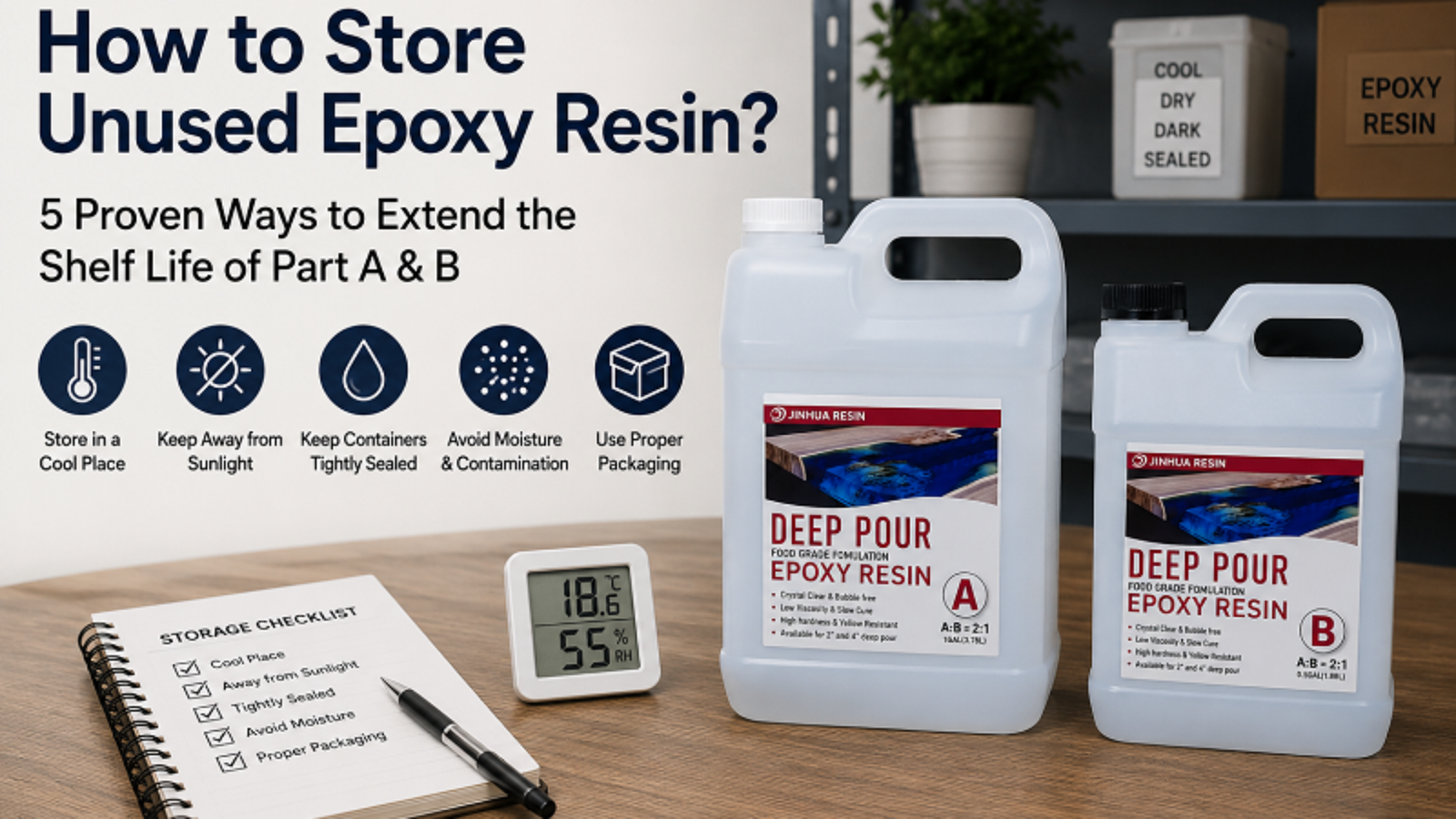
Whether you rely on slow-reacting deep pour epoxy for massive timber castings or standard surface coats for countertops, epoxy remains a climate-sensitive compound. Almost every woodworker or resin artist has run into the same headache: opening a half-used bottle from months ago only to discover Part A turned into a milky, crystalline slush, or Part B aged into a dark amber color that fails to cure properly.
This isn’t just a waste of expensive raw materials; it can completely ruin a project you spent weeks preparing.
The good news? Unopened or partially used resin systems can easily maintain their performance for 12 to 24 months—provided you protect them from environmental hazards. Here is a breakdown of the silent culprits behind resin degradation and five practical rules to double your resin’s shelf life.
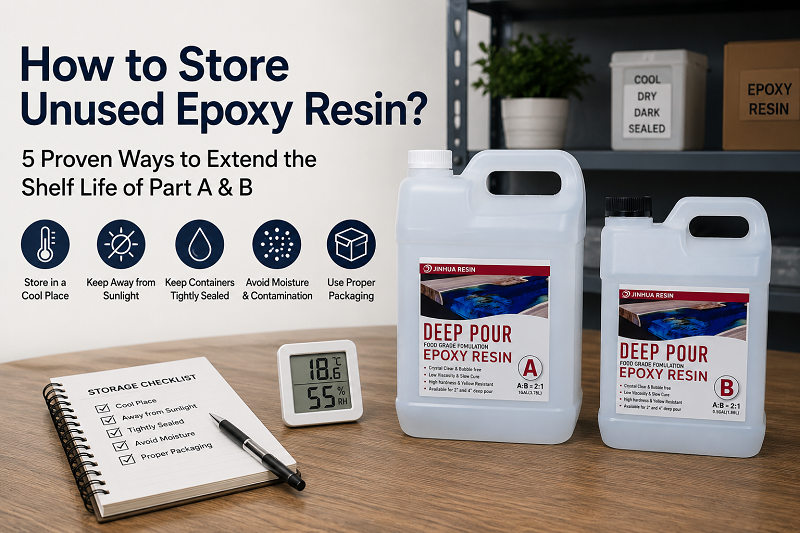
What Ruins Unused Epoxy Resin?
Before you can store Part A and Part B properly, you have to understand what’s happening inside those bottles. Unmixed epoxy isn’t just sitting there—it’s constantly reacting to its environment.
- Air & Moisture (The Hardener’s Worst Enemy): Part B hardeners love water. The second you leave the cap off, the liquid starts sucking humidity right out of the room. This triggers a chemical reaction called amine blushing, leaving you with amber-colored liquid, thick sludge, or a piece that stays sticky and foggy forever.
- Sunlight & UV Rays: UV radiation tears apart the polymer chains in unmixed resin. Leave a clear bottle near a window, and it’ll turn yellow and brittle long before you even get a chance to mix it.
- Wild Temp Swings: Summer heat bakes the liquid, triggering tiny thermal reactions inside the jug that kill its shelf life. On the flip side, winter cold freezes Part A into a solid, cloudy mess.
5 Rules to Keep Your Resin Fresh for Months
1. Keep the Room Temperature Steady (15℃-25℃)
If there is one thing liquid polymer hates, it’s a roller-coaster climate. Find a spot in your shop or house that stays consistently between 15℃ and 25℃.
- Keep It Away from Heat: Don’t leave your stash in a hot summer garage, next to a radiator, or anywhere near direct sunlight. High ambient heat cooks the chemical batch, aging it months ahead of time.
- Busting the Winter “Freeze” (Crystallization): If your workspace drops below 10℃, Part A might look like milky white slush or turn completely rock-hard. Don’t panic and don’t throw it away. It hasn’t gone bad; it just crystallized. Tighten the cap, submerge the bottle in a warm water bath (50℃-60℃) for 30 to 60 minutes, and watch the crystals melt right back into liquid glass.
2. Lock Out Air (Seal Immediately & Use Inert Gas Barriers)
Air exposure is the main reason amine hardeners turn yellow and lose their reactivity.
Wipe Threads & Cap Instantly: After pouring what you need, wipe the bottle threads clean with a dry paper towel to prevent the cap from gluing shut, then tighten the lid immediately.
Pro Hack for Half-Empty Jugs: When using large containers of deep pour resin, pouring out half leaves a massive air gap inside the jug. Spraying a quick burst of inert heavy gas (like Argon or specialized resin preserver spray) into the container before capping creates an invisible blanket over the liquid, displacing moisture and oxygen.
3. Block UV Light: Say No to Clear Bottles
Direct light compromises the optical clarity of your raw materials.
Always store your compounds inside their original opaque containers (usually high-density polyethylene or metal cans).
If you transfer liquid into smaller working bottles for daily use, choose dark amber or opaque squeeze bottles and tuck them inside a closed cabinet away from windows.
4. Never Mix Up Caps or Dispensing Tools
Cross-contamination is an easy mistake that ruins entire batches.
Part A and Part B caps often look identical. If you accidentally swap them, residual chemicals on the inside of the cap will trigger a tiny localized cure along the threads, forming hard crusts or contaminating the whole jug.
The Fix: Mark your “A” and “B” lids clearly using bold, different-colored markers. Never use the same stir stick or pump for both components.
5. Practice FIFO & Smart Decanting
Label Everything (The FIFO Rule): As soon as a box arrives at your shop, slap the date on the bottle with a Sharpie. Write down when it arrived and the exact day you popped the seal. Always reach for the oldest bottle on the shelf first—opening a fresh jug when you still have half-used stock sitting around is just asking for expired chemicals.Don’t Keep Cracking the Main Jug: Buying deep pour resin in bulk gallons saves money, but opening a massive container just to grab a few ounces for a small coaster project is a huge mistake. Every time you open that lid, fresh, humid air rushes in. Instead, pour off a small working batch into smaller, airtight squeeze bottles for daily use. That way, your main stash stays factory-sealed and fresh for the big builds.
Final Thoughts
Epoxy resin isn’t a non-perishable product; think of it as a reactive liquid that demands careful handling. By controlling temperature, air exposure, light, and cross-contamination, you can ensure your unused Part A and Part B remain crystal clear, fully reactive, and ready for your next build—even a year down the road.