


Ask ten buyers what they check before placing an order and most will say price, then lead time. The data sheets usually come third, if at all. That’s the wrong order. A TDS and SDS will tell you more about whether a supplier can actually hold to spec than a sales call ever will.
TDS vs. SDS — they’re not the same document
A Technical Data Sheet covers performance: viscosity, mix ratio, pot life, cure time, hardness, clarity. It’s the “what this resin does” document.
A Safety Data Sheet covers composition and hazard: chemical makeup, handling rules, exposure limits, disposal requirements. It’s the “what this resin is” document.
A lot of buyers sourcing from an epoxy resin manufacturer file both away without reading them closely. Worth changing that habit. These two sheets are often the fastest way to catch a mismatch before it turns into a production problem three months later.
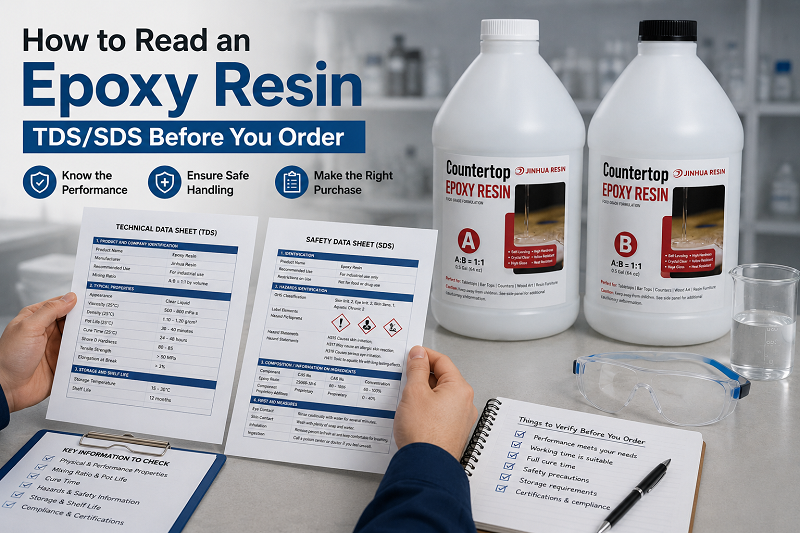
What to look at on the TDS first
Start with the mix ratio. Check whether it’s given by volume, by weight, or both. A supplier who lists only one number is handing you half the picture — resin and hardener rarely share the same density, so the volume ratio and the weight ratio diverge. Dose by the wrong figure and the cure chemistry drifts off.
Then pot life and cure time. People mix these up constantly, and honestly some suppliers do too. Pot life is how long the mixed batch stays workable once you’ve combined resin and hardener. Cure time is how long it takes to fully harden once poured or applied. A 45-minute pot life paired with a 24-hour cure behaves nothing like a 20-minute pot life paired with a 72-hour cure, even if both products get marketed under the same “deep pour epoxy” label.
Viscosity is next, and the number means little without a temperature attached. A resin rated at 400 cP at 25°C could run closer to 800 cP in a workshop that sits at 15°C in winter. If your production floor runs cold, ask the supplier for viscosity figures at your actual working temperature — the lab standard alone won’t tell you much.
For deep pour specifically, check the maximum pour depth listed. Go past it and you risk exothermic cracking, cloudiness, or yellowing — defects that only show up after the resin has cured, at which point there’s no fixing them. If a TDS skips this figure entirely, ask before you order, not after.
And for table top epoxy, look at Shore hardness and any notes on UV stability or long-term yellowing. A resin that scratches within weeks or ambers within a season generates returns. Not repeat business.
What to look at on the SDS first
Section 3 lists the chemical composition and CAS numbers. If you sell into a regulated market, this is the section your compliance team will actually pull from — not whatever’s on the product landing page.
Section 9 has flash point, VOC content, specific gravity. These figures drive shipping classification and storage rules, which affect landed cost more than most buyers expect going in.
Section 15 covers regulatory declarations — REACH, RoHS, and similar. If a supplier can’t produce an SDS with this section properly filled out, that’s not automatically a dealbreaker, but it’s reason enough to ask more before committing to volume.
Signs worth pausing on
A generic SDS that doesn’t quite match the product you ordered. Some manufacturers run one template SDS across an entire resin line, which means the hazard data on file may not reflect what’s actually in your specific batch.
No batch-to-batch tolerance data on the TDS. Ask directly what variance the manufacturer holds on viscosity and pot life run to run. Plus or minus 5% is normal. A supplier who can’t answer that question at all is telling you something, even without meaning to.
Numbers with no test method behind them. A data sheet worth trusting cites the standard for each figure it reports — ASTM D2196 for viscosity, ASTM D2240 for hardness, and so on. Figures without a method are harder to verify, and harder to hold anyone accountable to later.
Why this is worth the extra ten minutes
These two documents aren’t paperwork you glance at once and file. Read closely, they’re the clearest signal available before you place an order — whether this manufacturer actually controls their process, or is reselling whatever came off the line that particular week.
A supplier worth ordering from should answer follow-up questions on both sheets without hedging, and should be willing to test at your real working conditions rather than pointing back to lab standard numbers. If they can’t, that tells you plenty on its own.