

A buyer emails asking for “epoxy resin.” Nothing else. Clear or colored? Table top grade or deep pour? That missing detail is usually the difference between a product that performs and one that comes back with a complaint attached. Clear and colored epoxy resin start from the same chemical backbone, but once pigment enters the formula, the additive packages and the end-use requirements pull apart fast.
For sourcing managers, distributors, and brands building a private-label line, this isn’t a cosmetic decision. Get it wrong and you end up with yellowing tabletops, cracked flooring, or a batch of “matching” colored parts that plainly don’t match each other. Below is what actually separates clear and colored epoxy resin, and which one fits which job.
What Sets Clear Epoxy Resin Apart
Clear epoxy resin is built around one target: optical clarity that holds up over time. That means low-yellowing hardener chemistry, tighter control over raw material purity, and — in most decent formulas — a UV inhibitor package. Clear on day one is easy. Clear after twelve months under a kitchen window or in a coastal storefront window is the harder bar to clear, and it’s the one that actually matters.
B2B demand splits into two categories here.
Table top epoxy is low-viscosity and fast-curing, made for thin pours — usually under 1/8 inch per coat. It self-levels, degasses fast, and is dialed in to avoid amine blush and yellowing, since this stuff sits in direct light for years at a time.
Deep pour epoxy is solving a different problem: heat. Pour a thin-pour resin two inches deep and it will overheat, crack, or cloud up from its own exotherm. Deep pour formulas slow the hardener reaction down on purpose, so thick sections — river tables, encapsulations, molds poured 1–2 inches per layer — cure without cooking themselves.
If you’re sourcing from an epoxy resin manufacturer for river tables, art casting, or premium furniture tops, confirm which one you’re actually being quoted. “Clear epoxy,” with no mention of table top or deep pour, is not a complete spec — it’s half of one.
What Sets Colored Epoxy Resin Apart
Colored epoxy resin runs on a similar base resin but adds a pigment dispersion system built for color stability, opacity control, and — this is the part OEM buyers care about most — batch-to-batch consistency. Pigments show up as liquid dispersions, mica-based metallics, or opaque mineral pigments, and each one behaves a little differently in cure time, viscosity, and how well it holds up under UV.
Three buckets cover most of the demand:
- Decorative and craft resin — jewelry, coasters, art pieces, where saturation and mix-in flexibility (glitter, dyes, inclusions) matter more than how the color holds up in five years of sunlight.
- Floor coating systems — industrial and commercial epoxy flooring, where the whole job hinges on color consistency across a 5,000 sq ft pour. Off-shade between pallets, and the job gets rejected.
- OEM private label products — brands locking a signature color to a Pantone or RAL code, run after run, then shipping it under their own name.
Nailing a color once isn’t hard. Nailing it on batch 40, six months later, off a different pigment lot — that’s a formulation and QC problem, not a stir-the-bucket-harder problem. It’s also where a real epoxy resin manufacturer separates itself from one that just resells someone else’s base resin.
The Core Technical Differences
| Factor | Clear Epoxy Resin | Colored Epoxy Resin |
|---|---|---|
| Primary formulation goal | Optical clarity, non-yellowing | Color stability, opacity control |
| UV stability requirement | Very high (visible yellowing = failure) | Moderate to high, depends on application |
| Viscosity control | Critical for self-leveling, bubble release | Critical for even pigment dispersion |
| Batch consistency risk | Lower — clarity is binary (clear or not) | Higher — shade drift is gradual and easy to miss |
| Typical thickness | Table top (thin) or deep pour (thick) | Usually thin-to-medium pour, coating-focused |
| Common failure mode | Yellowing, cloudiness, cracking on deep pours | Color mismatch, pigment settling, uneven opacity |
Clear resin lives or dies on light stability and cure control. Colored resin lives or dies on pigment engineering and repeatability. Being good at one doesn’t automatically make a manufacturer good at the other, so ask for application-specific data sheets — not a single generic “epoxy resin” spec sheet meant to cover everything.
Matching Resin Type to Application
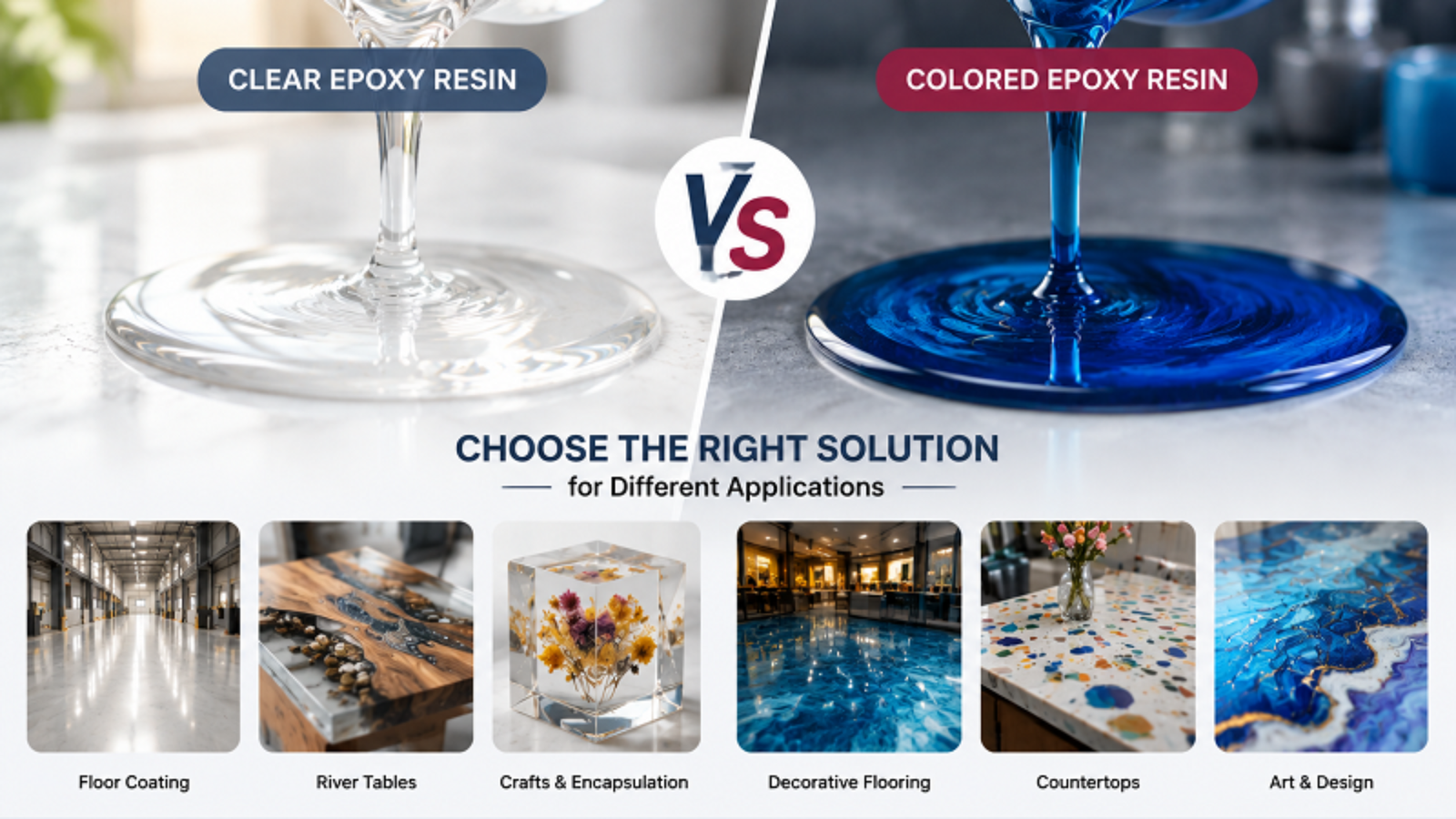
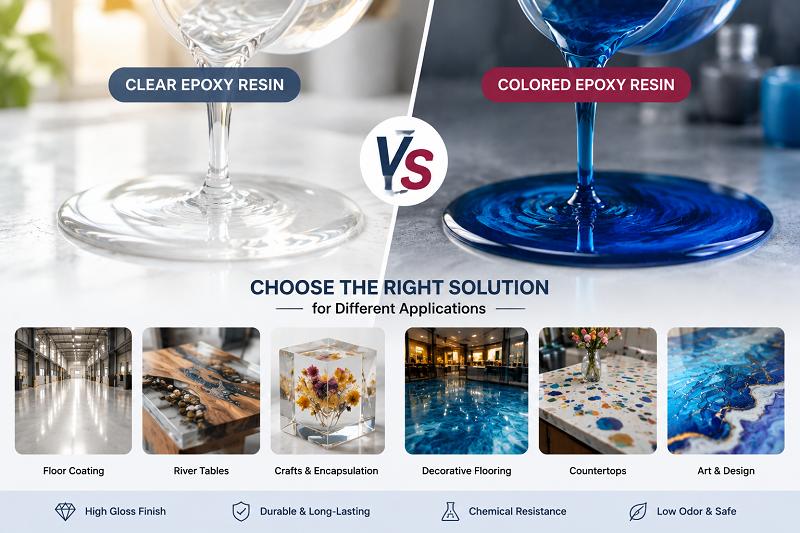
Countertops and tabletops. Residential kitchen counters, bar tops, restaurant tables — nearly all of it calls for clear table top epoxy, because the wood grain or embedded material is the actual design feature, and cloudy or yellowed resin wrecks it. A few commercial buyers ask for tinted or opaque tabletop finishes for branded surfaces; that pushes the spec toward colored resin with UV-stable pigments instead.
River tables and large-format art. Deep pour clear epoxy is the default here — these pieces depend on optical depth through inches of material. Colored versions exist too, usually with translucent dye instead of opaque pigment, to mimic water or build an ombré effect. Either way, the base chemistry still needs deep-pour exotherm control underneath it.
Floor coatings. Almost entirely colored epoxy resin territory. Warehouse floors, garage coatings, decorative flake systems all need consistent, opaque color across large areas, plus abrasion and chemical resistance that a tabletop spec was never built for. A floor coating manufacturer doing OEM and private label work tends to carry a much deeper pigment-matching library than a supplier that’s mainly focused on tabletops.
Jewelry and craft resin. Both types get heavy use here, often in the same product — clear as a base or top coat, colored for the design layer underneath. Fast cure and low odor matter more than long-term UV performance for most craft work, since these pieces aren’t sitting under direct sun for years the way a tabletop is.
Industrial and functional coatings. UV resin and specialty coatings for electronics, EV components, or precision manufacturing lean clear, prioritizing dielectric properties and dimensional stability over anything to do with color. When color does show up here, it’s usually functional — safety coding, brand ID — not decorative.
What This Means for OEM and Private Label Buyers
Building a private label epoxy resin line is a bigger decision than picking one SKU. Clear and colored resin often need separate production lines, separate QC checkpoints, and sometimes separate raw material suppliers within the same factory. When you’re vetting an epoxy resin manufacturer for OEM work, ask directly:
- Do they run separate QC protocols for clarity testing versus color-matching — spectrophotometer readings against a reference standard, not someone eyeballing it?
- Can they hold a custom Pantone or RAL match across multiple production runs, with documentation to prove it?
- What’s their actual yellowing test data for clear resin — accelerated UV chamber results, not just a claim that “our resin doesn’t yellow”?
- Do they keep table top, deep pour, and colored/pigmented production physically separate, so pigment residue doesn’t creep into clear batches?
A manufacturer that answers all four with data instead of reassurance is the one worth building a private label program around.
Cost and MOQ Considerations
Colored epoxy resin almost always costs more per kilogram than clear. Pigment dispersions, color-matching runs, and the QC overhead of holding a spec across batches all add to the price. On a first private label order, expect colored resin to run somewhere around 8–15% above the equivalent clear formulation — though that gap narrows once volume climbs and the manufacturer has a stable pigment supply chain locked in for that specific color.
MOQs diverge too. Clear table top or deep pour epoxy usually comes with a lower MOQ, since it’s a standard formula the manufacturer already runs at scale. A custom color match is a different story — it typically needs a higher MOQ, because the manufacturer has to justify a dedicated production run and avoid getting stuck with leftover pigment that no other customer’s spec will use. If you’re testing a new colored SKU, ask whether a smaller trial batch is available before committing to the full MOQ. Color approval almost always takes at least one round of physical samples.
Freight and packaging run about the same for both. The one wrinkle: colored resin shipped as a matched two-part kit (resin plus pre-dosed pigment) can add a bit of extra packaging complexity compared to a standard resin-and-hardener set.
Common Questions from B2B Buyers
Can clear epoxy resin be tinted after purchase, instead of buying pre-colored resin? For small-batch or craft use, yes — liquid pigments or dyes get mixed in at the point of application. For OEM production, though, this pushes the color-consistency problem onto the buyer’s own mixing process, which is a lot harder to control than sourcing pre-pigmented resin from a manufacturer with dedicated dispersion equipment.
Does colored epoxy resin have different UV resistance than clear? Depends on the pigment system, not the color itself. Some opaque pigments actually block light penetration and improve UV resistance; poorly formulated colorants can fade or shift shade under sustained sun exposure. Ask for accelerated weathering data tied to the specific pigment in use, not a general UV rating for the base resin.
Is deep pour epoxy always clear, or does a colored version exist? Colored deep pour exists, most often with translucent dyes for river-table “water” effects rather than fully opaque pigment. Exotherm management doesn’t change based on color — a colored deep pour still needs the slow-cure chemistry of a standard deep pour system. It’s not table top resin with dye stirred in.
What’s the minimum order for a custom color match on floor coating epoxy? Varies by manufacturer and pigment type, but plan on it being meaningfully higher than a stock color. If you’re evaluating a floor coating manufacturer for a branded color program, ask for the MOQ and lead time on color matching specifically — separate from whatever number is on their standard catalog.
Making the Call
The choice between clear and colored epoxy resin isn’t really about preference — it’s about what the application actually needs. Clear resin belongs wherever light transmission, depth, or embedded materials are the selling point: tabletops, river tables, precision coatings. Colored resin belongs wherever consistent, repeatable color is the actual deliverable: flooring, branded surfaces, craft lines, most OEM private label work.
Source based on that distinction instead of a generic “epoxy resin” request, and the payoff shows up fast — fewer returns, faster QC sign-off, a supplier relationship that survives past the first order. If you’re not sure which category your project falls into, that’s the question to put to your manufacturer first, ahead of price and ahead of MOQ.