


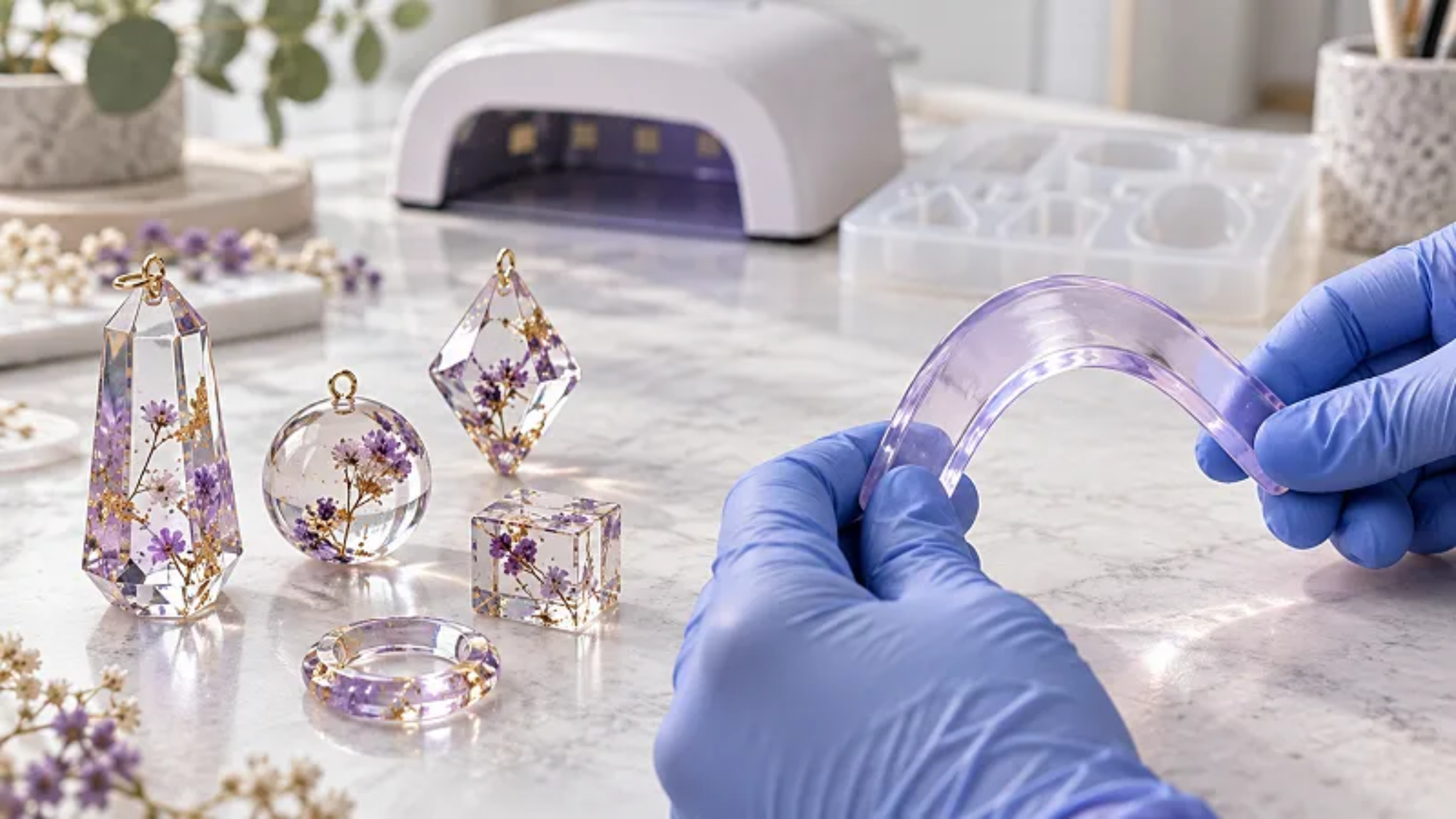
Two resin charms can look identical on the bench. Press one and it holds its shape. Press the other and it bends, then springs back. For a jewelry maker, that’s the whole feel of the finished piece. For a craft brand or distributor, it’s the gap between a satisfied customer and a return.
So how do you settle hard vs soft UV resin? Start with the finished object. If the piece needs a rigid body and a crisp outline, pick a hard grade. If flex is part of the design, look at a soft grade. Then test the formulation with your own lamp, mold, colorants and real part thickness. A label on the bottle won’t do that for you.
This guide covers what separates the two types, where each one fits, and what business buyers should check before a bulk order.
What Hard and Soft UV Resin Mean
Most craft UV resins are single-component materials that cure under a compatible light source. That sets them apart from the two-part epoxy systems used for river tables and thick castings. Don’t call a UV resin “epoxy” unless your supplier has confirmed the chemistry.
“Hard” and “soft” describe how the resin behaves after proper curing. Hard grades set up fairly rigid. Soft grades stay flexible. Neither word is a standard, though. One supplier’s soft grade may bend far more than another’s, so judge by a sample, not by the name.
One common mix-up: viscosity is not flexibility. A thin, easy-pouring resin can cure rock hard, and a thick, syrupy one can cure bendy. Ask your supplier about the two properties separately.
Hard UV Resin for Pieces That Hold Their Shape
Hard UV resin is the natural starting point for small castings with a defined edge: a flat pendant, a faceted charm, a little ornament. If the design only works when the object stays stiff in the hand, go hard.
That said, hard doesn’t mean scratch-proof or unbreakable. Thin corners, holes drilled near an edge and narrow connection points are all weak spots. A pendant can be fine across its body and still crack at the hole. Test the actual design, not a thick test disk.
If you make batches, run your finishing steps on fully cured samples. Drilling, sanding and fitting hardware put stress on the piece that a freshly demolded casting never sees. Check the area around the fixing point, especially if customers will pull or twist the item.
Soft UV Resin for Designs That Need Flexibility
Soft UV resin suits thin decorative elements and coatings where bending is intended. Think of a flexible petal, a shaped accessory, or a coating on a bendable base. Some commercial soft grades are specifically described as staying bendable after cure.
Flexibility says nothing about adhesion, though. A coating can bend without cracking and still peel off its substrate. Phone-case decoration is the classic example: run the adhesion trial on the exact case material and surface finish. A pass on one plastic doesn’t carry over to another.
Check recovery too. After bending, does the part return to shape, keep a crease, or slowly sag under its own weight? These are good acceptance questions for a trial, but not every soft resin behaves the same way. A long thin strip and a compact charm can respond differently even when poured from the same bottle.
Hard vs Soft UV Resin: Comparing Them Against the Design
Treat this table as a starting point for choosing. It lists priorities, not guaranteed specs.
| Selection point | Hard UV resin | Soft UV resin |
|---|---|---|
| Intended cured behavior | Relatively rigid | Flexible, to a grade-specific degree |
| Design priority | Shape retention | Controlled bending |
| Trial focus | Edges and fixing points | Recovery and deformation |
| For coatings | Verify substrate compatibility | Verify both bending and adhesion |
| For either type | Confirm curing in the actual design | Confirm curing in the actual design |
Keychains show why an application name alone doesn’t decide it. A small rigid charm leans hard. A flexible decorative insert is worth testing in a soft grade. Both still need solid hardware and a cure that reaches every area. The “best resin for keychains” depends on how the piece is built.
Soft Resin Is Not the Same as Undercured Resin
A flexible result is only expected when you chose a flexible formulation. If a hard resin comes out bendy, leaks liquid or has weak patches, look at your curing process before blaming the grade.
Surface feel can’t prove full cure. A piece may feel firm outside while a shaded pocket inside never got enough light. On the flip side, an intended soft grade shouldn’t be written off just because it bends. Compare it with the supplier’s spec and with a correctly processed reference sample.
For a repeatable check, cure two samples at the same thickness: one uncolored, one with your planned decoration. Follow the supplier’s exposure instructions and let both cool before you judge them. If only the decorated piece fails, suspect light access or additive compatibility. If both are inconsistent, look at the lamp setup and processing conditions.
Light Access Matters for Both Grades
Picking hard or soft doesn’t remove the need for a proper curing setup. Confirm the recommended wavelength, exposure conditions and layer thickness. Lamp wattage alone won’t tell you how much usable light reaches every part of the piece.
Pigments, dense glitter, opaque inserts, mold walls and part geometry all block light. A clear top face doesn’t prove the underside, or the area behind a metal decoration, was cured. Use supplier-approved materials and validate the full design. Manufacturer guidance also notes that adding colorant can lengthen the exposure a given formulation needs.
So don’t turn “cures in one minute” into a production rule. That number may only hold for a clear, thin sample under one lamp. For colored designs or different molds, build a validated process of your own.
How Craft Brands Can Build a Useful Product Range
If you’re a distributor or private-label brand, hard and soft UV resin should answer different customer needs. Two near-identical bottles with vague descriptions just make selection harder and flood your support inbox.
Say plainly what each product does. A hard grade fits rigid decorative pieces. A soft grade fits designs that need verified flexibility. List the compatible lamp requirements and application limits. A photo of a cured sample being bent works well, as long as it comes from the formulation you actually ship.
Look at what your customers already ask. If they want stable pendants, a flexible product won’t solve that. If they decorate bendable objects, a soft grade may be worth exploring, after adhesion testing. Build the range around proven uses, not around every grade on the supplier’s list.
Keep claims tight. “Flexible after curing” is useful. “Never cracks” is a promise you can’t back. Transparency, yellowing resistance and surface durability each need their own evidence. The words “hard” and “soft” don’t prove any of them.
What to Validate Before Ordering Bulk UV Resin
Write a short acceptance brief before you request samples. Cover the part geometry, target thickness, substrate, colorant, lamp, and the movement the product will see in use. Add photos or a sample part if you can. That gives the supplier far more to work with than “send me your best resin.”
Keep conditions identical across candidates. Useful checks include appearance after cure, shape retention, bending recovery where relevant, surface feel, attachment security and adhesion to your chosen substrate. Test at the highest colorant loading you plan to sell, not just on a clear piece.
Define what “pass” means before testing. For example, your team might require a flexible decoration to survive a set bending sequence with no visible cracks or peeling. That’s an internal test method, not an industry certification. Design the sequence around real use and agree it with the supplier if it becomes part of your purchase acceptance.
Read the technical data sheet and safety data sheet for the exact grade. Ask how batches are identified and whether the supplier keeps a reference sample for repeat-order checks. Once a sample passes, document the process. A piece someone remembers looking good isn’t a baseline.
Choosing UV Resin from Jinhua Resin
Jinhua Resin lists a UV resin and a soft-type UV resin for craft applications. You can use the two as a starting pair for comparing a rigid finish with a flexible one. Confirm the exact grade and its current documentation with us before you commit.
When you request a quote, tell us what you make and how you cure it. Include your target bottle size or bulk quantity, your market, and the acceptance checks your business cares about. Ask for a sample that matches your application. Don’t assume any clear UV resin will behave the same.
Jewelry studios usually care most about consistent results in a small mold. Distributors need clear positioning and reliable instructions. A brand developing a flexible decoration may live or die on substrate adhesion and repeated bending. The more of this you share, the easier it is to match a formulation to your product.
Frequently Asked Questions
Is soft UV resin supposed to stay flexible?
Yes, when flexibility is part of the formulation’s design. Confirm the expected degree of movement with the supplier. If a hard grade turns out unexpectedly soft, that’s a curing problem to investigate separately.
Is hard UV resin always more durable?
No. Durability depends on the type of stress, the part geometry, cure quality and the formulation. A rigid piece suits shape retention, while a flexible design may need a softer material.
Can I mix hard and soft UV resin together?
Don’t assume the result will be a predictable middle grade. Use a supplier-approved blend, or ask for a formulation with the properties you want, then validate its cure and performance.
Can soft UV resin be used for thick castings?
“Soft” doesn’t tell you a safe casting depth. Follow the thickness limits in the grade’s documentation. For large or deep pieces, ask whether a different casting system fits better.
Which grade should I buy for a new craft product?
Start from how the finished object has to behave. Decide whether you need rigidity or flexibility, then test the resin with your real production materials before you scale up.
If your design needs a stable shape, hard UV resin is the practical pick. If it needs controlled movement, give soft UV resin a serious look. Either way, pair the choice with a documented curing trial, so the resin performs in your finished product as well as it did in the sample bottle.