


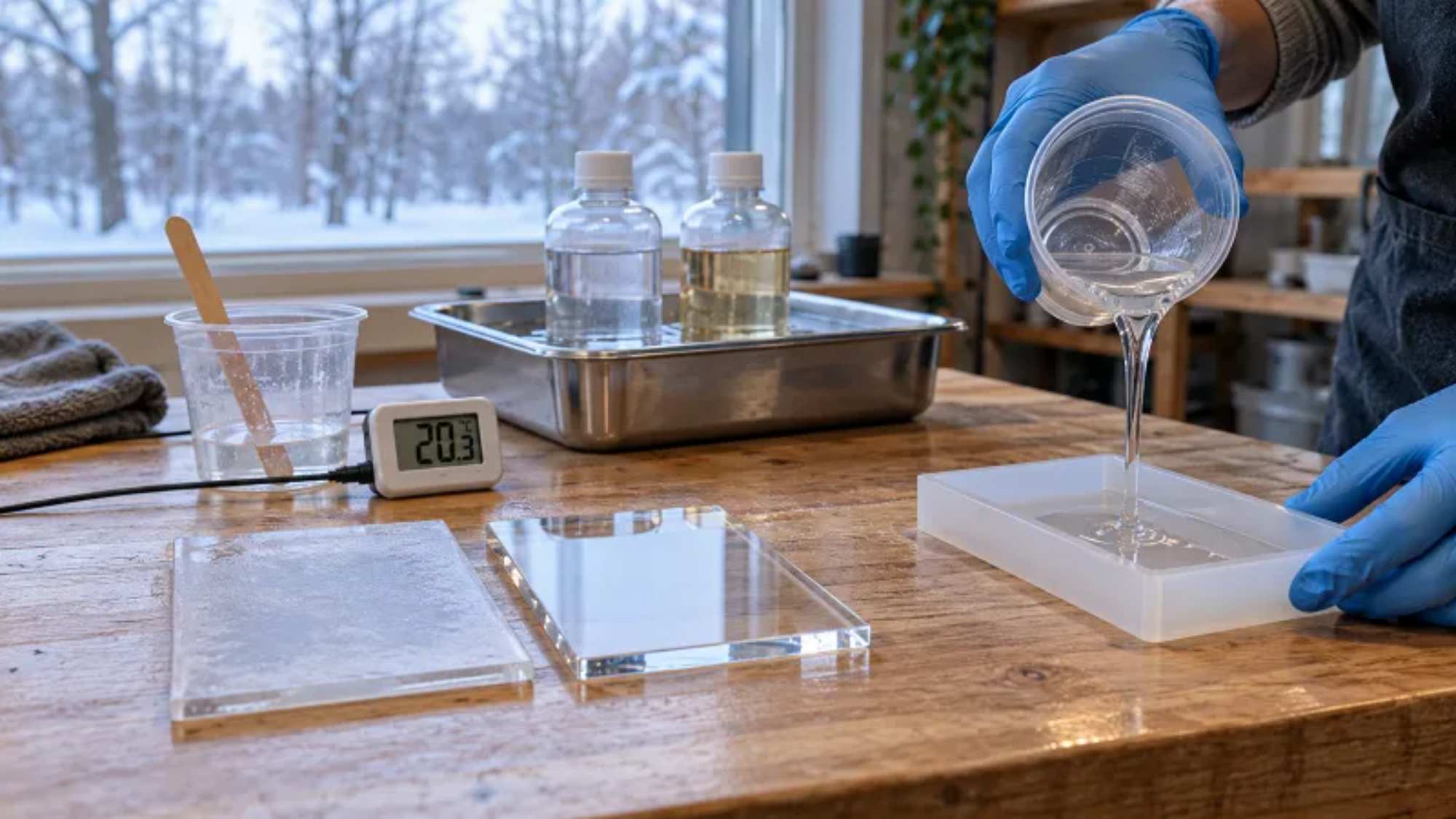
Epoxy doesn’t care what the calendar says, but it cares a lot what the thermometer says. Pour cold weather epoxy resin in a garage at 50°F and you can end up with a surface that stays tacky for days, a greasy film that won’t wipe off, or bubbles frozen in the middle of the pour. None of that means the resin is bad. The room was just too cold for the chemistry.
Winter is when distributors and shops see the most complaints, because customers keep pouring while the heat drops. This guide covers the minimum temperatures that matter, what amine blush is and how to fix it, what to do when resin shows up cold or crystallized, and a checklist you can hand to customers. If you buy from an epoxy resin manufacturer for resale, the last two sections are aimed at you.
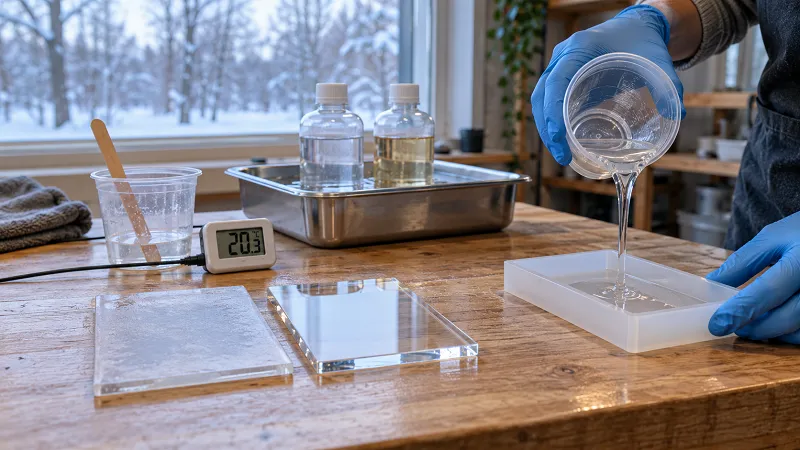
How cold is too cold for epoxy?
Most data sheets give a working range of roughly 70–80°F (21–27°C), with a floor around 60°F (16°C). That floor applies to the resin, the hardener, the surface you’re pouring on and the air, not just the number on the wall thermostat. Below it the reaction slows hard. As a rule of thumb, reaction speed roughly halves for every 18°F (10°C) of cooling, so a resin that cures in 24 hours at 77°F can take far longer at 55°F, and at some point it just stops short of a full cure.
Look for the stated minimum on your TDS. If the sheet doesn’t give one, ask the epoxy resin manufacturer, and until you hear back treat 60°F as the line.
What cold does to resin and hardener
Slow cure. Epoxy that should be hard in a day or two stays soft or tacky, sometimes for a week. The surface may feel dry while the layer underneath is still gel.
Thick resin. Cold epoxy is far stiffer, so it levels badly and holds on to bubbles. We cover the mechanics in our guide to epoxy resin viscosity.
Crystallization. After a cold truck ride or a night in an unheated warehouse, some resins turn cloudy, grainy or semi-solid in the container. That’s crystallization, and it’s reversible. Loosen the lid slightly, set the container in a warm water bath at about 120–140°F (50–60°C) and keep water out of it. Stir gently until the resin is fully clear, then let it come back to room temperature before you measure. Don’t microwave it or set it on a direct heat source. Leftover crystals throw off the mix ratio, so use it only when it’s clear.
Amine blush. Different problem, bigger headache. It gets its own section.
Amine blush: the waxy film nobody expects
Amine blush is a waxy, greasy or cloudy film that forms on the surface of curing epoxy. It happens when amine groups in the hardener react with carbon dioxide and moisture in the air before they finish reacting with the resin. Cold, damp conditions make it much more likely, because the cure is slow and the surface sits exposed for longer.
You’ll spot it as a hazy, oily or sticky surface on a pour that’s otherwise hard. A fingernail won’t dent the epoxy underneath, but the top feels slick. Blush dissolves in water, so the fix is simple: wash with warm water and a little dish soap, scrub with a nylon pad, rinse, dry, and sand lightly before recoating. Skip the sanding and the next coat may not bond.
To prevent it, keep the surface at least 5°F (3°C) above the dew point, avoid pouring on very humid days, and keep the room warm through the whole cure, overnight included. One more thing. Don’t heat a closed space with an unvented propane or kerosene heater. Those put carbon dioxide and moisture into the air, which is exactly what blush feeds on. Electric heat is the safer choice.
How to pour epoxy in cold weather
- Warm the workspace to at least 70°F (21°C) the day before, and keep it there until the cure is finished.
- Bring everything inside for 24 hours: resin, hardener, wood, molds, mixing cups. Lumber from a cold shed carries chill and moisture into the pour.
- Check the surface temperature, not just the air. An infrared thermometer is cheap, and a hygrometer tells you whether you’re close to the dew point.
- If the containers are still cool, warm them in a water bath to about 77–80°F, lids sealed. Stay under roughly 86°F, since hot resin gels fast.
- Measure by the TDS ratio and mix for the full time, scraping the sides and bottom. Cold resin needs it.
- Cover the pour loosely to keep dust off and heat steady, and keep the room within range for the entire cure. A thermometer left next to the pour tells you what happened overnight.
Resist the urge to rescue a cold pour with a heat gun or a heat lamp parked close to the surface. Concentrated heat makes hot spots, which can yellow the epoxy or cure the top faster than the layer underneath and leave it wrinkled. A small electric heater across the room, or a heated mat under the work surface, gives gentler and more even warmth.
Troubleshooting: cold-weather problems
| Symptom | Likely cause | Fix |
| Still tacky after the stated cure time | Too cold during cure, or off-ratio mix | Move it to a room at 70–77°F and give it extra days. If it stays soft after several warm days, the ratio was probably off and the soft layer has to be removed. |
| Greasy or hazy film on a hard pour | Amine blush | Wash with warm soapy water, rinse, dry and sand before recoating. |
| Bubbles frozen in the pour | Cold, thick resin | Warm both components, pour in thinner layers, and use a heat gun or torch on thin coats. |
| Cloudy or grainy resin in the container | Crystallization | Warm water bath, stir until clear, cool to room temperature before mixing. |
| White haze on the cured surface | Moisture from damp wood or humid air | Dry and warm the wood and the workspace before the next pour. |
Winter storage and shipping for distributors
If you hold stock, keep it above about 60°F (16°C) all year. A cold warehouse is how crystallized resin and thick, hard-to-pour epoxy end up in your support inbox. Move pallets indoors before a cold snap, let them settle to room temperature before anyone opens a container, and rotate older stock out first. Our guide to shelf life and reorder planning covers the inventory side.
Winter freight adds its own risk. A container that sits in an unheated truck or a port yard for a week can arrive cold, so ask your epoxy resin manufacturer how the product is packed and whether it has temperature recommendations for transit. Tell your own customers the same thing in writing. A short winter note in the order confirmation (store resin indoors, pour at 70°F or above, let containers acclimate for a day) can head off many of these tickets.
Specifying epoxy for cold climates
Not every formula behaves the same at low temperature, and your customers in Minnesota, Ontario or the north of the UK aren’t pouring in the same shop as customers in Arizona. If you sell private label epoxy into a cold market, tell your epoxy resin manufacturer the lowest temperature your customers really pour at, and ask what the formula does there. Our piece on custom-formulated versus standard private label epoxy explains how that conversation usually goes.
Jinhua Resin is an epoxy resin manufacturer making table top epoxy, deep pour epoxy and UV resin under OEM and private label programs. Send us your target climate and your application, and we’ll talk through options.
FAQ
Can you pour epoxy in cold weather?
Yes, as long as the resin, hardener, surface and room all stay inside the range on the TDS, usually about 70–80°F (21–27°C). Once you drop below roughly 60°F (16°C), expect slow cure, thick resin and surface problems.
What temperature is too cold for epoxy to cure?
Cure slows sharply below about 60°F (16°C). Near 50°F (10°C), many epoxies stay tacky or never reach a full cure. Your data sheet gives the real minimum for your product.
How do I get rid of amine blush?
Wash the surface with warm water and a little dish soap, scrub with a nylon pad, rinse and let it dry. Then sand lightly before you recoat. Blush is water-soluble, so solvents aren’t needed.
Is cloudy epoxy resin in the bottle ruined?
Usually not. Cloudy, grainy or semi-solid resin is typically crystallized, and it can be reversed. Warm the container in a water bath until it’s clear, then let it cool to room temperature before mixing.
Does a heat gun help epoxy cure in cold weather?
A heat gun helps pop surface bubbles on thin coats, but it won’t cure a pour. Steady, even warmth in the room does that. Keep the heat gun moving so it doesn’t scorch the surface.