


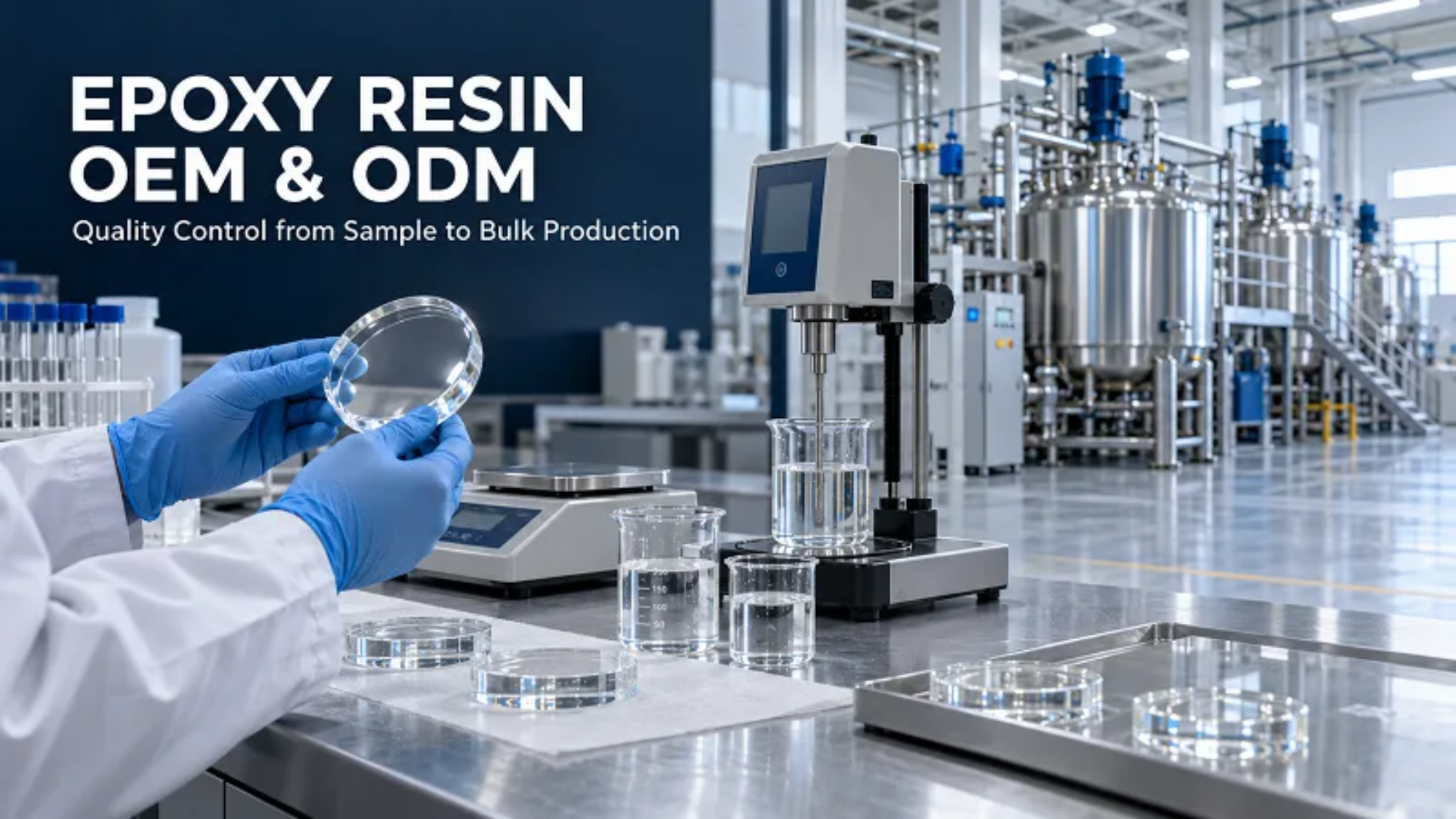
Most buyers who run into trouble with epoxy resin OEM orders don’t get burned on price. They get burned on consistency. The sample was crystal clear, the first pallet was fine, and by the third shipment customers are emailing about yellowing, soft spots and bubbles that won’t leave.
That almost never means the factory “made a bad batch.” It means the factory never turned a good sample into a repeatable process.
This guide walks through the full epoxy resin OEM and ODM cycle in the order it actually happens, with the quality checkpoints that matter at each stage. It applies whether you’re sourcing table top epoxy, deep pour epoxy or UV resin.
OEM vs. ODM: Who Owns the Formula?
The two terms get mixed up constantly, and the difference changes how much risk you carry.
OEM means you supply the specification, or sometimes the formula itself, and the factory produces it under your brand. ODM means you describe the result you want, such as “deep pour, 5 cm in a single pour, water-clear, no yellowing,” and the epoxy resin manufacturer develops the formulation.
In practice, most private label epoxy resin projects land somewhere in between. The factory starts from a proven base formula and adjusts it for your market: viscosity, cure speed, color, pot life. It’s faster than a ground-up ODM project, and it carries far less risk than inventing a formula from scratch. If you’re a first-time importer, this hybrid route is usually the smart one.
Step 1: Write a Brief That Leaves No Room for “Close Enough”
Quality disputes in epoxy resin OEM projects usually trace back to a vague brief. “Similar to Brand X” isn’t a specification. A usable brief covers:
- Product type and application: table top, river table, jewelry casting, floor coating
- Pour thickness per layer: roughly 2–3 mm for table top, 25–50 mm or more for deep pour
- Target viscosity at 25°C, in mPa·s
- Mix ratio, by volume or weight, and working time
- Demold or full-cure time, and target Shore D hardness
- Destination market and its compliance needs: REACH, Prop 65, RoHS, TSCA
That last item gets skipped more than any other. A formula built for one market can fail another market’s requirements, and reformulating after you’ve approved samples costs weeks. Settle it before the first sample is mixed.
Step 2: Sample Development Should Test Stability, Not Looks
A reputable epoxy resin manufacturer typically delivers first-round samples within 7–14 days when working from an existing base formula. Don’t judge them by clarity alone. Clear samples are easy. Stable ones are hard.
Pour it the way your customer will. Lab conditions at 25°C tell you little about a customer’s garage at 15°C. Test at realistic temperatures, in realistic molds, at realistic thicknesses. For deep pour epoxy, watch for exotherm: a formula that runs hot in a thick pour can crack, yellow or cure unevenly.
Run an aging comparison. Yellowing is the single most common complaint in the resin trade. Ask the factory for UV aging or accelerated weathering data, or run your own side-by-side: a sample and a control placed in strong light for several weeks, then compared for color shift.
Sign off on a reference sample. Both sides keep a sealed retained sample marked with batch number, date and key parameters. Every bulk shipment gets judged against it. Without that reference sample, any later dispute becomes one side’s word against the other’s.
Step 3: The Pilot Batch That Locks the Formula
Lab samples are measured in grams. Bulk production is measured in tons. Scale-up changes things: heat builds up differently in a large reactor, mixing efficiency shifts, degassing takes longer, and filling lines introduce new contamination risks.
That’s why a serious epoxy resin OEM process includes a pilot run, commonly 100–500 kg, before any full order. The pilot answers three questions:
- Do viscosity, color and cure profile at scale match the approved sample?
- How much does normal raw material variation move the final result?
- Does filling and packaging add moisture, dust or other contaminants?
Once the pilot passes, the formula and process parameters get frozen in a written work instruction. After that, changing a raw material supplier or adjusting a ratio requires written notice to you and re-approval. If a factory resists this, it’s a red flag. Silent substitutions are how consistent products turn inconsistent.
Step 4: Quality Control During Bulk Production
Consistency in bulk production comes from breaking quality into checkpoints and recording every one, on every batch. Here is what a solid control plan looks like:
| Stage | What gets checked | Typical method |
|---|---|---|
| Incoming raw materials | Epoxy value, amine value, moisture, color | Titration, Karl Fischer, Gardner color |
| In-process | Charging accuracy, mixing time, reaction temperature | Weighing system records, temperature logging |
| Intermediate | Viscosity, density | Rotational viscometer (ASTM D2196), ASTM D1475 |
| Finished product release | Mix ratio check, gel time, cured hardness | ASTM D2471, Shore D (ASTM D2240) |
| Packaging | Net weight, seal integrity, batch labeling | Sample weighing, visual inspection |
Viscosity is the number to watch. A common industry tolerance is about ±10% against the approved value. If gel time drifts well outside the agreed window, something is wrong with the raw materials or the ratio, and that batch shouldn’t ship.
Traceability is non-negotiable. Every drum or kit should carry a batch code that links back to raw material lots, production date, operating team and inspection records. When a customer reports a problem three months after delivery, a capable epoxy resin manufacturer can pull the batch history within hours, not days.
Step 5: Pre-Shipment Inspection and Retained Samples
Before goods leave the factory, you should receive:
- A certificate of analysis (COA) for each batch, showing measured viscosity, gel time, hardness and other agreed parameters
- SDS and TDS documents matched to the product, which customs brokers and end customers will both ask for
- Retained samples, kept by the factory for at least 12 months per batch
Retained samples matter more than most buyers realize. If a customer reports abnormal curing half a year later, you can compare the retained sample against the returned product and settle the question with evidence.
On your first order, do your own incoming check too. Pull random units, mix and pour them by the standard method, and compare against your reference sample. It costs very little, and it exposes problems while you still have leverage.
Questions to Ask Before You Commit to an Epoxy Resin OEM Supplier
You can learn a lot about a factory from how it answers plain questions:
- Do you run your own lab, and can you share batch-level test data rather than a generic datasheet?
- How do you notify customers about formula or raw material changes?
- Is a pilot run part of your development process, or an optional extra?
- How long do you keep retained samples?
- Can you provide compliance documents for my target market?
- Are you a factory or a trading company? (Ask to see the production floor, even by video.)
A true epoxy resin manufacturer won’t be bothered by any of these, because the answers already exist in its daily operations. Vague or defensive replies tell you what you need to know.
FAQ
What is the minimum order quantity for epoxy resin OEM?
It varies by product and packaging. Custom formulas generally carry higher minimums than standard catalog items, since the factory has to dedicate production time and sometimes custom packaging. Ask for MOQs per product line rather than a single number.
How long does it take from sample to first bulk delivery?
When the factory adjusts an existing formula, expect roughly 4–8 weeks including pilot and production. A full ODM development project usually needs 2–3 months, sometimes longer if compliance testing is involved.
Can I sell epoxy resin under my own brand?
Yes. Private label epoxy resin is the core of OEM service: your label, your packaging design, your kit configuration. Confirm artwork lead times early, since packaging often becomes the bottleneck.
How do I avoid batch-to-batch differences in color and viscosity?
Require incoming inspection on raw materials, a locked formula after the pilot run, and a COA with every shipment. Those three controls prevent most drift.
Should I test every shipment myself?
On the first two or three orders, yes. Once the factory has proven consistent, periodic spot checks are usually enough.
Final Word
Good epoxy resin OEM results don’t come from one perfect sample. They come from a process that repeats: a clear brief, a signed reference sample, a pilot batch that locks the formula, and test data that follows every shipment.
If you’re looking for an epoxy resin manufacturer with OEM and ODM capability, tell us your target market and application, and we’ll start with a sample plan built around your specs.