


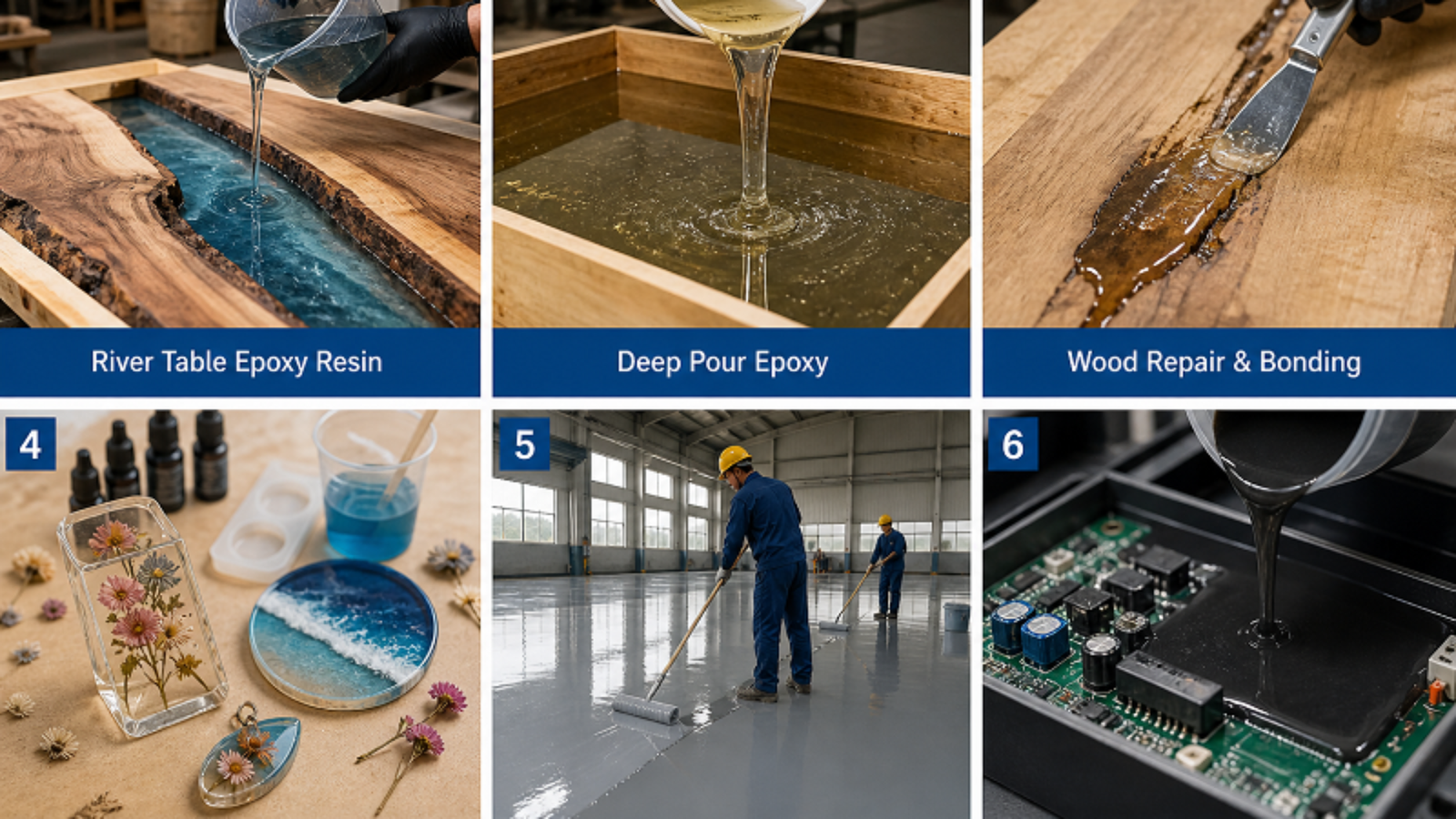
Epoxy resin may sound like something far removed from our lives, but in fact, it’s used in many places around us—the smooth, shiny coating on parking lot floors, the transparent tabletops made by pouring it into tree hollows in woodworking workshops, and even those fluid art paintings you see online.
It’s a two-part thermosetting system — mix resin with hardener, and a chemical reaction kicks off that turns the liquid into a tough, permanent solid. The cured material bonds to almost anything, resists water and most chemicals, and holds up under mechanical stress. That combination is exactly why it shows up in such wildly different places, from bridge maintenance crews to craft hobbyists in their garage.
Here are the 10 most common applications — and what actually makes epoxy the right material in each one.
1. Table Top Epoxy Resin
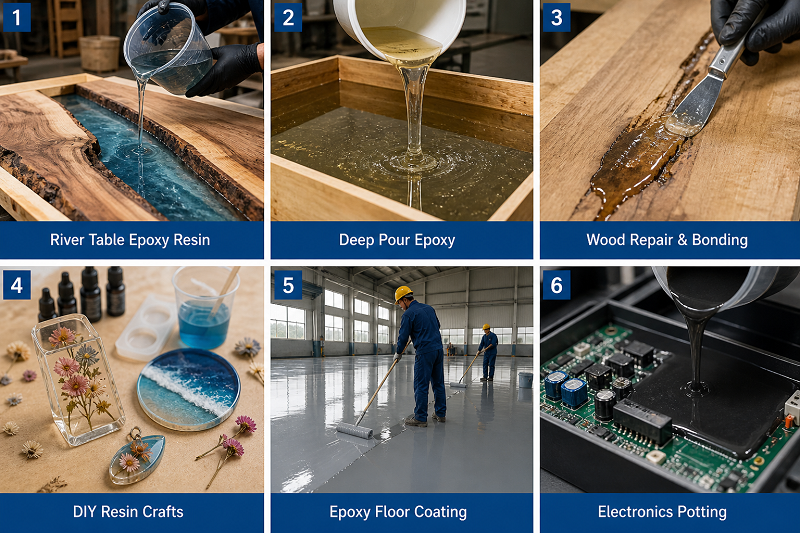
River tables went from niche woodworker projects to something you see in every trendy café and boutique hotel lobby. The concept is straightforward: two live-edge slabs placed face-to-face, the gap filled with pigmented or clear epoxy, then sanded flat once cured. The result looks like a frozen river running through solid wood — and it’s held up by nothing more than a good pour and some patience.
Tabletop formulas have a specific set of requirements that separate them from general-purpose epoxy. Water-clear clarity matters because any cloudiness or haze is immediately visible on a finished surface. UV stability matters because a tabletop that yellows within a year is a problem. Heat resistance matters because hot coffee cups will leave white rings on a surface that can’t handle the temperature.
For commercial installs — bar tops, restaurant tables, reception counters — alcohol resistance is another box that needs to be checked. Bartenders will wipe those surfaces down with cleaning solutions dozens of times a day.
Typical mix ratio: 2:1 or 3:1 (resin to hardener, by volume)
Working time: 30–90 minutes depending on formulation
Use cases: Live-edge dining tables, bar tops, café counters, office desk resurfacing
2. Deep Pour Epoxy
Standard tabletop epoxy caps out at around 5–6mm per pour. Push past that and the exothermic reaction during cure builds up too much internal heat — you get yellowing in the best case, cracking and warping in the worst. Deep pour formulas are specifically engineered to slow that heat release down, which allows single pours of 50mm or more without the same risk.
The tradeoff is time. Where a tabletop product might be ready to demold in 16–24 hours, a deep pour system typically needs 36–72 hours before it’s safe to handle, and full cure can stretch past a week. That slower pace isn’t a flaw — it’s the mechanism that prevents the heat buildup.
Ambient temperature plays a bigger role here than with thinner pours. Cold slows everything down significantly; heat, paradoxically, can cause problems even with a slow formula if you’re working with a very thick section. Keeping the workspace in the 18–24°C range is the practical sweet spot for most products.
Key specs to check: Maximum single-pour depth, cure color (water-white vs. slight amber), bubble release window
Use cases: Thick river tables, clear resin castings, specimen preservation, resin art installations
3. Woodworking & Wood Bonding
In woodworking, epoxy fills a gap that other adhesives leave open — sometimes literally. PVA wood glue performs best with tight-fitting joints under clamping pressure. Epoxy doesn’t need either. It fills gaps and cures solid, making it the right call for joints that aren’t perfectly matched, for locking in loose tenons, or for filling knots and natural voids in slabs before a decorative pour.
Low-viscosity penetrating epoxy serves a completely different purpose: stabilizing punky or rotted wood. It soaks into the fibers and cures solid, turning soft, crumbling material back into something you can work with — drill into, sand, and finish. Historic timber restoration and wooden boat repair have relied on this for decades. It’s also useful for pre-treating end grain before a tabletop pour to reduce absorption and prevent air bubbles from migrating up through the wood.
One practical note: epoxy’s pot life means you need to work with intention. Unlike PVA, which stays workable for a while after application, a mixed epoxy batch has a clock running. For large assemblies, choose a longer-working formula, and mix smaller batches if needed.
Vs. standard wood glue: Gap-filling, fully waterproof, sandable and shapeable after cure; higher cost, requires attention to working time
Use cases: Knot and void filling, rot consolidation, gap-filling structural joints, slab prep, wooden boat repair
4. DIY & Craft Applications
Resin crafting has exploded on social media, and the appeal is easy to understand. Small two-part kits paired with mica powders, alcohol inks, dried flowers, foils, or embedded objects can produce jewelry, coasters, keychains, bookmarks, phone cases, and decorative panels — things that look polished and intentional without requiring professional tools or a workshop.
The material’s defining characteristic for craft use is optical clarity. You can encapsulate almost anything inside a clear pour and it’ll stay visible and protected permanently. That’s something no other common craft material can replicate.
New crafters run into the same problems repeatedly. Not measuring the A:B ratio accurately enough is the most common one — even being slightly off can result in a surface that stays tacky and never fully cures. Under-mixing is the second: you need to scrape the sides and bottom of the container and mix for the full time the instructions specify, not until it “looks mixed.” And skipping the heat gun pass after pouring means surface bubbles get locked in rather than popped.
UV-stable formulas are worth the slight price premium for anything that’s going on display or outdoors. Non-UV-resistant resin starts to yellow noticeably faster than most beginners expect.
Use cases: Jewelry and accessories, coasters and home décor, resin art panels, custom gifts, embedded keepsakes
5. Epoxy Floor Coating
Factory floors, warehouses, parking structures, and hospital corridors share a common problem: they need surfaces that can take serious, sustained abuse. Constant forklift traffic, heavy equipment, chemical spills, and daily cleaning cycles will destroy standard paint within months. Epoxy floor coatings bond tightly to concrete, cure to a hard surface with pencil hardness ratings above 2H, and hold up against oils, acids, and caustic cleaning agents.
Systems are categorized by build thickness. Thin-coat systems (0.3–1mm) are mainly decorative, adding color and some chemical resistance to an otherwise sound floor. Medium-body systems (1–3mm) provide meaningful protection for moderate industrial use. Self-leveling systems (2–5mm) are the choice for heavy-duty environments and anywhere a seamless, easily cleaned surface matters — food processing facilities and pharmaceutical plants are the obvious examples, since no joints means no places for contamination to hide.
Surface prep determines whether the coating sticks or peels. The concrete needs to be mechanically abraded or shot-blasted, not just cleaned. Moisture content must be below 8%. Application temperature generally needs to stay above 5°C for proper cure.
Application notes: Surface moisture below 8%, application temperature above 5°C, mechanical abrasion required
Use cases: Factory floors, logistics warehouses, parking decks, hospitals, food processing facilities
6. Electronics Potting & Encapsulation
Electronic components have a long list of environmental enemies: vibration, moisture ingress, corrosive atmospheres, thermal cycling, and mechanical shock. Potting compounds address most of these at once by encasing the assembly in a solid, inert shell. PCBs, sensors, connectors, and LED driver modules are among the most commonly potted components.
The formulation requirements are specific. Low viscosity is needed to fill the tight geometries inside electronic assemblies without trapping air pockets. Low exotherm is essential — a high heat-release formula can damage sensitive components during cure. Low post-cure shrinkage prevents mechanical stress on solder joints and component leads.
Specialized variants go further: thermally conductive grades use ceramic or metalite fillers to pull heat away from components that run hot; flame-retardant grades meet UL94 V-0 requirements for applications where fire safety certification is mandatory.
Use cases: PCB protection, sensor potting, outdoor LED fixtures, automotive electronics modules
7. Concrete Crack Repair
Concrete cracks. It’s not a failure — it’s a material property. The question is how you handle it when it happens in a structural element. Low-viscosity epoxy injection is one of the most effective methods available: the material penetrates cracks as narrow as 0.05mm, fills the void, and cures to a strength that typically exceeds the surrounding concrete. The crack location stops being the weak point.
Compared to cementitious repair mortars, epoxy injection systems have two practical advantages in difficult conditions. First, they work in damp environments — getting a below-grade structure completely dry before repair is often not realistic, and epoxy systems can be formulated to cure against moisture. Second, their bond strength and low shrinkage means the repair stays put under the same loading conditions that caused the original crack.
Use cases: Bridge and highway maintenance, basement leak repair, slab crack restoration, tunnel lining repair
8. Anti-Corrosion Coatings for Steel
Steel corrodes slowly and invisibly until the damage is already significant. By the time rust is visible on a structural member, the steel section loss may already be affecting load capacity. Protective coating systems applied before corrosion takes hold are dramatically more cost-effective than repairs after the fact.
Zinc-rich epoxy primers work by sacrificial protection — the zinc corrodes preferentially, leaving the steel underneath intact. Micaceous iron oxide (MIO) epoxy midcoats add a barrier layer with flake-like pigments that create a tortuous path for moisture and oxygen to travel through. Together they form the standard two-coat base for most industrial heavy-duty corrosion protection systems.
In aggressive environments — marine exposure, chemical processing facilities, wastewater treatment plants — a properly specified and applied high-solids epoxy system can extend maintenance intervals from the typical 5-year cycle to 15 years or more. The difference in lifetime cost is substantial.
Use cases: Bridges, port and harbor infrastructure, industrial storage tanks, petrochemical structures
9. Marine Coatings
Salt spray, continuous immersion, and constant wet-dry cycling put marine coatings under stress that most industrial applications don’t come close to. Steel hulls need dense, adhesive barrier coatings that keep seawater and oxygen physically separated from the metal. Epoxy coal tar products and high-solids epoxy primers have been the standard for hull protection for decades — not because they’re the newest option, but because they work reliably in conditions that defeat other systems.
Epoxy also plays a central role in FRP (fiberglass-reinforced plastic) boatbuilding. Compared to hulls laminated with polyester resin, epoxy-based FRP laminates have higher interlaminar shear strength and substantially better resistance to osmotic blistering — the bubbling that develops when water slowly penetrates a polyester laminate over years of use. For boats that spend extended time in the water, the difference in long-term durability justifies the higher material cost.
Use cases: Steel hull protection, FRP boat construction, harbor pilings, offshore platform maintenance
10. Pipeline Lining
Urban water and sewer networks were built to last decades, but they don’t last forever. When pipes start failing, replacing them by open-cut excavation means tearing up roads, disrupting utilities, and spending months on what could be a single city block. Epoxy lining systems offer a less disruptive path: a new internal wall is created inside the existing pipe either by spray application or cured-in-place liner, without needing to dig the pipe up.
The performance requirements depend entirely on what the pipe carries. Potable water linings must meet NSF/ANSI 61 certification — no leaching of harmful substances into the water supply is a non-negotiable baseline. Industrial wastewater pipes carrying acids, bases, or solvents require formulations chosen specifically for the chemistry involved, not just generic corrosion resistance.
Use cases: Municipal water mains, sewer rehabilitation, petrochemical piping, industrial wastewater systems
Quick Buying Guide: Parameters That Actually Matter
“Epoxy resin” covers an enormous range of products. A craft kit and an industrial maintenance coating are both technically epoxy, but they’re engineered for completely different performance envelopes. Using one where the other belongs usually doesn’t end well. These are the parameters worth checking before committing to a product:
Mix ratio — Whether it’s 1:1, 2:1, or 3:1, the ratio is fixed by the chemistry. Estimating it or adjusting it will degrade cure performance, sometimes severely. Measure by volume or weight as specified.
Pot life — The window between mixing and gelation. Large pours, big floor areas, or complex assemblies need longer working time. Don’t assume you have more time than the spec sheet says.
Maximum pour depth — Deep pour and tabletop products have very different limits. Exceeding the specified depth with a standard formula risks exothermic cracking and discoloration. It’s not a conservative recommendation — it’s a material limit.
UV resistance — For anything that will be on display, near windows, or outdoors, UV-stable formulations are worth the extra cost. Standard grades yellow faster than most people expect, especially in direct light.
Certifications — For countertops in food prep areas, potable water contact, pharmaceutical flooring, or fire-sensitive environments, the relevant certifications (NSF, FDA, UL94, etc.) aren’t optional. Check the product’s technical data sheet, not just the marketing copy.
For product selection support or sample requests, contact our technical team directly.