


The global epoxy resin market didn’t just grow in 2025 — it restructured. Demand kept climbing, but the forces reshaping distribution had little to do with capacity alone. Trade tariffs, regional supply chain realignment, tightening sustainability requirements, and a measurable shift toward digital procurement all arrived at roughly the same time, and the combined effect has been significant.
For buyers, traders, and brand owners, this isn’t background noise. Where you source from, which channel you use, and how exposed you are to price swings in 2026 — all of it connects back to what’s happening in the distribution layer right now.
Asia-Pacific Still Leads, but the Region Is No Longer One Market
Asia-Pacific held its position as the dominant hub for epoxy resin production and export in 2025. China alone accounted for more than 45% of global supply, with monthly export volumes exceeding 40,000 metric tons — flowing primarily into Southeast Asia, Europe, and North America. South Korea, India, and Japan remained significant producers, though each occupies a distinct position in the value chain.
The phrase “Asia-Pacific dominates” is technically accurate but increasingly misleading. Within the region, a clear division of labor has taken shape:
China remains the largest source of standard-grade epoxy resin, with the scale and cost structure that no other country currently matches at volume. The pressure point is trade policy: Chinese exporters face US anti-dumping duties as steep as 354.99%, which has directly pushed a portion of North American buyers to explore alternative origins. When tariffs make a traditional source prohibitively expensive, buyers don’t wait — they qualify new suppliers.
India moved up considerably in 2025. Domestic epoxy resin manufacturers expanded capacity over the past few years, supported by government incentives and growing regional demand from Southeast Asia, Africa, and the Middle East. Several manufacturers have pursued backward integration — controlling more of the raw material-to-finished-product chain — as a way to compete on price without depending entirely on commodity market fluctuations.
Japan and South Korea are playing a different game entirely. High-purity electronic-grade resins, semiconductor encapsulants, and high-Tg aerospace composite systems are their competitive territory. Neither country is chasing volume in standard commodity grades, and neither needs to.
Europe: Regulatory Pressure Is Cutting Both Ways
European epoxy resin manufacturers entered 2025 facing two distinct pressures simultaneously — continued low-price competition from Asian imports, and increasingly strict EU regulations on what chemical formulations can be sold in the market at all.
That second pressure, counterintuitively, works partly in their favor. Products imported from Asia must meet REACH requirements. Conventional BPA-containing formulations are facing higher market access barriers. And in the category of waterborne systems, low-VOC formulations, and bio-based epoxy products, European producers still hold a meaningful technical lead over most Asian competitors.
Germany, France, and the UK have been consistent in pushing for lightweight, high-strength materials in vehicle and aircraft manufacturing — composites that require epoxy. Offshore wind is another structural driver: Europe leads globally in installed offshore capacity, and turbine blades plus protective coatings represent a sustained, high-volume demand base for resin. That demand isn’t going anywhere, and it’s largely insulated from the commodity-grade pricing pressure that squeezes lower-end segments.
North America: Tariffs Forced a Distribution Rethink
No region saw more distribution disruption in 2025 than North America. Anti-dumping and countervailing duties on imports from China — with rates ranging from 1.01% to as high as 547.76% depending on the product and source — forced buyers to structurally reassess supplier relationships they’d treated as stable for years.
The first-order effect was straightforward: some North American epoxy resin manufacturers brought idled production capacity back online. New capacity investment followed. Reshoring policy, infrastructure spending, and renewable energy tax credits created conditions where domestic production became economically viable again in categories where it previously couldn’t compete.
For distributors working the North American market, the shift was more complicated. Import channels that had been reliable and cost-effective suddenly became expensive and uncertain. Domestic and nearshore (Mexico) sourcing moved up priority lists — and Mexico’s automotive manufacturing clusters, which run significant volume in structural adhesives and composite materials, accelerated that shift from the demand side as well.
Direct vs. Distributor: Large Buyers Are Shortening the Chain
One of the more durable behavioral shifts in 2025 was the acceleration of direct purchasing relationships between large end-use buyers and epoxy resin manufacturers — at the expense of the traditional trading distributor layer.
Three things drove this:
First, the supply disruptions of recent years — pandemic-era logistics failures, port congestion, raw material price spikes — exposed a real problem with distributor-mediated purchasing: price opacity and limited priority access when supply got tight. Large buyers who relied on distributors found themselves last in line during shortage periods. The lesson stuck.
Second, the major epoxy resin manufacturers responded by building out their direct sales infrastructure. Technical application support, on-site services, and strategic pricing arrangements for high-volume customers made direct relationships more attractive on both sides of the transaction.
Third, digital procurement platforms matured enough to remove much of the friction from cross-border direct purchasing. B2B e-commerce tools and online RFQ systems gave smaller buyers — not just large ones — a realistic path to engaging manufacturers directly, rather than routing everything through a local trading company.
The traditional distributor hasn’t been made obsolete. But the ones still performing well in 2025 are the ones who transitioned from being a logistics intermediary to being a technical service provider with local inventory capability. That pivot is the difference between a distributor that’s growing and one that’s getting squeezed.
Three Trends That Will Define 2026
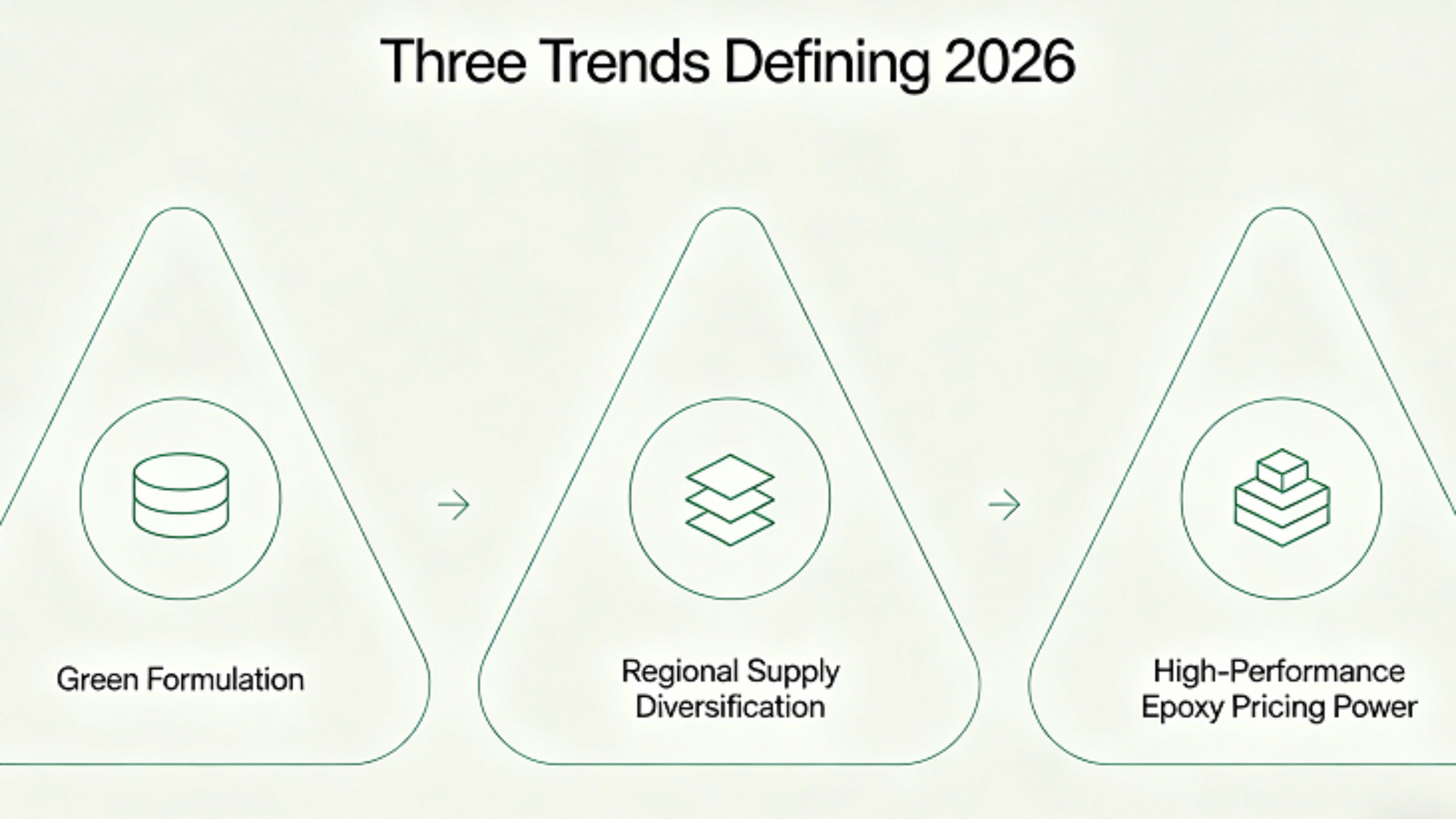
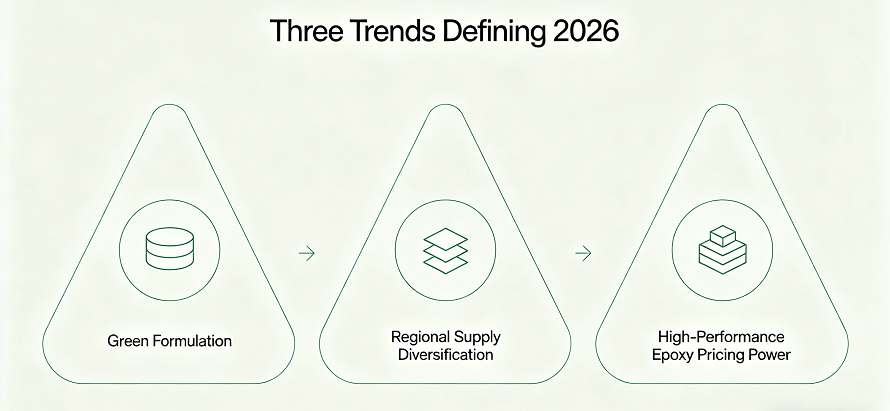
Green formulation is becoming a baseline requirement, not a differentiator
Waterborne epoxy and bio-based resin products crossed a threshold in 2025 — they stopped being niche alternatives and became active procurement requirements for European buyers and a growing share of North American ones. Tighter BPA and VOC regulations are accelerating the shift toward waterborne, bio-circular, and low-VOC chemistries across the board. For Asia-Pacific exporters targeting EU supply chains, green certification is no longer optional. Epoxy resin manufacturers that haven’t started the compliance groundwork are already behind.
Regional supply diversification is accelerating — single-origin dependency is a known risk
Emerging producers in the Middle East and Latin America are building a larger footprint in global supply networks. India, Vietnam, and Thailand are absorbing PCB manufacturing and wind blade production capacity that’s shifted out of China. For procurement teams, the dual-supplier strategy — one Asian source for cost, one regional source for security — is moving from best practice to standard operating procedure in 2026. Buyers who haven’t structured this yet are carrying concentration risk they may not have fully priced.
Specialty demand is giving high-performance epoxy resin manufacturers real pricing power
Wind energy, semiconductor packaging, and EV battery module encapsulation are the three fastest-growing application segments, and each one demands performance specs that standard industrial-grade resin can’t meet. Renewable energy buildout and electrification trends are adding sustained volume momentum in exactly the categories where formulation complexity is highest. Epoxy resin manufacturers focused on these niches are operating with meaningfully better margin and negotiating leverage than commodity-grade producers. That gap will widen through 2026.
Practical Guidance for Buyers Heading into 2026
The structural shifts above translate into a few concrete adjustments worth making now:
Build a dual-supplier structure for core categories. At minimum, one Asian source for cost efficiency and one domestic or nearshore source for supply security. This isn’t theoretical risk management — it’s the lesson the market taught loudly over the past few years.
Get your compliance documentation in order before you need it. If your products enter EU or US supply chains, ask your epoxy resin manufacturers now for REACH declarations, SVHC substance lists, and VOC content testing reports. Waiting until a customer audit to discover gaps is an avoidable problem.
Reassess the distributor relationship honestly. If your current distributor isn’t providing technical support or local inventory buffering — if they’re purely moving product — the case for going direct is stronger than it’s ever been. Run the comparison.
Track raw material prices on a quarterly basis. Bisphenol A (BPA) and epichlorohydrin (ECH) are the two primary feedstocks for most standard epoxy systems. Their price movements feed directly into finished product quotes. Setting up a simple tracking mechanism gives you a baseline to evaluate supplier pricing rather than taking it at face value.
The global epoxy resin distribution network won’t settle into a quiet period in 2026. But the direction is clear enough to act on: regionalization, green compliance, and shorter supply chains are the three forces that will keep reshaping this market for the next two to three years.