


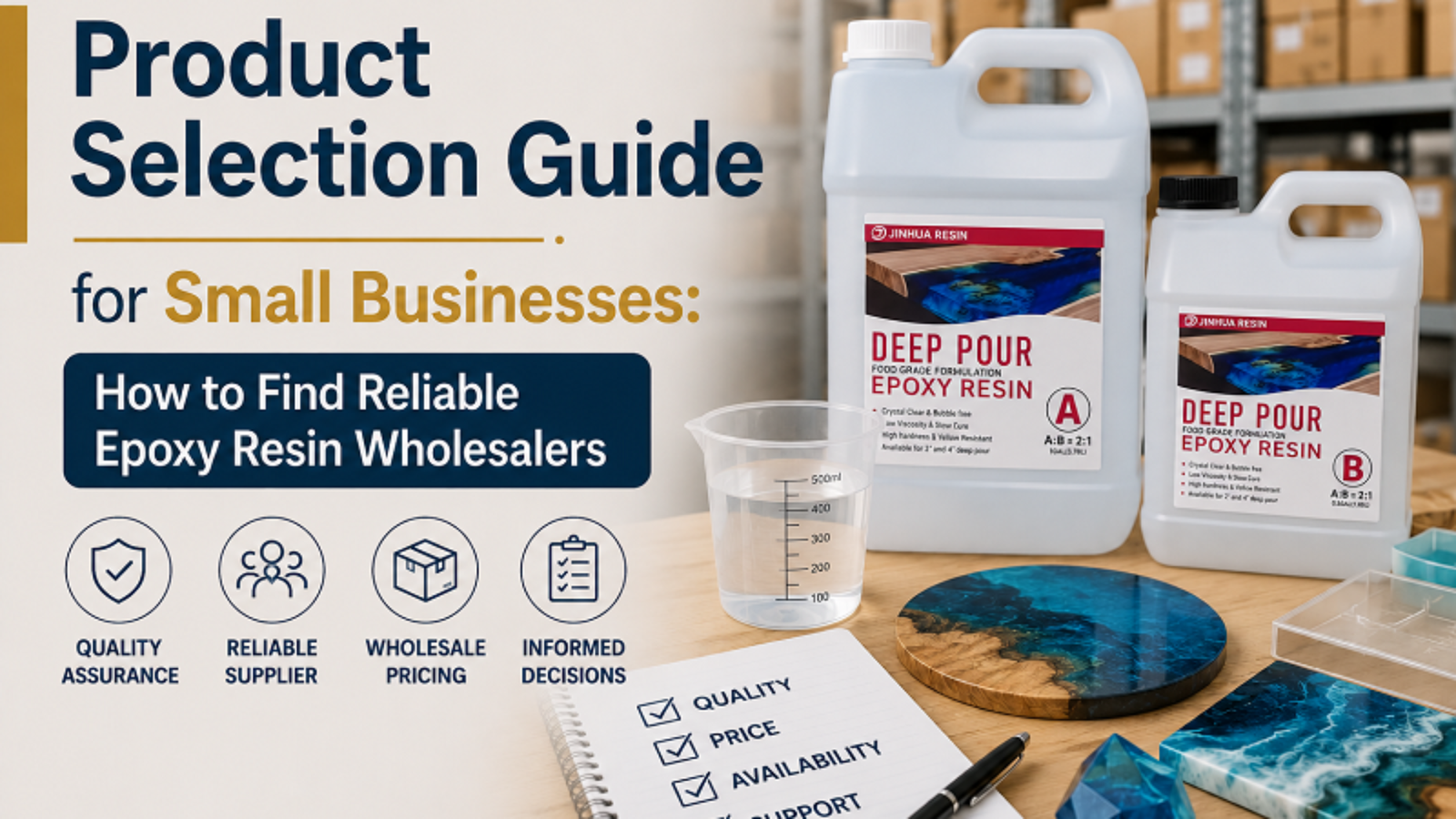
Running an epoxy resin business sounds easy enough — right up until you try to buy materials at any real volume. The distance between picking up a gallon kit online and placing your first wholesale order is wider than most small business owners expect. MOQs run from 1 kilogram to 500. Quotes swing wildly between suppliers. And working out whether a source is genuinely trustworthy takes a lot more than scanning through Amazon listings or a polished Alibaba storefront.
This guide is for owners who are done with retail sourcing and ready to do this properly. River table shops, resin art sellers, flooring crews, product-line builders — the approach is the same across the board. Find the right supplier by asking the right questions first, before any money changes hands.
Price Is Rarely What Gets You
It’s an easy trap to fall into — leading with cost. Wholesale epoxy resin quotes between suppliers can swing 30–60%, and when margins are tight, that number grabs your attention. But price is almost never the thing that actually derails a small business.
What causes real damage is unpredictability. A batch that behaves differently from the last one. A shipment that shows up three weeks behind schedule. A supplier who answered every message promptly until after your first payment cleared. Those problems cost significantly more than the few dollars per kilogram you saved by going with the lowest quote.
Reliability, supply consistency, and how a company responds when something goes sideways — these are what actually matter in a supplier relationship, especially for businesses operating without deep inventory buffers or cash reserves.
The goal here isn’t the cheapest epoxy resin wholesaler on the market. It’s the one worth building something with.
Step 1: Get Your Requirements on Paper First
Before you approach a single supplier, spend twenty minutes writing down what you actually need. Vague inquiries invite vague responses — and vague responses waste everyone’s time.
Usage volume and reorder frequency. How much are you going through each month, in kilograms or gallons? How often do you want to restock? If you’re currently using 20 kilograms a month, a supplier with a 500kg floor isn’t a match — regardless of what their pricing looks like.
Product type and spec. Epoxy isn’t one thing. Table top, deep pour, self-leveling floor coat, UV-cure, marine grade — each is a distinct formulation. Know which you need, and if you have requirements around viscosity, mix ratio, pot life, or cure time, write those down too.
Certifications you’ll need. Selling into the US or EU, or working in a regulated application like food contact surfaces, electronics, or marine? You’ll need paperwork. ISO 9001 is the baseline. RoHS and REACH matter for electronics and consumer goods. Not every epoxy resin manufacturer keeps this documentation current and accessible — worth checking early.
Packaging format. 5-gallon pails, 55-gallon drums, something in between? The format affects unit economics and storage practicality both. Not every epoxy resin manufacturer ships in every configuration.
Step 2: Where to Actually Look
The sourcing landscape looks different than it did five years ago. Fewer cold calls and trade show business cards; more platforms and direct outreach. More options overall, but also considerably more noise.
B2B platforms. Alibaba, Made-in-China, and Global Sources collectively list thousands of epoxy resin suppliers, the majority based in China — which dominates global production. Guangdong, Jiangsu, and Zhejiang are the main manufacturing regions; Guangdong’s port access makes it a strong export base, while Jiangsu’s established chemical infrastructure keeps production capacity consistent. These platforms are worth using as a starting point. Just treat every listing as a lead that still needs to be qualified — not a vetted supplier.
Trade shows. Major chemical industry events in Asia and Europe give you direct access to epoxy resin manufacturers showing their latest products in person. For small businesses, these are often where the most durable long-term relationships begin. An hour of face-to-face conversation moves faster than a week of email back-and-forth.
Going direct to manufacturer websites. Many established epoxy resin manufacturers run their own wholesale and OEM inquiry pages. Cutting out the platform middlemen typically means better pricing, cleaner communication, and access to technical support that a reseller simply can’t offer.
Word of mouth. If you’re active in any maker community — woodworking forums, flooring contractor groups, resin art circles — ask who people are actually buying from. A personal recommendation from someone running a similar operation is worth more than any directory listing.
Step 3: Do Your Homework Before Placing an Order
Once you have a shortlist, do the work before committing. A few hours of due diligence now is worth considerably more than the months of frustration it replaces.
Request documentation upfront. Any serious epoxy resin manufacturer should hand over a Technical Data Sheet (TDS) and Certificate of Analysis (COA) without you having to push for it. Key specs to look at: epoxy equivalent weight, viscosity range, hydrolysable chlorine content, volatility. A supplier who hesitates on basic documentation isn’t one you want holding your supply chain.
Ask specifically about batch consistency. This separates production manufacturers from trading companies that are just reselling someone else’s product. What does their QC process actually look like? How do they verify batch-to-batch consistency? Do they retain samples? A real epoxy resin manufacturer answers these questions with specifics.
Watch how they communicate. How long did the first reply take? Do their technical answers actually address what you asked? A supplier who’s slow or vague before the sale will be slower and vaguer once you’ve paid.
Find verifiable references. Case studies, third-party reviews, direct customer references. An epoxy resin manufacturer with a real production track record behind them carries less risk than a newer operation with aggressive pricing and no history you can check.
Order samples before committing to volume. Test the actual product in your actual workflow — pour it, cure it, push it. No TDS substitutes for that.
Step 4: MOQ Is Negotiable More Often Than You’d Think
Minimum order quantities are the most common sticking point for small businesses trying to enter the wholesale market. The reality is more flexible than it used to be.
Historically, many suppliers on platforms like Alibaba structured their MOQs around industrial buyers — hundreds or thousands of kilograms as a starting point. That’s still true for some. But a growing number of epoxy resin manufacturers have adjusted their programs to include small business tiers, because they’ve recognized that smaller accounts that grow over time are worth having.
When you’re looking at MOQ terms, push past the headline number:
- Can you combine multiple products to hit the threshold?
- Is the MOQ calculated per SKU or across the whole order?
- Do they have tiered pricing that improves with volume, without requiring large upfront commitments?
- Will they lower the MOQ for a first order if you’re willing to commit to a reorder schedule?
A supplier who’s genuinely interested in a long-term relationship will find a way to make the first order work. One who won’t move on anything is built for industrial accounts — probably not the right fit for where you are now.
Step 5: The First Order Is Just the Beginning
The best wholesale partnerships for small businesses aren’t transactional — they’re operational. When you’re evaluating an epoxy resin manufacturer, the real question is whether this is a company you can still be working with three years from now.
Accessible technical support. A good supplier can help you choose the right product for a new substrate, troubleshoot a curing issue, or work through an application problem. For businesses without an in-house chemist, that kind of support has real practical value — particularly when you’re scaling or taking on a new product category.
Room for custom formulations. As your volume grows, the ability to work directly with an epoxy resin manufacturer on viscosity, cure time, or colorant requirements becomes a genuine competitive edge. Not everyone offers it. But knowing whether it’s possible down the road matters when you’re choosing who to grow with.
OEM and private label capability. Building a brand rather than just consuming resin as an input? Look for an epoxy resin manufacturer with real OEM capacity. Your own labeled product changes the margin structure and brand perception considerably.
Pricing that scales with you. Does the supplier show you a clear pricing roadmap tied to volume? A good epoxy resin manufacturer tells you what the price looks like at 100kg, at 500kg, at 1000kg — not just quotes a one-time number and leaves it there. Knowing what growth means for your unit economics matters.
The Checklist: What a Reliable Epoxy Resin Wholesaler Actually Looks Like
Before finalizing any supplier, run through this:
- ✅ ISO 9001 certified at minimum; REACH / RoHS / FDA docs available on request
- ✅ TDS and COA provided without being asked twice
- ✅ Documented batch consistency process and QC records
- ✅ Responds to B2B inquiries within 24 hours
- ✅ Sample order available before MOQ commitment
- ✅ Flexible or negotiable MOQ for first orders
- ✅ Clear, tiered volume pricing — not just “contact us”
- ✅ Verifiable customer references or published case studies
- ✅ Post-purchase technical support included
- ✅ Open to custom formulation or OEM conversation as volume increases
Worth Saying Once More
Finding a reliable epoxy resin wholesaler takes more upfront work than retail ever did. But for any small business planning to stay in this space beyond a few months, that work pays off. The right epoxy resin manufacturer doesn’t just lower your material costs — they give you a stable supply chain, real technical backing, and a partner that’s actually invested in your operation running well.
Map your requirements first. Build a shortlist and qualify it properly. Sample before you commit. And when you find a supplier who communicates straight, delivers what they promised, and takes a small order as seriously as a large one — that relationship is worth protecting.