

At some point, every brand selling epoxy products under its own name reaches the same fork in the road: keep reselling someone else’s formula under your logo, or work with a manufacturer to build something that’s actually yours. The second path — OEM and private label production — is how most established epoxy brands got their start, and it’s increasingly accessible to smaller buyers than it used to be.
But “OEM” gets used loosely, and the gap between what buyers expect and what the process actually involves causes more failed partnerships than any technical issue. This guide walks through what actually happens when you work with an epoxy resin manufacturer on a private label or custom formulation project — from the first formula conversation through to repeat production — so you know what to ask for, what to expect, and how long it realistically takes.
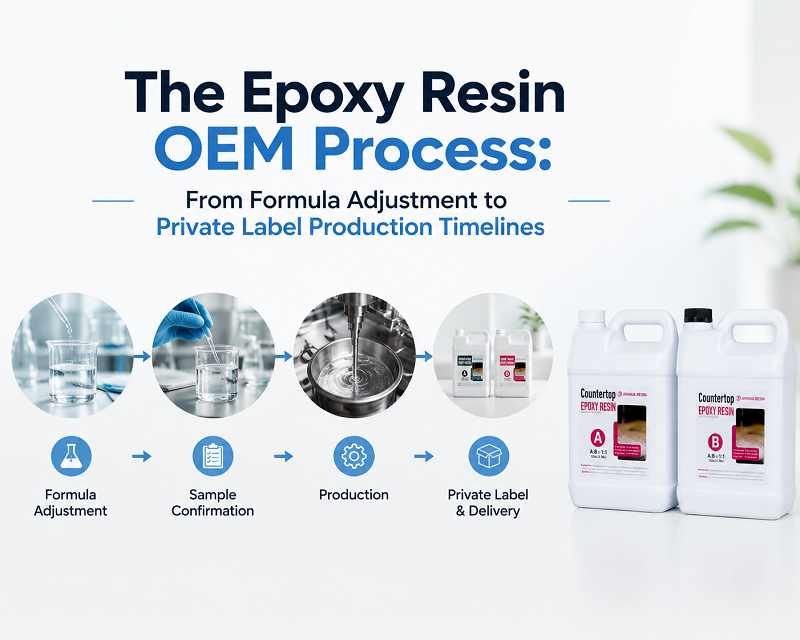
What “OEM” Actually Means for Epoxy Resin
Before getting into process, it’s worth clarifying terms, because they get conflated constantly.
Private label means taking an existing, proven formulation from a manufacturer and packaging it under your own brand name. The product inside the bottle is the same one the manufacturer already produces — you’re buying their formulation, their quality control, and their production capacity, with your label on the outside.
OEM (Original Equipment Manufacturer) production, in the epoxy context, more often refers to custom formulation work — adjusting an existing base formula to meet specific performance requirements, packaging specifications, or market positioning that the manufacturer’s standard product doesn’t address.
ODM (Original Design Manufacturer) sits further along the spectrum — the manufacturer develops a formulation largely from scratch based on your performance brief, rather than modifying an existing product.
Most buyers entering this process actually want something between private label and OEM: a manufacturer’s proven base formula, with adjustments to viscosity, cure time, color, or packaging that differentiate it for their market. Understanding which of these you’re actually asking for shapes the timeline, cost, and minimum order quantities you’ll be working with — and being clear about it from the first conversation avoids a lot of back-and-forth later.
Step 1: Defining What You Actually Need
The OEM process starts before any formulation work — it starts with a clear brief. This step gets rushed more often than any other, and rushing it is the single biggest cause of delays later in the process.
A useful brief for an epoxy resin manufacturer covers:
Product category and application: Table top epoxy, deep pour epoxy, art resin, UV resin — each category has different base chemistries, and “epoxy resin” alone isn’t specific enough for a manufacturer to scope the work.
Performance requirements: Pot life, cure time, viscosity range, UV resistance level, hardness, and any application-specific requirements (self-leveling for table tops, low exotherm for deep pours, fast cure for production-line UV resin).
Target market and compliance needs: If the product is headed to North America or Europe, REACH, Prop 65, RoHS, and TSCA requirements need to be on the table from day one — not discovered during the compliance review of a finished formulation.
Packaging specifications: Container size, kit ratios (1:1 vs 2:1 vs other), labeling requirements, and any branding elements that need to be incorporated into packaging design or supplied separately.
Volume expectations: Initial order volume and projected ongoing volume. This affects everything from which production line your order runs on to what MOQ thresholds apply.
Manufacturers who are serious about OEM work will ask for this information upfront — and a manufacturer who skips straight to pricing without asking these questions is either offering you an unmodified standard product, or hasn’t thought through what custom work actually requires.
Step 2: Formula Matching and Adjustment
Once the brief is clear, the manufacturer’s technical team maps it against their existing formulation library. This is where private label and OEM diverge in process.
For private label: If an existing formula meets your performance requirements as-is, the process moves quickly to sample approval and packaging discussions. No formulation work is needed — you’re adopting a proven product.
For OEM adjustments: The technical team identifies the closest existing formula and determines what needs to change. Common adjustments include:
- Viscosity modification (adding or reducing reactive diluents)
- Cure time adjustment (changing hardener ratios or hardener type)
- Color base adjustment (modifying APHA color values for clarity-critical applications)
- UV stabilizer package changes (adjusting HALS/UVA loading for different climate exposure)
- Pot life extension or reduction (for different application methods or climates)
Each adjustment has downstream effects on other properties — extending pot life often affects cure time; reducing viscosity can affect UV stability if it changes stabilizer concentration proportionally. A competent technical team models these tradeoffs before producing a test batch, rather than discovering them after.
For ODM work: Formulation starts closer to first principles, based on the performance brief rather than an existing product. This takes longer and typically involves multiple rounds of lab-scale formulation before reaching a sample worth testing at production scale.
Step 3: Sample Production and Testing
This is where the formulation moves from theoretical to physical. Lab-scale samples — typically 1–5 kg — are produced according to the adjusted formula and sent for evaluation.
What buyers should test at this stage:
Application testing: Mix and apply the sample under conditions matching your actual end-use — same temperature range, same substrate, same application method your customers will use. A sample that performs well in a controlled lab environment but hasn’t been tested under your real-world conditions is an incomplete evaluation.
Cure verification: Confirm pot life, tack-free time, and full cure time match the brief. These numbers matter for downstream production planning on your end.
Visual and optical properties: For table top epoxy or deep pour epoxy applications, clarity, color, and gloss need to be evaluated against your target specification — ideally compared side-by-side with a reference sample.
Compliance verification: If REACH, Prop 65, or other compliance requirements were part of the brief, this is the stage to request preliminary compliance data on the adjusted formulation — not after production scale-up.
Sample iteration typically takes one to three rounds. A single round is realistic for private label or minor adjustments. Two to three rounds is typical for OEM formulation work involving multiple property changes. ODM projects can require more, depending on how far the target specification sits from existing formulations.
Realistic timeline for this stage: 2–6 weeks, depending on the number of iteration rounds and whether compliance testing is run in parallel or sequentially.
Step 4: Scale-Up and Pilot Production Batch
Lab-scale samples don’t always behave identically at production scale. Mixing equipment, batch size, and production environment all introduce variables that a 1–5 kg lab sample doesn’t expose.
A pilot production batch — typically 100–500 kg depending on the manufacturer’s production line minimums — validates that the formulation performs consistently when produced at the scale your orders will actually require. This step matters most for:
Deep pour epoxy formulations, where exotherm behavior at lab scale (small sample mass, fast heat dissipation) doesn’t predict behavior at production pour depths.
Color-critical formulations, where pigment dispersion uniformity needs to be verified across a larger batch volume.
Viscosity-sensitive formulations, where production mixing equipment may introduce more or less shear than lab mixing, affecting final viscosity.
The pilot batch is also typically what gets used for full compliance testing — REACH, Prop 65, RoHS documentation should be generated from material that represents your actual production formulation, not the original lab sample.
Realistic timeline for this stage: 2–4 weeks, including production scheduling, the pilot run itself, and testing of pilot batch material.
Step 5: Packaging Development and Branding Integration
Packaging runs in parallel with formulation work where possible, but final packaging decisions typically wait until the formula is confirmed — container materials need to be chemically compatible with the final formulation, particularly for products with higher reactive diluent content or unusual viscosity profiles.
Container compatibility: Not all plastic containers are suitable for all epoxy formulations. Some reactive diluents can interact with certain plastics over extended storage. The manufacturer should confirm container compatibility based on your final formulation — this is a step that gets skipped by manufacturers without genuine OEM experience, and the consequences (container degradation during the product’s shelf life) surface months after shipment.
Kit configuration: Part A / Part B ratio determines container sizing — a 2:1 ratio requires different container volumes than 1:1. This needs to be finalized before container tooling or procurement.
Labeling: For private label and OEM products, label artwork needs to incorporate required regulatory information (hazard symbols, SDS reference, batch coding) alongside your branding. Manufacturers experienced in export markets will flag regulatory labeling requirements specific to your target market — EU CLP labeling requirements differ from US OSHA requirements, for example.
Realistic timeline for this stage: 3–6 weeks, often running concurrent with Steps 3–4. Custom container tooling (if required) can extend this significantly — generic containers with custom labels are faster than fully custom container molds.
Step 6: First Production Run and Quality Verification
The first full production run at commercial volume is the point where everything gets verified together: formulation, packaging, labeling, and compliance documentation as a complete product.
Buyers should expect:
Certificate of Analysis (CoA) for the production batch, documenting key quality parameters against the agreed specification.
Retained samples from the production batch — both for your own reference and for any compliance documentation that references specific batch numbers.
Batch documentation that establishes the baseline for future reorders — this is what your manufacturer will reference when producing subsequent batches to maintain consistency.
This is also the stage where any final adjustments get made before the formulation is “locked” for ongoing production. Minor tweaks at this stage are normal; major formulation changes at this stage suggest the brief or sample testing stages weren’t thorough enough.
Realistic timeline for this stage: 3–5 weeks for production, depending on order volume and the manufacturer’s production schedule.
Step 7: Establishing the Reorder Process
Once the formulation is locked and the first production run is complete, ongoing reorders should be significantly faster than the initial development process — this is one of the main commercial benefits of going through OEM development in the first place.
A well-structured reorder process includes:
Standing formulation reference: Your manufacturer maintains the locked formulation as a reference for all future batches, eliminating the need to re-specify requirements with each order.
Reorder lead times: For an epoxy resin manufacturer with established production capacity, reorder lead times for an already-developed OEM product are typically 3–6 weeks from order confirmation to shipment — substantially faster than the 3–6 month total timeline for initial development.
Batch-to-batch consistency tracking: Request that CoA documentation continues for reorder batches, allowing you to track consistency over time and catch any drift before it affects your end customers.
Volume flexibility: Discuss MOQ for reorders versus initial development runs — these are often different, with reorder MOQs sometimes lower once the formulation and production setup are established.
Realistic Total Timeline
Putting the stages together, a realistic timeline for a private label or moderate OEM adjustment project:
- Brief and formula matching: 1–2 weeks
- Sample development and testing: 2–6 weeks
- Pilot production and compliance testing: 2–4 weeks
- Packaging development: 3–6 weeks (often parallel)
- First production run: 3–5 weeks
Total: Roughly 3–4 months from initial brief to first shipment for private label or moderate OEM adjustments. More extensive ODM projects — formulations developed substantially from scratch — typically run 4–6 months given additional formulation iteration rounds.
These timelines assume the buyer provides a clear brief at the outset and responds to sample evaluation requests promptly. The most common cause of timeline extension isn’t manufacturing — it’s buyers taking weeks to evaluate samples or finalize packaging decisions partway through the process.
What Separates a Capable OEM Partner from a Reseller
A manufacturer offering genuine OEM capability — versus simply relabeling a standard product — typically demonstrates this through:
Technical questions early in the conversation: Asking about your application conditions, target market, and performance priorities before discussing pricing signals a manufacturer thinking about formulation, not just packaging.
Transparency about formulation tradeoffs: A manufacturer who explains how adjusting one property affects others is showing genuine formulation expertise, not just running your request through a generic process.
Compliance integration from the start: An epoxy resin manufacturer with real export experience raises REACH, Prop 65, and other compliance requirements during the briefing stage — not as an afterthought once a formulation is finalized.
Realistic timelines: Manufacturers promising private-label turnaround in days, or OEM formulation work in under a month, are either overpromising or not doing the work the timeline implies.
Final Thoughts
OEM and private label epoxy production is one of the most accessible ways for a brand to differentiate its product line without building manufacturing capability from scratch — but the process has real steps, real timelines, and real technical work behind it. Buyers who go in with a clear brief, realistic timeline expectations, and an understanding of what each stage actually involves get better outcomes — and better long-term manufacturer relationships — than those treating OEM as a quick relabeling exercise.
At Jinhua Resin, we support both private label and custom OEM formulation work across our table top epoxy, deep pour epoxy, and UV resin product lines, with export compliance documentation for North American and European markets built into the development process. Contact us to discuss your brief and realistic timelines for your specific requirements.
Jinhua Resin | Professional Epoxy Resin Manufacturer | OEM & Private Label Development | Table Top Epoxy & Deep Pour Epoxy | Export-Ready