


When formulating industrial coatings, composites, or heavy-duty adhesives, your choice of polymer base dictates the lifespan of the entire project. In the high-performance thermosetting market, two options come up constantly: DGEBA and DGEBF.
At first glance, their technical data sheets look almost identical. However, treating them as interchangeable is a mistake that often leads to brittle coatings, premature product failure, or inflated production costs. To avoid these issues, smart procurement managers work closely with an established epoxy resin manufacturer to match the exact chemical grade to their specific operational environment.
This guide moves past the basic data sheets to compare the core chemistry, viscosity, chemical resistance, and actual field performance of Bisphenol-A and Bisphenol-F epoxy resins.
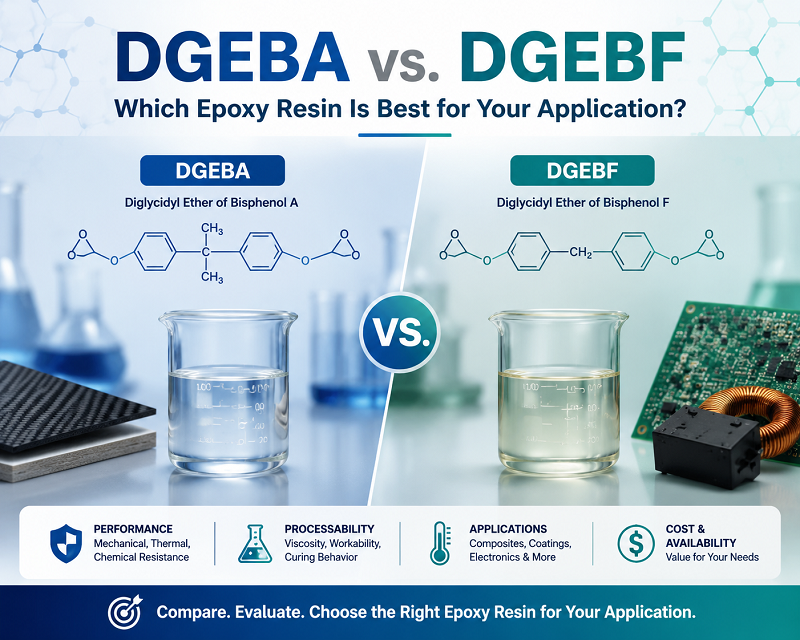
1. The Core Chemistry: Breaking Down BPA vs. BPF
To predict how these resins perform under stress, we have to look at their molecular structures. This structural framework is exactly what an epoxy resin manufacturer alters to tune a product’s final properties.
What is DGEBA?
DGEBA (Diglycidyl Ether of Bisphenol-A) is the traditional industry standard. Produced by reacting Bisphenol-A (BPA) with epichlorohydrin, its molecule contains a rigid central carbon link alongside two bulky benzene rings. This stiff molecular backbone gives the cured material its excellent physical strength, thermal stability, and reliable electrical insulation.
What is DGEBF?
DGEBF (Diglycidyl Ether of Bisphenol-F) swaps out the Bisphenol-A for Bisphenol-F (BPF). By removing the central methyl groups found in BPA, it reduces internal crowding within the molecular chain. The resulting DGEBF molecule is leaner and more flexible before curing. This structural shift lowers the liquid viscosity and alters the final cross-link density, which is why it is highly sought after from any specialized industrial epoxy resin supplier.
2. Viscosity and Processing Behaviors on the Line
Viscosity directly affects your production efficiency, determining everything from pump wear to how fast the resin wets out fiber reinforcements.
| Property | DGEBA (Bisphenol-A) | DGEBF (Bisphenol-F) |
| Typical Viscosity (at 25°C) | 11,000 – 15,000 mPa·s | 2,000 – 4,000 mPa·s |
| Risk of Crystallization | High | Low to Moderate |
| Need for Diluents | Often requires reactive diluents | Frequently used solvent-free |
| Fiber Wet-Out Speed | Moderate to Slow | Rapid and thorough |
The Practical Value of Low-Viscosity DGEBF
At room temperature, pure DGEBA feels like thick molasses. Moving or mixing it without applying heat or adding solvents is a constant headache for plant operators.
DGEBF changes that. Its viscosity is roughly one-quarter of standard DGEBA. This thin consistency gives B2B formulators a few major practical perks:
- Higher Filler Loading: You can pack more functional fillers—like silica, alumina, or flame retardants—into the mix before it becomes too thick to pump.
- Fewer Solvents Needed: It allows an epoxy resin manufacturer to build cleaner, zero-VOC formulations without relying on volatile organic solvents or reactive diluents that can compromise structural integrity.
- Faster Wet-Out: In resin infusion setups (like RTM or VARTM) for carbon fiber, DGEBF flows easily through tight fabric layers, stopping dry spots before they happen.
Handling the Crystallization Headache
Cold warehouses kill DGEBA efficiency. The resin tends to crystallize into a milky, semi-solid paste that requires hours under heating blankets to liquefy. DGEBF uses an isomeric mixture profile that resists this crystallization process, giving it a much more forgiving shelf life in cold storage—a benefit any reliable epoxy resin factory will verify.
3. Cured Performance: Chemical Limits and Structural Toughness
When you blend the resin with an amine or acid anhydride hardener, DGEBF’s compact molecular shape yields a tighter cured matrix than DGEBA can manage.
Chemical and Solvent Resistance
Because DGEBF molecules are smaller, they pack tightly during polymerization. This creates a dense atomic grid that acts as a shield against chemical attacks. If you source your materials from a qualified epoxy resin manufacturer, they will typically recommend DGEBF systems for handling:
- Aggressive organic solvents like acetone, toluene, and MEK.
- Concentrated mineral acids (sulfuric, hydrochloric).
- Corrosive industrial wastewater and crude oil sludges.
DGEBA handles basic environments well, but it swells, softens, and degrades much faster than DGEBF when soaked in harsh chemical baths over long periods.
Mechanical Strength and Heat Deflection
- Strength vs. Stiffness: Both bases are tough. However, the rigid BPA backbone means DGEBA often retains slightly higher stiffness and modulus in low-stress environments.
- Impact and Toughness: DGEBF yields a slightly more compliant, less brittle network, making it better at absorbing cyclic vibrations without cracking.
- Glass Transition Temperature ($T_g$): Cured under identical lab conditions, DGEBA usually reaches a slightly higher $T_g$ due to its rigid aromatic center. If your project demands maximum resistance to dry heat, a custom DGEBA blend from your epoxy resin manufacturer is usually the right choice.
4. Downstream Industrial Applications: Matching Grades to Projects
These distinct performance profiles have split the industrial market into clear application camps, shaping how an epoxy resin factory runs its production schedules.
Where DGEBA Works Best
- Civil Engineering & Everyday Adhesives: Standard concrete repair, commercial garage floor sealants, and consumer glues use DGEBA because it keeps raw material costs down.
- Industrial Powder Coatings: Solid-grade DGEBA is the go-to base for electrostatic powder coatings used on appliances, car parts, and pipeline rebar.
- Basic Electrical Encapsulation: For potting electronics that stay dry and operate at steady temperatures, DGEBA gives you great insulation without the premium price tag.
Where DGEBF is Mandatory
- Marine Coatings and Tank Linings: Sump pumps, chemical storage tanks, fuel lines, and ocean-going ships use DGEBF to survive continuous exposure to salt spray and corrosive chemicals.
- Heavy-Duty Flooring: Food processing plants (which endure harsh hot-water and acid cleanings) and battery rooms require rugged, self-leveling DGEBF floors from a specialized epoxy resin manufacturer.
- Aerospace and Wind Composites: Filament-wound hydrogen tanks and high-load structural components rely on DGEBF to achieve low-void fiber wet-out and long-term fatigue resistance.
5. Hybrid Formulation: Getting a Custom Blend
You don’t always have to pick just one. To hit specific performance and cost targets, an experienced epoxy resin manufacturer will frequently build DGEBA/DGEBF hybrid systems.
Adding a measured percentage of Bisphenol-F into a Bisphenol-A base gives you a highly optimized material:
- It drops the overall viscosity without using cheap diluents that ruin physical properties.
- It stops the liquid resin from turning to crystals in cold weather.
- It keeps material costs reasonable while giving a distinct boost to chemical resistance and structural flex.
Summary: Choosing the Right Supplier and Grade
The choice between DGEBA and DGEBF comes down to analyzing your operating environment against your budget limits.
- Stick with DGEBA if: Your project involves standard indoor conditions, general structural bonding, basic electrical potting, or applications where keeping raw material costs low is your primary goal.
- Upgrade to DGEBF if: You need a low-viscosity liquid for deep resin infusion, high filler loading capacity, defense against strong acids and solvents, or long-term durability in punishing marine environments.
Understanding these underlying structural differences helps you protect your production line from unexpected field failures. For the best results, consult a vetted B2B epoxy resin manufacturer who can provide complete technical data sheets (TDS) and customize a blend tailored specifically to your machinery and industry compliance rules.