


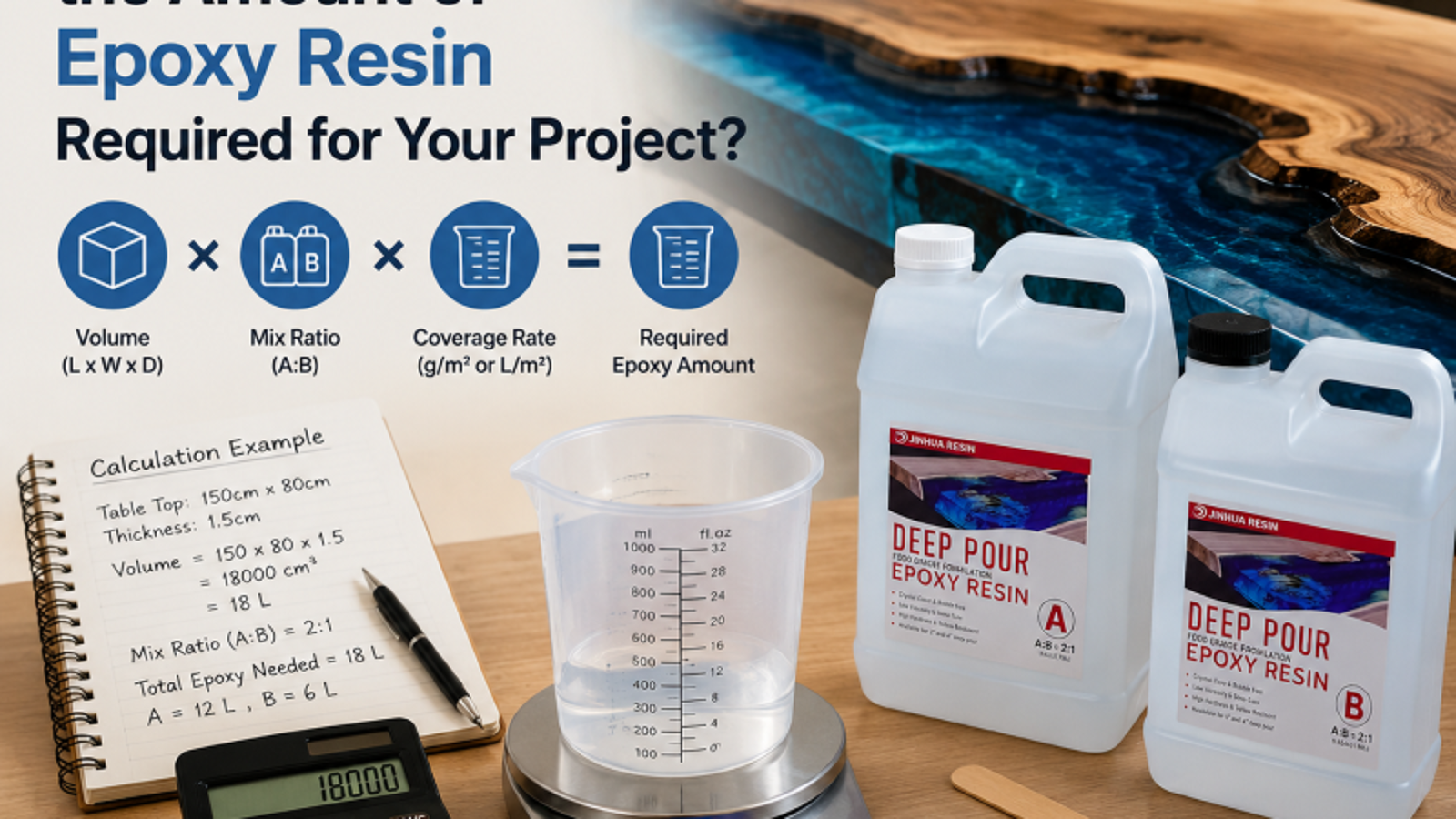
One of the most common pitfalls for both beginners and experienced crafters embarking on a new project is misjudging the volume of materials needed. Mix too little epoxy resin, and you are forced to rush a second batch mid-pour, risking distinct lines, structural weaknesses, and uneven curing. Mix too much, and you end up wasting premium-grade chemical liquid that hardens uselessly in your mixing container.
Accurately calculating the exact volume of epoxy resin required before you crack open your bottles ensures a flawless finish, seamless layering, and budget-friendly project management.
Whether you are preparing to seal a wooden kitchen countertop, coat a canvas, or pour a massive deep-pour river table, this comprehensive guide breaks down the precise mathematical formulas and physical variables you need to know.
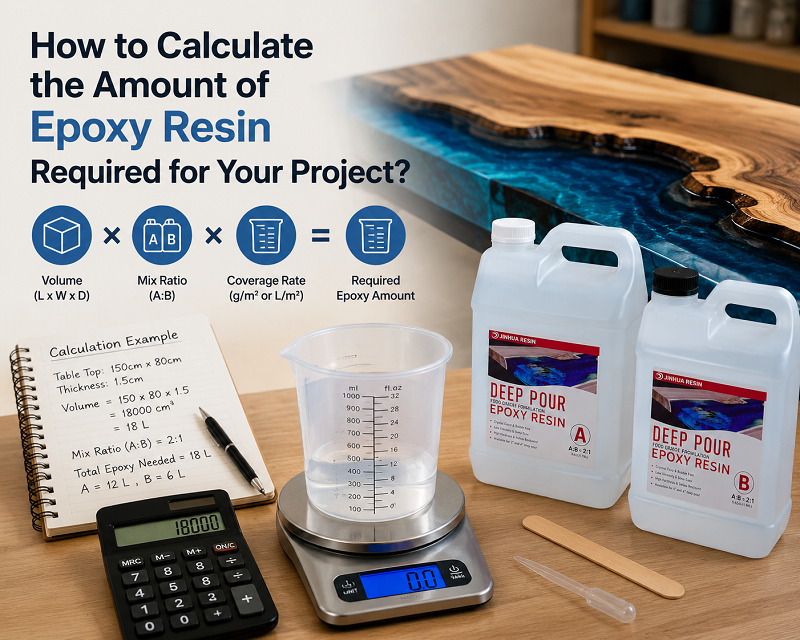
The Core Variables: Understanding Three-Dimensional Volume
To find out how much epoxy resin liquid will fill a specific space, we must treat the project area as a three-dimensional geometric shape. Regardless of the shape, you will always need to measure three essential metrics:
- Length
- Width
- Depth (or Thickness)
Crucial Tip for Accuracy: Always use the same unit of measurement for every dimension before performing your calculations. If you measure your table length in meters but its depth in millimeters, your final calculation will be completely distorted. For precision, converting everything into centimeters ($cm$) or inches ($in$) from the very start is highly recommended.
Standard Calculation Formulas for Different Project Shapes
Not every epoxy resin project is a perfect rectangle. Below are the standard geometric formulas tailored specifically for casting and coating projects.
1. Cuboid and Rectangular Projects (Tables, Trays, Countertops)
For classic rectangular projects like river tables, chopping boards, or surface coatings, you are dealing with a standard rectangular prism volume.
Volume = Length \times Width \times Depth
- Metric System Formula (cm):Volume~(cm^3) = Length~(cm) \times Width~(cm) \times Depth~(cm)
- Imperial System Formula (in):$$Volume~(in^3) = Length~(in) \times Width~(in) \times Depth~(in)
2. Circular and Round Projects (Coasters, Round Tables, Clock Faces)
When pouring epoxy resin into circular silicone molds or onto round table surfaces, the formula shifts to account for the radius (r) of the circle and the mathematical constant Pi ($\pi \approx 3.1416$).
Volume = \pi \times r^2 \times Depth
- Metric System Formula (cm):Volume~(cm^3) = 3.1416 \times [Radius~(cm)]^2 \times Depth~(cm)(Note: Radius is exactly half of the total diameter of your circle).
Converting Volume into Weight (The Density Factor)
Calculating the physical space or volume ($cm^3$ or $in^3$) is only the first part of the puzzle. Liquid epoxy resin kits are heavily manufactured and sold by weight (grams or kilograms) or fluid volume (ounces or liters).
Because epoxy resin compounds possess a higher density than plain water, 1 milliliter of mixed polymer does not weigh exactly 1 gram. On average, the specific gravity (density) of standard clear casting polymer sits around 1.1~g/cm^3$ to $1.15~g/cm^3.
To convert your calculated volume into the precise weight you need to measure out on your digital scale, use these simple conversion factors:
The Metric Conversion Pathway
If you measured your dimensions in centimeters, your volume is expressed in cubic centimeters ($cm^3$), which directly translates to milliliters ($ml$).
- Weight~in~Grams~(g) = Volume~(cm^3) \times 1.1
- Weight~in~Kilograms~(kg) = Grams \div 1000
The Imperial Conversion Pathway
If your measurements were recorded in inches, your volume is calculated in cubic inches ($in^3$).
- Fluid~Ounces~(fl~oz) = Volume~(in^3) \times 0.554
- Weight~in~Ounces~(oz) = Volume~(in^3) \times 0.61
Step-by-Step Practical Calculation Examples
Let’s look at two realistic scenarios to see how these math formulas work in a real-world workshop setting.
Example A: A Medium-Sized Rectangular River Table
Imagine you are crafting a wooden river table where the central void requiring an epoxy resin pour measures 120 cm long, 20 cm wide, and has a thickness of 4 cm.
- Calculate the Cubic Volume:120~cm \times 20~cm \times 4~cm = 9,600~cm^3~(ml)
- Convert Volume into Total Target Weight:9,600 \times 1.1 = 10,560~grams
- Final Requirement: You will need approximately 10.56 kg of total mixed material (Part A + Part B combined) to execute this specific pour successfully.
Example B: A Round Ocean-Theme Coaster
Suppose you are pouring a series of circular coasters using a silicone mold with a diameter of 10 cm and a desired pour depth of 0.8 cm.
- Determine the Radius:Radius = 10~cm \div 2 = 5~cm
- Calculate Circular Volume:3.1416 \times (5 \times 5) \times 0.8 = 3.1416 \times 25 \times 0.8 = 62.83~cm^3~(ml)
- Convert to Weight:62.83 \times 1.1 = 69.11~grams
- Final Requirement: Each coaster will consume roughly 69 grams of mixed fluid.
Crucial Field Adjustments: Account for the Wasted Space
While pure mathematics yields perfect answers on paper, practical material handling involves several real-world variables that can throw off your calculations if ignored.
1. The 10% Waste Buffer (Safety Margin)
No matter how carefully you pour, material loss is inevitable. A small amount of mixed epoxy resin will always remain stuck to the sides and bottom of your mixing buckets. Furthermore, if you are working on a coating project, material will drip over the edges during the leveling process.
The Professional Rule of Thumb: Always multiply your final calculated weight or volume by 1.1 (adding a 10% safety margin). It is infinitely better to have a tiny cup of leftover material than to look at a half-filled mold with a clock ticking on your chemical pot life.
2. Factoring in Irregular Objects (Wood, Stones, Embeds)
If your casting project involves submerging large solid objects—such as live-edge wood slabs in a river table or stones in a deep art piece—those objects displace liquid.
- For tight, highly irregular spaces, break the area down into smaller imaginary rectangles, calculate each zone individually, and add them together.
- If wood edges are wildly uneven, measure the maximum width and minimum width of the gap, find the average width, and plug that average value into your primary equation.
Summary Cheat Sheet for Workshop Reference
Keep this quick reference guide pinned inside your workspace to eliminate guesswork next time you prepare to mix your liquids:
| Project Shape | Base Mathematical Formula | Conversion to Total Metric Weight |
| Rectangle / Square | Length \times Width \times Depth | Volume~(cm^3) \times 1.1 = Grams~(g) |
| Circle / Cylinder | 3.1416 \times Radius^2 \times Depth | Volume~(cm^3) \times 1.1 = Grams~(g) |
By taking five minutes to measure your dimensions accurately and running them through these basic conversion formulas, you protect your projects from curing defects, minimize expensive material waste, and achieve professional, highly predictable results with your epoxy resin systems every single time.