


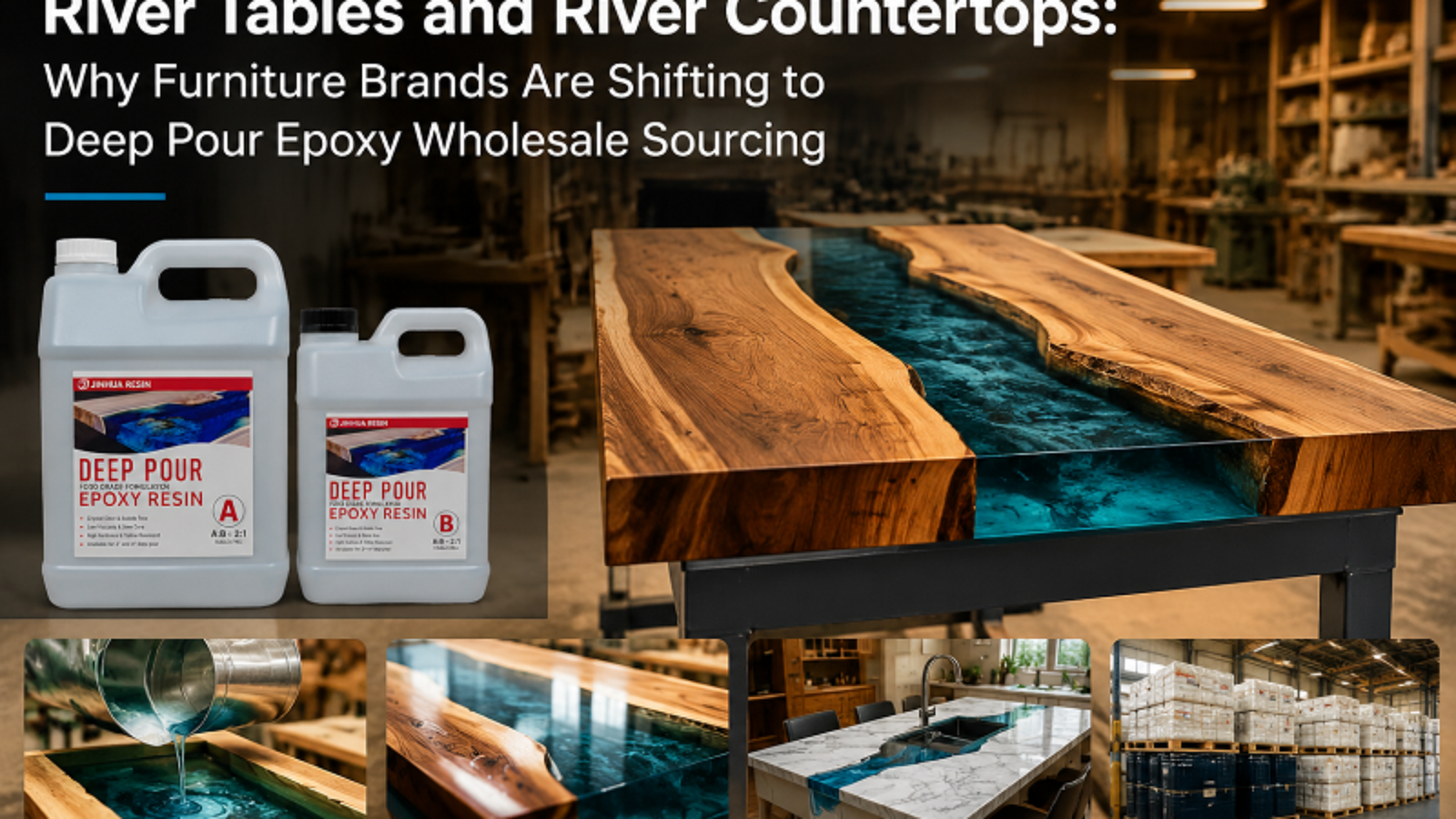
A Product Category That Outgrew Its DIY Origins
River tables started as a niche project in the custom woodworking community — live-edge slabs, deep-fill epoxy channels, conference tables that commanded five-figure prices from architects and interior designers. That was ten years ago. Today, river tables appear in furniture retail chains, hospitality fit-outs, residential kitchen renovations, and mass-market home goods catalogues. The aesthetic went mainstream. The supply chain didn’t keep up.
Most of the deep pour epoxy resin reaching North American and Australian furniture makers still moves through the same fragmented channels it did when river tables were a hobbyist pursuit: craft supply distributors, small-batch resin brands, direct import by individual studios. For B2B buyers — furniture brands, wholesale distributors, contract manufacturers — the opportunity is in professionalization: bringing supply chain discipline, consistent formulation quality, and volume pricing to a segment that has mostly operated without it.
This article maps the B2B demand structure for deep pour epoxy in the furniture market, explains why formulation requirements for professional furniture applications differ from hobbyist products, and identifies what wholesale buyers should look for when qualifying a Chinese epoxy resin manufacturer for this segment.
The Market Structure: Who’s Actually Buying Deep Pour Epoxy
Understanding the demand structure matters for anyone building a wholesale or distribution business in this space. Deep pour epoxy buyers in the furniture sector aren’t a monolithic customer base — they have different volume requirements, different formulation needs, and different purchasing behaviors.
Custom Furniture Studios
Single-operator or small-team workshops producing bespoke river tables, live-edge dining tables, and custom bar tops. Volume per order: 5–50 liters. Purchasing frequency: irregular, project-driven. Price sensitivity: moderate — they’re selling finished pieces at significant markup and can absorb a premium for product they trust. What they care about most: optical clarity, color stability (their finished pieces need to look the same in five years as they do on delivery), and reliable technical support when something goes wrong.
This is the buyer who reads every line of a TDS and calls the supplier when the pour behaves differently from last time. For distributors, they’re high-touch but high-loyalty. Get the product right and they don’t switch.
Mid-Scale Production Furniture Brands
Companies producing river table collections for retail — furniture stores, online platforms, hospitality procurement channels. Volume per order: 100–500 liters. Purchasing frequency: monthly or quarterly. Price sensitivity: higher — they’re competing on price at the retail level and need consistent material cost. What they care about most: batch-to-batch consistency (finish quality needs to be identical across a production run of 50 tables), pour depth predictability, and documentation that supports their quality system.
This is the buyer who needs a Certificate of Analysis with every shipment and will run incoming inspection on resin properties. Supply disruption is a production line problem, not an inconvenience.
Contract Manufacturers and Hospitality Fit-Out Specialists
Companies pouring large-format epoxy elements — bar tops, reception counters, feature walls — for commercial clients. Volume per order: 200–2,000 liters. Purchasing frequency: project-based with occasional blanket orders. What they care about most: maximum pour depth per layer (commercial projects often require sections that exceed consumer product specifications), open time in large-volume pours, color match stability across multiple orders placed months apart.
This segment is the most technically demanding. The pour depth requirements push against the thermal management limits of most commercial deep pour products. Color consistency across orders requires a supplier with documented raw material stability, not just batch-to-batch QC.
Retail Resin Brands (Private Label)
Brands that source epoxy resin from China and sell under their own label — consumer packaging, branded documentation, positioned against retail competitors. Volume per order: 200–1,000 liters across multiple SKUs. What they care about: OEM capability, private label packaging, documentation that matches their brand’s quality positioning, and a supplier relationship that can scale with their growth.
This buyer is not buying a commodity. They’re buying a supply chain partnership. The epoxy resin manufacturer’s OEM capability — custom labeling, bilingual documentation, packaging format flexibility — is as important as the product specification.
Why Professional Furniture Applications Demand More Than Hobbyist Formulations
The deep pour epoxy products marketed to hobbyists and the formulations required for professional furniture production are not the same thing. The differences matter for B2B buyers who are supplying professional fabricators.
Pour Depth: The Commercial Reality
Consumer deep pour products are typically specified to a maximum single-layer depth of 50–75mm (2–3 inches). That covers most hobbyist applications. Commercial furniture production regularly requires deeper single pours — 100mm channels in wide river tables, 150mm decorative elements in hospitality installations, thick casting blocks for sculptural furniture components.
At these depths, the thermal management requirements are significantly more demanding. A product specified to 75mm maximum depth doesn’t just “work less well” at 100mm — it risks thermal runaway: exothermic overheating that causes cracking, yellowing, volatile release, and in severe cases, mold damage or fire. Professional fabricators working at commercial scale need products with documented pour depth limits above the 75mm consumer product ceiling, with supporting temperature rise data rather than marketing claims.
Color Consistency Across Production Runs
A custom furniture studio producing one table can manage minor color variation between the epoxy pours on that piece. A production furniture brand manufacturing 50 river tables for a retail order cannot — every table needs to be visually identical. A hospitality specifier ordering additional units of a feature counter six months after the initial installation cannot have a visible color shift between the original and the replacement.
Color consistency across production runs requires a supplier with documented raw material sourcing stability, batch-to-batch colorimetric testing, and a change control process that prevents undocumented formula adjustments. None of this is guaranteed by ISO 9001 alone — it has to be specifically verified.
Open Time in Large-Volume Pours
In commercial production environments, a single pour often involves mixing and placing significantly larger volumes than the 1–2 liter quantities typical of hobbyist application. Mixing 10 liters of deep pour epoxy generates more total exothermic heat than mixing 1 liter — even in a deep pour formulation. The effective pot life decreases as mixed volume increases, because the larger mass generates and retains more heat.
Professional buyers need pot life data across a range of mixed masses, not just the standard 100g or 150g laboratory test condition. A product with 60 minutes pot life at 150g may have 35 minutes effective pot life at 5,000g — a difference that matters significantly when managing a large commercial pour.
Ambient Temperature Performance Range
Consumer product documentation typically specifies performance at 20–25°C. Professional furniture production happens in workshops across diverse climate zones: a furniture factory in Queensland operates at ambient temperatures that routinely exceed 30°C in summer; a contract manufacturer in Minnesota works through winters where the shop floor drops below 15°C. Both conditions materially affect pot life, working time, and maximum pour depth.
Professional buyers sourcing deep pour epoxy for resale into diverse geographic markets need temperature-range data, not a single-condition specification.
The Wholesale Sourcing Equation: What Changes at Volume
Moving from sample purchases to wholesale supply relationships in the deep pour epoxy category changes the relevant evaluation criteria significantly.
Formulation Stability at Volume
At sample and small-order quantities, formulation variation between batches is masked by the fact that each order is typically used in a single pour session. At wholesale volumes — where a single shipment might supply a furniture brand for 8–12 weeks of production — batch-to-batch variation in viscosity, cure speed, or color accumulates and becomes visible in finished product output.
The QC regime required for wholesale supply is meaningfully more rigorous than for sample orders. Per-batch Certificate of Analysis is table stakes. What distinguishes serious wholesale suppliers from product sellers is the depth of that CoA: actual measured values (not pass/fail notation), colorimetric data (Gardner color or APHA), and viscosity data for both components at multiple temperatures.
Private Label Packaging for the Furniture Market
The furniture market has specific packaging conventions that differ from general-purpose resin applications. River table fabricators typically work in 1:1 or 2:1 ratio systems with component volumes matched for mixing convenience — a 15-liter Part A paired with a 7.5-liter Part B, for example, rather than arbitrary drum quantities that require customers to measure out matching weights.
Wholesale buyers supplying professional fabricators need a Chinese epoxy resin manufacturer capable of filling to matched-component specifications, not just bulk drums. Custom labels, application guides, and bilingual documentation (for markets like Canada with French-language requirements, or Australia with GHS-specific SDS format) are the basic OEM requirements for this channel.
Supply Consistency and Forward Planning
Professional furniture production can’t be managed around resin supply uncertainty. A furniture brand on a 6-week production cycle for a retail order needs to know that the epoxy supply will be available on schedule, with consistent specifications, for the duration of the order. Supply gaps, specification changes, or documentation delays at the manufacturer level translate directly into production delays and contract penalties at the furniture brand level.
Wholesale buyers should establish supply agreements that include volume commitments, lead time guarantees, advance notification of raw material changes, and defined remedies for supply failures. These provisions exist in mature industrial supply relationships — they’re not standard in the casual supplier-buyer conversations that characterize much of the deep pour epoxy market today.
Qualifying a Chinese Deep Pour Epoxy Manufacturer for Furniture Applications
The qualification criteria for a deep pour epoxy supplier serving professional furniture applications are more demanding than for general-purpose resin sourcing. These are the minimum requirements.
Pour depth documentation. Temperature rise curves at 50mm, 75mm, 100mm, and 150mm pour depths. Maximum recommended depth per layer at 20°C, 25°C, and 30°C ambient. This data should be available without special request — if it isn’t, the manufacturer doesn’t have it.
Color stability data. Initial Gardner color or APHA value. Yellowing index at full cure (ASTM E313). UV aging data — YI increase after defined accelerated UV exposure. Batch-to-batch color consistency data across at least 5 production batches.
Pot life at range of mixed masses. Standard 100g/150g laboratory data plus data at 1kg and 5kg mixed masses. Without this, wholesale buyers can’t accurately communicate pot life to professional fabricators working at commercial volume.
Raw material sourcing transparency. Named primary raw material suppliers, qualified supplier list, and raw material change notification policy. Color consistency across production runs is only achievable if raw material inputs are stable — and raw material stability requires documented supplier management.
OEM and packaging capability. Matched-component filling capability. Custom label production. Bilingual documentation capability. Minimum order quantities for OEM production that work for wholesale buyers at realistic launch volumes.
Export documentation. IMDG classification for both components, GHS-compliant SDS in destination-market format, UN-certified packaging, and Certificate of Analysis per shipment.
Jinhua Resin (jinhuaresin.com) is a Guangdong-based epoxy resin manufacturer producing deep pour epoxy formulations for professional furniture and commercial installation applications. Temperature rise data, color stability documentation, pot life across mixed masses, matched-component OEM packaging, and full export documentation are standard for wholesale buyers.
A Reference: Deep Pour Epoxy Specification Requirements by Buyer Segment
| Buyer Type | Volume/Order | Key Spec Requirements | OEM Need |
|---|---|---|---|
| Custom studio | 5–50L | Clarity, color stability, tech support | Low |
| Production furniture brand | 100–500L | Batch consistency, CoA, pour depth data | Medium |
| Contract manufacturer | 200–2,000L | Max pour depth >75mm, temp-range data, color match | Medium–High |
| Private label brand | 200–1,000L | Full OEM, custom packaging, bilingual docs | High |
The Professionalization Opportunity
The deep pour epoxy segment is in transition. Five years ago, most volume moved through craft channels to hobbyist buyers. Today, production furniture brands, hospitality contractors, and retail resin labels are buying at wholesale volumes and expecting industrial-grade supply chain support — consistent formulation, documented specifications, OEM capability, and reliable logistics.
The Chinese epoxy resin manufacturers who can serve this transition — who have the formulation depth to produce genuine deep pour products, the QC systems to deliver batch consistency at wholesale volume, and the OEM infrastructure to support private label brands — are a smaller subset than the field of suppliers who will claim to. For B2B buyers building businesses in this segment, the qualification work is the moat.
Sourcing deep pour epoxy wholesale for furniture production or private label? Jinhua Resin offers pour depth documentation, color stability data, matched-component OEM packaging, and wholesale supply programs for the professional furniture market: jinhuaresin.com