


“Can I just use the same epoxy for my floor and my countertop?” We get this question more often than you’d think — usually from a distributor trying to simplify their catalog, or a first-time buyer hoping to avoid stacking MOQs across two product lines.
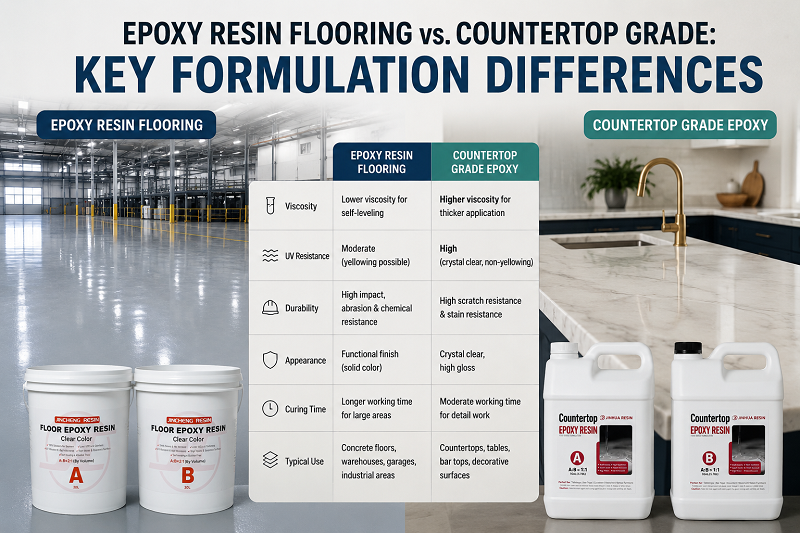
Short answer: no. Not if you want either surface to actually perform. Epoxy Resin Floor Coating and countertop epoxy start from different design briefs, and that shows up in nearly every property that matters — viscosity, hardness, UV stability, cure speed, even what gets mixed in. Below is where the two genuinely diverge, and why a manufacturer formulates them as separate product lines in the first place rather than one “universal” epoxy.
Different Jobs, Different Priorities
A countertop sits indoors, gets wiped down daily, and is expected to stay glass-clear for years. It needs to shrug off knife nicks, tolerate a hot pan set down without thinking, and hold its clarity under UV coming through a kitchen window.
A floor gets walked on, rolled over with carts, hit with spills and chemicals, and in industrial or garage settings, ground down by tire traffic and foot traffic all day. Clarity almost never matters here. What matters is impact resistance, chemical resistance, and slip resistance.
Those two very different jobs are the reason the resin systems split apart from the first stage of formulation — not a marketing distinction, a chemistry one.
Viscosity and Application Method
Countertop-grade resin is generally built to self-level: low enough viscosity to spread into a smooth, glass-like surface, but controlled enough that it doesn’t run off the edge of a mold before it starts to gel.
Flooring formulations vary more, because floors get applied differently depending on the job:
- Self-leveling floor epoxy sits at a viscosity close to countertop resin — used for seamless, high-gloss commercial and residential floors.
- Trowel-applied or broadcast systems run thicker, often loaded with aggregate (silica sand, quartz) to build texture and thickness for industrial or garage floors that need real mechanical toughness.
- Mortar and screed systems, the thickest tier, are almost paste-like — mixed with graded sand for warehouses and production floors expected to take heavy, repeated loads.
Pour a countertop-grade resin at trowel thickness on a floor, and it probably won’t self-level the way you’d want, may trap air it wasn’t designed to release, and won’t hold up to abrasion the way a floor needs. Do the reverse — flooring epoxy poured at countertop thickness on a tabletop — and you risk fast, uneven cure, more trapped bubbles, or a finish that never reaches the water-clear look buyers expect from Table Top Epoxy Resin.
UV Stability: The Biggest Chemistry Split
This is where the two categories part ways most sharply at the molecular level.
Countertop and table top epoxy resins almost always carry UV stabilizers, often built on non-yellowing chemistry — aliphatic hardener systems, or hybrid blends — because yellowing is one of the most visible, most complained-about defects in clear cast work. A countertop that starts yellowing six months after installation, sitting under a kitchen window, is a warranty claim in the making.
Epoxy Resin Floor Coating, especially base coats and industrial systems, typically runs on standard — often aromatic — resin chemistry, which yellows faster under UV. For flooring, that trade-off is usually fine. Most commercial and industrial floors either stay out of direct sun or get finished with a UV-stable polyurethane or polyaspartic topcoat specifically to handle sun exposure and add abrasion resistance. The epoxy base coat doesn’t need to be UV-stable on its own; the topcoat is doing that job.
Buyers who source flooring epoxy purely for yellowing resistance — without realizing a topcoat system is standard practice — sometimes end up paying for UV stability they don’t need, or worse, skipping the topcoat they actually do.
Hardness and Wear Resistance
Both categories cure hard. But “hard” means something different depending on what the surface has to survive.
Countertop epoxy targets scratch and mar resistance suited to kitchen use — knife nicks, a hot pan within stated limits, daily wiping with cleaning products.
Flooring epoxy, industrial-grade especially, is built for a different kind of durability: compressive strength and abrasion resistance under sustained mechanical load — forklifts, dropped tools, rolling equipment, years of impact rather than months. That usually calls for a higher cross-link density formulation, sometimes combined with aggregate fillers doing mechanical work the resin can’t do alone.
Shore D hardness numbers can look nearly identical between a countertop product and a flooring product on paper. But hardness alone says little about abrasion or impact resistance — the two properties that actually matter most for a floor.
Chemical and Stain Resistance
Both are epoxy systems, so both hold up reasonably well against chemicals compared with other coatings — but what they’re tested against differs.
Countertop epoxy is generally tested and marketed against household stains: wine, coffee, cooking oil, mild kitchen acids. Flooring epoxy, particularly industrial and commercial grades, is tested against a rougher list — motor oil, solvents, cleaning chemicals, sometimes battery acid or facility-specific chemicals. A formulation built for an auto shop floor is solving a different chemical-resistance problem than one built for a kitchen countertop, even though both get labeled “epoxy resin” on the box.
Additives: What Actually Goes Into Each System
This might be the clearest way to tell the two categories apart — just look at what’s in the mix.
Countertop and Table Top Epoxy Resin typically include:
- UV stabilizers and non-yellowing agents
- Defoamers, for a bubble-free clear finish
- Pigments or dyes for color work — or nothing at all, for water-clear casting
- Occasionally mica powders or metallic pigments for decorative pours
Epoxy Resin Floor Coating typically includes:
- Aggregate fillers — silica sand, quartz — for texture, slip resistance, and buildable thickness
- Color flake or chip blends for commercial and garage floor finishes
- Anti-slip additives for safety compliance in wet or industrial spaces
- Occasionally conductive or static-dissipative additives for specialized industrial floors, like electronics manufacturing
If you’re vetting a supplier’s private label capability, this is worth asking directly: does their formulation team actually work across both additive categories, or does production really specialize in one? Floor systems bring their own set of formulation and application questions that a countertop-focused supplier may not be set up to answer.
Cure Profile and Pot Life
Countertop resin is usually formulated with a longer working time, giving room for detailed pours, embedded objects, and multi-layer work without the material gelling mid-project. Full cure on a clear cast countertop can take several days to reach full hardness and chemical resistance, even if it’s touch-dry within 24 hours.
Flooring systems, especially in commercial settings where downtime costs money, are often formulated to get back into service faster — reopening to foot or vehicle traffic within 24 to 72 hours is common. That typically means a different hardener chemistry and a faster cross-link speed than a countertop system, which prioritizes working time over turnaround.
Cost and MOQ Considerations for Buyers
This is where the formulation gap turns into a purchasing decision.
Countertop-grade and UV-stable formulations generally cost more per kilogram than standard Epoxy Resin Floor Coating base coat, mostly due to the UV stabilizer package and the tighter quality control a clear, bubble-free finish demands. If you’re a distributor stocking both categories, don’t assume one blended MOQ or price tier covers your whole catalog — ask for separate technical data sheets and separate pricing per grade.
If your business sells into both flooring and furniture/countertop markets — common among private label distributors — it’s worth confirming early whether your manufacturer can reliably formulate and supply both grades, or whether they really specialize in one. A supplier strong in deep pour epoxy for tabletops isn’t automatically equipped for an industrial, aggregate-loaded flooring system. The reverse is just as true.
The Bottom Line
Epoxy Resin Floor Coating and Table Top Epoxy Resin share a resin chemistry family, but they’re engineered around different problems. Countertop formulations chase clarity, UV stability, and a self-leveling finish. Flooring formulations chase abrasion resistance, mechanical durability, and flexibility across trowel, broadcast, and self-leveling application methods.
Before placing an order — especially a private label or OEM order — confirm which grade you actually need, and get data specific to that grade from your manufacturer. The wrong grade in the wrong place doesn’t just underperform. It fails in ways that get expensive to fix after the fact.