

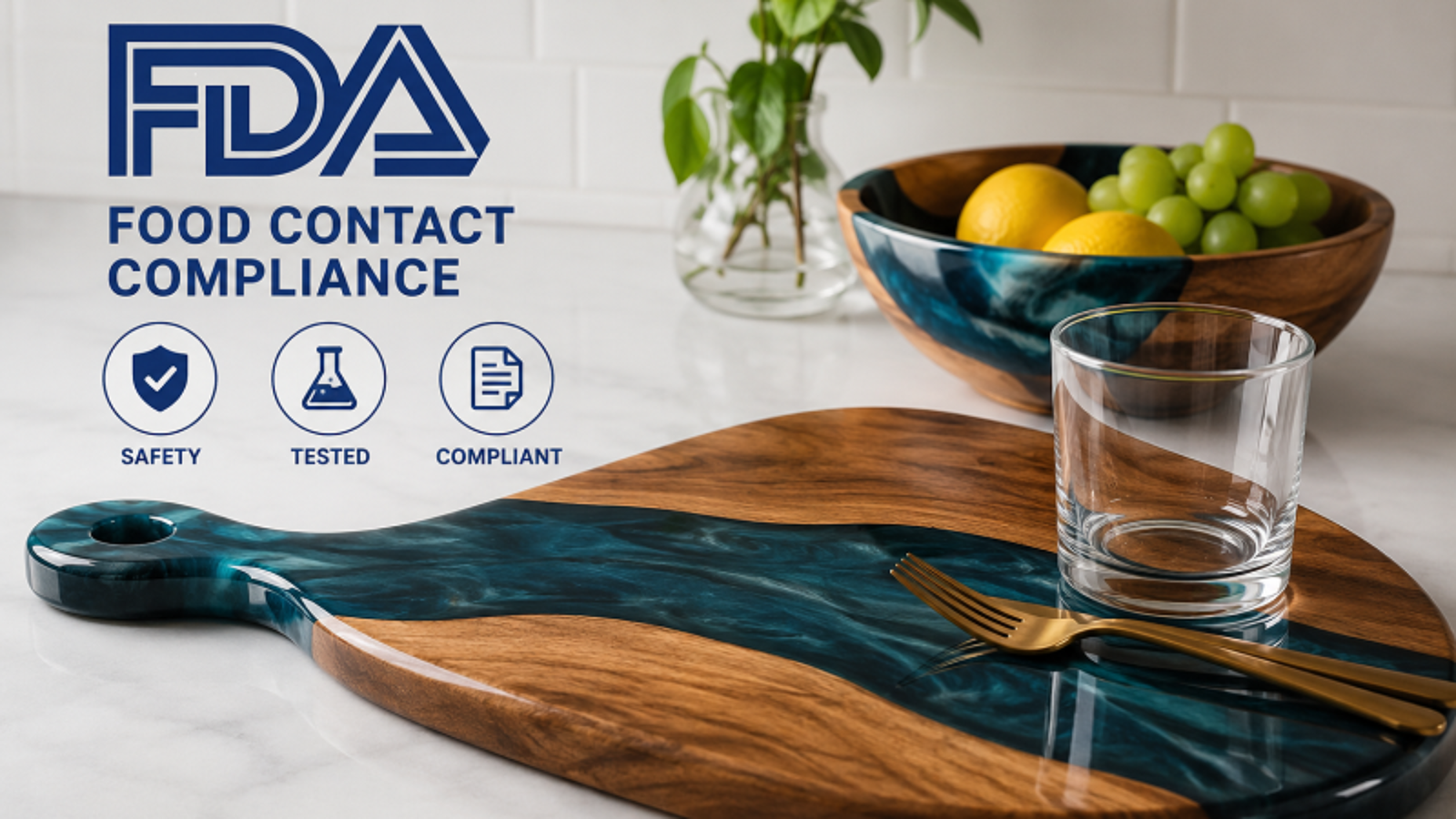
“Is this food safe?” is one of the most common questions buyers ask an epoxy resin manufacturer — and one of the most frequently misunderstood. The phrase “FDA compliant” gets tossed around loosely in marketing copy across the resin industry, often in ways that don’t match what FDA regulations actually require or cover. If you’re sourcing a food-safe epoxy resin for a dining table, cutting board, coaster, or any surface that might touch food, it’s worth understanding what FDA Food Contact Compliance actually means before you pass that claim on to your own customers.
The Regulation Buyers Are Usually Asking About
When people say “FDA approved for food contact,” they’re almost always referring to 21 CFR 175.300 — the FDA regulation covering resinous and polymeric coatings intended for food contact surfaces. This regulation sets requirements for coatings used as the food-contact surface of articles like containers, closures, and food-processing equipment.
One distinction buyers often miss: the FDA doesn’t “approve” or “certify” specific products or brands the way some marketing language implies. There’s no FDA seal, registration number, or certificate issued to a specific epoxy resin product. Instead, a manufacturer evaluates their formulation against the regulation’s requirements and testing standards, and — if it meets them — can state that the resin is formulated to comply with 21 CFR 175.300. That’s a meaningfully different claim than “FDA approved,” and the difference matters once you’re making compliance claims of your own.
What FDA Food Contact Compliance Actually Covers
The regulation specifies extraction testing limits — how much of the coating’s components are allowed to migrate into food simulants (substances that mimic different food types: water, alcohol, oil, acidic solutions) under specified test conditions. It also restricts which raw materials and additives can go into a compliant formulation.
Compliance here is about migration and composition — not about the resin being edible, not about it being safe to cut directly on with a knife indefinitely, and not about it covering every possible food-contact scenario. A resin can be compliant for occasional, indirect food contact (a charcuterie board’s edges, a coaster, a serving tray) without being intended for direct, repeated, high-abrasion contact like a cutting surface.
What This Compliance Does Not Cover
This is where a lot of buyer confusion — and a few questionable marketing claims — tend to come from.
It’s not a cutting-surface certification. Food-contact compliance addresses chemical migration, not mechanical durability. A resin surface can be fully compliant with 21 CFR 175.300 and still be a poor choice for a cutting board’s actual cutting surface, since repeated knife contact carves grooves that can harbor bacteria regardless of the resin’s chemical safety profile. Most manufacturers specifically recommend against resin as a direct cutting surface for this reason, even on formulations that are otherwise compliant.
It doesn’t automatically extend across every formulation a supplier makes. A supplier may have one specific formulation tested and compliant, while their other products — different color systems, different hardener pairings — aren’t automatically covered by the same status. Compliance is formulation-specific, not brand-wide. If a supplier tells you their resin is “FDA compliant” without naming the formulation and batch, that’s worth a follow-up question.
It doesn’t mean heat-resistant or dishwasher-safe. Food contact compliance says nothing about how the resin holds up under hot dishes, dishwasher cycles, or prolonged hot-liquid contact. Those are separate performance properties, tested entirely differently.
It’s not third-party verified by default. Some manufacturers self-certify based on their own testing and formulation review; others send migration testing to third-party labs. Ask which applies to your supplier — third-party verification carries more weight if your downstream customers or retail partners ever ask for documentation.
What Documentation to Actually Ask For
If you’re sourcing epoxy resin for food contact for any application where food contact is possible, ask for more than a verbal claim of FDA Food Contact Compliance:
A statement of compliance specific to the formulation and color you’re ordering — not a general company-wide claim, but the exact product code or batch you’re purchasing.
Test data or a summary of the migration testing performed, where available, particularly if you’re selling into a market or through a retail partner that might ask for backup documentation.
Clarity on intended use. Ask specifically whether the compliance claim covers your actual application — a tabletop with occasional food contact is a different use case than a cutting surface or a container meant for prolonged food storage.
Regional Differences Worth Knowing
FDA regulations apply to the US market specifically. Selling into the EU, UK, Canada, or Australia means food-contact compliance is governed by a different framework in each — EU Regulation 1935/2004 and related measures in Europe, for instance, run on a different testing and compliance structure than the FDA’s. A resin compliant under 21 CFR 175.300 isn’t automatically compliant under EU food-contact rules, and vice versa. Selling into multiple markets means confirming market by market — one compliance claim rarely covers all of them.
How to Talk About This With Your Own Customers
For buyers building a brand around resin furniture, coasters, or serving pieces, precision beats broad marketing language every time. Instead of a blanket “food safe” statement, something closer to “formulated with a food-safe epoxy resin that complies with FDA 21 CFR 175.300 for food-contact surfaces” holds up better — paired with specifics on intended use: occasional contact, not a cutting surface, not for prolonged food storage, heat limits where applicable.
That kind of specificity builds more buyer trust than a vague “FDA approved” claim, and it protects you from the liability that comes with overstating what your product’s compliance actually covers.
Questions Worth Asking Your Manufacturer
- Is this specific formulation and color tested and compliant with 21 CFR 175.300, or is that a general claim across your product line?
- Is the compliance based on your own testing, or third-party verified?
- What intended food-contact use does this compliance cover — occasional contact, direct contact, prolonged contact?
- Do you have documentation I can share with my own retail partners or customers if asked?
- If I’m selling into the EU, UK, or another market, does this same compliance carry over, or do I need separate documentation?
The Bottom Line
FDA Food Contact Compliance is a real, meaningful claim — but only when it’s specific to the exact formulation, tested against the right regulation, and scoped accurately to the intended use. It’s not a blanket safety certification, and it doesn’t replace common-sense cautions like avoiding resin as a direct cutting surface. Get documentation specific to what you’re actually buying from your epoxy resin manufacturer, and stay precise about intended use when you pass that claim along to your own customers.