


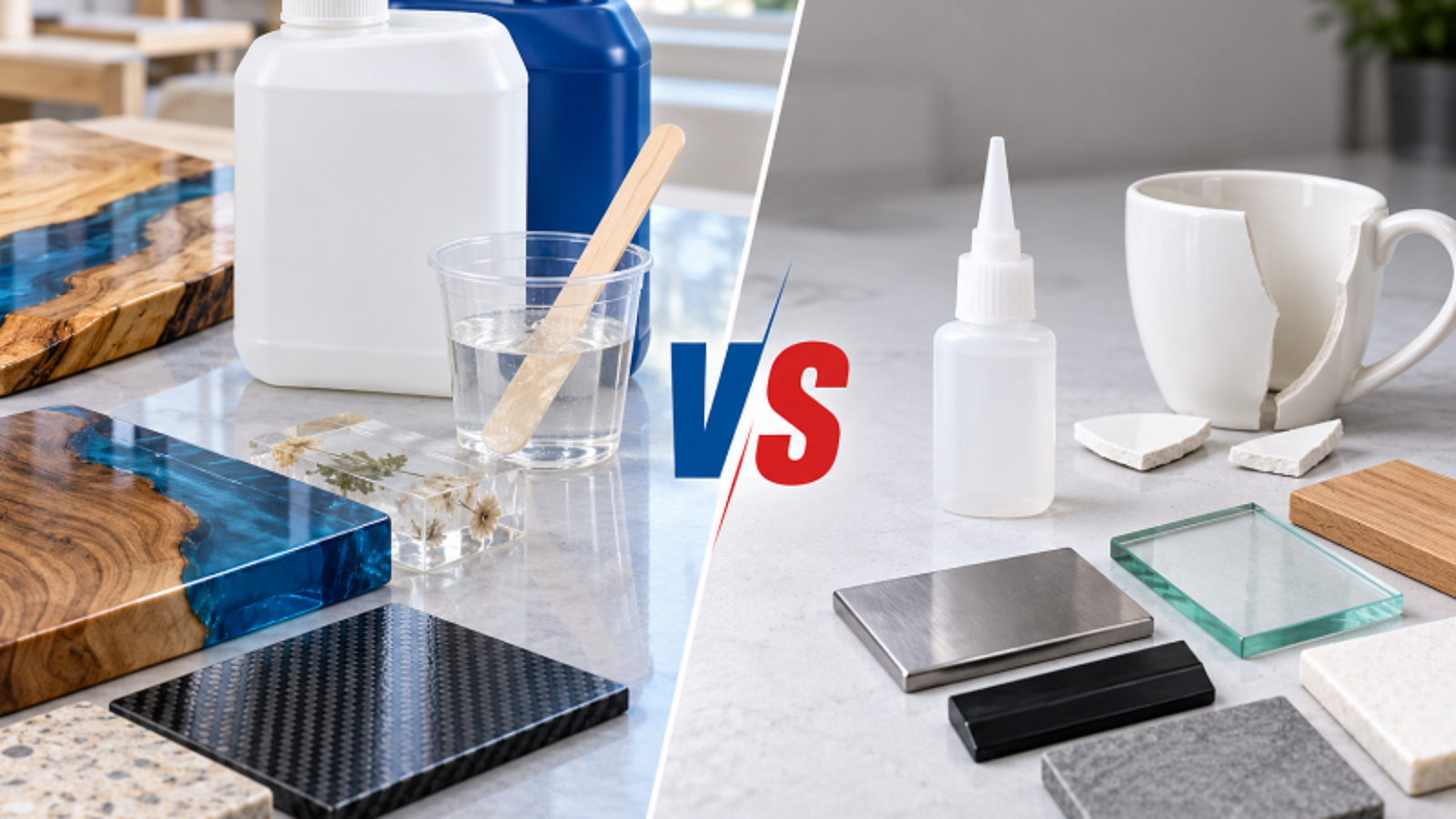
Something breaks, and two tubes get pulled out of the drawer: epoxy and super glue. Both claim to bond almost anything. Both are cheap and sold everywhere. And both, used on the wrong job, will let you down within a week.
The epoxy resin vs super glue question isn’t really about which adhesive is “stronger” — it’s about which one matches the material, the gap between the parts, how much time you need to position things, and what the joint will have to survive afterward. Pick based on the label alone and you’re gambling.
This guide walks through wood, metal, plastic, glass, ceramic, and stone, plus the handful of variables — working time, gap-filling, cure speed, outdoor exposure — that actually decide the outcome.
What Epoxy Resin Actually Is
Most epoxy is a two-part system: resin (Part A) and hardener (Part B). Mix them at the ratio on the label and a chemical reaction kicks off, slowly turning a liquid into a solid, crosslinked material.
That word “slowly” matters. A river-table epoxy, a flooring epoxy, and a structural metal adhesive can all technically be called “epoxy resin,” but they’re engineered for completely different jobs. One prioritizes optical clarity and self-leveling. Another prioritizes shear strength on steel. Assuming they’re interchangeable is where a lot of DIY repairs — and a few OEM production runs — go wrong.
What tends to hold true across most epoxy formulations:
- Bonds well to a wide range of substrates
- Fills gaps instead of just skimming a thin film
- Gives you real working time before it sets
- Handles moisture and many chemicals reasonably well
- Cures fine in thicker pours, not just thin lines
That working time is the whole point in a lot of applications — it’s the difference between rushing a bond and actually aligning it.
What Super Glue Actually Is
“Super glue” is the everyday name for cyanoacrylate, or CA glue. Unlike epoxy, it’s a one-part adhesive that cures when it meets trace moisture — on the surface you’re bonding, or just in the air around it.
Speed is the entire appeal. Depending on the formula, the substrate, and how humid the room is, initial grab can happen in seconds, not minutes.
What that trade-off buys you, and costs you:
- Extremely fast bonding, no mixing required
- Great for small, tight-fitting repairs
- Needs close, flush surfaces — it isn’t built to span a gap
- Strong on rigid materials, but conventional formulas can go brittle under impact
Convenient, yes. The best choice for every job? No — and that’s really the whole point of this comparison.
Epoxy vs Super Glue at a Glance
| Epoxy Resin | Super Glue (CA) | |
| Components | Two-part | One-part |
| Initial bond | Slower | Seconds |
| Working time | Minutes to hours | Seconds to a couple minutes |
| Gap filling | Strong | Weak, unless specially formulated |
| Large surfaces | Practical | Awkward — cures before you finish spreading it |
| Small precision joints | Workable, but slower | Ideal |
| Thick application | Yes | No |
| Repositioning parts | Realistic | Barely any window |
| Moisture resistance | Often very good | Formula-dependent |
| Impact resistance | Can be engineered in | Conventional CA is often brittle |
| Casting or coating | Yes, with the right epoxy | Not applicable |
Neither column is the “winner” — the job decides that.
Is Epoxy Actually Stronger Than Super Glue?
There’s no clean answer to this without naming the materials and the type of load, because an adhesive that performs beautifully in shear can fail fast in peel or impact.
Super glue can produce a genuinely strong bond on two small, rigid, tightly matched surfaces. But that bond is often brittle, especially with off-the-shelf cyanoacrylate — a sharp knock can crack it where a more flexible epoxy joint would just flex.
Epoxy tends to pull ahead when there’s a visible gap, a larger surface to cover, an irregular joint, or a load that includes impact rather than pure tension. So instead of asking which glue is “stronger” in the abstract, ask what the joint actually has to survive day to day.
Wood
Wood is porous, uneven, and full of small surprises — knots, hairline cracks, gaps left by a missing sliver of material. That irregularity is where epoxy earns its keep: it flows into the void and fills it rather than just sitting on top.
That’s why it shows up so often in furniture repair, crack stabilization, and — on the decorative end — river tables and live-edge tabletops, where the resin isn’t just holding wood together but becoming part of the piece.
Super glue still has a place here. For two small, cleanly cut pieces that need to be fixed in place fast, it’s often the quicker and less messy option. But for anything with a gap or an irregular break, reach for epoxy first.
Metal
Surface prep decides more than the adhesive choice does on metal. Oil film, oxidation, old paint, or a factory coating can all sit between the adhesive and the actual substrate — and neither epoxy nor super glue bonds well to a layer of grease.
Once the surface is genuinely clean, epoxy handles larger bonding areas and gapped joints better, and it buys time to align parts before the bond locks in. Super glue is the better call on small, tight-fitting metal components where speed matters more than gap tolerance.
Either way, vibration, heat cycling, and chemical exposure will test the bond long after the glue has cured — worth thinking through before you commit to one adhesive.
Plastic
Plastic is the material where “epoxy or super glue” is the wrong first question. The right one is: what kind of plastic?
ABS and rigid PVC generally cooperate with both adhesive families, given decent surface prep. Polyethylene, HDPE, polypropylene, and PTFE are a different story — their low surface energy makes them notoriously hard to bond with standard epoxy or plain cyanoacrylate, primer or no primer.
If the plastic is compatible and there’s a gap to fill, epoxy is the more forgiving option. For tiny, precisely fitting plastic parts, super glue is faster. Either way, test on a scrap piece first — some plastics whiten, haze, or stress-crack on contact with certain adhesives, and you don’t want to discover that on the visible side of the part.
Glass
A clean glass break with tightly matching edges is textbook super glue territory — thin bond line, fast set, done.
Epoxy takes over once there’s a gap to fill, a larger area to cover, or you need more than a few seconds to position the piece. It also shows up in decorative work where glass is embedded or layered with other materials. Just don’t assume “clear epoxy” means invisible forever — UV exposure, thickness, and age all affect long-term clarity, so test before committing to a piece you care about.
Ceramic
Broken ceramic rarely breaks clean. The fracture edges are usually irregular, sometimes with small chips missing, and epoxy’s slower set gives you room to line up several fragments before it locks.
For a clean break with no missing material — a mug handle snapped in two, for instance — super glue is often faster and plenty strong. Once the break gets complicated, epoxy is the more forgiving choice.
Stone and Concrete
Porous, rough, and usually bonded over a fairly wide area — stone and concrete favor epoxy almost by default. A thin film of cyanoacrylate just doesn’t have the volume to fill irregular mineral surfaces the way epoxy formulated for the job can.
One caveat worth repeating: structural concrete repair needs a product actually engineered and certified for that use. A decorative casting epoxy is not a substitute for a construction-grade adhesive, no matter how well it performs on a tabletop.
Gap Filling, Cure Speed, and Coverage
Three variables decide more repairs than material type alone.
Gap filling has a clear winner: epoxy. Super glue is built to bridge a thin, tight seam, not stand in for missing material. A few specialty CA products are marketed as “gap-filling,” but don’t expect ordinary super glue to behave like a two-part system.
Cure speed goes the other way — super glue wins outright. Epoxy needs time for resin and hardener to crosslink, though that window varies a lot by formulation; some cure in minutes, deep-pour systems are designed to stay workable far longer.
That slower cure isn’t a downside once you’re working a larger surface. Spreading resin evenly, aligning a big component, popping bubbles, clamping the assembly — all of that takes time super glue simply doesn’t give you.
Outdoor Durability
Neither adhesive is automatically outdoor-rated. UV exposure, rain, freeze-thaw cycling, and temperature swings are hard on both families unless the formulation was built for it. Some epoxies resist water and chemicals well but yellow under sustained UV; cyanoacrylate performance swings widely by brand and formula.
Skip the assumption that “epoxy” or “super glue” as a category tells you anything about outdoor performance. Check the actual product specification for the environment you’re bonding in.
Getting the Surface Ready
Adhesive strength is capped by surface prep, full stop. A few things worth doing before either product goes on: clean off oil, wax, dust, and any release agent, since a contaminated surface won’t bond no matter what you apply. Light sanding adds mechanical grip on many materials, though not every finish — transparent or decorative surfaces especially — should be aggressively abraded. And test unfamiliar material combinations before committing to the real piece.
For epoxy specifically, the mixing ratio on the label isn’t a suggestion. Off-ratio mixing shows up as a tacky surface, soft cure, or reduced strength — and adding extra hardener doesn’t speed things up or improve the result. It’s also worth remembering that an epoxy can feel hard to the touch well before it reaches its full mechanical properties; give it the full cure window before loading the joint.
Can You Combine Them?
Sometimes, yes — a small dab of fast-setting adhesive tacks a part in place while a slower epoxy cures around it. It works, but it’s easy to overdo: if the CA covers too much of the surface meant for the epoxy, you’ve just reduced the contact area the epoxy needed to actually bond. For anything load-bearing, proper clamping or fixturing beats improvising with two adhesives at once.
Epoxy Resin Isn’t Only an Adhesive
Worth flagging, especially if you’re sourcing epoxy rather than just repairing something at home: a lot of epoxy resin isn’t sold as an adhesive at all. River tables, countertops, resin art, jewelry, wood coatings, and industrial flooring all run on epoxy systems optimized for very different things than bond strength — clarity, self-leveling, low exotherm in a thick pour, surface hardness.
A deep pour formulation built for a thick, bubble-free cast is not the same product as a tabletop epoxy chasing gloss and clarity, and neither is the same as a structural adhesive engineered for shear and peel performance on metal. As an epoxy resin manufacturer, we’d rather see a buyer pick the formulation that matches the actual application than assume “epoxy resin” is one interchangeable product — that mismatch is where most disappointing results come from.
Quick Answers
Is epoxy stronger than super glue?
Depends on the load. Epoxy tends to win on large or gap-filled joints; super glue can be extremely strong on small, tight-fitting surfaces but is often more brittle under impact.
Which is better for plastic?
Depends on the plastic. ABS and rigid PVC generally work with either; low-surface-energy plastics like PE and PP resist both without specialized treatment.
Which is better for metal?
Super glue for small, close-fitting parts; epoxy for larger areas, irregular joints, or anything that needs gap filling.
Which is better for wood?
Epoxy for cracks, voids, and larger repairs; super glue for small, precisely fitting pieces that need fast fixation.
Which is better for ceramic?
Super glue on a clean break; epoxy once the fracture is irregular or material is missing.
Can super glue replace epoxy resin?
Not for casting, coating, or most gap-filling work. Super glue is strictly an adhesive; epoxy resin systems cover bonding, coating, casting, encapsulation, and lamination.
The Bottom Line
There’s no universal winner in epoxy resin vs super glue — only a better fit for the job in front of you.
Reach for super glue when the parts are small, closely fitting, and speed matters more than gap tolerance. Reach for epoxy when you need working time, gap-filling, coverage over a larger or irregular surface, or mechanical properties tuned to a harder application.
For anything beyond a household fix — OEM production, bulk sourcing, private-label projects — the deciding factors multiply: substrate compatibility, bond geometry, cure conditions, operating temperature, moisture, UV exposure, mechanical load. Jinhua Resin manufactures epoxy systems across tabletop coating, deep pour casting, flooring, and craft applications, with viscosity, working time, hardness, and clarity all tuned to the application rather than sold as one-size-fits-all.