


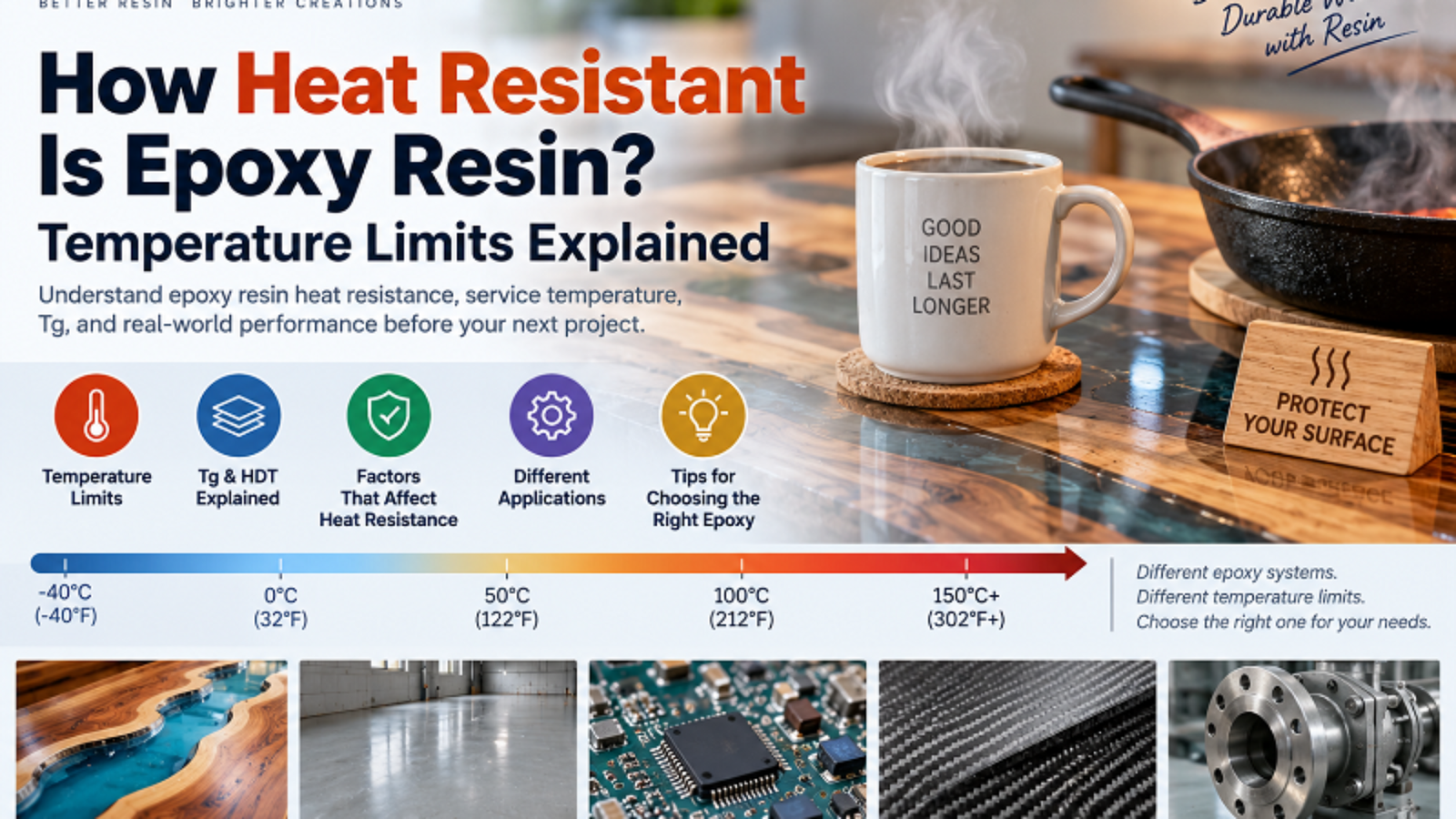
Countertops, river tables, coatings, adhesives, electrical encapsulation, composites — epoxy shows up everywhere because it’s strong, versatile, and takes an incredible amount of abuse. But heat is where things get complicated. The moment epoxy sits near hot pans, machinery, direct sunlight, or high processing temperatures, one question comes up constantly: how heat resistant is epoxy resin, really?
There’s no clean answer. Resin chemistry, hardener choice, cure schedule, formulation, and end use all shape how a given epoxy handles heat. A basic clear craft resin might start softening well before a purpose-built high-temperature system even notices the heat. Marketing copy that just says “heat resistant” glosses over all of that — and it’s exactly the kind of vague claim that gets buyers into trouble.
This guide breaks down what epoxy resin heat resistance actually means, what happens when cured epoxy gets pushed past its limits, and how to pick the right resin for countertops, casting, industrial parts, and everything in between.
Yes, But It Depends
Fully cured epoxy resin does offer real heat resistance — that part’s true. What varies is how much.
General-purpose resins made for crafts, furniture, and coatings are built around moderate service temperatures. They’re not designed to shrug off industrial heat loads. Specialty high-temperature epoxy systems exist precisely because standard formulations can’t keep up in more demanding environments.
Before comparing products, it helps to know these aren’t interchangeable terms:
- Service temperature
- Short-term heat exposure tolerance
- Continuous operating temperature
- Glass transition temperature (Tg)
- Heat deflection temperature (HDT)
- Thermal degradation point
An epoxy that survives a quick brush with a hot object might fail completely under sustained exposure to that same temperature. So instead of asking “what temperature can epoxy handle,” the more useful question is: what temperature can this epoxy handle, for how long, in this application?
So What’s the Actual Temperature Limit?
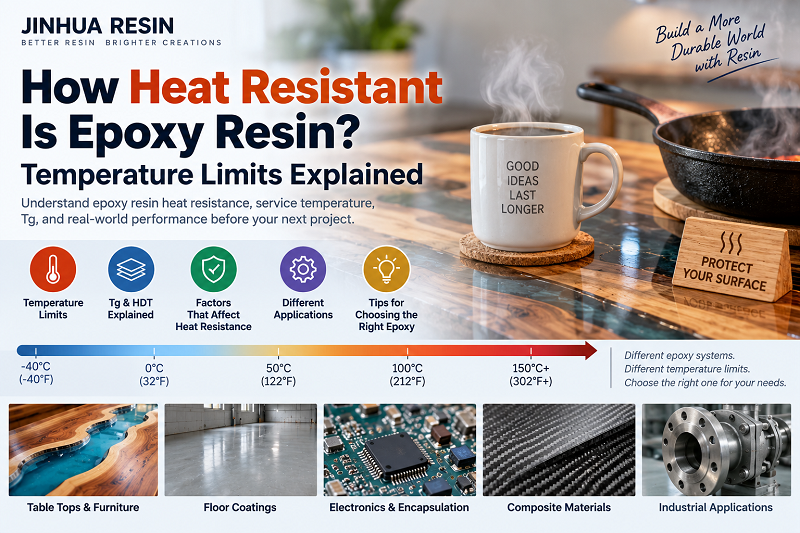
There isn’t one universal number, but general-purpose cured systems typically land somewhere in the 50–80°C (122–176°F) range for continuous service. Formulated high-temperature epoxies can push past 100°C (212°F), and specialized industrial systems go considerably higher still.
Treat those figures as ballpark, not gospel. Real-world performance depends on resin chemistry, the hardener, the mix ratio, cure temperature, whether the part gets post-cured, any fillers involved, how long the heat exposure lasts, and whether the piece is under mechanical load at the same time. When heat resistance actually matters for a project, pull the Technical Data Sheet. Don’t guess from the label.
Glass Transition Temperature (Tg) — Why It Matters More Than “Heat Resistant”
Tg gets thrown around a lot, and it’s worth actually understanding.
It’s not a melting point. Epoxy is a thermoset — once it cures, it forms a crosslinked network that doesn’t revert to liquid resin no matter how hot it gets. Tg instead marks the range where cured epoxy shifts from a hard, glassy state into something softer and more rubber-like.
Near or past Tg, expect the material to lose stiffness, flex more, carry less load, and become more prone to deformation. A part can look completely fine at an elevated temperature while its actual mechanical strength has already dropped significantly. That’s why “heat resistant to 100°C” tells you far less than the Tg number does — especially for anything structural.
Heat Deflection Temperature (HDT)
HDT is a different measurement: how a material behaves under a specified load as temperature climbs. It matters most for parts that need to hold their shape while carrying weight or stress.
Tg and HDT are related but not the same test, and not interchangeable. When comparing two epoxy products’ spec sheets, confirm you’re looking at the same type of measurement rather than assuming every number on the page means the same thing.
What Actually Happens When Epoxy Gets Too Hot
Push cured epoxy past its intended range and a few things tend to happen, sometimes in sequence.
It softens. As temperature nears or crosses Tg, the surface gets noticeably less rigid — a tabletop, for instance, becomes easier to dent with a hot pot.
It deforms under load. If the piece is bearing weight while hot, it can gradually change shape. This is a real concern for structural components and composites specifically.
It loses mechanical performance. Stiffness, strength, adhesion, and dimensional stability all drop at elevated temperatures — sometimes without any visible sign that something’s wrong.
It discolors. Clear or light-colored epoxy can yellow or darken under excess heat.
It cracks or delaminates. Repeated heating and cooling makes materials expand and contract. If the resin and substrate don’t expand at the same rate, thermal cycling can eventually crack the surface or pull it loose from the substrate.
It degrades. At high enough temperatures, epoxy undergoes actual chemical breakdown — not the temporary softening near Tg, but permanent damage. Once that happens, the material doesn’t recover its original properties on cooling.
Does Epoxy Melt?
Not in the way people usually mean. Thermoplastics soften, melt, and can be reshaped and reheated indefinitely. Epoxy can’t do that once it’s cured — the crosslinked network that forms during curing is permanent.
Push it hard enough with heat and it’ll soften, deform, lose strength, discolor, or eventually char and break down chemically. But it won’t liquefy back into resin. “Melting” just isn’t the right word for what’s happening.
Table Top Epoxy and Heat: What’s Realistic
This is where heat resistance gets personal for most buyers, because table top epoxy surfaces deal with coffee cups, plates, cooking containers, and warm serving dishes on a near-daily basis.
A properly cured tabletop surface handles normal household temperature swings and moderate warmth without issue. What it can’t handle is a pan straight off the stove or out of the oven — that’s often far hotter than any standard decorative epoxy’s service range, and setting it down directly risks soft spots, imprinting, discoloration, or permanent gloss damage. A trivet or heat pad solves the problem entirely and costs nothing to use.
Deep Pour Epoxy: Different Problem, Different Solution
Deep pour epoxy gets formulated to deal with a completely different heat challenge: the exothermic reaction that happens during curing, not after.
Pour too much resin at once and heat builds up inside the casting faster than it can escape. That leads to rapid uncontrolled curing, bubbling, yellowing, cracking, internal stress, and in bad cases, smoke. Deep pour systems slow the reaction down specifically so heat has time to dissipate during a thick pour.
Here’s the catch people miss: managing exotherm during cure and having high heat resistance after cure are two completely separate properties. A deep pour resin engineered for a thick river-table casting might have roughly the same post-cure service temperature as any other decorative epoxy. Always check the cured resin’s thermal specs on their own — don’t assume a low-exotherm formulation implies high heat tolerance.
Industrial Applications Raise the Stakes
Motors, electrical components, machinery, composite parts, encapsulation, industrial adhesives — these environments push epoxy far beyond anything a countertop sees. Here, thermal performance has to work alongside mechanical and chemical demands simultaneously.
A high-temperature epoxy in an industrial setting needs to hold onto adhesion, dimensional stability, electrical insulation, mechanical strength, and chemical resistance through repeated heating and cooling cycles — not just survive one heat spike. Picking whichever product advertises the highest number isn’t a strategy. The full operating environment needs evaluation, not a single spec.
Post-Curing: Does It Actually Improve Heat Resistance?
Sometimes. Post-curing means running cured or partially cured epoxy through a controlled elevated-temperature schedule afterward. Done right, on a formulation designed for it, this can push the polymer network toward a higher degree of cure and raise Tg or other thermal properties.
But this only works when the product is built for it. Heating a standard epoxy on your own doesn’t turn it into a high-temperature resin — it might do nothing, or it might cause problems. If post-curing is viable, the manufacturer needs to specify the temperature, duration, ramp rate, and cooling procedure. For production runs, following that schedule exactly is what makes performance consistent from batch to batch.
Does Thickness Change Heat Resistance?
Two different answers depending on when you’re asking.
During curing, yes — a thick pour holds onto exothermic heat far more than a thin coating does. A resin built for a 3mm coat shouldn’t get poured at 50mm; the heat buildup alone can cause real problems.
After curing, it’s murkier. A thicker cured section doesn’t automatically have a higher Tg or service temperature — that’s set by the chemistry and cure state, not the dimensions. That said, thick and thin sections do heat and cool at different rates in the real world, which can still affect how they actually perform in use.
What Actually Determines Heat Resistance
A handful of variables do most of the work.
Resin and hardener chemistry sets the crosslinked structure, which is the main reason thermal performance varies so much between products. Getting the mix ratio right matters too — too much or too little hardener doesn’t speed up cure or improve heat resistance, it just prevents the resin from curing fully. A partially cured epoxy will underperform a fully cured one on heat resistance every time, and post-curing (when the formulation supports it) can push Tg higher still. Fillers can shift thermal behavior and heat transfer characteristics depending on what’s used. And exposure time changes everything — a resin that survives a brief touch at a given temperature might fail completely if held there for hours or days. Add mechanical load on top of heat, and the margin for error shrinks further.
Epoxy vs. Polyurethane on Heat
Neither wins outright — both chemistries can be engineered across a range of temperatures.
Epoxy tends to bring strong adhesion, hardness, dimensional stability, chemical resistance, and solid composite performance to the table. Polyurethane often counters with more flexibility, better abrasion and impact resistance, and, in the right formulations, good UV stability. When temperature matters for a specific project, compare actual technical data between the two products rather than assuming one chemistry automatically beats the other on heat.
Choosing a Heat-Resistant Epoxy: A Practical Checklist
Before buying, work through these:
- What’s the normal operating temperature the finished piece will see most of the time?
- What’s the realistic maximum — occasional spikes, hot objects, nearby machinery?
- How long does that exposure actually last? Ten seconds at 100°C and continuous operation at 100°C are entirely different problems.
- Will the part be under mechanical load while it’s hot?
- Check the Tg and HDT numbers — they tell you far more than a vague “heat resistant” claim ever will.
- Confirm the cure schedule. Some systems only hit their rated thermal performance after a full cure or post-cure.
- Think about the substrate. Resin and substrate rarely expand at the same rate as temperature shifts.
- Ask for the TDS before any bulk or commercial purchase. This one step avoids most heat-related failures downstream.
FAQ
What temperature can epoxy resin withstand? It depends entirely on the formulation. General-purpose systems handle moderate service temperatures; specialized high-temperature epoxies go considerably higher. The TDS is the only reliable source for a specific product’s limits.
Is epoxy resin safe for hot coffee mugs? Generally yes for normal household warmth, but prolonged contact with very hot items can still leave marks on some formulations. A coaster removes the risk entirely.
Can you put a hot pan on an epoxy countertop? Better not to. Cookware straight from a stove or oven usually runs hotter than a standard decorative epoxy’s service range.
Does epoxy melt in heat? No — it’s a thermoset, not a thermoplastic. Excessive heat causes softening, deformation, discoloration, or chemical degradation, not melting.
Does epoxy get soft when heated? Yes, particularly as it approaches or crosses its glass transition temperature.
Can epoxy withstand boiling water? Some formulations tolerate brief exposure near boiling; others soften or lose performance. It depends on the specific resin, its cure state, and how long the exposure lasts.
Is deep pour epoxy more heat resistant than other types? Not automatically. Deep pour formulations manage exothermic heat during a thick cure — that’s a separate property from post-cure service temperature.
The Bottom Line
There’s no single number that defines epoxy resin heat resistance across every product. Standard systems handle moderate heat just fine; purpose-built formulations exist for the situations that need more.
What actually determines performance: resin and hardener chemistry, Tg, HDT, full cure, post-cure schedule where applicable, exposure duration, mechanical load, and the substrate underneath. For countertops, river tables, crafts, and general coatings, standard epoxy usually covers what’s needed within its intended range. For machinery, electronics, high-temperature composites, or industrial parts, that’s a job for an engineered high-temperature system.
Don’t buy on a single advertised number. Pull the TDS, and figure out whether that number describes continuous service, a brief spike, Tg, HDT, or something else entirely — they’re not the same claim wearing different labels.
Jinhua Resin supplies epoxy systems for tabletop coatings, deep pour epoxy, DIY projects, wood applications, composites, and industrial use, with OEM and private-label options available across markets. Matching the right formulation to working time, viscosity, pour thickness, cure schedule, hardness, and thermal requirements is what makes performance reliable once a project moves from spec sheet to real-world use.