


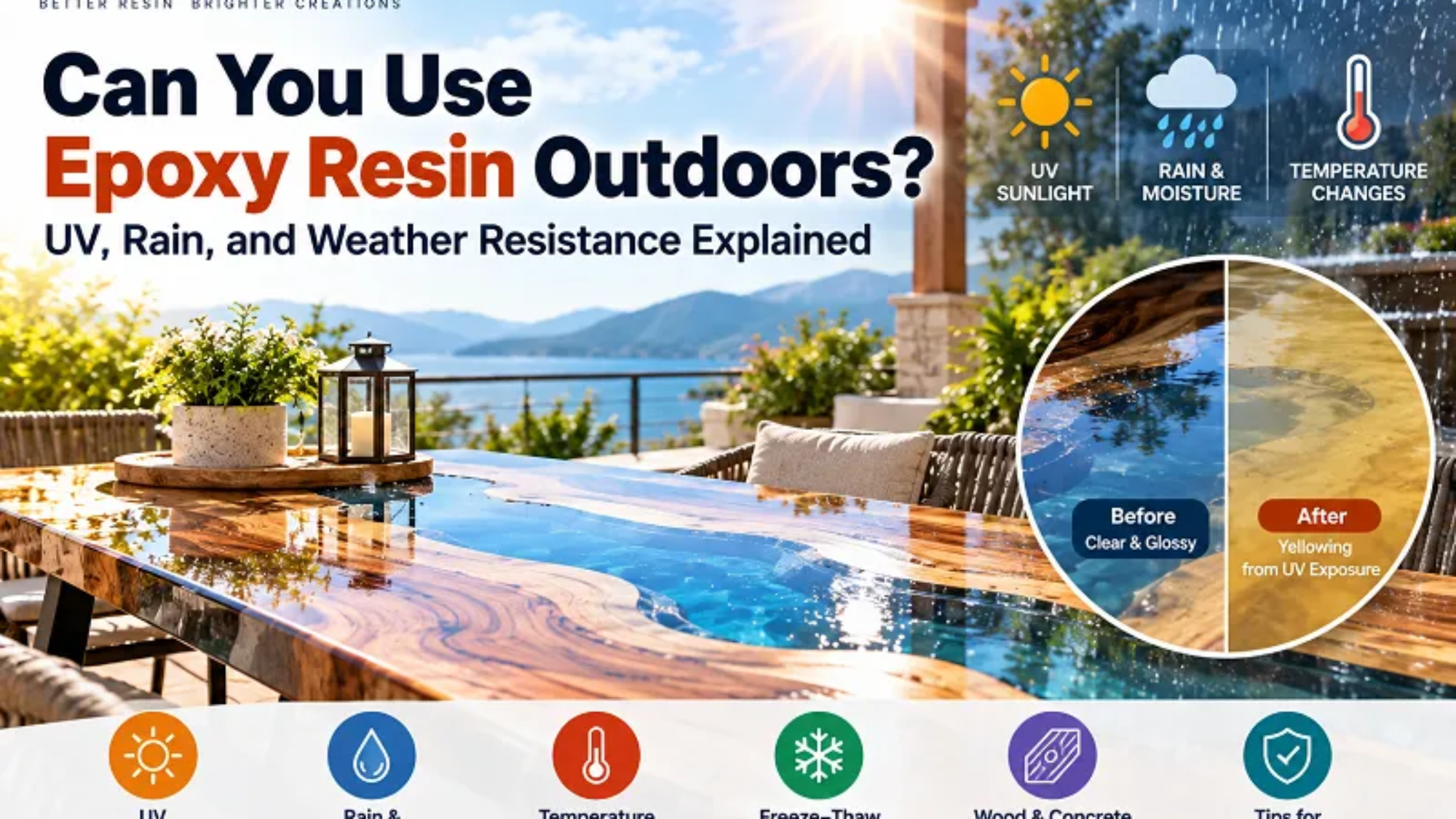
Epoxy turns up everywhere: river tables, countertops, wood coatings, concrete floors, industrial surfaces. It sticks hard, cures hard, shrugs off most chemicals and looks great doing it. Then someone asks the obvious question. Will it survive a summer on the patio?
Short answer: yes, but not every epoxy is built for it. Using epoxy resin outdoors works when the formulation, the surface prep and the top protection all match the exposure. Rain is rarely what ruins a job. Sunlight is.
A fully cured epoxy handles water well. A standard grade, though, will yellow, dull and chalk if it sits under continuous UV. So “waterproof” is only one item on the checklist. You also need to ask about UV, temperature swings, freeze-thaw, substrate movement, and how many years the surface has to last. This guide takes them one at a time, written from the formulation side by an epoxy resin manufacturer.
Where Epoxy Works Outside
Epoxy holds up in plenty of exterior jobs: wooden tables and patio furniture, decorative wood, concrete surfaces, signs, marine parts, composites and exterior repairs. But a craft-grade clear epoxy made for indoor tabletops and an industrial coating engineered for weather are two very different products, even when both are sold as “epoxy.”
The good results all follow the same pattern: the right resin, a properly prepared surface, correct application, and UV protection on top.
Is Epoxy Resin UV Resistant?
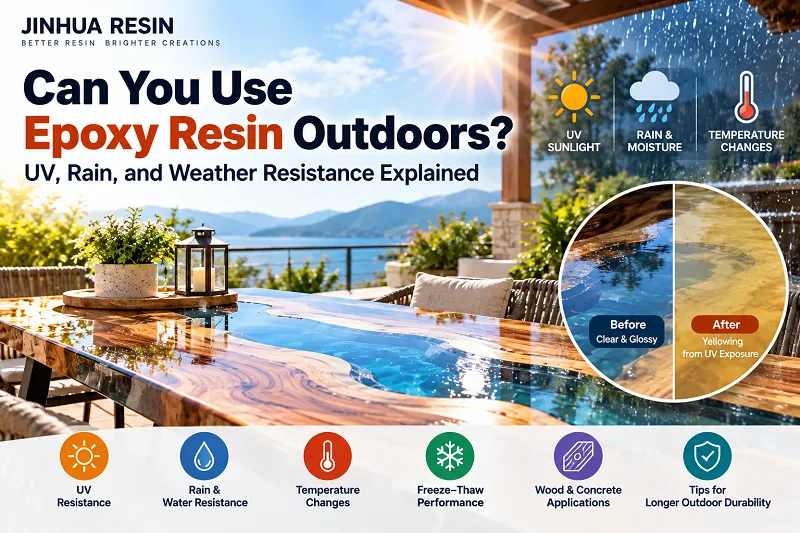
Standard epoxy is not UV stable. Sunlight slowly attacks the cured polymer, and the damage shows up as yellowing, a cloudier look, lower gloss, a chalky surface, color drift and, eventually, surface breakdown.
None of this happens overnight. How fast it goes depends on the formulation, whether UV stabilizers are included, sunlight intensity, daily hours of exposure, local climate, color and whether there is a topcoat. Clear epoxy shows the change first, because even a faint yellow tint is obvious against a clean finish. Pigmented epoxy hides the shift. It does not stop it.
Why Epoxy Turns Yellow in the Sun
The mechanism is photo-oxidation. Ultraviolet energy breaks down the aromatic structures found in most standard epoxy chemistry, and the fragments absorb light differently, which reads as yellow or amber. Heat, oxygen, hardener chemistry and film thickness all speed it up.
Many modern formulations carry UV absorbers or hindered amine light stabilizers to slow the process. Read that carefully, though: UV resistant is not UV proof. A stabilized epoxy stays clear longer than a basic one. Under continuous direct sun, it will still change. If color stability matters to the project, plan on a UV-stable topcoat from the start.
Is Cured Epoxy Waterproof?
Once cured, epoxy has excellent water resistance. It forms a continuous film that keeps moisture out of porous materials like wood and concrete.
But the coating is only as good as its weakest point, and water always finds it. Cracks, pinholes, bare edges, joints, screw holes, damaged patches and badly prepared substrates are all entry routes. Coat only the top of a wooden table and rain will still get in through the underside, the edges and the joints. The wood swells, and the coating starts to lift.
Can Rain Damage Epoxy?
Fully cured epoxy: no, not from ordinary rain. Uncured epoxy: yes. Rain or heavy dew during cure can cause cloudiness, surface haze, blushing and uneven gloss.
Before any exterior application, check the air and substrate temperature, relative humidity, dew point, the rain forecast and the cure time the product needs. A common field rule is to keep the substrate at least 3°C (5°F) above the dew point. Do not judge readiness by touch, either. Touch-dry and fully cured are not the same thing. Most ambient-cure epoxies need around seven days at 25°C (77°F) to reach full cure, so follow the technical data sheet before exposing the surface to rain or standing water.
What Temperature Swings Do to Outdoor Epoxy
A patio table can be cool at dawn, scorching by mid-afternoon and cool again at sunset. That daily cycle makes both the epoxy and the material underneath expand and contract, usually at different rates. Wood adds another variable because it also moves with moisture.
Repeated cycling can lead to cracking, delamination, lost adhesion and edge lift. The risk applies to wood, metal, concrete and composites alike, which is why the coating system has to be chosen for the substrate and the climate together.
Hot Sun: UV Plus Heat
Sunlight hits epoxy twice, once with UV and once with heat. A dark surface in direct sun can run far above the air temperature. On a 35°C (95°F) day it can pass 65°C (150°F).
That matters because many ambient-cure epoxies have a glass transition temperature (Tg) somewhere in the 45–65°C range, so check the datasheet for the exact figure. As the surface approaches Tg, the epoxy softens. It dents more easily, can deform and loses hardness. Design for the expected surface temperature, not the number on the weather app, and check the recommended service temperature before committing.
Can Epoxy Survive Freezing Weather?
Cured epoxy generally tolerates cold well. The harder test is freeze-thaw. Water that has worked into cracks, pores or joints expands when it freezes, and repeated cycles stress both the coating and the substrate. Exterior concrete is especially exposed.
Application temperature is a separate problem. Mixing and pouring at very low temperatures gives thicker material, poor leveling, weak wetting and slow or incomplete cure, even when the cured product could have handled the cold just fine. Keep the two specs apart: application temperature (most epoxies work best at roughly 18–30°C, or 65–85°F) and service temperature after cure.
Epoxy on Outdoor Wood
Wood is one of the better outdoor uses. Epoxy seals the pores and cuts moisture uptake on tables, benches, signs, marine timber and furniture. The wood needs to be dry, clean, sanded, free of oil and structurally sound before anything goes on.
Spend the extra time on edges, joints, cracks and end grain, because that is where wood drinks water. For long-term sun exposure, add a compatible UV-resistant exterior finish over the epoxy. The epoxy does the sealing and bonding; the finish takes the sunlight.
Epoxy on Outdoor Concrete
Epoxy can work on some exterior concrete, but four things need attention first.
Moisture vapor. Water travels up through a slab. Even if the epoxy sheds rain from above, vapor pressure from below can cause blisters and delamination, and a vapor barrier may be needed. UV. Standard epoxy yellows and chalks under sun. Thermal movement. Exterior slabs heat, cool and crack. Slip. Smooth epoxy turns slick when wet, so walking surfaces need anti-slip aggregate or texture.
Because of all that, exterior floor systems often use epoxy as the primer or build coat and put a more UV-stable material on top.
Epoxy vs Polyurethane vs Polyaspartic for Exterior Use
These materials are usually partners, not substitutes. Epoxy brings adhesion, hardness and build thickness. Polyurethane and polyaspartic coatings bring better UV stability and color retention. The common exterior system is an epoxy base coat with a UV-stable topcoat.
| Property | Epoxy | Polyurethane | Polyaspartic |
| UV stability | Low to moderate (standard grades) | Good | Good to very good |
| Bond to prepared concrete | Excellent | Moderate; usually a topcoat | Good |
| Hardness | High | Moderate | High |
| Flexibility | Low | Higher | Moderate |
| Cure speed | Slow to moderate | Moderate | Fast |
| Typical exterior role | Primer or build coat | UV topcoat | UV topcoat, quick return to service |
Treat the table as a general guide. Performance varies by formulation, and the word “polyaspartic” on a label does not guarantee weather resistance. Ask for technical data on the actual system, and confirm layer compatibility and recoat windows before you order.
How to Make Outdoor Epoxy Last Longer
Pick the right resin. Choose a product made for your substrate and exposure. Ask for data on UV resistance, water resistance, service temperature, adhesion, chemical resistance and recommended topcoats.
Prepare the surface. The substrate should be clean, dry, free of oil and dust, and sanded or mechanically profiled. Poor prep will sink a high-quality epoxy.
Seal every weak spot. On wood and other porous materials, that means edges, corners, joints, holes, cracks and undersides. Water goes for the weakest point.
Hit the film thickness. A coat that is too thin or uneven protects less than you think. Follow the coverage rate on the datasheet.
Let it fully cure. No rain, standing water, heavy use or big temperature swings until the recommended cure stage.
Add UV protection. For direct sun, use a compatible polyurethane or polyaspartic topcoat. Any epoxy resin manufacturer worth working with will tell you which topcoats suit its system.
Inspect regularly. Look for cracks, scratches, chalking, gloss loss, delamination and edge damage. Small repairs made early keep moisture away from the substrate.
How Long Does Epoxy Last Outdoors?
There is no universal number. A covered table and an uncovered surface baking in daily sun age at completely different rates. An exterior industrial floor with vehicles and chemicals needs a different system from a decorative garden bench. Service life comes down to formulation, UV exposure, climate, moisture, temperature cycling, substrate movement, prep quality, film thickness, wear, maintenance and topcoat.
So skip “how many years will it last?” and ask a better question: what will this surface actually be exposed to, and what system matches that?
Frequently Asked Questions
Can epoxy resin stay outside?
Yes, suitable systems can. Standard epoxy may yellow or lose gloss under prolonged UV, so extra UV protection is often needed.
Is epoxy resin waterproof in the rain?
Fully cured epoxy resists water well. Cracks, pinholes, joints and unsealed edges can still let water reach the substrate.
Does epoxy resin yellow in sunlight?
Many standard clear epoxies do, gradually. UV stabilizers slow it, and a compatible UV-resistant topcoat slows it further.
Can epoxy be used on outdoor wood furniture?
Yes. It seals the wood and reduces moisture uptake, but furniture in direct sun is better with a UV-resistant finish on top.
Can epoxy be used on an outdoor patio?
It depends on the concrete condition, moisture level, sun exposure, temperature range and slip requirements. A multilayer system with a UV-stable topcoat usually beats exposed standard epoxy.
Is epoxy UV proof?
No standard epoxy should be treated as UV proof. Some formulations resist UV better, but prolonged sunlight still affects most systems.
Can epoxy survive winter?
Cured epoxy can perform in cold climates if the whole system is designed for it. Freeze-thaw cycling, substrate moisture and movement are the things to plan around.
Final Thoughts: Can You Use Epoxy Resin Outdoors?
Yes, but rain is the smallest part of the answer. A well-chosen, fully cured epoxy gives you strong adhesion, water resistance, surface sealing, hardness and chemical resistance. What outdoor exposure adds is UV, yellowing, high surface temperatures, temperature cycling, freeze-thaw and substrate movement.
For covered furniture, protected wood, certain concrete jobs, composites and repairs, epoxy is a solid choice. For surfaces in strong direct sun, add UV protection. In many professional systems, epoxy is the bonding and build layer, and a UV-resistant polyurethane or polyaspartic topcoat handles the weather.
Jinhua Resin is an epoxy resin manufacturer supplying systems for tabletop coatings, deep casting, DIY projects, wood applications, composites, flooring and industrial use, with OEM and private-label formulation available. Check UV exposure, water resistance, service temperature, substrate, film thickness and long-term weather before you pick a formulation, and outdoor results get a lot more predictable.