



Most color failures in epoxy get blamed on the resin. They shouldn’t be. When a table top comes back cloudy, tacky in patches or two shades off the sample, the culprit is usually the colorant — the wrong type, too much of it, or one that never belonged in epoxy in the first place.
If you buy or sell table top epoxy in volume, this matters twice. Your customers will color the resin themselves, and every failed pour lands as a complaint on your desk. A good epoxy resin manufacturer can tell you which colorants have been tested with a given formula. A bad one shrugs.
This guide covers the table top epoxy pigments that work, the ones that don’t, and the loading limits that keep a pour curing hard and clear. Treat the numbers as starting points — the TDS for your specific resin always wins.
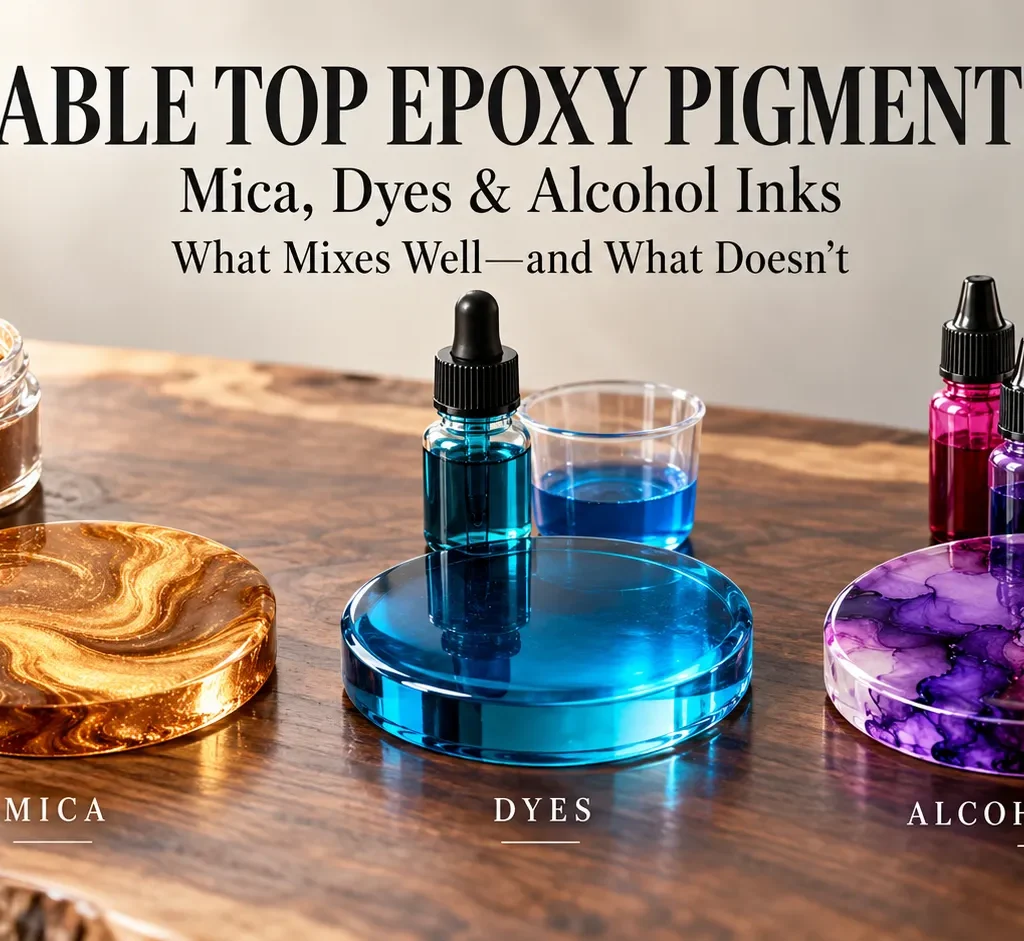
Why colorant choice changes more than color
Epoxy is a two-part chemical reaction. Anything you stir in either joins that reaction or interferes with it. Pigment particles raise viscosity and hold onto air. Solvents in some inks evaporate during cure and leave haze behind. Water — even a few drops — reacts with the hardener and turns the surface cloudy or sticky.
So colorants split into two groups: those made for epoxy, and those that merely look good in a cup of wet resin. Only the first group survives a full cure and years of daily use. Any epoxy resin manufacturer worth working with will have sorted its approved list into exactly those two piles.
Five colorants compared
Loading rates below are by weight of mixed resin unless noted. They hold for most table top epoxy; deep pour epoxy and UV resin follow different limits, covered further down.
| Colorant | Best for | Typical loading | Watch out for |
| Epoxy pigment paste | Solid, opaque colors — black, white, solid blues and greens | 1–5% | Heavy loading thickens the mix and can slow cure. Opaque color hides depth, so it is wrong for river tables. |
| Mica powder | Pearl, metallic and shimmer effects | 1–5% (up to about 8% for dense metallics) | Settles in thin, low-viscosity mixes. Clumps if dumped in dry. Holds micro-bubbles. |
| Transparent epoxy dye | Translucent “water” effects in river tables | 0.5–2% | Looks darker in thick pours. Cheaper dyes fade in sunlight. |
| Alcohol ink | Cells, marbling and accent veins | A few drops per 8 oz (about 240 ml); stay under 2% | Solvent causes haze or soft spots when overused. Most inks have poor lightfastness. |
| Acrylic paint | Not recommended as a base color | Under 3% if used at all | Water content clouds the cure and weakens the bond. |
Pigment paste: the safe default
If you want one colorant that works almost every time, use a pigment paste made for epoxy. The pigment is already dispersed in a resin carrier, so it blends without clumps and brings no water or solvent into the mix. Of all table top epoxy pigments, it is the one with the fewest ways to go wrong.
Start at 2% and adjust. Past 5%, the mix gets noticeably thicker, bubbles stay trapped longer and cure can slow. Opaque white is the heaviest offender — titanium dioxide is dense and needs more mixing time than most people expect.
One production habit worth copying: add the colorant to the resin side first, mix until the color is uniform, then add the hardener. Coloring after the two parts are combined eats into your working time and tends to leave streaks.
Mica powder: effect, not coverage
Mica gives table top epoxy its pearl and metallic look, but it doesn’t cover the way a paste does. Light passes through a mica-tinted pour, so the color you see depends on thickness, lighting and whatever sits underneath.
Pre-wet it. Stir the powder into a small amount of resin until it forms a smooth paste, then fold that into the batch. Dumped in dry, mica forms clumps that no amount of stirring will break. Stir slowly, too — fast mixing whips in micro-bubbles, and mica particles cling to them. And pour promptly. In thin coats, heavier metallic mica drifts toward the bottom within minutes. That is a feature if you want a shimmering base layer and a defect if you don’t.
For a river table, mica in the water channel works at 1–2%. Above that, the channel goes from translucent to cloudy.
Alcohol inks: use sparingly
Alcohol inks create the cells and feathered edges you see in ocean-style pours. They work because the alcohol carrier spreads fast and pushes resin aside. That same carrier is the problem.
Alcohol is a solvent. A few drops per 8 oz (about 240 ml) do no harm. Past roughly 2% by volume, you risk haze, soft spots and a longer cure. Most alcohol inks also fade — direct sun can wash bright pinks and reds noticeably within months. For tables near windows or outdoor counters, switch to mica or an epoxy-rated dye.
Use alcohol ink as an accent in a thin top layer. Never as the base color of the pour.
Colorants that don’t belong in epoxy
Some products keep turning up in DIY tutorials and shouldn’t. Food coloring, watercolor and other water-based products bring water into the mix — the hardener reacts with it, and the surface clouds or stays tacky. Oil-based paints and crayon shavings can interfere with cure. Cheap craft glitter sometimes bleeds dye into the resin. None of these were built to sit inside a two-part reaction.
How colorants behave in different systems
Table top epoxy. Coats run about 1/8 to 1/4 inch (3–6 mm), so color reads strongly even at low loading. There is rarely a reason to push a paste past 3%.
Deep pour epoxy. Pours go up to about 2 inches (5 cm) per layer, and transparent dyes deepen with thickness. A shade that looks right in a 1/8-inch test cup can look nearly black at full depth. Test at the real pour depth, not in a shallow cup.
UV resin. Opaque pigments block UV light, so the layer under the surface never cures. Stick with transparent dyes at 0.5% or less and cure in thin layers.
A five-step test before any production run
- Mix a 100 g (about 3.5 oz) test batch at your planned loading.
- Pour it at the real thickness — a cup filled to the depth of the final pour, not a thin smear.
- Wait out the full cure — typically 72 hours for table top epoxy, or whatever the TDS specifies. Don’t judge at 24 hours.
- Check the sample: press a fingernail into an edge, then look for tack, haze and specks.
- Leave one sample in direct sunlight for a week and see whether the color shifts.
What to ask your epoxy resin manufacturer
If you source table top epoxy for resale or private label, ask three questions before approving a formula. Which colorant types has it been tested with? What loading limit do they recommend before cure suffers? And can they supply a compatibility sheet you can pass on to customers?
At Jinhua Resin, we are an epoxy resin manufacturer supplying table top epoxy, deep pour epoxy and UV resin under OEM and private label programs. If colorant compatibility matters for your product line, tell us which pigments your customers use and we’ll talk through what to test.
FAQ
How much pigment can I add to table top epoxy?
Most epoxy pigment pastes work between 1% and 5% by weight. Beyond about 6%, the risk of a soft or slow cure rises. Check the TDS for your resin.
Can I mix mica and alcohol ink in the same pour?
Yes, but in separate layers — mica in the base, alcohol ink as a thin accent on top. Mixed together in one cup, the solvent tends to clump the mica.
Why did my colored epoxy turn cloudy?
The usual causes are water contamination, too much solvent-based ink, or too much pigment. A damp mixing cup is enough to do it.
Does color change cure time?
Heavy loading slows cure by diluting the reaction. Stay within the recommended range and the effect is small.