


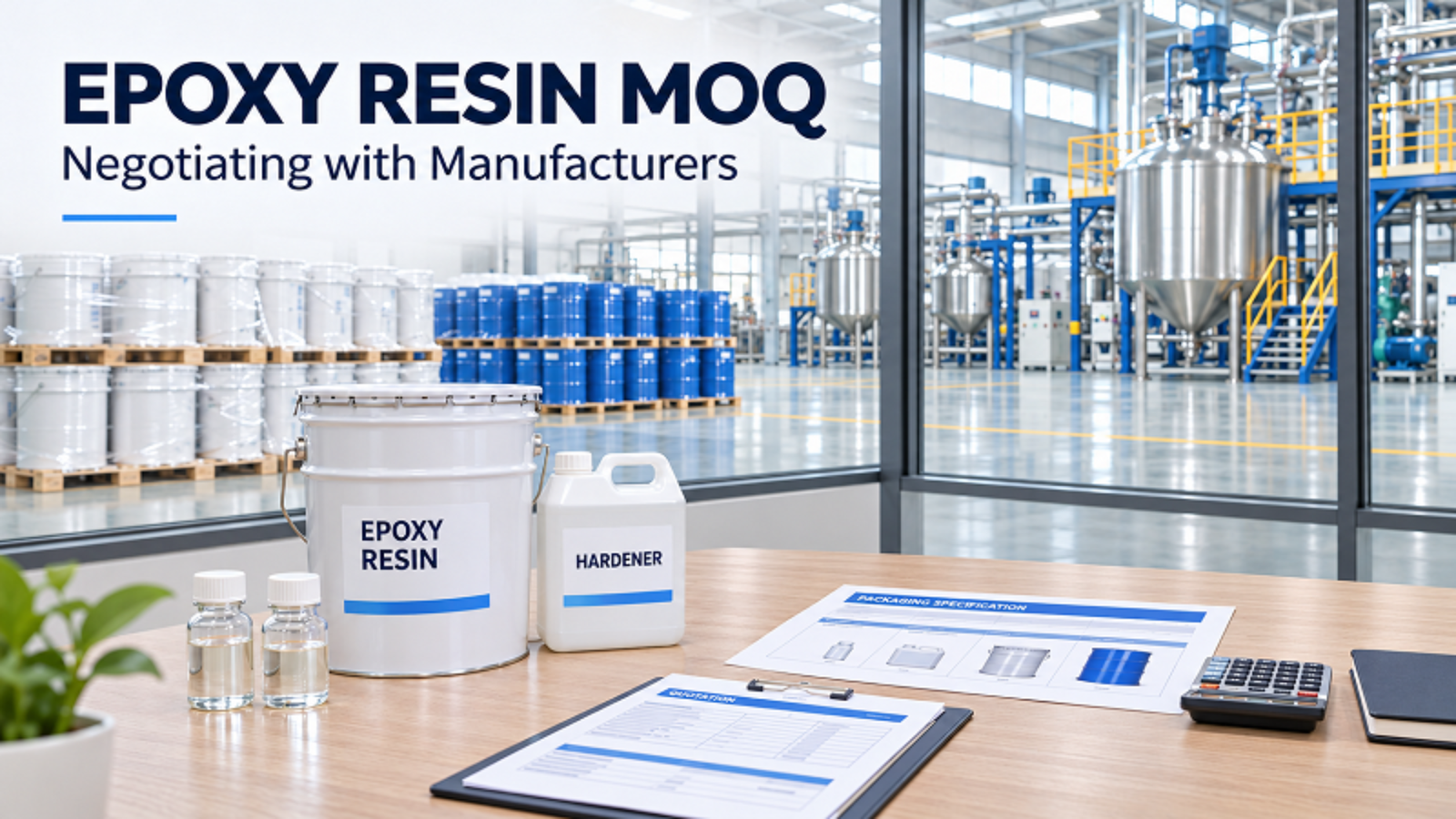
You found a supplier you like. The samples cured clear, the TDS checks out, the price per kilo works. Then the quote arrives with one line that changes the math: MOQ 2,000 kg.
For a new importer, that number feels like a wall. It isn’t. An epoxy resin MOQ is an opening position, not a law of physics — and it usually moves once you understand why it exists and what the factory wants in return. This guide covers both sides of the table, the way a working epoxy resin manufacturer actually thinks about batches, packaging and cash flow.
Why an Epoxy Resin Manufacturer Sets a Minimum Order
Factories don’t set minimums to be difficult. Three real costs sit behind the number.
Batch economics. Resin and hardener are made in reactors. Running a reactor for 200 kg costs almost the same in labor, cleaning and quality testing as running it for 2,000 kg. Small batches eat the margin.
Changeover. Switching from one formula to another means cleaning lines, swapping containers and retesting. Add custom packaging and the problem grows — printed cartons and labeled bottles are bought in their own minimums, often 3,000 to 5,000 pieces per design.
Raw material planning. Base resin, curing agents and additives are bought in bulk against forecasts. A one-off 100 kg order for a niche formula can leave leftover material with nowhere to go.
Once you see the MOQ as a cost recovery number, you can negotiate it. You’re not arguing with a policy — you’re solving a cost problem together.
What a Typical Epoxy Resin MOQ Looks Like
Minimums vary by factory, formula and packaging. These are industry-typical ranges for export orders — use them as a sanity check, not a promise.
| Order type | Typical MOQ | What drives it |
|---|---|---|
| Standard formula, factory packaging (drums or pails) | 500–1,000 kg | No changeover, ships from stock |
| Table top epoxy or deep pour epoxy, standard kits | About 1 pallet (~1,000 kg) | Kit assembly and packing labor |
| Private label on a standard formula | 1–2 pallets | Label and carton minimums |
| Custom packaging (printed boxes, branded bottles) | 2–3 pallets, or 3,000+ pieces | Packaging supplier minimums |
| Custom formulation (viscosity, cure speed, additives) | 1–5 tons per batch | Dedicated reactor run and testing |
| UV resin in small bottles | 2,000–5,000 bottles per SKU | Filling line setup, bottle sourcing |
Two things to notice. The biggest jumps come from customization, not volume. And the MOQ is usually per SKU or per formula, not per order — so ordering three products at 300 kg each is not the same as ordering 900 kg of one.
Know Which MOQ Is Actually Negotiable
Not every minimum moves. Sort yours into two buckets before you open the conversation.
Hard minimums come from outside the factory: a bottle supplier that won’t sell under 5,000 units, a printer with a fixed plate cost, a container that has to be filled to ship economically. You rarely beat these. Work around them instead.
Soft minimums are the factory’s own preference — “we usually do one ton” — based on convenience. These bend, especially for a buyer who offers something back.
Ask directly: “Is this MOQ set by your production line or by packaging materials?” A good epoxy resin manufacturer will answer honestly, and the answer tells you where to push.
Five Ways to Lower Your Epoxy Resin MOQ
Price alone is the weakest lever. Factories respond to certainty, so give them some.
Commit to annual volume, not a single order. Say you’ll buy 6 tons over twelve months in four shipments. The factory can plan raw material, produce in one larger batch and release stock as you need it. You get a lower first order; they get a forecast. This is the single most effective move.
Consolidate across products. If you want table top epoxy, deep pour epoxy and UV resin, put them in one purchase order. Many factories count total order value, not per-SKU weight, and shared base resins make small quantities cheaper to produce.
Give up what costs them the most. Standard packaging instead of printed boxes. A stock formula instead of a custom one for the first run. A 45-day lead time instead of 20. Each concession removes a cost that was driving the MOQ.
Offer cash terms. A higher deposit, or payment before shipment on a smaller order, reduces the factory’s risk on a buyer they don’t know. Cash is leverage when you can’t offer volume.
Pay a small-batch premium — openly. If the standard MOQ is 1,000 kg and you need 500 kg, offer 5–15% more per kilo for the smaller run. It’s an honest trade. Factories respect it far more than a demand for the full-volume price at half the quantity.
What to Say When You Negotiate
Short, specific, and built around their problem. A message like this works far better than “Can you lower the MOQ?”:
“We’re a new importer planning to sell your table top epoxy in the U.S. We can commit to 3 tons over six months, shipped in three lots of 1 ton. For the first lot we’d accept standard packaging. Can you produce in one batch and hold the price for all three shipments?”
Notice what it does. It names a real volume. It shows a path to repeat business. It offers a concession on packaging. And it asks for one clear thing in return.
A weak version looks like this: “Your MOQ is too high. Can you do 100 kg for the same price?” That tells the factory you have no volume, no plan and no flexibility — a poor starting point for any epoxy resin MOQ discussion.
Mistakes That Raise the MOQ Instead of Lowering It
Asking for a low MOQ before sharing your plan. Factories quote the safest number when they know nothing about you. Tell them your market, your channel and your growth expectation first.
Comparing against a trading company’s MOQ. A trader may offer 100 kg because they repack someone else’s stock. That’s convenient, but you lose control over batch consistency and traceability. If you’re unsure which side of the line a supplier is on, our guide on manufacturers versus trading companies covers how to tell.
Negotiating only the price. A 3% discount rarely matters to a factory. Delivery schedule, payment terms and order stability do.
Ordering a custom formulation too early. Custom work carries the highest minimums. Start with a stock formula, prove demand, then customize.
Ignoring total landed cost. A smaller MOQ with a higher freight cost per kilo, or an LCL shipment with extra handling fees, can cost more than a full pallet. Run the numbers before you celebrate the lower minimum.
How to Structure Your First Order
A sensible path avoids both overcommitting and getting stuck at a tiny quantity.
Begin with samples and a TDS review so specs are agreed in writing. Move to a pilot order — often 40–60% of the standard MOQ, at a modest premium — to test the product in your own market. Then agree a written schedule for the full MOQ, with pricing locked for the period.
Ask for a COA with each batch from the start. It sets the habit of documented quality and gives you something to point to if a lot ever varies.
Put the agreed MOQ, price validity, shipment schedule and any penalties in the contract. A verbal “we’ll be flexible next time” is worth nothing when the reorder arrives.
Start the Conversation With the Right Information
The best negotiations begin with a clear brief: the products you need, your expected annual volume, your target market and your packaging preferences. With that, a manufacturer can quote the lowest workable epoxy resin MOQ instead of the default one.
At Jinhua Resin, we’re an epoxy resin manufacturer in Guangdong producing table top epoxy, deep pour epoxy and UV resin, with OEM and private label options for overseas buyers. Send us your SKU list and a rough annual volume, and we’ll come back with a quote and a minimum that fits your launch plan — not a number designed to scare you off.