


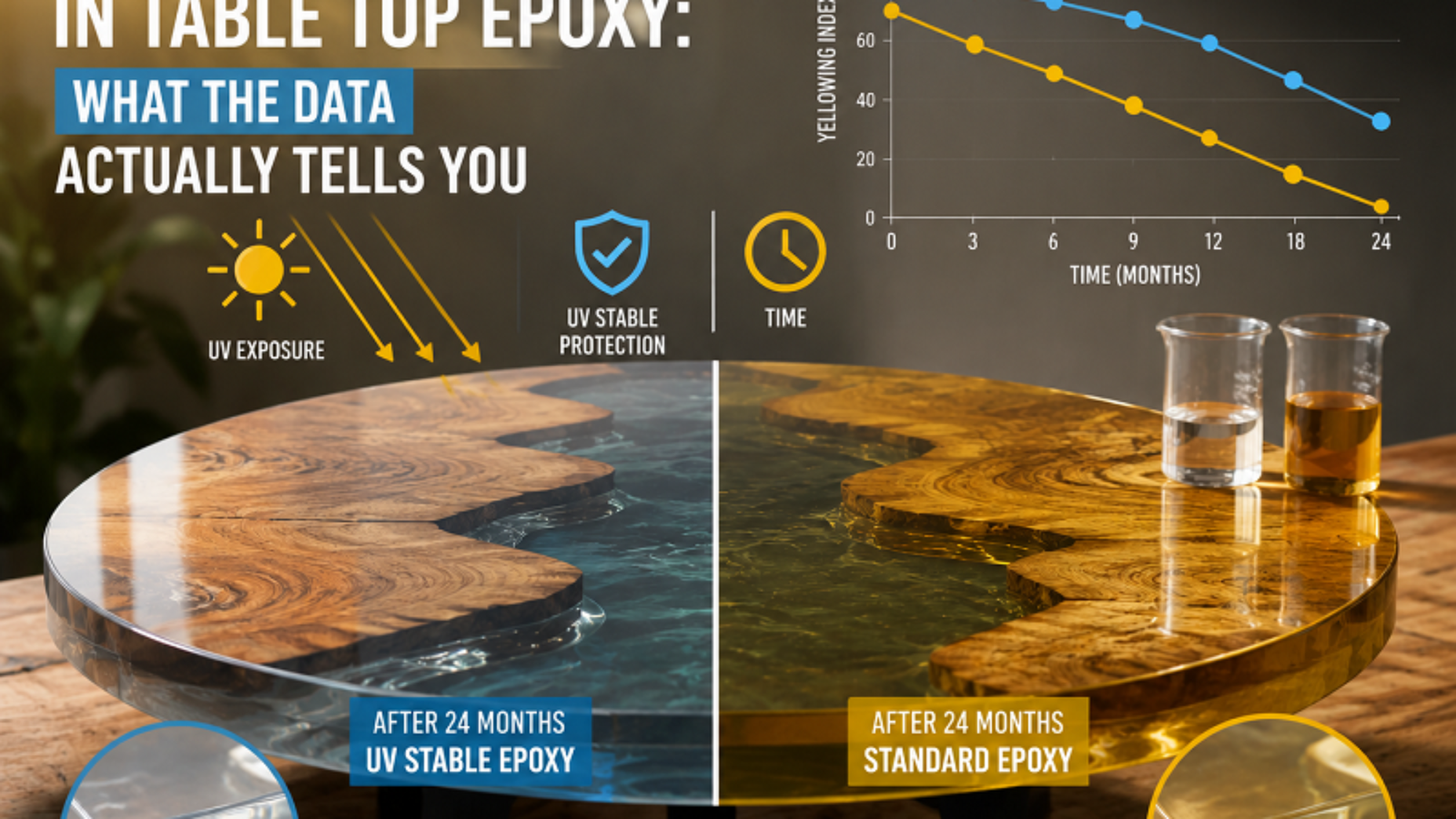
Somewhere in a furniture workshop right now, someone is sanding back a countertop that went amber six months after installation. The resin was marketed as UV-resistant. The application was textbook. The problem was never the process — it was a spec sheet nobody read closely enough.
For bulk buyers of table top epoxy, yellowing failures are expensive in ways that compound: rework labor, client disputes, replacement material, and the harder-to-quantify cost of a buyer who doesn’t come back. The frustrating part is that this outcome is almost entirely preventable — if you know which numbers to ask for and what they actually mean.
Here’s a practical breakdown of how UV performance data works, and how to use it to separate credible suppliers from ones riding on vague claims.
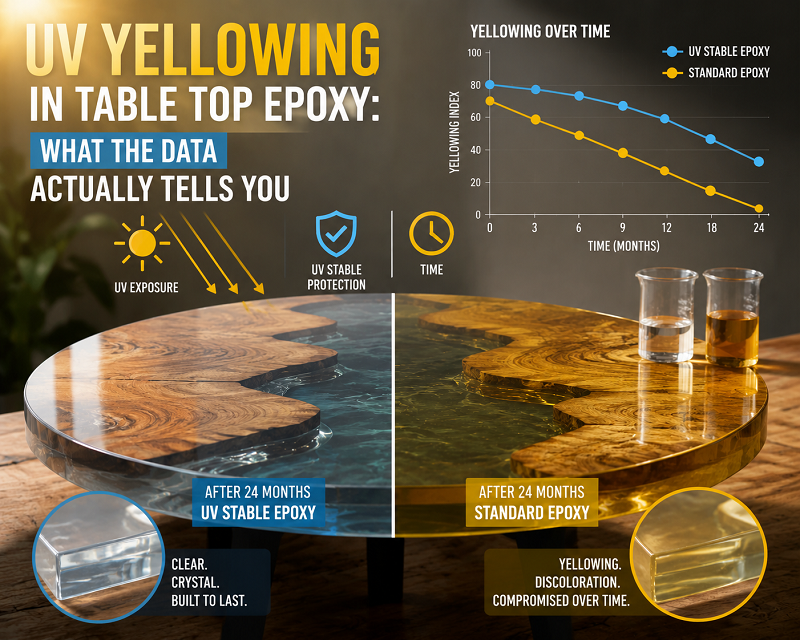
What Drives Yellowing in the First Place
Epoxy doesn’t yellow randomly. The mechanism is consistent and well-understood.
Ultraviolet light — whether from sunlight through glass, LED retail lighting, or direct outdoor exposure — targets specific bonds within the cured resin. In aromatic epoxy systems, those bonds sit in the molecular backbone itself, making them structurally vulnerable. When they break down, the resulting molecular fragments (chromophores) change how the surface reflects light — shifting it from clear toward yellow, then amber over time.
Two variables control the rate: the base chemistry of the resin itself, and the UV stabilizer system the manufacturer has built into the formula. A third variable is simply how much UV the finished piece encounters in its actual environment.
For commercial applications — restaurant counters, bar tops, retail displays, hotel furniture — that UV exposure is continuous and cumulative. A table top epoxy finish that looks flawless at installation and starts going warm-toned within a year creates real business problems: warranty claims, damaged relationships with end clients, and rework costs that weren’t in anyone’s margin calculation.
The Four Figures That Matter
UV performance data can look intimidating, but most of it collapses into four concrete metrics. Here’s what each one tells you:
ΔYI: The Primary Filter
Yellowness Index (YI) quantifies how far a transparent material has drifted from colorless — measured via spectrophotometer. The figure you want from any supplier is ΔYI: the shift in yellowness between a freshly cured sample and that same sample after standardized UV exposure. Lower numbers mean better performance.
A practical reference frame:
| ΔYI After UV Testing | Field Implication |
|---|---|
| Below 2 | Excellent — appropriate for high-end hospitality and premium furniture |
| 2–5 | Solid — viable for the majority of commercial indoor use cases |
| 5–10 | Marginal — color drift likely in well-lit environments over 2–3 years |
| Above 10 | Inadequate — visible yellowing expected within 12–18 months |
Any supplier who describes their table top epoxy as “low-yellowing” without attaching a ΔYI figure is offering an opinion, not a specification. The two aren’t the same thing.
Test Duration and Protocol: The Context Layer
Two products can both show ΔYI = 2 on paper. If one reached that result after 100 hours of testing and the other after 500, they’re not comparable — they’re telling completely different stories about long-term performance.
The standards most commonly cited for table top epoxy UV aging:
- ASTM G154 — Fluorescent UV lamp testing (UVA-340 or UVB-313). The global benchmark for industrial coatings.
- ASTM G155 — Xenon arc testing, which replicates the full solar spectrum more faithfully than fluorescent lamps.
- ISO 4892-3 — The international counterpart to ASTM G154, prevalent among manufacturers in Asia and Europe.
A defensible minimum for professional-grade table top epoxy: ΔYI ≤ 3 at 500 hours, ASTM G154 (UVA-340). Suppliers who can only produce 200-hour results — or who can’t share the test methodology at all — are communicating something about their product whether they intend to or not.
Gloss Retention: The Overlooked Half
UV degradation doesn’t limit itself to color. Surface gloss erodes under the same conditions, and a coating that holds its color while losing its sheen still ends up looking like a failure to the client.
Gloss retention is measured with a gloss meter at 60°, comparing pre- and post-aging readings. For high-gloss table top epoxy products, the working threshold is 85% retention or better after 500 hours. Always request this number alongside ΔYI — color and gloss together give you a complete picture of how a finish will age in the field.
Haze: Clarity Beyond Color
Haze is distinct from yellowing. It describes the scattering of light within the cured film — visible as cloudiness or a slightly milky quality that undermines the optical depth that makes quality table top epoxy worth specifying in the first place.
Reported as a percentage, haze in a well-manufactured product should open below 1% and increase by no more than 2–3 percentage points following UV aging. A supplier who leads with ΔYI data and omits haze figures is giving you part of the story.
Base Chemistry: Why It Sets the Performance Ceiling
Before any stabilizer additive can do its job, the resin’s base chemistry establishes the upper limit of what’s possible.
Aromatic resins — bisphenol A systems being the most common — have aromatic ring structures in their backbone that are inherently susceptible to UV attack. These rings are precisely what photodegradation targets. Many mid-market table top epoxy products are built on aromatic bases because the feedstocks cost less. Stabilizers extend the service life, but they’re working against the underlying molecular structure the entire time.
Aliphatic resins, and aliphatic-polyurethane hybrid systems, are built without those vulnerable rings. Their UV resistance is structural, not additive. Products intended for demanding end markets — hospitality interiors, export furniture, architectural applications — are typically based on aliphatic or partially aliphatic chemistries.
It’s worth asking any supplier directly: aromatic or aliphatic base resin? That answer defines the performance ceiling for the product regardless of what stabilizer loading it carries.
Inside the Stabilizer Package
Assuming an aliphatic base, the stabilizer system is what separates good UV performance from excellent.
HALS — Hindered Amine Light Stabilizers interrupt the free radical chain reactions that UV initiates in the polymer. They don’t prevent UV absorption; they neutralize the damage downstream. Effective, durable, and standard in any serious UV-resistant formulation.
UV Absorbers — primarily benzotriazoles and triazines — operate upstream: they capture UV energy before it can initiate degradation, converting it harmlessly to heat. The most durable table top epoxy products layer both mechanisms. HALS handles what gets through; UV absorbers reduce what gets in. Used together, the two systems consistently outperform either in isolation.
“UV stabilizers added” is a starting point, not an answer. A supplier who can name the stabilizer classes, describe how they’re combined, and show loading-level data is giving you something you can evaluate. One who hands you a brochure is not.
Five Steps for Vetting UV Claims Before You Commit
Request the full third-party report — not the data sheet summary Product data sheets distill test results into the most favorable headline. The actual third-party aging report — with lab identification, sample preparation protocol, exposure parameters, and complete numerical output — is what tells you whether those headlines are earned. Reluctance to share it is informative.
Confirm the exposure hours Below 300 hours is insufficient for a serious procurement decision. Five hundred hours is the practical floor. Suppliers with 1,000-hour datasets have done the validation work and generally aren’t reluctant to share it.
Compare ΔYI under identical conditions ΔYI figures are only comparable when measured against the same standard and the same exposure duration. Collect results from multiple suppliers on the same basis, then compare directly. ΔYI = 1.8 at 500 hours outperforms ΔYI = 4.5 at 500 hours, regardless of how either supplier’s marketing copy frames it.
Ask for a physically aged sample A cured panel that has completed UV chamber aging — or a field-aged sample from an actual installation — provides information that no spreadsheet fully captures. Side by side, the visual gap between ΔYI = 2 and ΔYI = 5 is immediately apparent.
Align the test method with your destination market Fluorescent UV testing (ASTM G154) is a solid baseline. For products heading to high-solar-exposure environments — coastal hospitality, sun-belt retail spaces, high-window showrooms — xenon arc data (ASTM G155) is more predictive of real-world performance. If your market exposure warrants it, ask for it by name.
Putting It Into Practice
For manufacturers competing on finish quality and longevity, UV performance data belongs in the procurement qualification process, not in the afterthought section of a supplier review. A table top epoxy supplier who comes to the conversation with verified ΔYI figures, gloss retention data, transparent chemistry disclosure, and third-party test reports is one you can build reliable production quality around.
One that responds to technical questions with generalities is telling you something about the product even when they don’t mean to.
The next time a supplier leads with “UV-resistant” or “crystal clear” on their table top epoxy, redirect to one question: what’s the ΔYI at 500 hours under ASTM G154? The answer — or the absence of one — will tell you more than the rest of the pitch combined.
At Jinhua Resin, UV test reports to ASTM G154 and ISO 4892-3 are included with every product inquiry as standard. If you’d like to put our numbers alongside your current supplier’s for a direct comparison, reach out here — we’ll include the full technical package and a sample set.
Jinhua Resin | Professional Epoxy Resin Manufacturer | Table Top Epoxy & Deep Pour Epoxy | OEM & Bulk Supply Available