
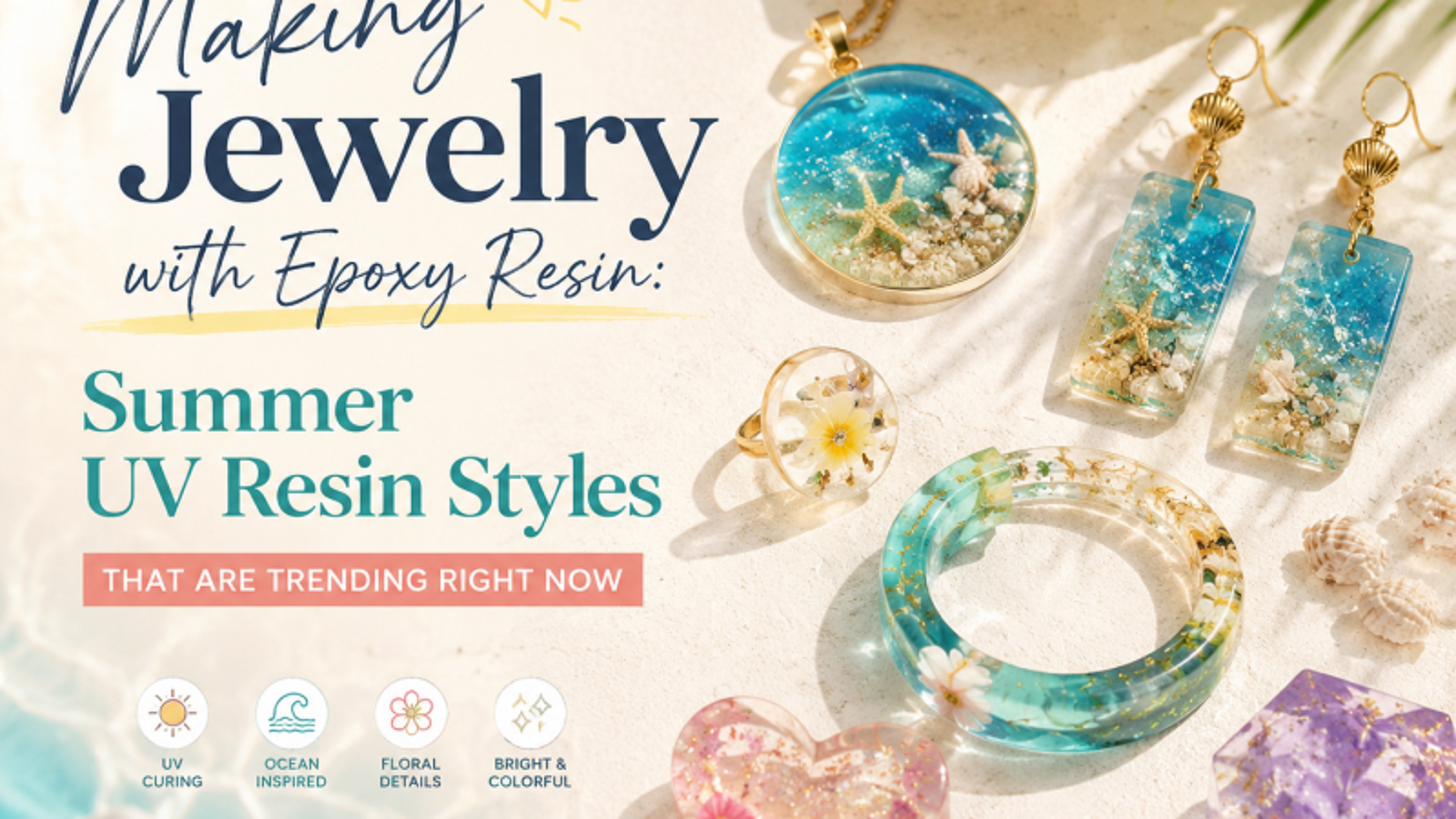
Summer is when UV resin jewelry-making really comes into its own. The bright light, the beachy color palettes, the long afternoons that are perfect for a craft project on the porch — all of it lines up with what UV resin does best: fast, satisfying projects that go from liquid to finished piece in minutes under a UV lamp, rather than waiting a full day for a slow cure.
If you’ve got a UV lamp, some pigments, and an afternoon to spare, here are the styles that are showing up everywhere in summer 2025 — and how to get started with each one.
1. Ocean Wave Pendants
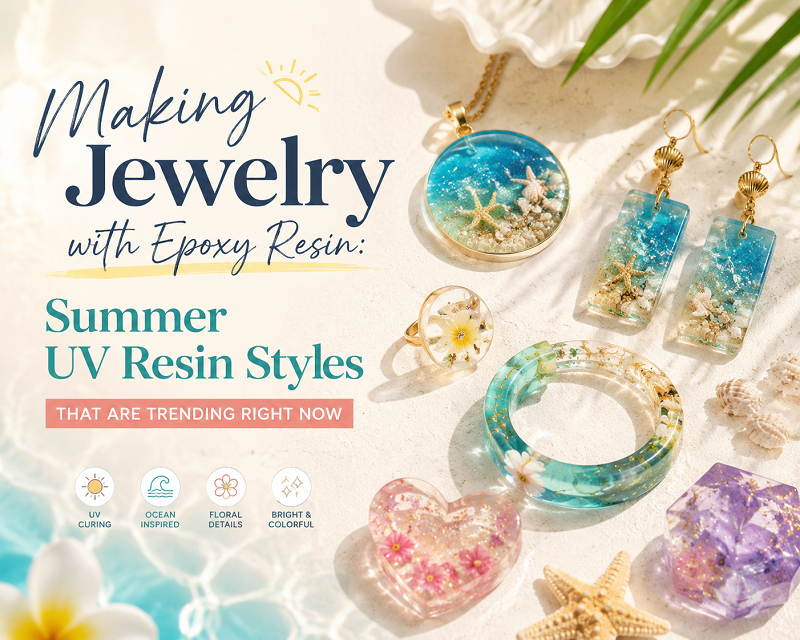
The ocean wave look has been a UV resin staple for years, and it’s not going anywhere — but the 2025 take on it leans toward softer, more realistic color gradients rather than the bright, saturated blues that were popular a few seasons ago.
To get this effect: start with a clear UV resin base in your pendant mold or bezel. Add small amounts of white pigment in swirling motions to create foam-like texture, then layer in soft blue and seafoam green tones, blending at the edges rather than creating hard color lines. Cure each layer briefly under your UV lamp before adding the next — this lets you build depth without the colors muddying together.
A trick that’s gaining popularity: adding a tiny pinch of fine glitter or mica powder along the “foam” lines mimics the way sunlight catches sea spray. Keep it subtle — a little goes a long way with UV resin, since the light-curing process can make glitter clump if you add too much at once.
2. Pressed Flower Jewelry
Pressed flowers in resin aren’t new, but they’re having a real moment this summer, particularly with smaller, more delicate florals — baby’s breath, small daisies, pansies, and ferns — rather than large statement blooms.
The process is simple but benefits from patience. Press your flowers flat for at least a week before using them (a heavy book works fine if you don’t have a flower press). Place the pressed flower into your mold, pour a thin layer of clear UV resin to seat it in place, cure briefly, then pour the remaining resin to fully encapsulate the flower. Curing in thin layers prevents the flower from shifting or floating as the resin moves.
For pendants and earrings, small botanicals work better than large ones — they fit naturally within smaller mold sizes and don’t require deep pours, which keeps cure times short and consistent with UV resin’s quick-turnaround appeal.
3. Geode-Inspired Pieces
Geode jewelry — pieces that mimic the look of a cut crystal geode, with layered colors radiating from a “crystal” center — has moved from a niche technique to one of the most searched-for UV resin styles this year.
The look is built in layers: a base layer of deep, saturated color (purples, blues, and teals are especially popular for summer pieces) around the edges, transitioning to lighter tones toward the center, with small pieces of glass chips, crushed glass, or resin “crystals” clustered in the middle to mimic a crystal formation. Each color layer is cured separately under the UV lamp before the next is added, which is part of why UV resin — rather than slow-curing epoxy — is the preferred material for this technique. A multi-layer geode piece that might take all day with slow-cure epoxy can be completed in under an hour with UV resin.
4. Terrazzo-Style Earrings and Studs
The terrazzo look — small flecks of color suspended in a neutral or white base, mimicking the speckled stone flooring style — has carried over from home decor trends into jewelry, and it’s a particularly good fit for UV resin because of how quickly small, flat pieces like earrings and studs cure.
To create this effect: mix small amounts of colored resin (or use resin tinted with different pigments) and let them partially cure to a soft, rubbery state — not fully hard. Chop or break these partially-cured pieces into small, irregular flecks. Mix these flecks into a base layer of white or clear resin, pour into your mold, and cure under the UV lamp. The result is the classic terrazzo speckle pattern, and because both the flecks and the final pour use UV resin, the whole process — from mixing the fleck colors to the finished piece — can be done in a single afternoon.
5. Color-Shift and Iridescent Pieces
Pieces that shift in color depending on the angle and lighting — using color-shift mica powders or iridescent pigments — are one of the more eye-catching trends for summer 2025, and they photograph particularly well, which is part of why they’re popular for anyone making pieces to sell or share on social media.
These pigments work best in UV resin with a clear or very lightly tinted base, since the color-shift effect depends on light passing through and reflecting off the pigment particles — a heavily pigmented or opaque base will mute the effect. Mix the color-shift pigment into clear resin at a relatively low concentration (more isn’t always better here — over-pigmenting can make the shift effect look muddy rather than vibrant), pour into your mold, and cure. For pendants and statement pieces, a slightly thicker pour shows off the color-shift effect more dramatically than a very thin layer.
Tips for Working with UV Resin in Summer
A few practical notes for anyone getting started, especially if you’re working in a warm environment:
Heat affects pot life less than with two-part epoxy — UV resin doesn’t cure until exposed to UV light, so warm summer temperatures don’t speed up curing the way they would with a mixed two-part epoxy. That said, very warm resin can be slightly more fluid, which can help with self-leveling in flat pieces like pendants, but may also make fine details (like positioning small flecks or glitter) trickier to control.
Cure time depends on your lamp and layer thickness — thin layers (a few millimeters) typically cure in 60–120 seconds under a standard UV lamp, while thicker pours need longer exposure and may benefit from curing in stages rather than all at once.
Work in a well-ventilated space — even though UV resin cures quickly, ventilation during mixing and before curing is still good practice, same as with any resin product.
UV-resistant resin matters for color longevity — for pieces that will be worn outdoors or displayed near windows, a UV resin formulated with good anti-yellowing performance keeps colors looking fresh longer, especially for the lighter pastel tones popular in ocean and geode styles.
Final Thoughts
What makes UV resin particularly well-suited to summer jewelry-making is the pace — these are projects you can start, layer, and finish in an afternoon, which fits the rhythm of summer crafting much better than projects that need a full day (or several) to cure. Whether you’re drawn to ocean waves, pressed botanicals, geode layers, terrazzo speckles, or color-shift pieces, the techniques above all lean on the same core advantage: quick, controllable curing that lets you build up detail without long waiting periods between steps.
If you’re just getting started, a small UV lamp, a few silicone molds, and a clear UV resin with good clarity and color stability will cover most of the styles above — and from there, it’s mostly a matter of experimenting with pigments and layering techniques to find your own style.
Jinhua Resin | Professional Epoxy Resin Manufacturer | UV Resin & Art Resin | OEM & Bulk Supply Available